A few months ago, I made plans to attend TwitchCon 2022 in San Diego, a convention run by the company behind the streaming platform Twitch.
I had last been there in 2017 when Tempo was still heavily involved in esports and video gaming content creation. I wanted us to have a strong presence at the convention due to Twitch’s relevance to our industry, so we set up a booth, held a panel, and even ran a small tournament on a pair of classic arcade machines. Since then, there wasn’t really a good business purpose to attend TwitchCon (and it was shut down for a few years because of the COVID-19 pandemic), so I hadn’t returned in subsequent years.
The reason I was going to attend this year was to accompany my friend Doug Wreden. By now, I’m sure at least some of you are aware of the various fun things I’ve been doing with Doug during my time in the Seattle Metropolitan Area, most recently eating an 18-pound salmon with him live on stream as a stretch goal for a recent charity event.
Doug ended up canceling. He had residual exhaustion from attending PAX West, he had a lot of work stuff going on, and he is still not fully recovered from his health issues (which you can learn more about if you look at some of his old YouTube videos where he talks about his condition).
This was perfectly fine to me. I recognize that people’s plans can change, and as long as they communicate that to me, I’m always extremely flexible. In fact, I am the type of person who, if you have plans with me but message me half an hour before meeting up telling me that you want to cancel because you just don’t feel like going, I will still be perfectly fine with that—as long as there is transparency, honesty, and overall respect for my time in the long-run. … More on that later.
Doug let me know weeks in advance that he’s reconsidering TwitchCon. Although my original plan to attend was based solely on going with Doug, I decided that I would still attend whether or not Doug was going, mostly because I had a stop in Las Vegas threaded in on the way to San Diego, but also because I don’t really like changing travel plans.
I should have canceled too.
TwitchCon reminded me, again, just how much I hate the communities within the esports, video gaming, and live streaming scenes. I “suffered” through this several years ago when my primary duties at Tempo were esports and content creation. It was a very valuable learning experience and I am very grateful that I got to participate in it, but it’s not something that I ever want to do again.
I honestly don’t know how these people are going to survive in the real world without just all becoming “Karens.” It is astonishing to me how large a percentage of Twitch community members act as if the world revolves around them. I’m not sure what went wrong that caused these people to think that they deserve to be treated exactly how they want, while completely disregarding the wishes of others. There is no irony more ironic than how sensitive these people can be, yet be oblivious and ignorant to how arrogant, entitled, and passive-aggressive they look to everyone else outside their “safe space” bubble.
I know I’m not the only one who feels this way, because most of my meetings during TwitchCon were outside the convention center with people who didn’t bother purchasing an admission ticket. I think people realize by now that the convention could potentially be a good networking opportunity, but they don’t want to deal with the clown fiesta that is TwitchCon itself. I arrived in San Diego on Thursday, attended all my meetings and appointments, and stayed off-site until Saturday afternoon.
On Saturday, I promised someone I would meet them in Room 26 of the convention center at 2 PM. I left my hotel with ample time to walk to the convention center, pick up my credentials, and make my way to the second floor.
I received an email from Twitch prior to the convention informing me that I am required to get a vaccine validation wristband prior to entering anything hosted by Twitch. The email indicated that this validation process would take place at Bayfront Park.
Because my hotel was in central Core-Columbia, I approached towards the San Diego Convention Center at its western entrance. Bayfront Park was in the southeast near the Hilton San Diego Bayfront, so I walked all the way across the length of the convention center to get there. Once I arrived, there was nobody there and there were no signs anywhere instructing me where to go. I messaged someone I knew had already made it into the convention center, and I was advised to go to Entrance A instead. That’s where I just was before walking across the entire length of the building.
I walked from where I was near Entrance H and retraced my steps all the way over to Entrance A, finding a random Twitch employee who was able to give me a black wristband for vaccine validation along the way (very much not where Twitch told me where they would be). After getting my wristband, I went into the convention center through Entrance A and walked through the security checkpoint.
I proceeded to set off the metal detector, but the security officer didn’t tell me to empty my pockets or take off my belt or boots or anything… just to walk through it again. Needless to say, I set it off again. The security officer looked extremely confused at the metal detector, as if she had been on her way to McDonald’s but randomly stumbled upon TwitchCon and was asked to be a security officer for the first time ever, and suddenly realized that this metal detector wasn’t a Big Mac®. After I walked in circles three times (setting off the metal detector each time), she just waved me past.
Prior to being let further into the building, I was told that there was a mask mandate enforced by Twitch and that I would be required to remain masked while inside the Convention Center. I did not have a mask with me because I use masks for scientific purposes and not for political ones, so they gave me an oversized surgical mask with a non-functional nose bridge pinch. I promptly quite literally became unable to see, as my warm breath from having already walked a few miles was now going straight up the mask and onto my glasses, fogging them to impenetrable opacity.
Now blind, I stumbled my way to the badge pickup counter to scan my QR code (which miraculously worked as intended), retrieved my admission badge, and started heading deeper into the convention center. There were no signs anywhere and I was sort of lost in the middle of an open area, so I went to a group of security guards and asked them if they could point me towards the direction of Room 26. They discussed amongst themselves for several seconds, and then one of the security guards told me to follow her. She led me through a door that said “Authorized Personnel Only.”
On the other side of the door, she told me to take the escalator all the way up to the second floor, and that would be where Room 26 would be. I thanked her and went all the way up, but ended up in an abandoned corner of the convention center that was clearly a restricted area. A janitor saw me and stared at me as if I was missing a head. I meandered around, still half-blind from my fogged-up glasses, until I found a door leading to the courtyard area. As the door shut and locked behind me, I looked back and saw an “Employees Only” sign on the door.
There were a lot more convention-goers around me now, so I was definitely getting closer, but I was still pretty lost, and I couldn’t find any maps anywhere. I kept roaming around and asking random Twitch staff members if they could give me instructions on how to finish getting to Room 26, but literally everyone I asked said they didn’t know and advised me to ask someone else. I would go to the “someone else” they recommended, and that someone else wouldn’t know either.
With the power of the process of elimination on my side, I narrowed down where this enigmatic meeting room could possibly be to a single section of the convention center—the only section that I hadn’t walked through yet. I saw a sign that led me from Room 31 to Room 28, so I followed that sign, naturally assuming that Room 26 would be further down from Room 28.
I made my way to Room 28 and discovered that the path forward had been arbitrarily blocked off by security. One of the security guards looked like he wanted to let me through anyway, but the other security guard on duty stopped that from happening. He explained that the meeting rooms were laid out in a circle, and I would have to walk all the way around to the other side of the circle to get to Room 26.
I was 34 minutes late for my meeting.
Remember how I said earlier that I am extremely understanding when it comes to rescheduling plans, as long as the other person is frank and communicative about it? Well, the other side of that is, if I don’t receive appropriate communication, I will become extremely irritated.
One of the things that Doug was looking forward to at TwitchCon was meeting up with other Twitch streamers, and not being able to do so anymore was the thing he was most disappointed about when canceling his TwitchCon trip. Because of this, I decided to offer to treat a few of his friends to dinner instead, in his place. They accepted, so I blocked Saturday evening off my calendar for them.
This was on the same day as the clown fiesta above of trying to pick up my credentials and attend the meeting in Room 26. As if this day wasn’t already ridiculous enough, Doug’s friends ended up never picking a specific time or location to meet up, even after I had checked in multiple times. They also didn’t get back to me to retroactively decline my offer either—just complete radio silence. We ended up not going to dinner together, and they needlessly took up a slot in my schedule that I could’ve given to someone else.
If you ever want to speedrun getting blacklisted from ever doing anything with me ever again, that is how to do it.
With all this being said, the trip wasn’t a complete catastrophic failure.
Apart from the two mentioned above, all my other meetings and lunch/dinner appointments went smoothly and productively.
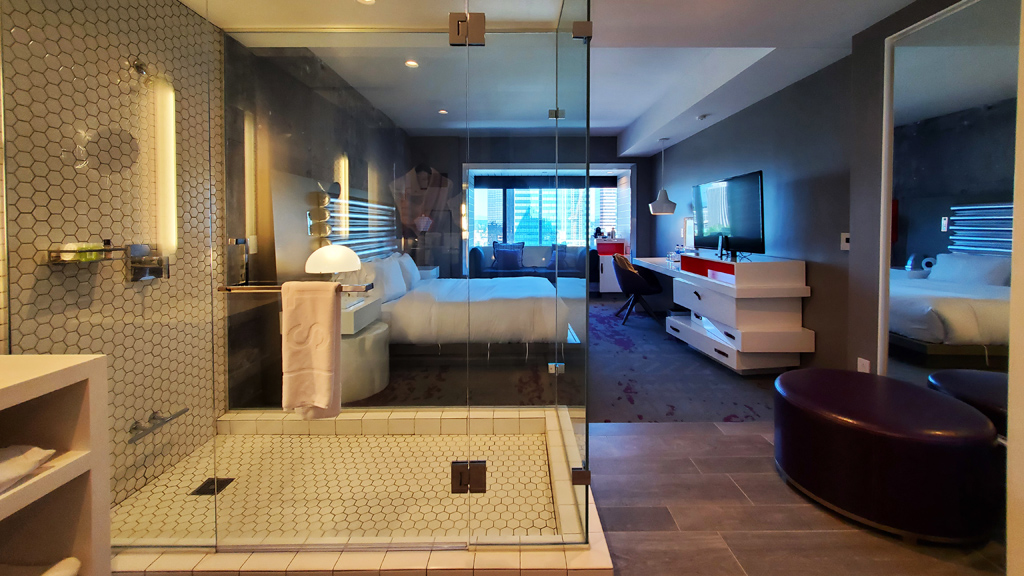
The hotel I stayed at—the US Grant—was very nice. I prefer newer hotels with more modern styling, and the US Grant was a bit more on the classic side, but it was still very pleasant. The staff was great, the breakfast was good (it was also very expensive, but I had daily breakfast credits from my elite status, so the price didn’t matter to me), the rooms were stylish, and the location was pretty convenient.
I also met up with some of Tempo’s former employees, and it was nice catching up. I had some nice conversations with their new co-workers from their new companies, we went to get some good food (I ate the best calamari dish I’ve ever had, at a restaurant that they picked), and I watched in confusion as they played Magic: The Gathering and I had no idea what was going on.
I was considering doing some tourist activities in San Diego while I was there, because there is a dense concentration of a lot of interesting things in Balboa Park, but I heard that a lot of convention-goers were also going to a lot of the tourist hotspots, so I decided to save it for another visit.
San Diego seems to be one of the less miserable big cities in California, so I’m not completely opposed to going back to visit again, if the proper opportunity arises. However, if I could go back in time and rewrite this past weekend… I would’ve definitely skipped this TwitchCon trip.