Hello, Schack Art Center in Everett, Washington

While in Everett, and before heading back to the central Seattle Metropolitan Area, I decided to do one more tourist activity up north, and selected the Schack Art Center.

Admission to the art exhibits was free, and it seemed like they made most of their money off classes that they offer. Unfortunately, there were none a­vail­a­ble at the time that I visited, though I was still able to peek in and look at glassblowing equipment.

Afterwards, I snapped some photos of my favorite art pieces.


—§—


Hello, Jetty Island in Everett, Washington

Since starting my road trip and living out of hotel rooms, I generally roam around to wherever has the most affordable hotel rates. This methodology recently brought me to Everett, Washington, a city inside Snohomish County on the northern end of the Seattle Metropolitan Area.

For one of my tourist activities, I decided to explore Jetty Island, an island about a thousand feet (a little over 300 meters) off the coast of Everett. Jetty Island is a popular tourist area, and it recently opened up for tourism via the passenger ferry.

After parking my truck at the lot, paying a few dollars for the ferry ride, and making it onto the island, I started my hike by heading north.

There was a short trail that had been cleared, but in general, hiking was fairly difficult because I was part of some of the first batches of tourists arriving on the island for the season. I ended up being one of the trailblazers flattening wild grasses under my feet to form a path, or climbing up fallen tree trunks in areas where the grasses were too tall.

Continuing off the path and into deeper vegetation led me to a swampy area.

Eventually, it became a bit unmanageably muddy and difficult to proceed, so I retraced my steps for a little bit, then started heading towards the beach.

On the beach, I saw some sea foam that was a lot more colorful than I’m used to seeing—it was a rich tan color, as opposed to off-white like I’ve seen before.

The shoreline also had a lot of random tree stumps.

As expected, there were also plenty of shells. This one had an ornate, purple, stone-like substance on the outside.

I eventually made it to the northern tip of the island, where I saw a flock of seagulls perched on some rocks.

After looping around and continuing on the east shoreline, I saw more seagulls, and even a few seals.

There was a row of rocks surrounded by upright logs; I’m not sure if this was intended to be a path at some point, but the rocks seemed far too slippery to be reliably safe, so I continued trailblazing through the grassy area.

I have pretty bad eyesight, so I didn’t realize this at the time, but when I was browsing through the photos I took, I noticed something in the corner. Upon zooming all the way in, I discovered a colony of seals poking their heads out of the water.

Jetty Island is known for being home to a lot of bird species, so I saw a lot of loose feathers lying around. I came across one that was sticking upright out of the sand, which I found intriguing, so I reached down and picked it up… then proceeded to immediately regret doing so. I stabbed it back into the sand and took a picture of it, pretending like it had never left the ground…

After making a figure 8 and making a long trip down the west coastline, I walked past the more popular beach area, then came across a flock of geese taking a dip in Possession Sound.

Even further south, I noticed a wrecked and abandoned ship.

Eventually, I made it all the way to the southern tip of the island. If I was a risk-taker, I could’ve continued further south on the tree trunks and rocks, but after slipping and falling on rocks at Sacred Cove Beach in Rancho Palos Verdes, California earlier this year that left me with a painful bruise that lasted months, I decided that just taking a picture would suffice.

This southern tip also had a lot more algae than other areas of the island. I found it very intriguing that algae in moderate volumes would make it look goopy.

Overall, my adventure across the island was a little over four and a half miles (7.39 kilometers) and took over 2 hours due to taking many stops from photos and navigating carefully through the wilder areas. If you like exploring nature, this is a great trip that you can knock out in one day.

If you just want a day to relax, there is a nice beach not too far away from the ferry unloading zone where you can enjoy the sand and water. If you’re a bird­watching enthusiast, it is definitely worth heading to the northern part of the island, bringing a lawn chair or something to camp out, and watching all the interesting species on the island.


—§—


I spent a week surrounded by two dogs and a cat

Almost a year ago, I blogged about meeting Erin Krell’s pets for the first time—Bullet and Kaya the Alaskan Klee Kais, and Drake the domestic longhair. I’ve obviously visited them many times since then, but recently for a week, I petsit them while Erin went on vacation with her husband.

This was the first time I had lived with animals ever since moving out from my previous living situation with a roommate who had three cats. It can ob­vi­ously get pretty distracting, but it was nice having them around, and usually, it was a healthy type of distraction—they would prompt me to get off my computer for a bit and move around with them.

The day before I took over petsitting for a week, Erin, her husband, and I went to pick up some burgers and a fish sandwich from a restaurant and brought the dogs along. Here are Bullet and Kaya patiently awaiting their parents’ return.

The dogs enjoyed spending time outside, which was useful for me to go out and get some fresh air. We went on walks every day except for one day when it rained all day, and I took them out to the backyard an additional four times per day so they could go to the bathroom.

One convenient part about their house was that the exercise room had a direct view of the backyard, so the dogs were able to sunbathe, while I would be indoors lifting weights and keeping an eye on them to make sure they weren’t doing anything too wild.

Drake, as you’d expect from a fairly normal cat, was very independent. He would roam around the house at his leisure, then make his way downstairs when his internal clock told him it’s time for his next meal. After eating, he would make his way back upstairs to a comfortable spot and clean himself up.

Here is Bullet staring deep into my soul and trying to figure out why I won’t give him another treat, even though it’s already been AN ENTIRE 12 MI­NUTES since his last treat.

Kaya had a little bit of separation anxiety, laid by the front door a lot, and slept in Erin and her husband’s bed for a while. However, at some point, I think she realized that her parents were on vacation and hadn’t just gotten lost coming back from the grocery store, so she curled up in a ball and slept overnight next to me in the guest room for the second half of the week.

Here is Bullet, exhausted after a session of fetch. And by a session of fetch, I mean me fetching the toy, and Bullet running back and forth giving e­mo­tion­al support.

Bullet is probably one of the smartest and most intuitive dogs I’ve ever met, but even the smartest dogs sometimes have internal clock errors. Here is Bul­let miscalculating the time and asking for his dinner half an hour too early.

Here is Drake after dinner one day, forgetting to retract his tongue back into his mouth after finishing grooming himself.

And for some bonus photos, here is Kaya sitting below Erin’s desk while she works, which I took a few weeks ago…

… as well as Drake staring off into the distance, looking like a wise old man, probably solving integral calculus and differential equations in his head.


—§—


Hello, Manito Park in Spokane, Washington

On my way back from Canada, I re-entered through Idaho and drove across through the panhandle for my second visit to Spokane, Washington. I had a great time exploring downtown Spokane during my last visit, and this time, I decided to visit Manito Park, about a mile south of Interstate 90.

I parked in the northern-most lot northwest of the roundabout connecting East 18th Avenue and South Tekoa Street, then started walking around Mirror Pond. Most of the paths were paved with asphalt, but there were a few dirt trails around the northwestern area of the park.

The northwestern area also had the Lilac Garden, containing, as you may have guessed, lilacs.

Next up was Rose Hill.

After Rose Hill, I crossed West 21st Avenue and looked at some of the flower arrangements east of Rose Garden Path.

South of this was Duncan Garden, a manicured garden with a very pleasant display of flowers and trimmed shrubs.

The steps going up from Duncan Garden led to the Gaiser Conservatory.

The Gaiser Conservatory had two sections, with the one to the east having a more humid environment.

The west side of the conservatory was drier and featured vegetation you’d see in an arid climate.

I continued my walk down south near the playground and kickball field, then circled back around through the picnic area to where I had parked. Back by the pond, I saw some ducks waddling around in the grass.

Even with partly cloudy skies, it was still pretty sunny and got pretty warm. I think Manito Park would be a great place to find a spot in the shade and relax if the weather is nice, and a pleasant (and free) place to go for a walk if you like looking at flowers.


—§—


Canada is underrated

If you’re caught up with my other blog posts from Canada already, then you probably easily picked up this sentiment, but the Canadian leg of my road trip has been my favorite segment so far. Pretty much everything Canada has been a stellar experience, but I decided to highlight some of the things that left a lasting impression on me. (Note that these are in no particular order, and they’re not my favorite things—they just happen to be things that stuck in my memory.)

  • British Columbia Highway 5 (also known as the Southern Yellowhead Highway) and the Trans-Canada Highway, starting from Hope and ending in Calgary, is my favorite location of all time. The quality of scenery on this stretch of highway exceeds what you would see in even some of the best National Parks in the United States, and this scenery is literally just hugging the road on all sides, everywhere.

  • I’ve noticed that Canadian people are noticeably nicer and have a strong sense of community—sort of like my experience in Montana, but to an even greater degree. People I’ve spoken with through random encounter on the street or while hiking will greet me as if we had already known each other for a long time, and opt for some more meaningful, relevant conversation as opposed to filler small talk.

  • On average, I’ve noticed that Canadian people are more physically attractive. It seems like Canadians care more about maintaining their health and appearance. There are still obviously some plump people in Canada, but I don’t recall seeing a single person throughout my entire stay in Canada who I would consider as obese… which is a dramatic difference from when I visited the southeastern United States, where literally over half the people I encountered appeared to me as unmanageably obese.

  • I am a huge fan of Diet Coca-Cola and would say it is my favorite beverage (along with Coca-Cola Zero) if you exclude just plain water. A lot of people claim they are cola enthusiasts, but when they do blind taste tests, they can’t tell the difference among different kinds of cola. Well, I have done blind taste tests, and have been so accurate as to even be able to point out when my friends were trying to trick me and mixed half Coca-Cola and half Pepsi into a single cup. With that claim of “expertise” having been said, I think Canadian Diet Coca-Cola tastes significantly better than that of the United States. I am not really sure exactly why that is, but it just leaves a cleaner, crisper aftertaste. I think that it’s because the sweetener might be different, but I’m not certain; all I know is that I definitely like it better.

  • Throughout my travels, I’ve managed to earn Ambassador Elite status in Marriott’s Bonvoy loyalty program, which entitles me to free upgrades and a lot of special treatment. However, because I am specially eligible (unrelated to the standard loyalty program) for a pretty substantial discount off regular rates, I generally don’t mind if I don’t always get the best upgrades or the best perks in the United States—I’m already very thankful that Marriott allows me to travel full-time at an affordable rate. However, in Canada, every single hotel I stayed at honored the full benefits of my Ambassador Elite status, gave me the maximum available upgrades, provided me with over-the-top welcome gifts, and overall just had stellar service that dwarfed what I came to expect from United States hotels.

  • The absence of firearms in Canada was a bit strange at first. I obviously left my gun in the United States, as I did not have the credentials to carry it with me into Canada, and I kept doing double-takes for the first week or so while I was still accustomed to not having a firearm with me. However, people in Canada just don’t really act suspiciously in general, and I never really felt that I was ever in a situation where I would even potentially need a firearm. Eventually, it felt a lot more peaceful after getting getting used to it.

  • Compared to the United States, Canadian drivers are a lot more reasonable and drive in a much more predictable manner. I’m used to driving in a very wide variety of conditions, from bustling, aggressive cities all the way to quite literally the middle of nowhere surrounded by wild grasses, and I’d say that the median driver in Canada is about the equivalent to the median driver in Utah, a state which I’ve spoken highly about in the past about how great their drivers are. On a related note, there is an overall lower travel speed on Canadian highways, so I actually ended up getting better fuel economy by not having to keep up with the flow of traffic at 85+ MPH (137+ KPH) like in the United States.

With those general thoughts and impressions out of the way, here are some leftover photos I had from Canada that didn’t fit in with any of my previous blog posts.

The first is the Canada Border Services Agency checkpoint in Abbotsford, British Columbia, across from Sumas, Washington. I had to drive quite a bit through what felt like local roads in order to get here. I decided to enter through Abbotsford instead of Surrey because I skipped Vancouver, as a stay in Vancouver was a bit too expensive due to tourism picking up for the summer.

My first overnight stop was in Kamloops, British Columbia. I got a nice, upgraded corner suite on the top floor of the Fairfield Inn and Suites by Marriott Kamloops, which had a nice view of the mountains.

My next overnight stop was at the Fairfield Inn and Suites by Marriott Revelstoke, where again, I got a nice upgraded suite on the top floor, and again, with an amazing view of the mountains.

My longest stop was in Calgary, where I selected the Element by Westin Calgary Airport. I got a great rate, and it had a convenient central location in Calgary. I got upgraded to a corner studio on the highest floor with a great view of both downtown and the suburbs, and their hot breakfast service had recently been reinstated, so I was able to get a different fresh dish every morning. There was plenty of space, there was a wired Internet connection available, and the sink even had a water filter built into it. I don’t think I could’ve asked for a better place to call my temporary home during my stay in Calgary.

After spending a night at the Fairfield Inn and Suites by Marriott Lethbridge, I continued my way down south back home to the United States. I made my final Tim Hortons stop in Cranbrook, British Columbia, where I enjoyed a few Timbits with iced coffee and enjoyed the clear skies and mountain views.

I ended up running into some construction traffic during my final stretch southbound on British Columbia Highway 95, but the scenery was so nice that even traffic somehow became enjoyable.

As if acting like a harsh reality check, when I arrived at the United States Customs and Border Protection’s Eastport Port of Entry in Bonners Ferry, Idaho, the officer basically acted as if I was committing a crime by attempting to re-enter the United States—a polar opposite experience from when I entered Canada for tourism.

Having formerly been in law enforcement, his “angry for no reason” demeanor made me disappointed, as he was a great example of officers who leave a bad impression of law enforcement on the community and make it more difficult for everyone else in the field. It was particularly upsetting because I had spent the last few weeks being showered with kindness by Canadians, and it felt very unjust to have an officer with a bad attitude greeting these kind Canadians at the border.

Hopefully this port has a refresher course on community policing and public relations coming up soon.

If Canada was part of the United States and relocation logistics were easy, I 100% would move there… though I guess it wouldn’t be how it is today if it was part of the United States. I guess the next best alternative would be to move to Montana, which I may consider at some point. Or, another option could be to maintain United States citizenship and spend 51% of my time in the US and 49% of my time in Canada on visitor visas… though I imagine that’s a decision I would only make after I settle down with a wife.

Regardless, the point is, visiting Canada has opened my eyes up to many new possibilities. I was never really that curious about Europe, but after making this trip to Canada and traveling internationally for the very first time, I’m more interested in visiting other countries, in hopes of seeing things that I would have never imagined was possible just from my limited scope and understanding of the United States.

Considering that a majority of Tempo‘s new employees are in the Seattle Metropolitan Area and I’ve been spending more time here, I’m thinking I will seize any future opportunities to make more trips to Canada, considering how close it is.


—§—


Investment allocation breakdown for 2022 Q2, comprehensive edition

Disclaimer: I am not a registered investment advisor, nor do I have the proper qualifications to become one. The information contained in this blog post is intended to be strictly anecdotal as a means of personal storytelling, and it should not be construed as financial advice. Everyone’s situation is uniquely different, so do not blindly copy my strategy; instead, consult with a certified professional if you have any questions or need proper guidance.

 
After doing these investment breakdowns quarterly for over a year now, and each quarter, building upon the previous quarter’s breakdown, I realized that it’s not very realistic to ask people to go down the entire rabbit hole of all of my past investment allocation breakdowns in order to understand the full context of anything new that I’m sharing. Because of this, I have decided to do a “comprehensive edition” of my investment breakdown at least once a year in order to “reset” the trail of breadcrumbs and provide a new standalone anchor point from which readers can start.

Because of this, this particular comprehensive edition of 2022 Q2’s investment allocation breakdown is going to be a lot more detailed and will contain lots of repeated information from previous posts—which is the entire idea here, as the main point of me doing this is to be able to compact everything im­por­tant into a single article so readers won’t have to navigate back in time.

Now, with that having been just said, I think this may seem pretty silly, but I direct you to a blog post that I published in the past titled “Investing US$10,000.00 in the stock market – Parkzer vs. DougDoug’s Twitch chat.” In that post, I discuss my current outlook on the market; it will give a general explanation as to why I seem to be so focused lately (within the past half a year or so) with portfolio diversification and alternative investment classes.

Cash

I subscribe to many safe-investing principles, including the idea that time in the market is better than timing the market, and how you should always hold minimal cash—only enough to cover your emergency fund. If anything makes you heed my disclaimer above a­bout how I’m not an investment advisor, it should be this—I am at an all-time high in cash holdings, and I am being a hypocrite and not following my own advice.

I didn’t recently sell investments in preparation for making a major purchase or anything—I just don’t feel comfortable dumping a bunch of money into the stock market right now until I see some modicum of stability return to the charts. I am losing a substantial amount of value from my money due to high inflation by just holding it in cash, but that is a trade-off I’m wiling to accept to avoid losing even more to a crashing market.

My bank account of choice is the Discover Online Savings Account. I’ve been a Discover customer ever since I was 18 years old and got my first credit card; Discover has always been reliable for me, and because it is an online bank, even though the interest rate on the savings account is tiny, it is still astronomical compared to traditional brick-and-mortar banks that may offer less than a tenth (or even a hundredth) of a percentage point.

 27.19%

Domestic broad market index funds

For the money that I do still have in the stock market, a large portion of it is in domestic broad market index funds, namely Vanguard To­tal Stock Market Index Fund Admiral Shares (VTSAX) and Vanguard High Dividend Yield Index Fund Admiral Shares (VHYAX).

I use Vanguard as my primary brokerage, but I also have a Fidelity account for account types that Vanguard doesn’t offer—namely a Health Savings Account and a regular brokerage account that supports incoming transactions of over-the-counter securities (which Van­guard recently stopped supporting in late April) (I also hold my 529 College Savings Plan with Fidelity because the sign-up proc­ess was much easier than Vanguard’s). Within my Fidelity HSA, I hold my money in the form of the Fidelity ZERO® Total Market In­dex Fund (FZROX).

Although I’m hesitant in current market conditions, domestic broad market index funds are my favorite category of investment. Each calendar year when limits reset, I max out my tax-advantaged accounts, and all other investments into the stock market generally go into brokerage accounts in the form of broad market index funds.

 17.84%

International total market index funds

For the purpose of diversifying outside of the United States of America, I also own Vanguard To­tal International Stock Index Fund Ad­mi­ral Shares (VTIAX).

I don’t know much about countries outside the United States, and I am probably grossly uneducated about international matters, but I know for a fact that the United States is not the only successful country in the world, and I want to make sure that I have exposure to outside markets in case something horrible happens to the United States and/or something incredible happens to a foreign country.

Beyond that, I don’t really have much further insight here; I just picked out a broad market index fund specifically focusing on non-US companies (as opposed to worldwide index funds) such that I don’t have any overlap with domestic index funds I already own, and can control and proportion my exposure to global markets.

  5.29%

Target date funds

In my retirement accounts, specifically my Roth IRA and SEP-IRA, I like to purchase target-date broad-market index funds. Spe­cif­i­cal­ly, I have my money split fairly evenly between Vanguard Target Re­tire­ment 2055 Fund (VFFVX) and Vanguard Target Re­tire­ment 2060 Fund (VTTSX).

The premise of a target date fund is to pick out a year in the future for when you think you are going to need to start making with­drawals, and the index fund manager automatically adjusts the holdings of the fund to optimize growth up until that point. For ex­am­ple, if you are expecting to retire in 2060, these funds will invest heavily in high-risk, high-return stocks for now, but as it gets closer to 2060, the fund will progressively shift holdings into low-risk, low-return bonds such that your money won’t suddenly plum­met if a stock market crash were to happen close to your retirement year when you need to start making withdrawals.

Due to annual contribution limits set by the government on these tax-advantaged retirement accounts, a majority of my investments are in regular brokerage accounts. Thus, by putting all my tax-advantaged retirement savings into target date funds, I’m only putting a relatively small percentage of my investment into these automatically-adjusting portfolios, and I am manually managing everything else outside of these retirement accounts.

A reasonable question I often get is why I don’t manually self-manage all of my investments (including retirement savings), instead of en­trusting my IRA contributions to Vanguard’s fund manager, considering how involved I already am with investing and wealth man­age­ment. The main reason is so it can act as a safeguard in case something happens to me in the future where I am no longer able to ac­tive­ly manage my own money. Of course, I imagine that the likelihood of that actually happening (and then my caretaker also not being able to actively manage my money) is inconceivably low. However, for my personal risk tolerance, I feel like I already have plen­ty of other investments such that I’m willing to sacrifice a bit of money on an automatically-managed target date fund with a slight­ly higher expense ratio so it acts like a makeshift insurance policy for my retirement, in case the market crashes right when I need the money.

As a side note, I also recently started taking advantage of another tax-advantaged account, the UNIQUE 529 College Investing Plan. I set one up with Fidelity, and again, for the sake of convenience, and because of how small of a fraction of my total portfolio this ac­counts for, I was comfortable just putting the money into a target date fund. Based on the fact that I may use this money myself for further education (as opposed to passing it onto my children), Fidelity selected the NH College Portfolio (Fidelity Index) as my fund.

 20.53%

Real estate investment trusts (REITs)

If you ask people how to best diversify your investment portfolio, the go-to answer from most people is usually going to be real estate. Unfortunately, traditional real estate has a relatively high barrier of entry—not only do you have to go out and find a physical prop­er­ty at a rea­son­a­ble price with good potential for positive cash flow, but you also need to put a chunk of capital down to purchase the property, even if you’re loaning money from a lender.

Luckily, there are some alternatives for real estate investment that don’t involve purchasing an actual building, facility, or plot of land. The real estate investment trust is an investment vehicle that allows you to invest in a company that, to put it simply, acts like a land­lord on your behalf and shares their real estate profits with you. A vast majority of taxable revenue from income-driving activities, such as collecting rent payments from leasees, are distributed to REIT shareholders in the form of dividends.

Because I personally am not at a point where I feel ready to commit to purchasing physical real estate, 100% of my real estate investment exposure is through Vanguard Real Estate Index Fund Admiral Shares (VGSLX).

 11.72%

Bonds

I have been relatively fickle with bond holdings because of how young I am and how much opportunity cost there is to investing in bonds instead of in stocks, considering the amount of runway I have prior to needing to withdraw from my investments. With that being said, upon the full onset of the COVID-19 pandemic and the relief efforts the United States government took to print an absurd amount of money out of nowhere, it was fairly obvious that inflation was going to skyrocket.

This was less well-known before, but I’m glad that this information is much more commonplace now—the United States Department of the Treasury offers a special bond called the Series I Savings Bonds that acts as a hedge against inflation. As of this writing, the in­ter­est rate on these bonds is 9.62%, which is earth-shatteringly high considering that many people are losing double-digit per­cent­ages on their portfolios by investing their money elsewhere.

An overwhelming majority of my bond holdings are in the form of Series I Savings Bonds. It’s a great way for me to retain as much of my money’s existing value as possible for now, and then once the market stabilizes, I can sell the bonds and reallocate them back into higher-risk stocks.

  6.77%

Cryptocurrency

I started investing in cryptocurrency primarily as a way to diversify my portfolio, but part of my interest also came from the fact that I saw many other people getting rich off buying into cryptocurrency early, and I wanted to join in on the gamble.

Tempo Games is going to be integrating blockchain technology into one of its upcoming game releases. Even though I oversee cor­po­rate operations and am not directly involved in game design or technical en­gi­neer­ing, I still felt like it would be important for me to be familiar with the concept. One of the best ways to learn is to accrue experience through first-hand, hands-on exposure and ex­per­i­men­ta­tion, so I have been making active cryptocurrency investments a lot more in the past few years.

I own a decent chunk of Bitcoin and a little bit of Dogecoin and Shiba Inu token, but a majority of my holdings are actually in the form of the Grayscale® Digital Large Cap Fund (GDLC) and the Bitwise 10 Crypto Index Fund (BITW). These are over-the-counter securities that represent underlying cryptocurrency holdings held by the firms and packaged into a single share, the convenience of which is paid for via a 2.5% annual management fee.

There are three distinct reasons why I own most of my cryptocurrency in this form:

  1. This is less applicable now, but when I first started purchasing cryptocurrency, I was not confident in my ability to manage my own wallet, and I had a mild concern that I would make a mistake that could render all my cryptocurrency useless or gone.
  2. At various times throughout the life of these funds, the market price per share was lower than the actual value of the underlying holdings. For example, on December 31, 2021, GDLC was trading OTC at US$24.25, but the cryptocurrency that each share rep­resented was valued at US$32.18, which means I got a nearly 25% discount on the cryptocurrency I purchased that day.
  3. If there were to be a situation where I suddenly die, my estate would then be distributed amongst my survivors. Because I have no spouse and no children, my parents are next in line to receive my assets. Considering my past experiences with watching them try to use emerging technology, I do not want tens of thousands of dollars’ worth of my assets to be locked behind a mo­bile app that they are going to have to figure out how to swap for United States dollars through a cryptocurrency exchange.
  2.87%

Individual stocks and private companies

I went through a phase when I was younger when I was very interested in researching companies and picking out stocks. In the past few years, I was also a participant of the retail investor movement and buying meme stocks. Since then, I’ve waned down my in­di­vid­u­al company holdings substantially, and instead just stick with companies that are meaningful to me.

I own Marriott International, Inc. (MAR) because they have functionally been my landlord for over a year now after I transferred out the lease to my condo in Las Vegas and traveled across the United States and Canada. I am an Ambassador Elite in their loyalty pro­gram, which is the highest tier achievable through their Bonvoy system; throughout this incredible volume of travel, as well as ad­di­tion­al research I’ve done on other hotel chains, I believe Marriott takes the best approach to lodging out of all the major brands.

I also own Cloudflare, Inc. (NET) and T-Mobile US, Inc. (TMUS) because they are two of my favorite companies to work with. I use almost all of Cloudflare’s available services to support my website, and also used them for Tempo’s corporate needs as well, up until we hired a new IT team and they took over that aspect of the company. I’ve been with T-Mobile ever since I left my parents’ AT&T family plan. I have never faced a single problem with either of these companies. In my opinion, both of these companies take an un­com­mon approach to business, in that they prioritize quality products and high customer satisfaction above anything else, and de­pend on those two aspects to naturally improve cash flow.

Finally, I purchased a nice batch of Stellantis, NV (STLA), the company behind my favorite auto brand and pickup truck, the Ram 1500 Rebel, as well as some other auto companies I’m a fan of, like Alfa Romeo, Maserati, and Jeep. Stellantis has shown great acumen towards advancing vehicle technology and implementing it in previously unestablished ways. I’m looking forward to seeing the Ram all-electric pickup truck, and there is a high chance that it is the next pickup truck that I’m going to end up purchasing.

Note that my holdings for the $10,000 investing challenge with DougDoug are not included in this line item (or in this investment al­lo­cation percentage breakdown at all), as I consider that more of a special project, and also want to avoid people trying to reverse en­gi­neer numbers to calculate my net worth. Instead, I have a brief section about the investment challenge at the end of this blog post.

  4.71%

Precious metals

As a way to even further diversify my portfolio, I took the recently-falling stock market trend as an opportunity to buy into some gold. I’m not really in a position right now to purchase solid gold bars and store them safely with me as a physical hedge against the market, but I found the Fidelity® Select Gold Portfolio (FSAGX) that I can buy from my existing Fidelity brokerage account, which comes close enough.

One thing to note here is that I’m not investing in gold because I’m particularly passionate about it or know what I’m doing; this is mostly a “why not” scenario where I am putting in a tiny fraction of my portfolio into something that I’ve always heard could be use­ful to have during market turbulence.

  1.20%

Fine art, and other collectibles

And finally, as a way to really diversify my portfolio, I began investing in fine art and other collectibles this quarter, and will continue doing so in increments in the future.

There were three factors that set me over the “tipping point” to begin investing in fine art:

  1. I always knew that fine art was something that only rich people invested in, and because of how I believe in the concept of “the rich get richer” (i.e., don’t work for your money, make your money work for you), I wanted to get in on this investment vehicle.
  2. With how “abstract” money has felt in the past few years, primarily caused by the United States government just printing a ton of money out of nowhere during the pandemic and making me question the core principle of the value of money (and, to some extent, how a radical move by the government could theoretically bring the value of my paper money down to zero), I realized that possessing “stuff” is more useful in the long-run than hoarding dollars.
  3. Although I can’t outright purchase fine art at my current level of wealth, I found StartEngine Collectibles Fund I, LLC’s Reg­u­la­tion A+, in which StartEngine has securitized fine art and is selling them as shares. This massively lowers the barrier of entry in­to fine art investing, even if the fees are fairly high. (To be clear, this is not a paid endorsement, which is why I linked to the SEC filing instead of their website; if you’re also interested in this type of investment, you should do your own research and con­sid­er all the options, rather than just blindly using the same company I did.)

  1.88%

 
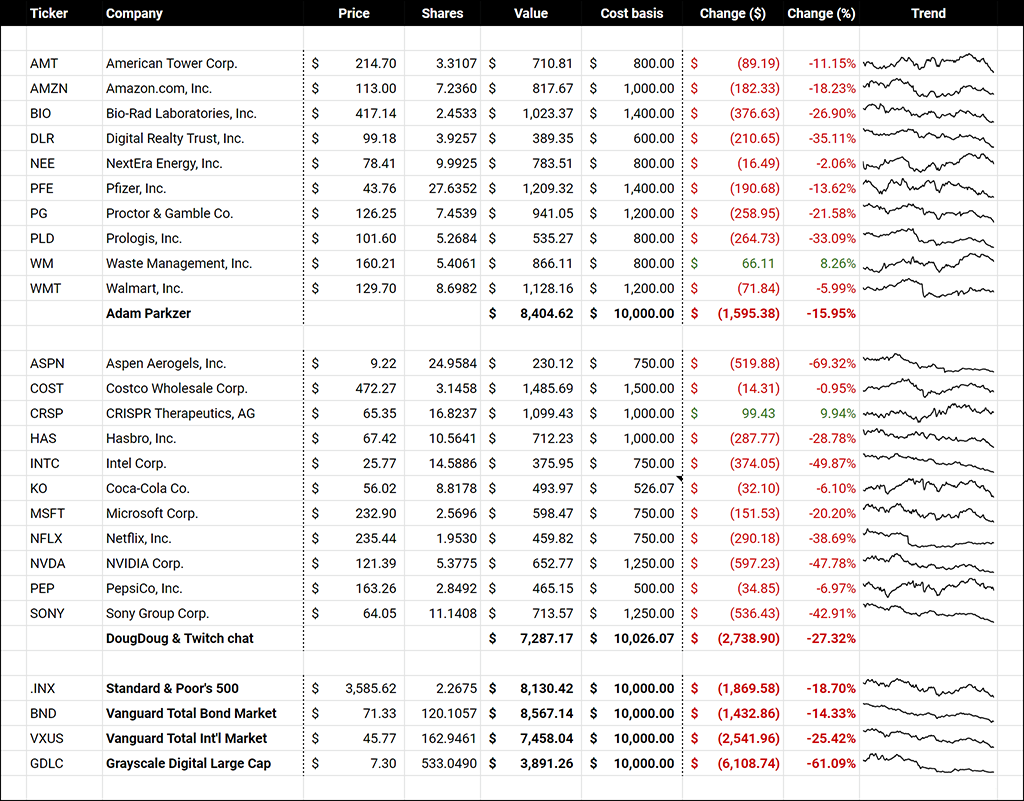
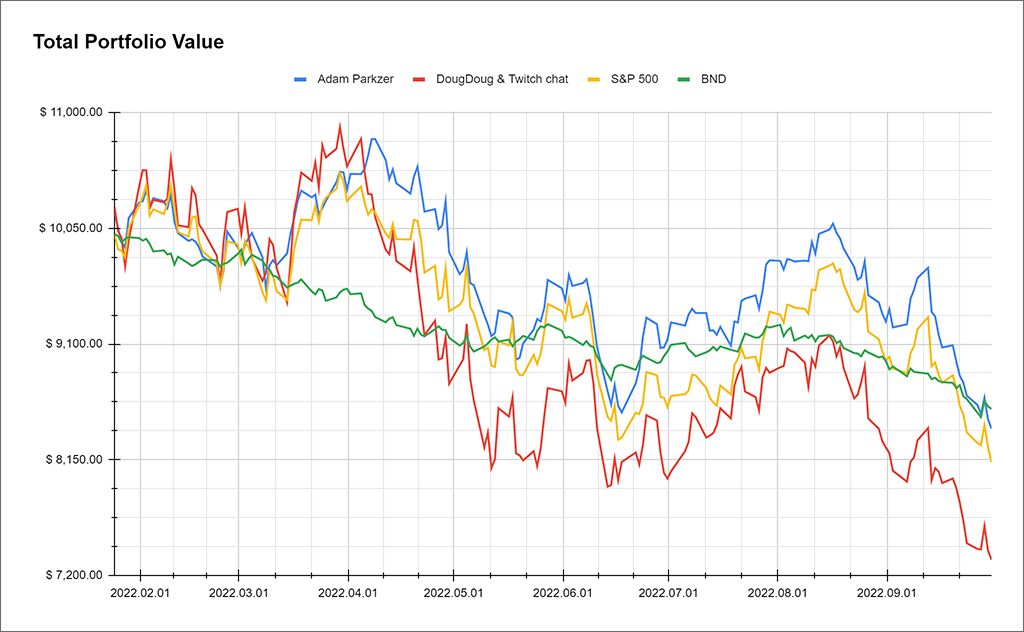
As promised, to wrap up, here is a breakdown of how my $10,000 stock investing challenge with Doug Wreden is going:

My portfolio is weathering the stock market decline relatively well with a balance of $9,137.88, managing not only to beat Doug and his Twitch chat’s port­fo­li­o, but also the S&P 500 and even the bond market. Doug’s portfolio is at $7,944.67, rapidly re-approaching its all-time low. However, if it’s any con­so­la­tion, I guess he and his community can at least be happy that they didn’t go all-in on cryptocurrency, which would be down to $3,805.97 by now.


—§—