Hello, Akasaka Palace and Garden in Minato City, Tokyo, Japan

One of the things that I found incredibly convenient during my trip to Tokyo was how easy the public transportation system was to use. Apart from one singular instance when my friend called a taxi and I just joined her, I exclusively took public transportation throughout the entire two weeks I was in Japan.

There are a lot of train stations and a lot of different train lines that have great coverage of the entire Tokyo Metropolis. However, obviously, not every train line goes to every station. Even though Ginza, the neighborhood I was staying in, has access to many train stations nearby, it doesn’t always have direct, non-transfer service to every single small station. Now, taking transfers isn’t that huge of a deal—the train stations are usually intuitive and easy enough to navigate that you can easily make transfers. With that being said, sometimes, if you just walk a kilometer or so (or less), you can make it to a different train station that does have direct service to Ginza.

On one of the days when I was out being a tourist, I faced this exact same scenario where I could take a ride from the closest train station, transfer part-way to Ginza, then take a different line to my destination… or, I could walk a bit and take a direct line instead. Because of how nice it is to just walk around and sightsee in Tokyo, I opted to walk to a different, further-away train station instead.

On my way there, I noticed an area where people were going through a security checkpoint. I figured that whatever was on the other side was important enough that it needed security, so I spontaneously decided to stand in line. After a short wait, I made it to some metal detectors, so I emptied my pockets and walked through. After passing the checkpoint and emerging into a little opening, I was guided to a ticket booth to purchase admission to the premises.

This is when I finally found out that the place I entered through was 迎賓館赤坂離宮 西門, which translates to the West Gate of the State Guest House, Akasaka Palace. Unfortunately, I arrived too close to closing and didn’t have enough time to go inside the building, but I was welcomed in to explore the outdoor garden area instead.

After I continued walking south alongside the western facade of the building, I saw the 迎賓館 主庭, which is the Main Garden of the State Guest House.

The main garden area allowed me to face northwards and capture a photograph of the south entrance to the state house.

The main garden was a very popular spot for people to congregate, which made sense due to the nice fountain that was situated in the center.

The fountain had statues of griffins and turtles surrounding the basin. The griffins were carrying a shield, which I imagine implies that they are defenders and protectors of the palace. As for the turtles, I am guessing they are supposed to symbolize longevity, wisdom, and stability.

It’s possible that they were apposed beside each other to visualize balance, as griffins are more active in their strategy compared to turtles. Or, due to the history and purpose of Akasaka Palace as it pertains to its usage in welcoming important guests as a diplomatic center, the griffin represents the West while the turtle represents the East. … Alternatively, I might just be overthinking all of it and there isn’t that deep of a meaning to it.

After capturing plenty of photos of the fountain, I continued walking eastbound and snapped one final picture of the southern facade of the building from an eastern vantage point.

I saw on the map that there was another building to the east—迎賓館赤坂離宮 和風別館「游心亭」, which is the “Yushintei” Japanese-style annex of the State Guest House, Akasaka Palace. I wanted to take a look at that as well, but the path to reach it was blocked off and the signage near the annex implied that a special tour reservation was required for entry.

So instead, I took a photograph of the flower bed nearby, then retraced my steps back to the west towards where I originally came in.

At the fork in the path, instead of going south, I continued east into the front yard. From here, I was able to get some nice photos of the northern side of the guest house.

There were some statues of birds atop some of the structural pillars of the guest house. They look similar to eagles, but they seem to be wearing little hats, so maybe my speculation isn’t entirely correct.

A lot of people were taking photographs near the front north entrance to the state house; after the group cleared up a bit, I walked up so I could get a close-up shot of the decorations adorning the gate.

The building had a section to its northwest and northeast that jutted out a bit; the doors in these sections had a white and gold canopy overhead that resembled the design of the gate.

There was another nice flower bed near the aforementioned door and steel awning.

I noticed that there was a closed gate on the eastern side of the front yard, which I imagine is there to allow guests in from the East Gate, the opposite counterpart to the West Gate through which I had entered the property.

Here is another shot of the guest house’s north facade from a northeastern vantage point, with the setting sun peeking through above.

In this “courtyard” area (if you consider fences to be sufficient surroundings to define the boundaries of a courtyard), I saw on the map that there was a restaurant called パークカフ, or the Park Café. It seemed to take up the entire northern half of the stone-paved section of the front yard.

Food in Japan was so good that I had been taking basically every single chance possible to try different snacks and meals whenever the opportunity arose. However, I had just finished eating at this time, so I opted to pass on dining at the Park Café and just took a photograph of the umbrella tables instead, which were a nice shade of dark red.

On the opposite side of the café was another nice gate, this one being gold and light blue.

This is a photo I took at the threshold of the aforementioned gold and blue gate, facing north in the direction of 若葉東公園, or Wakaba East Park.

Continuing north, I saw another fountain and building to my east. It wasn’t labeled on the map, so I wasn’t able to figure out what it was, but considering that there was a guard patrolling the area, I deduced that it wasn’t open to the public.

After making it all the way north, I turned around and took one final shot of the state house.

This is the gate protecting the northern entrance to the grounds, just north of 記念品販売所, which basically translates to the palace’s souvenir store.

I wanted to be diligent and make sure I saw everything I was allowed to see, so upon noticing that a side pathway near the souvenir store wasn’t blocked off, I doubled back about 50 meters. I saw the western equivalent of the fountain and building I saw from the east; this one didn’t have a patrolling guard, but it did have stanchions at the intersection of the footpath, so I didn’t take my chances to get closer.

As I was wrapping up my visit to Akasaka Palace, a plane flew overhead and left behind a condensation trail, so I seized the opportunity to juxtapose this street lantern in front of it and snap a photo.

And finally, this is the northern gate of the front yard, which was being used as an exit only, presumably due to the security checkpoints and ticket stations only being set up at the West Gate.

Admission to see all this was only 300円 for an adult ticket, which, as of today, is less than US$2.00. I’m very glad I randomly stumbled upon this during my walk to the train station; even though I didn’t get to tour inside the State Guest House, I think the sightseeing outside Akasaka Palace was still well worth it.


—§—


Playing IRL bingo in a random Tokyo neighborhood

When I decided to go on a trip to Japan, I picked the dates to overlap with the travel dates of a few friend groups of mine who were also visiting Japan from the United States. However, although I wanted to spend time and do activities together with them, I didn’t want to formally join as a member of any travel groups because I wanted to retain a degree of personal freedom. As a result, the underlying nature of my trip was basically a solo trip.

More specifically, I wanted to make sure I would have agency over my own schedule, rather than feeling an obligation to do everything together with the same group of people, i.e., I wanted to be able to split off from the group and do my own thing if something else piqued my interest better. I also wasn’t a fan of lodging together in a gigantic Airbnb, sharing rooms, and splitting the cost; instead, it was important that I had my own hotel room so I could feel like I had my own private and uninterruptable space.

Upon taking all that into consideration and carefully planning dates together with a bunch of different people, I finalized the two-week period during which I would be traveling to Japan on my own. Then, my friends would be able to invite me out to do things on a day-by-day basis, and I would join whichever group was doing the more interesting activity… or just be a lone tourist if I wanted to do something different.

After booking my flight and hotel, I later found out that another one of my friends, and someone who I had not coordinated travel dates with at all, would also happen to have a few overlapping days with me in Japan—Doug Wreden. We figured that it would be fun to meet up and spend a day together in Tokyo when we were both free, so we tentatively penciled that into our calendars.

Up until this point, I had experienced a fairly organized and structured trip. My other friends wanted to eat, see, and experience the best that Japan had to offer, so they diligently conducted research ahead of time and picked out activities that they thought would maximize their happiness. Even I did this to a mild extent—I leisurely browsed Google Maps using in-flight Wi-Fi during my flight to Narita International Airport and tagged interesting spots as “want to go.”

On the other hand, my friend Doug has been to Japan many times before, so he approached his trip in a more relaxed fashion. He wanted to be more spontaneous and do something that most other people would never do, while also experiencing the more “normal” side of Tokyo away from the concentrated, tourist-centric areas. Doug is a creative person who is great at gamifying everyday life, so he proposed that we do “IRL Bingo” where we make a Bingo board and then walk around a neighborhood of Tokyo we’ve never been to before to sightsee and check off items from our grid.

I was very on board with this. I’m someone who doesn’t pick “favorite things” as often as other people; instead, I like having a broad breadth of experiences and will prefer to do a wide variety of new things that I haven’t done before. This spontaneous IRL Bingo idea was great because the uncertainty of its outcome was a stark contrast from how I had spent my previous days in Tokyo, so it was a fantastic way to mix things up and keep things fresh.

In order to get to a new neighborhood to start our journey, we met up at Shinjuku Station, got on a random train, and got off at a random stop.

After exiting the station, we walked around the corner into a residential area so that we wouldn’t be in the middle of the sidewalk.

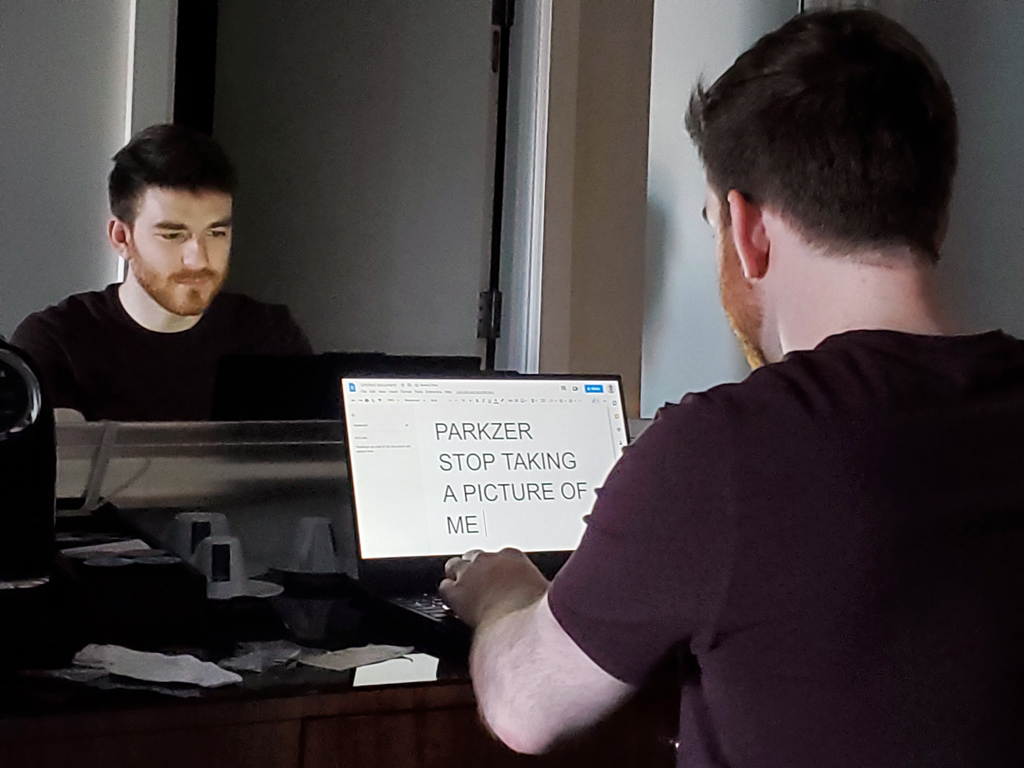
From there, Doug and Alex started coming up with ideas and assembling them together into a Bingo board.

One of the spaces was to see a car with a siren, but they further added a stipulation that the siren-bearing vehicle had to pass by in front of us. We almost checked it off right away, but unfortunately, the truck turned away from us and drove in the opposite direction.

From here, we turned into a residential area again and walked deeper into the neighborhood.

As a point of editorial commentary, I included a lot of random photographs in this blog post that don’t showcase anything particularly notable or special. This is because, just like how we wanted to see what “real” Tokyo was like away from the tourist zones, I wanted to showcase a more accurate representation of an average neighborhood of Tokyo. People share memorable experiences all the time—both positive and negative—but often don’t post about the mediocre. In the spirit of trying to portray realism, I made sure to mix in a lot of mundane pictures so I can ensure that I’m not accidentally sensationalizing anything.

One of the spots on the Bingo board was to find people playing baseball. We stumbled across a baseball field, so that was easy, but we were hoping to be able to check off two spaces by also seeing someone wearing Los Angeles Dodgers apparel. Unfortunately, everyone here was wearing their own uniforms.

Apparently my camera decided to focus on the chain link fence instead of the baseball gameplay, but I guess it looks sort of artistic, so I included it anyway.

We used this sign here for our “incorrect English” space. We suspect that they intended to write “landmark” instead of “randmark,” but because Asian languages often merge together their “r” and “l” sounds, this unfortunate error was born.

Upon doing some more research after-the-fact, I found out that this building is called ランドマーク宮澤, which reads as Rando-māku Miyazawa and translates to Landmark Miyazawa.

Here are some more photographs of the surrounding neighborhood.

Compared to the United States, these power lines were pretty chaotic. However, Doug and Alex didn’t want to count this for the botched power line space because apparently power lines in Japanese neighborhoods can get substantially worse than this.

With that being said, even though the power lines seem disheveled, I noticed that they were somehow still organized, just in a very messy way. When I followed each line, I realized that they were all orderly; it just happened to be that the power company seems to have not put in any extra effort into aesthetic cable management.

One of my favorite things about Tokyo was the abundance of convenience stores, and how convenient they actually are. In the United States, convenience stores are very inconvenient because they tend to just overcharge for everything, they are often fairly dirty, and they sometimes have suspicious individuals loitering around the property. In Japan, convenience stores are basically like miniature high-quality grocery stores that are reliable for taking a rest stop whenever you’re on a long walk.

In a 7-Eleven, I found this Super Mario gummy candy, which checked off the “Mario” spot on our Bingo board. I never really figured out how to do the “build your own level” activity that the wrapper advertised, but the candy itself tasted pretty good.

After a quick snack and water break, we ventured back out into the street.

One of the Bingo board spots was to find a Japan flag. In the United States, you’ll see national flags everywhere all the time, but in Japan, we did not see a single one. What was extra funny was that we found a US flag before we ever encountered a Japan one.

This store in itself was also amusing, considering that they advertise selling gun shooting gear, even though guns are generally broadly illegal to have in Japan.

By this point, we had been steadily achieving spaces on our Bingo board during our walk. For example, we saw an advertisement featuring a white man, we saw a Black construction worker, and we found an Indian restaurant.

You may have also noticed that one of the spaces involved me correctly identifying a police officer. This is because I kept on confusing construction workers and security guards for police officers, because I never quite found out what police uniforms look like. However, even a broken clock is correct for two minutes a day, and eventually, I was able to point out a real Japanese police officer.

We came across this gym that teaches martial plarts. At first I thought this was another tragic case of an incorrect English translation, but then I realized from the tagline that it was intentional—it was martial arts, with plants. Although that is a reasonable play on words, I don’t think they quite understand how goofy the word “plarts” sounds to a native English speaker…

One of the items on the Bingo board was to see a torii gate. I believe we had already seen a few by this point, but I found this one that was a gateway to a statue instead of to a temple.

By this point, it was starting to get darker.

I took a picture of this gas station because it was the first gas station I had seen since arriving in Japan. I had spent a majority of my time during the prior days in the denser cities of Tokyo, so I had seen a ton of convenience stores (which are often associated with gas stations in the United States because the retail section of gas stations are often convenience stores), but I had not seen an actual gas station yet.

At this point, we were only one space away from our first two Bingos—we would get a Bingo if either (1) we saw a McDonald’s, or (2) Doug gets jouzued. To be jouzu (jōzu, 上手)ed means to be told by a native Japanese speaker that one is skilled at speaking Japanese. Apparently this had become a meme in Japan, and it is now sometimes used more as a sarcastic statement than to actually tell someone that they’re genuinely skilled.

Out of nowhere, I saw a Harley-Davidson store. This was amusing, because I wear a lot of Harley-Davidson boots, so it was nice to see something familiar in Japan. I have comically wide feet that aren’t compatible with many shoe brands, but Harley-Davidson boots fit me well because their wide sizes tend to run extra wide, and they’re made out of real leather so they stretch and mold around my strangely-shaped feet.

We stagnated with only one space to go for Bingo for a while. After we wondered if all hope was lost, we suddenly saw a McDonald’s in the distance. In perfect storyline fashion, the train barriers lowered moments before we were going to cross the street to add to the suspense, but after a couple trains passed and we waited out the brief delay, we walked up to the McDonald’s and marked off the final square we needed for our first Bingo.

Our dinner reservation time was rapidly approaching, and we thought that we might need to call a taxi to get to the restaurant on time. However, as if the plot was pre-written, there was a bus that just happened to be parked right around the corner that was headed to Nakano Station, perfectly in the direction of where we need to go.

After a brief bus ride, we made it to Nakano Station. I had never seen this kind of indoor/outdoor hybrid mall before, which I thought was pretty neat.

After finishing dinner, we continued walking around the area. Because Nakano was far more densely populated than the residential area we were in earlier, we were able to check off a lot more squares on our Bingo board back-to-back.

We randomly stopped by an arcade, and I noticed that one of the machines had Fanta in it as a prize. I have never seen that before in the United States, and I thought that was a brilliant idea that American arcades should adopt.

I’m not a fan of claw machines because I know how they work—there is a way to set up the strength of the claw so that, even if you get a perfect grip, you won’t get the prize unless the machine rolls the proper number to activate the appropriate pressure to retain the prize all the way to the dispensing funnel. If you check the owner’s manual of these claw machines, you can see that operators can set a profit margin to make sure that they’re not losing too much money. There are some machines that can be cheesed, but for a majority of the straightforward claw machines, they almost all work in this configurable way.

With that being said, even if I was a fan of claw machines, I still wouldn’t play them because I don’t care for any of the prizes. I don’t really like stuffed animals, and I usually only want physical possessions if they have some kind of useful function or sentimental value. So, having soft drinks or food items as prizes for claw machines is brilliant, and I think it is a great way to potentially convince people like me to try it out a few times. I’m sure that winning a beverage from an arcade machine will be extra satisfying if you’re thirsty after a long walk and want a drink.

Alex remembered that there was an ice cream shop in the basement, so we went down to check it out. Unfortunately, the store was already closed (as was most of the other spots in the area), but there was a little bench area that was still open and not blocked off by a metal door, which I found to be amusing.

Eventually, in desperation, Doug decided to go to a bakery right before getting on our train and started speaking in Japanese to the cashier to try and get jouzued. He said exaggerated statements like “I’ve only been learning Japanese for one year” and otherwise pointing out how bad he was at Japanese, in order to fish out the jouzu compliment. After much of his embarrassment, he succeeded, and we were able to secure our second Bingo.

This is what our Bingo board looked like at the end of the day. We managed to be one square away from three more Bingos beyond the two we achieved.

Overall, this was actually one of the more fun days I had during my trip to Japan.

Although I enjoyed pretty much every single thing I did in Tokyo throughout the entire two weeks, I especially liked IRL Bingo because it felt like I was able to get a more authentic and unfiltered look at what Tokyo was like. At one point, I had been enjoying Tokyo so much that I was concerned whether I was accidentally going to only well-curated tourist hotspots that were manicured just to look nice to tourists, but after seeing everything I encountered during my day of IRL Bingo, it reinforced and helped make me feel more secure in my broad appreciation for Tokyo.


—§—


Hello, Yoyogi Park and Meiji Jingū in Yoyogikamizonochō, Shibuya, Tokyo, Japan

Yesterday, I wrapped up a trip to Japan and returned to the United States. In case you missed it, the blog post in which I review my flight and travel experience also has a lot of relevant context surrounding my trip. I’m in the process of going through my photographs now and catching up on blog posts.

One of the first tourist activities I did in Tokyo was visiting 代々木公園, or Yoyogi Park. Yoyogi Park is a very large public park in Shibuya in the Yoyogikamizonochō district, or 代々木神園町. This is the same district housing 明治神宮, or Meiji Jingū, a Shinto shrine.

I went together with some of my friends who are more familiar with Japan, and throughout my visit to the park, I mostly just followed them around and allowed them to lead the way. Unfortunately, after browsing some online resources while putting together this blog post and editing photographs, I realized that the park was quite a bit larger than I thought, and there was a decent amount of stuff that I seem to have missed out on. I definitely could’ve taken more agency to be more diligent in exploration, but because I was still a very new arrival to Japan at that time, I was a bit overwhelmed and wasn’t as meticulous as I could have been.

With that being said, I still enjoyed my time seeing Yoyogi Park and Meiji Jingū. Having grown up in the Chicagoland suburbs and now living in Las Vegas, it’s not common for me to see what is functionally a gigantic manicured forest in the middle of a dense city. I think that made it feel even more special—the park was important enough that they took space in an area that demonstrated how scarce the land was, and still built a very serene and soothing piece of nature on it.

After taking the Chiyoda Line from my hotel in Ginza to Harajuku Station, I met up with my friends and we entered the park through one of the side entrances.

This area had what appeared to be a series of special installments. They had flower arrangements…

… miniature dioramas…

… and bonsai trees.

After walking down a long path with these exhibitions, we made it closer to the temple.

There was a nice flower arrangement at the entrance of the temple.

Close to the temple, there was what I believe was the roundest tree I’ve ever seen, if you consider it as a ratio of its size.

It made me wonder whether this tree is somehow just naturally this perfectly spherical, or if it is pruned and maintained to be as such. I think it’s fairly impressive either way—it’s both amazing if a tree manages to grow in such a pristine shape, and it’s just as amazing if there are groundskeepers who put in the effort to climb to such elevations to trim the branches and leaves.

Unfortunately, the interior area of the temple had signs asking people not to take pictures, so the best I could do was to capture this from a distance in a way that didn’t show the photo-free area.

I also did a round around the stone-paved area to grab photographs of the surrounding buildings.

I couldn’t quite confirm for sure, but this appeared like an area where people could write messages and leave them hanging in the designated areas to dedicate them to the shrine.

While walking around this area (and the park in general), I noticed that the birds were particularly vocal. It was quite amusing, and it sounded like the birds were making squawking and shrieking noises rather than more subtle chirping and cheeping sounds that I’m used to hearing from American avians.

After exploring the temple, we exited through one of the gates and found this hand-washing station. There wasn’t one by the gate through which we had originally entered, but according to the signage near this one, I believe the idea is that you are supposed to cleanse yourself using this provided water prior to entering the temple.

After a bit more walking, we made it to the southern side of Yoyogi Park.

A lot of this area was basically a forest with very tall trees. It reminded me of some of the forests I hiked through in Washington, Idaho, and Montana, except these trees in Yoyogi Park felt more surreal after remembering that literally only a few hundred meters away, there were mid- and high-rise buildings densely packed together.

After finishing a very peaceful and calming walk, we made it to what I believe was intended to be the main entrance, and the path through which most tourists would start their visit to Yoyogi Park.

We started navigating our way away from the park and towards a restaurant to get some dinner, and in the process, I got a chance to ascend some stairs to a pedestrian skybridge, which allowed me to get an elevated view of the city around the park and snap some nice photos.

As you were probably able to tell, I very much enjoyed my time in Yoyogikamizonochō. The best part was that this isn’t even the only park of its type in the Tokyo Metropolis—there are a lot of “oasis in the middle of a bustling city” kind of spots spread throughout the various cities in Tokyo (and I ended up visiting a few more of them, as you will see in future blog posts).


—§—


Hello, Museum of Making Music in Carlsbad, California

I’m currently in the process of traveling from Las Vegas to San Diego for an event at the San Diego Convention Center. Instead of flying straight there, I decided to stop by Los Angeles County first to visit some friends, then finish the journey via car. I could’ve just finished the drive in one session, but I decided to split it up and spend some time in northern San Diego County being a tourist because it’s conveniently on the way there.

Because of how much traveling I’ve done in the United States, I have begun to vaguely fall into the “basically seen everything” bucket at this point (for my country). Consequently, when I visit a new city, I like to check stuff out that is unique and distinct to that particular city that I can’t find elsewhere; this strategy has helped me continue my exposure to novel experiences throughout my adventures.

On an unrelated note, I like music.

One of the activities I decided to do part-way to San Diego was to visit the Museum of Making Music in Carlsbad, California. I felt like this museum hit my two aforementioned metrics well—I haven’t really seen too many other museums dedicated to music (the only other one that comes to mind that I’ve been to is Studio Bell, Home of the National Music Center), and it covered one of my topics of interest.

Upon entering the museum, I paid US$15.00 for a general admission ticket and was greeted by a docent who spent some time showing me an introductory short film and explained how to get the most out of my museum experience. From there, I was on my own to explore at my own leisure, which I did for the next couple hours.

I was a little tight on time because I had a dinner reservation for 5 PM PDT that day, which I picked as the earliest available time slot due to wanting to finish the drive to San Diego that same evening and make it into my hotel before it got too late into the night. Sometimes, a couple hours is enough for a museum, but at the Museum of Making Music, I felt like a couple hours is only sufficient for a rushed experience.

Each station not only had many instruments in the exhibit, but an interactive screen where you could learn more about each item on display. It also had a lot of videos with performances using the displayed instruments, along with behind-the-scenes looks at how makes and models of those instruments are produced. Beyond just the exhibits, there were also sections of the museum containing sample instruments that you could try out.

I think if you just want to quickly skim the exhibits and look at things, a couple hours is fine. However, if you’re a music enthusiast like me, you can easily fill 4-5 hours (or more) in this museum by reading all the information about the exhibits, watching the videos of performances, learning about how all the instruments are made, and playing all the instruments in the sections you’re allowed to touch. There are a nice variety of guitars available to try—even some decently pricey ones. There was also a DJ controller with a tutorial so you can learn how to mix music.

After my somewhat abridged experience, and considering its relatively low admission price compared to other Southern California museums, I would recommend it for pretty much anyone—a glowingly high recommendation for those passionate about music, and a moderate recommendation for everyone else.

Here are some photographs I took during my visit:


—§—


Hello Oceanside, California

I am currently on my way to San Diego, California to attend TwitchCon, a convention run by the same company that runs Twitch, taking place in the San Diego Convention Center. Instead of flying straight there from Las Vegas like I’ve done before, I decided to stop by Los Angeles and make a ~120 mile (~195 kilometer) drive down south so that I can make some stops along the way and be a tourist.

Earlier today, I arrived in Oceanside, California in the northern part of San Diego County. I thought this was very inconvenient timing for the drive because it was raining this morning and afternoon, which is relatively rare in Southern California. However, fortunately, once I arrived in Oceanside, the rain stopped and it actually ended up being a benefit to me because the inclement weather caused other people to stay indoors, which meant I was able to walk around the beach without too many other sightseers around.

After checking into my hotel and parking my truck in the underground structure, I walked out and started my adventure near the Oceanside Pier.

After doing an out-and-back on the pier, I took the pedestrian walkway over the beach and connected onto North Pacific Street.

After continuing northbound for a while, I reached the San Luis Rey River.

I crossed the bridge and connected onto Harbor Drive, which allowed me to walk first into the parking lot and then down into the harbor once I found an opening.

After a pleasant stroll down and back up the harbor, I decided to grab some food before returning to my hotel. There was a restaurant in the distance with colorful holiday lights strung up on the exterior, harbor-facing facade of the building. I thought it looked nice, so I walked my way over there and went inside to find Joe’s Crab Shack.

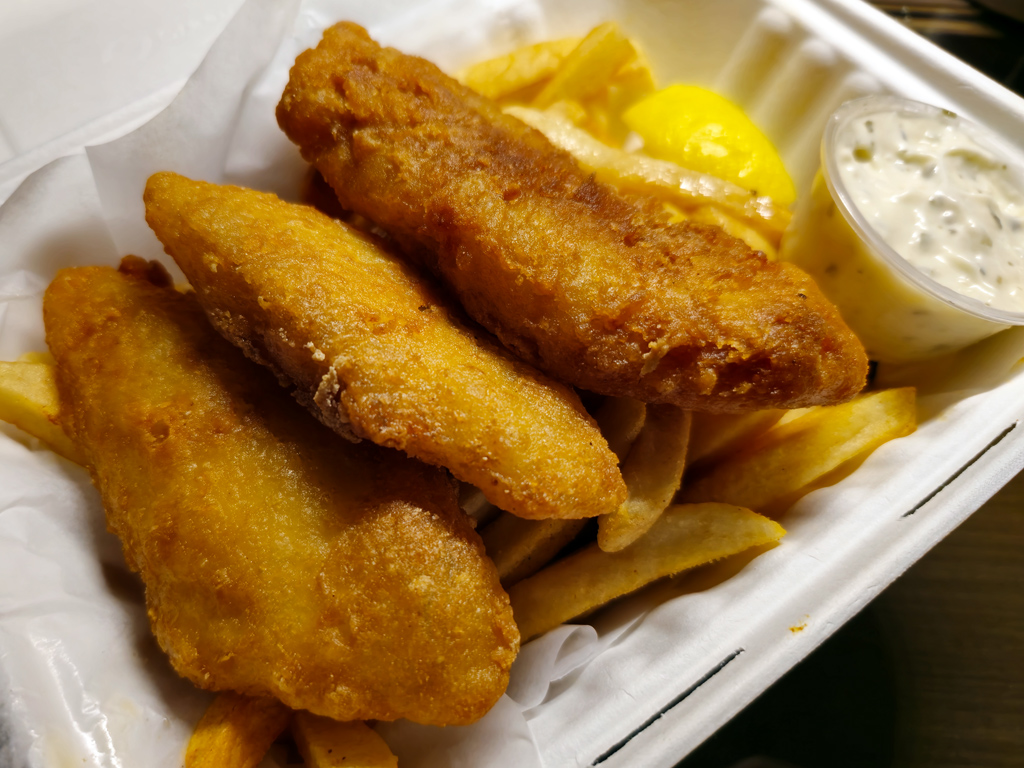
I had a pleasant waitress who was excited to hear that I had come all the way from Las Vegas. After a friendly chat, I put in my order for a cup of clam chowder and a plate of fish and chips.

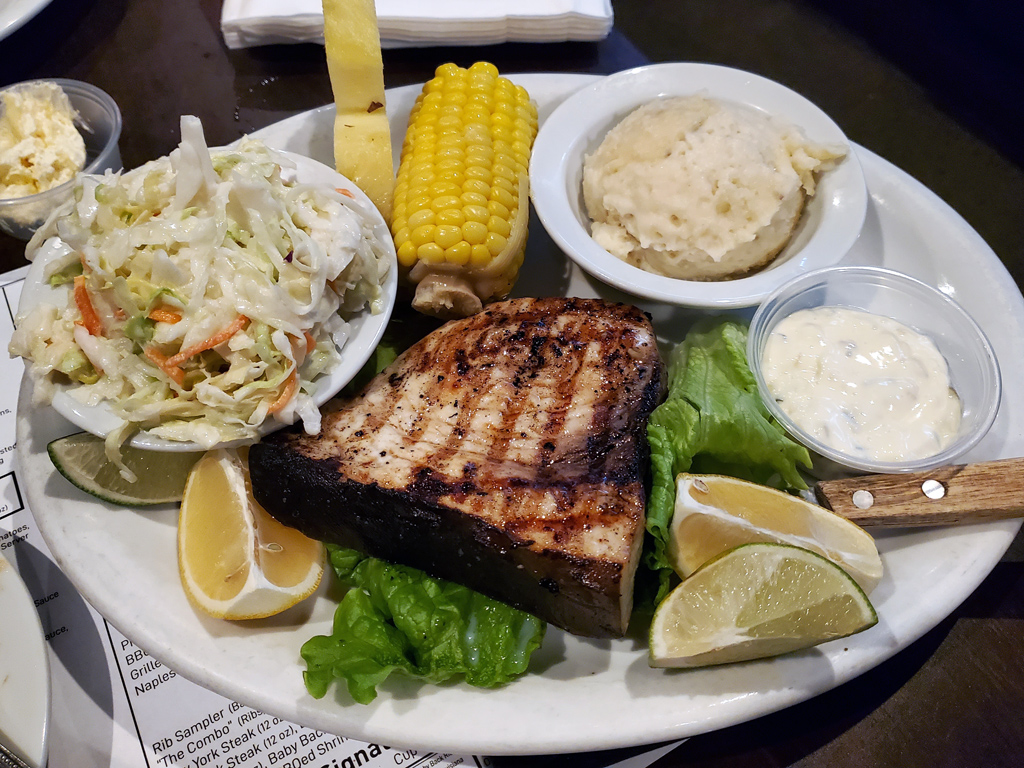
The fish and chips were greasy, heavy, and very filling. Halfway through my meal, I was already feeling pretty full, so I stripped the breading off the fish before consuming it, which made it much more palatable.

After paying for my dinner and bidding my waitress farewell, I walked back outdoors. It was dark already, which made for a good nighttime photo opportunity of North Coast Village in the distance.

I used to post a lot more hotel room photos back when I was on my road trip across the United States, but stopped doing so because it became redundant for me. With that being said, I’ve gotten a few requests to keep sharing hotel pictures, so of course, I have to deliver. For this segment of my trip, I’m staying at the SpringHill Suites by Marriott Oceanside Beach at the intersection of North Myers Street and Mission Avenue.

I’ve leaned towards staying in nicer hotels under the Marriott family during my recent travels, but during my multi-year road trip when I just wanted something simple, clean, straightforward, and peaceful, I stayed in a lot of SpringHill Suites (along with some newer-generation Fairfield Inns and Courtyards). I actually haven’t stayed in a SpringHill Suites since mid-2022, so seeing this layout again is quite nostalgic for me.

I was fortunate to receive an upgraded room thanks to my Bonvoy elite status, so I had a nice ocean view from my balcony.

Oceanside so far has been pretty nice. It’s been cool and cloudy, which is fantastic for going on a walk, and it’s been unexpectedly serene and soothing. I did encounter some homeless people on the beach, including a fairly sizeable camp set up inside the Oceanside Pier Amphitheater with a literal campfire going, but it seems like everyone generally just minds their own business and maintains the peace.

I’m checking out of my hotel tomorrow in the late morning to visit a museum and then go to a tasting menu reservation, so I will have at least two more activities prior to arriving in San Diego to talk about and share on my blog in the coming days.


—§—


Hello, Lakeside Gardens at the JW Marriott Hotel Hanoi in Vietnam

Although those who know me well will have been able to easily guess which hotel that I, a Marriott loyalist, stayed at during my trip to Hà Nội, Việt Nam, I still didn’t want to “confirm” it on my blog until the end of my trip, considering that there was a lot of other stuff for me to post about anyway, and no matter how low the security risk might be, it’s still considered within best practices to not disclose your exact location.

Now that it is safer to do so, I can verify that I did indeed select the JW Marriott Hotel Hanoi for my time in Vietnam. I heard that they had a reputation for offering excellent service; considering that I am a foreigner who was traveling for the very first time to a country that does not speak English as their primary language, I figured I could take advantage of and lean on the hotel staff to help get me through my stay if anything were to come up. (Luckily, I didn’t have anything go wrong throughout my entire trip, but it was still good peace of mind to know that the staff was there to help whenever needed.)

The hotel overall was fantastic, and I especially appreciated the executive lounge where I was able to get free meals, snacks, beverages, and filtered water all day. Another thing I liked about the hotel was the Lakeside Gardens, a serene and well-manicured garden on the hotel property.

Here are some photographs I took in and around the Lakeside Gardens:

During my walk, I noticed that the staff brought out boxes of documents at some point and began throwing them into a fire pit. I suspect that this was their equivalent of when people shred confidential documents in the United States.

Within the gardens, there was a special section called the Herb Garden. I saw on the JW Marriott website that they had cooking classes that took place in the Herb Garden, with the curriculum focusing on different kinds of herbs and the roles they play in Vietnamese cuisine. I considered trying it but ended up never getting around to it because it was very rainy and humid most of the days of my stay, and on the sunnier days, I went off-property to be a tourist out in the city.

Here are some more photographs from in and around the Lakeside Gardens:

After walking all the paths of the Lakeside Gardens, I circled around to the front and side of the hotel.

This was the view that I had from my hotel room’s window; it overlooked the Lakeside Gardens, as well as the lake and a portion of the Hanoi skyline.

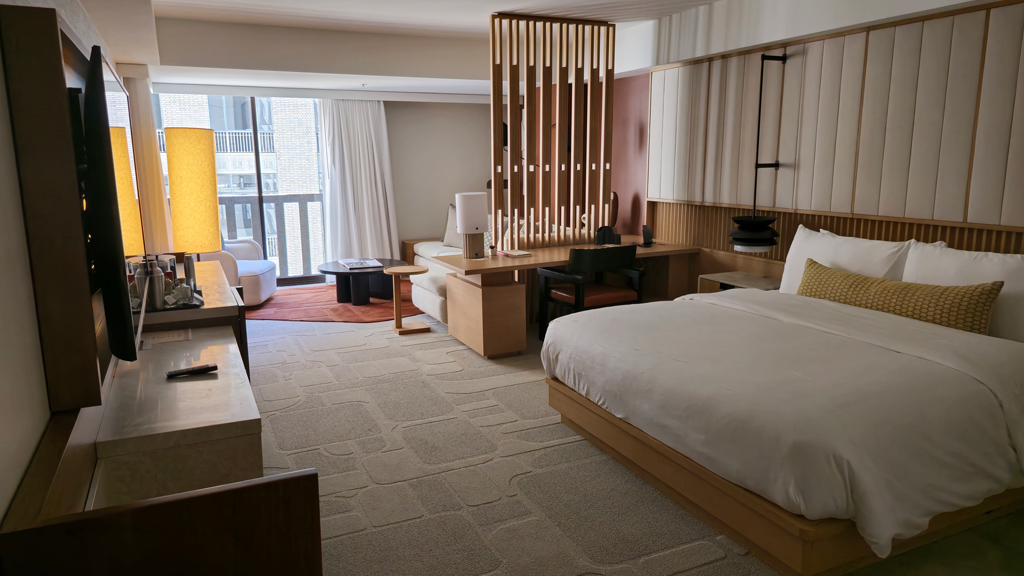
I figured this was also probably one of the most relevant blog posts for me to share pictures of my room as well. I just had a regular guest room, but it was very nice and exceeded the quality of many other hotels’ higher-end suites. It was very spacious, and the design was a nice balance of minimalistic simplicity and elegant comfort. My favorite part about it was the floor-to-ceiling windows, which allowed me to let in plenty of sunlight during the daytime and enjoy the sparkling city lights during the night.

The pricing during my stay was surprisingly affordable—around US$150.00 per night on average. It was still very expensive relative to Vietnam’s cost of living, but if you compare it to hotel prices in the United States, $150 a night is basically just a regular hotel, and high-end resorts under Marriott’s luxury brands (like the JW, Ritz-Carlton, and St. Regis) will be at least several hundred (if not over a thousand) dollars per night.

Overall, the JW Marriott Hotel Hanoi fulfilled everything I could have possibly wanted from my lodging in Vietnam. It was a tranquil retreat away from the bustling city, and it had enough amenities that someone could theoretically never leave the property and have plenty of food and activities to last them an entire two-week vacation.


—§—