Before departing the Las Vegas Valley again for my next trip, I squeezed in another seasonal visit to the Bellagio Conservatory & Botanical Gardens inside MGM Resorts’ Bellagio Resort & Casino on the Las Vegas Strip in Paradise, Nevada. This time around, the rotating exhibit on display was “Lunar New Year 2026: Year of the Horse.”
The Lunar New Year exhibits are the “bonus” fifth seasonal exhibits that they slot in between winter and spring, and as such, they end up having the shortest live periods. This one for the Year of the Horse opened to the public on January 10, 2026 and will stay up for about three more weeks as of today, concluding on February 28, 2026 and entering dark dates on March 1, 2026 in preparation for the spring installment.
One special thing I noticed about this installation that I don’t recall seeing before recently is that they relocated the Garden Table. Usually, this prix fixe chef’s tasting menu experience is situated across the aisle from Sadelle’s Café in the northwest corner of the Conservatory, but for Lunar New Year 2026, they moved it to the opposite, southeast corner instead. I still have never dined at the Garden Table, though one day I imagine I will overcome the feeling of strangeness at the idea of literally thousands of people walking by and looking at me while I eat in the middle of a botanical garden.
Here are some photographs I took of the installment:
Here is a bonus Year of the Horse decoration that was set up right outside of Harvest, a restaurant in the southwestern quadrant of the Bellagio and on the path to the walkway between the Bellagio and the Vdara Hotel & Spa.
Disclaimer: I am not a registered investment advisor, and even if I was, I wouldn’t be your advisor. The information contained in this blog post is strictly anecdotal and should not be construed as financial advice. Everyone’s situation is uniquely different, so if you are seeking guidance, consult a licensed and certified professional for personalized assistance.
Another year, another investment portfolio breakdown. My overall investment strategy has remained consistent over time (i.e., dumping a majority of my money into very safe index funds), but compared to last year, there are still a handful of noticeable changes.
As a side note, I used to post updates every quarter, but as of the past few years, I have changed it to just doing annual breakdowns instead. When I did more frequent updates, I would build on previous blog posts and list those as prerequisite reading to supply the needed context, but after I lowered the frequency to once per year, I started writing them as standalone pieces. This means that you won’t have to go back and read an older blog post to understand what I’m talking about, but this also means that you might notice some repeated information here if you’ve read previous investment breakdowns.
Before I begin with the breakdown, I figured I would start with a quick story and a broader financial change that would not be apparent just from my categorical allocation breakdown.
On a random day, I received a phone call from someone claiming to be from Fidelity Investments, a financial services company I use as one of my brokerages. My immediate assumption was that it was a scammer trying to gain access to my Fidelity account by pretending to be an employee. Regardless, for my amusement, I still listened to what they had to say.
Rather than asking me for my address or social security number or any other personal information, the employee instead told me that he saw my Fidelity account and reached out to let me know that they have an investor center in Henderson of the Las Vegas Valley in Nevada, close to my home address. He wanted to invite me to stop by in-person for a visit at any time during business hours. That’s it.
I was now even more suspicious at this point, because obviously, the only thing more suspicious than a scammer is an actual real financial services employee trying to be genuinely helpful and welcoming. I thanked him for the call and let him know that I would stop by if I’m in the area or if I have any questions. Afterwards, I checked the phone number on the caller ID and confirmed that it did match up with that Fidelity branch.
Funny enough, this simple single phone call actually had a decent effect on me.
Historically, I only ever used Fidelity to manage my Health Savings Account, charitable giving account, and over-the-counter trades—all services that Vanguard did not offer. However, recently, I set up a regular individual brokerage account on Fidelity and started putting more money into it so I could split my assets more evenly between Vanguard and Fidelity as to serve as a form of risk mitigation in case I were to lose access to one of my accounts or get hacked.
The fact that there now seems to be a “human touch” on Fidelity’s end, with potentially an account manager with eyes on my portfolio, makes me quite a bit more willing to put more money into my Fidelity account while limiting my Vanguard account to just retirement contributions for now. That has been the strategy I’ve stuck with over the past year, so when I do security-by-security breakdowns in some of these categories, you might notice more Fidelity funds popping up.
With all that said, here is the percentage breakdown of how I distribute my money in my investment portfolio:
Cash
I have always said this, and I will continue to say it: I always prioritize time in the market over timing the market. As a result, I always encourage people to hold onto somewhere around 3-6 months’ worth of core living expenses, and then put the rest into investments right away, as soon as possible. It doesn’t always matter which investments you pick; the most important part is that you are not just holding it in deflating cash.
I personally err on the side of safety and lean closer to a buffer of six months’ worth of living expenses held in cash. Especially now with my company Tempo going through an uncertain and volatile financial period, I have been giving the company loans and delaying my personal compensation so that the corporation can have more working capital, so it is more important now than usual for me to have a cash buffer in my bank account.
(And in case you’re wondering, no, I did not just leak some exclusive insider information; because AVY Entertainment, Inc., d.b.a. Tempo had a Regulation CF offering, it has to file yearly Form C-ARs available for public viewing on the SEC’s website, so it is public knowledge by this point that our financial state is anything but stable.)
Like usual, an overwhelming majority of my portfolio is still invested in domestic broad market index funds, a very boring but very safe category. Nothing much has changed here—I put little bits of money into interesting investments as I see the opportunities arise, but otherwise, the rest of my money goes into these index funds.
During the COVID-19 pandemic, I bought a lot of Vanguard High Dividend Yield Index Fund Admiral Shares (VHYAX) to try and weather out the uncertainty of the market, as dividend funds were not as unpredictable as growth funds. Before and after the pandemic, I mainly bought Vanguard Total Stock Market Index Fund Admiral Shares (VTSAX). As I mentioned above in the introduction, I haven’t been buying much Vanguard non-retirement funds and have been investing in Fidelity funds instead, so the shares of VHYAX and VTSAX I own are pretty old.
As for the new money I’ve been putting into domestic broad market index funds, it’s all been going into the Fidelity ZERO Total Market Index Fund (FZROX). One of the downsides of this Fidelity ZERO fund is that it is non-transferrable, so if I ever need to move this out to a different brokerage, I would have to have a gigantic taxable event to realize all my gains, as there are no in-kind securities at other brokerages. With that being said, I don’t foresee a major scenario where I would have to do that anytime soon, so that is a risk I was willing to take in exchange for the 0% expense ratio.
43.056%
International broad market index funds
One of my main investment goals during 2025 was to invest more in the international market, and I definitely succeeded at that. During my end-of-2024 investment breakdown, I shared that my allocation in international broad market index funds was only just barely over 5%. Since then, I have doubled that to over 10%.
In 2025, I finished selling my entire position in Vanguard Total International Stock Index Fund Admiral Shares (VTIAX) for the purposes of tax loss harvesting. After waiting out the wash sale period, I put all that money (and more) back into the international market via the Fidelity ZERO International Index Fund (FZILX). (And yes, a lot of resources have told me that VTIAX and FZILX likely do not count as substantially similar enough to trigger a wash sale, but I wasn’t in a rush and preferred to just be safe.)
Although I am happy with how much progress I’ve made towards shifting my domestic vs. international ratio in the direction I wanted, I still think I need more exposure to international markets relative to the amount of belief I have in international markets. Thus, throughout this year as well, I will continue investing more into FZILX while not putting as much into FZROX.
10.078%
Bonds
Back during the COVID-19 pandemic, I purchased Series I Savings Bonds from the United States Department of the Treasury as a hedge against the rampant inflation that was happening as a result of the government printing an insane amount of new money. Although the returns aren’t as crazy right now, I remember the annual rates exceeding 9% during the peak of pandemic relief efforts.
I haven’t sold my Series I Savings Bonds yet because there is a penalty on the interest if you sell it when the bond is less than five years old. However, in case you haven’t been keeping track, it’s already 2026, so my bonds’ five-year maturity dates are either approaching very quickly or have already passed. This is going to be one of my upcoming projects—checking the exact dates when I purchased the bonds, then coming up with a plan on when to sell them and how to reinvest the proceeds.
For now, I’m unsure how I’m going to proceed with regards to purchasing more bonds. I am getting older, but I’m still not that old. I would consider myself as having a medium risk tolerance, which is high enough that I don’t want to doomsday prep by pulling out of the stock market and dumping everything into bonds. I will think on this a bit more over the next year and report back during my next investment portfolio breakdown.
5.127%
Target date funds
I split my target date funds off into a separate category because they are a combination package of different kinds of index funds and bonds that automatically adjust based on which target year you pick. For example, if you elect a fund for 2030, it means that you are retiring soon and need stability (i.e., bonds) in your portfolio; if you elect a fund for 2070, it means that you’re a recent addition to the workforce and won’t be retiring for a long time, so you need growth (i.e., stocks) in your portfolio.
Considering how active of an investor I am, it may be strange to see that I take advantage of these “set it and forget it” kind of funds in exchange for paying a higher expense ratio. The reason I do it is a form of diversification in the sense that, if I ever become incapacitated up to the point where I am no longer able to manage my investment portfolio anymore, target date funds end up being a hedge against my money still being in highly volatile funds at the time of my retirement and potentially tanking due to a neglectful absence of response to a falling market.
Note that I am only buying these inside my Roth IRA and SEP-IRA.
22.253%
Real estate investment trusts (REITs)
I’m still keeping an eye out for good real estate purchase opportunities, but until something comes up, my only real estate exposure is through real estate investment trusts. Realistically, I foresee my first major real estate investment being an self-occupied property, but I’m having a great time being a nomad right now and not rushing to wrap up that chapter of my life yet. I can of course just become a landlord, but that comes with a lot of obligations and locks up a chunk of my capital that I could instead reserve as more liquid securities.
My position in Vanguard Real Estate Index Fund Admiral Shares (VGSLX) is still negative at the moment, so I’ve been selling it off little by little for tax loss harvesting and reinvesting it in other funds. For example, in early January 2026 when my tax-advantaged retirement account limits reset, I sold US$7,000.00 of VGSLX and did a Vanguard-to-Vanguard transfer into my Roth IRA account as a contribution, then purchased VFIFX with that balance.
I do still want to maintain real estate exposure though, so for whatever amount of VGSLX I sell, I end up buying a comparable amount of Fidelity Real Estate Index Fund (FSRNX) at some point in the future (after the wash sale period). In the further future where I finally jump on a property purchase opportunity, I will likely sell my REITs (to whatever extent is reasonable in a capital gains tax sense) and apply it towards a down payment on my mortgage.
Most notably, I finally sold off my position in Nxu, Inc. (NXU). For those missing the lore, I contributed US$564.80 during one of Atlis Motor Vehicles’ early funding rounds because I thought their electric pickup trucks seemed cool. Since then, the company became an absolute disaster, rebranded, and was fighting a constant struggle against being delisted because their stock price tanked so much. After holding on for a long time, I eventually gave up and sold my ownership for US$0.92, resulting in an overall loss of US$563.88.
For my next individual stock purchase, I’m looking at companies that give discounts or other perks to shareholders. For example, I learned that some cruise lines like Royal Caribbean International will give on-board credits to cruisers who own 100 shares of Royal Caribbean Cruises, Ltd. (RCL). Beyond travel, I also found out that companies like Ford offer special X-Plan Partner Pricing to people who own 100 shares of Ford Motor Company (F). A hundred shares of RCL is a commitment of over US$30,000.00 as of today, so that is something I would only buy if RCL completely crashes, but 100 shares of F is only a little over a thousand dollars, which I think is very manageable and could be useful if I ever end up wanting to buy a Ford or Lincoln vehicle later.
As a side note, I am not including my equity ownership of AVY Entertainment, Inc., d.b.a. Tempo in this portfolio breakdown, not only because it is a private company and pinpointing an accurate and up-to-date valuation is relatively tricky, but also because my ownership in the company is large enough that it would probably skew this breakdown and make it less useful from the general public’s perspective.
2.416%
Debt instruments
New as of 2025, I diversified my portfolio even more by investing into debt instruments. In simpler terms, I have basically become a lender for people’s loans. Of course, I’m not going out there and literally letting people borrow money; instead, I purchased shares of the Fidelity Investment Grade Securitized ETF (FSEC).
I’ve noticed that people are borrowing a lot of money. After hearing stories that my friends in Los Angeles tell me, it seems like everyone is just buried in debt because they want to pretend like they’re rich and show off to their friends, and people are basically drowning under uncontrollable waves of interest payments. I’ve also noticed the rise of easy-approval “buy now, pay later” platforms that give out no-friction micro-loans for basic, day-to-day purchases that facilitate people going deeper into debt.
I think this is a problem, and I would like educational institutions to teach students more about personal finance so that people do not fall into these debt traps. With that being said, I’m also not going to simply pass on this category of investment. Although FSEC isn’t going to hold a substantial percentage of volatile short-term loans per se, it is still a way for me to try and make some profit from the lending industry.
0.428%
Cryptocurrency
My cryptocurrency holdings are just as volatile as ever. As I write this, I am looking at the price of Bitcoin that has fallen to lows that have not been seen since April of last year. Fortunately, my cryptocurrency investment started as basically a gambling fund, and in the big-picture scope of things, I still have gargantuan returns from cryptocurrency.
Although holding as much of my cryptocurrency as possible as actual tokens in my personal wallet is the most cost-efficient in terms of avoiding management fees, I still have all these in a traditional brokerage for two main reasons. The first is because I have a substantial amount of unrealized gains on my holdings, and selling all this off to repurchase it as actual coins would trigger a huge taxable event. The second is that most people still don’t know how to manage hardware wallets, so if I ever become incapacitated to the point where someone else has to manage my portfolio, I can rest easy that that’s easy to do on Fidelity, as opposed to my caretaker needing to fiddle around with what is basically a little USB drive.
7.796%
International currency
As part of my efforts to increase my exposure to international investments, I also started purchasing international currency trusts alongside the aforementioned international broad market index funds. I started dabbling in currency in 2024, then expanded my holdings during 2025.
During the COVID-19 pandemic when I wanted to diversify my portfolio and invest in assets that could hedge against the volatile and crashing market, I bought some shares of Fidelity Select Gold Portfolio (FSAGX) and let it sit in my Fidelity brokerage account without thinking much about it.
Since then, I got some more motivation to look into investing in precious metals, only to discover that FSAGX technically counts as gold exposure, but isn’t quite as gold as it can get. I do have a vague memory of having wanted to invest in actual gold back in 2020 and 2021; I remember buying FSAGX because I wanted it to be a substitute to buying literal gold bars or gold nuggets and storing them in my closet. Thus, I technically made a mistake by investing in a precious metals mining and processing fund instead. Once I had that realization, my thirst for knowledge kicked in and I started doing more research.
I ultimately decided on selling my position in FSAGX and buying SPDR Gold Shares (GLD) instead. Unlike FSAGX, GLD actually holds physical gold bars, even though the shareholder ownership is structured as a paper proxy. As an individual retail investor, I can’t exactly “cash in” my shares of GLD in exchange for the aforementioned gold bars, but for my purposes, it seemed like the most reasonable and reliable way to get exposure to the price of physical gold.
FSAGX and GLD are not substantially identical securities, so I did not have to wait for any wash sale periods; the instant I sold FSAGX, I used that money to buy GLD. I’m glad I did, because gold has been skyrocketing throughout 2025, and my decision to buy exposure to gold has been quite a wise financial decision.
1.053%
Fine art, and other collectibles
In 2022, I participated in StartEngine Collectibles Fund I, LLC’s Regulation A+ offering as a way to gain exposure to fine art and collectibles. Since then, StartEngine has been horrible to work with, and there has been little to no movement or development in their collectibles department. Even just holding onto this investment is just an administrative burden at this point.
I may subject this to the same fate as my shares in Nxu, Inc. (i.e., liquidating them entirely), but until I make that decision and work on executing the logistics of it, I guess this will just sit here collecting dust.
0.246%
That concludes another investment portfolio breakdown, as well as an overview of what I’ve been up to investment-wise over the past year. If all goes as planned, I’ll see you again in early 2027 with some more juicy financial updates.
Joël Robuchon is often considered to be one of the best restaurants you can find in Las Vegas when it comes to high-end dining. Their dégustation (i.e., their tasting menu, but in French because it is a French restaurant) is frequently described as one of the best culinary experiences in town, and I know of a few people who dine there annually to celebrate their favorite special events.
I want to go there at some point, but in the meantime, I decided to dine at the more casual version of the restaurant—L’Atelier de Joël Robuchon at the MGM Grand on the Las Vegas Strip in Paradise, Nevada. Their version of the dégustation is the menu découverte, or the seasonal discovery menu.
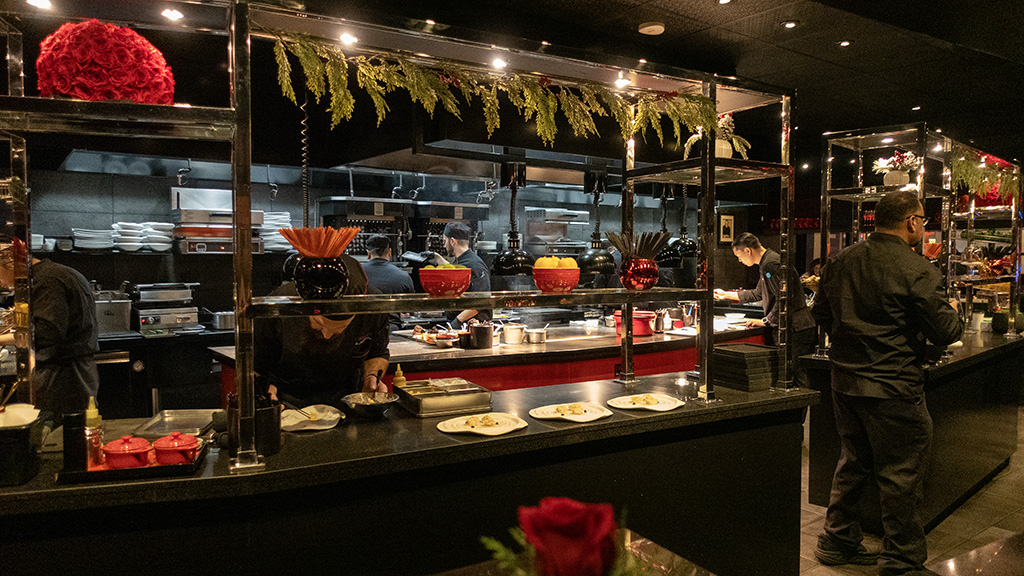
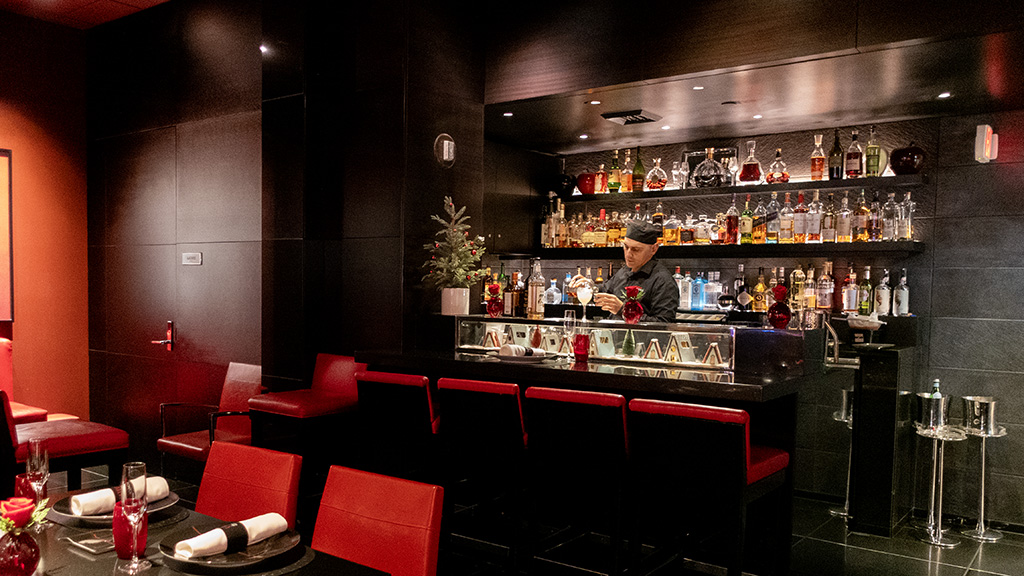
Because I was dining alone, I opted for a seat at the bar so that I wouldn’t be occupying a full table by myself, and so I could see the cooks and chefs in action.
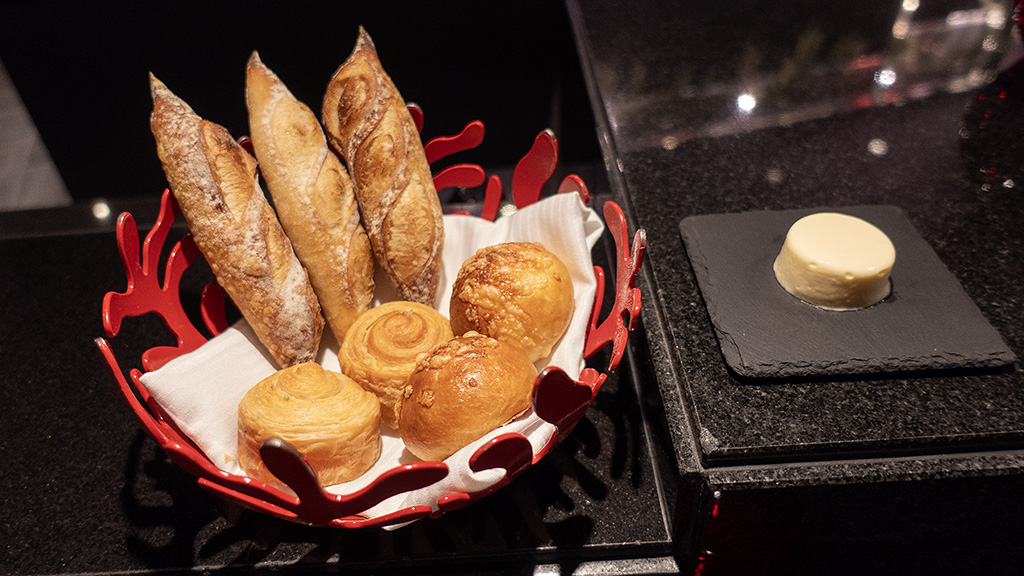
Promptly upon my arrival, I was shown the menus and was served a basket of bread. Throughout my meal, I finished this entire basket of bread on my own, and also ate a few more with a refill.
There were three different types of bread, and each of the various dishes had a certain kind of bread with which it seemed to pair the best. For example, I had the miniature baguettes with the richer and fattier dishes, I ate the croissant with the lighter dishes, and I used the cheese bread to dip into any remaining sauces.
I also just generally appreciated that there was a gigantic portion of unlimited bread to go along with the meal.
One of the complaints that I hear from friends who go to omakase or tasting menu restaurants is how they sometimes leave hungry, which adds an unnecessary sense of disappointment to an otherwise great meal. With that being said, restaurants obviously can’t be expected to serve huge portion sizes to satisfy even the most starving diners. Even though prices are partially set by demand, they’re also set by the cost of the underlying ingredients, so the chef needs to find a good balance between portion size and the overall affordability of the meal.
One way to address this is to give cheap carbohydrates as a bonus filler dish for those who are still hungry. For example, some omakase restaurants will ask if you want more food, and if so, they will give you complimentary scoops of sushi rice until you are satisfied. The way L’Atelier de Joël Robuchon gave me a ton of bread reminded me of the scoops of sushi rice from Japanese restaurants, which I liked. The bread is going to be relatively cheap for them to make, but the return on investment in customer happiness will be huge.
I mentioned this in my recent review of Gordon Ramsay Hell’s Kitchen, but I’ve been short of time lately because I once again did my annual “12 Days of Christmas” live streaming marathon around Christmas and New Year’s time in late 2025. I’m finally getting around to catching up on blog posts, so these photos from L’Atelier are also a few weeks old.
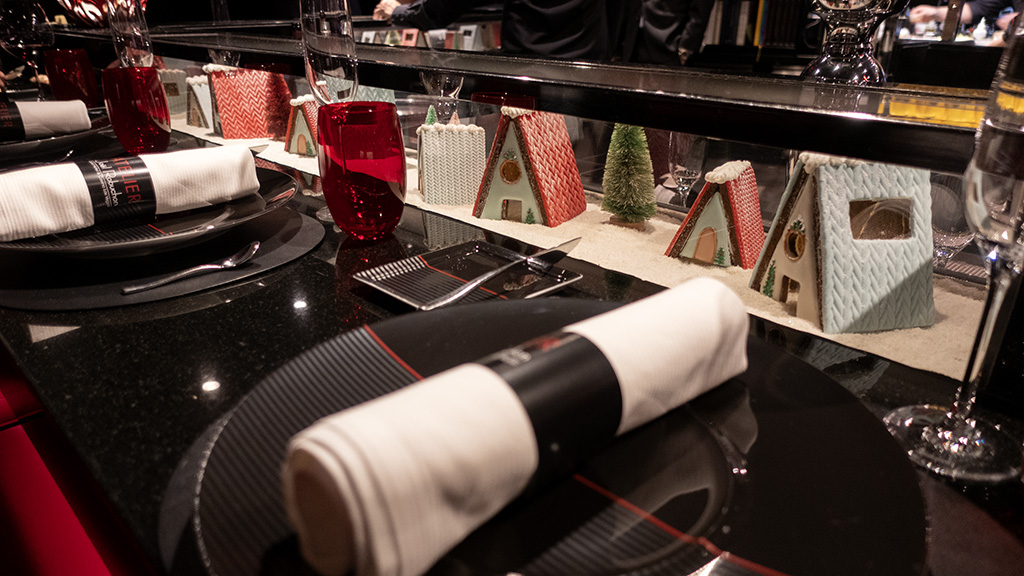
When I dined there, they had winter season decorations set up everywhere, which was a nice, festive touch.
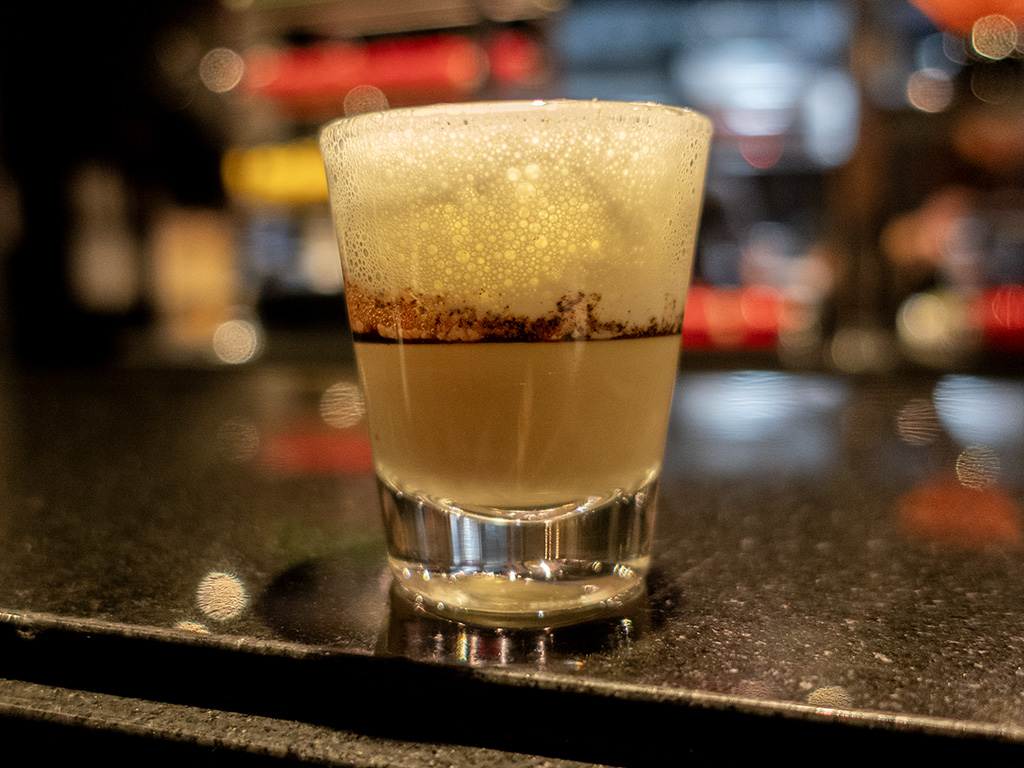
Once I let them know that I wanted to try the seasonal discovery menu and picked my preference of main dish, I was given an amuse bouche to sip on while waiting for my first item. I don’t quite remember what the individual components were, but I recall that it was pretty good.
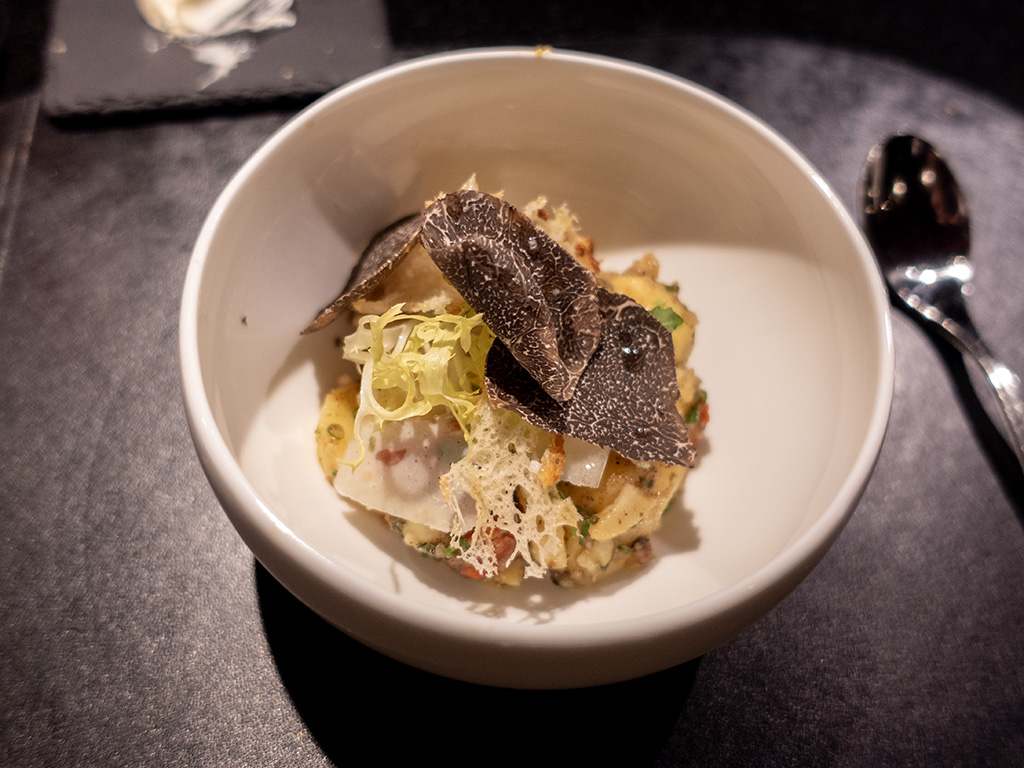
The appetizer was la salade de pommes, which translates to apple salad, with fingerling potatoes, tomato confit, truffle vinaigrette, and fresh shaved black truffle. This was a nice, refreshing start to the tasting menu.
My waiter mentioned that they were offering a special truffle add-on where I could have more freshly shaved black truffle added to additional future dishes for a supplement. Although the truffle on this had a nice, mild, soothing flavor to it, I still opted not to get the supplement so that I could taste the other dishes in the way that the chef originally intended.
The discovery menu had a wine pairing, but because I don’t drink alcohol, I asked for a custom non-alcoholic pairing instead.
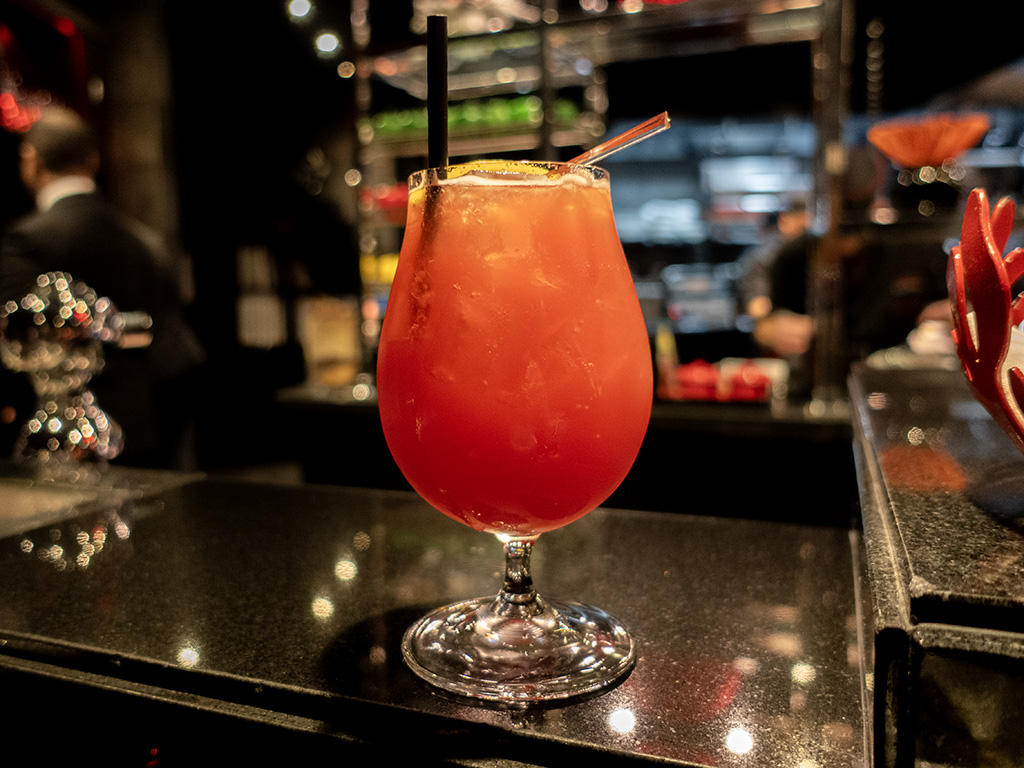
For my first drink, I was served their Blushing Mule made from Seedlip Grove 42 non-alcoholic spirit, lime, house-made raspberry syrup, and ginger beer.
I enjoyed this drink, and I thought it went along nicely mainly with the umami dishes. The intensity of the flavor was quite high, and it pierced through the fattiness very well. I’m also a big fan of ginger, so I thought having that familiar zing of ginger enhanced the overall flavor profile of the drink.
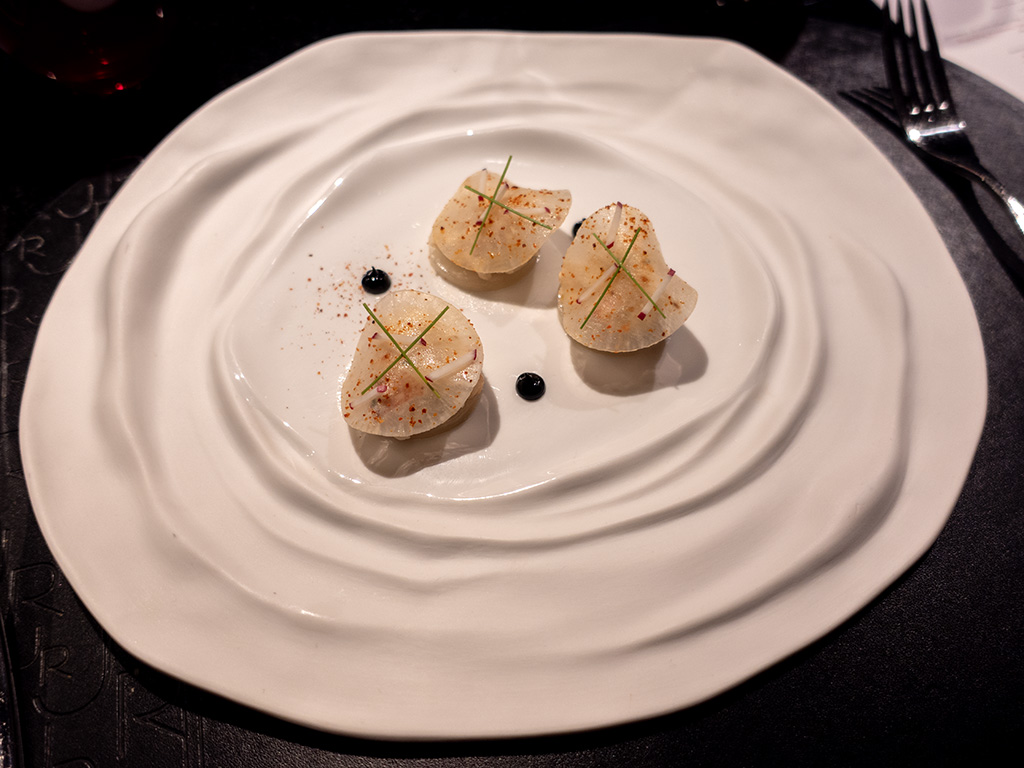
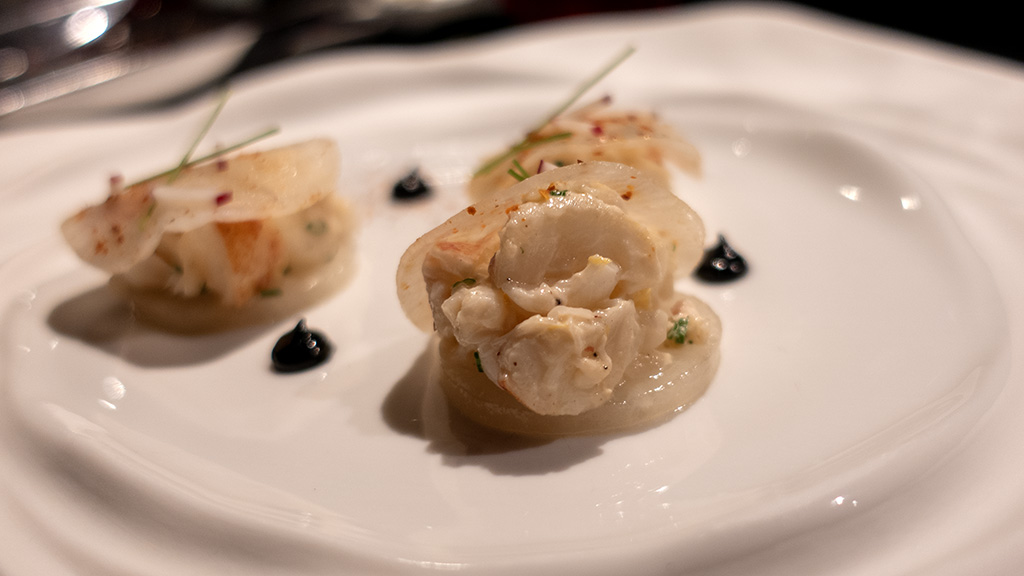
The next dish was la homard royale, which translates to lobster royale. This was a Maine lobster dish served under daikon radish marinated in a honey vinaigrette.
To my limited understanding of French cuisine, I was under the impression that the lobster being called “royale” usually means that it is particularly rich, buttery, and/or creamy. Funny enough, I would consider this lobster dish to be quite crisp and clean, rather than creamy. The lobster itself was lightly coated in a somewhat creamy sauce, but paired with the daikon radish, the overall dish was very refreshing.
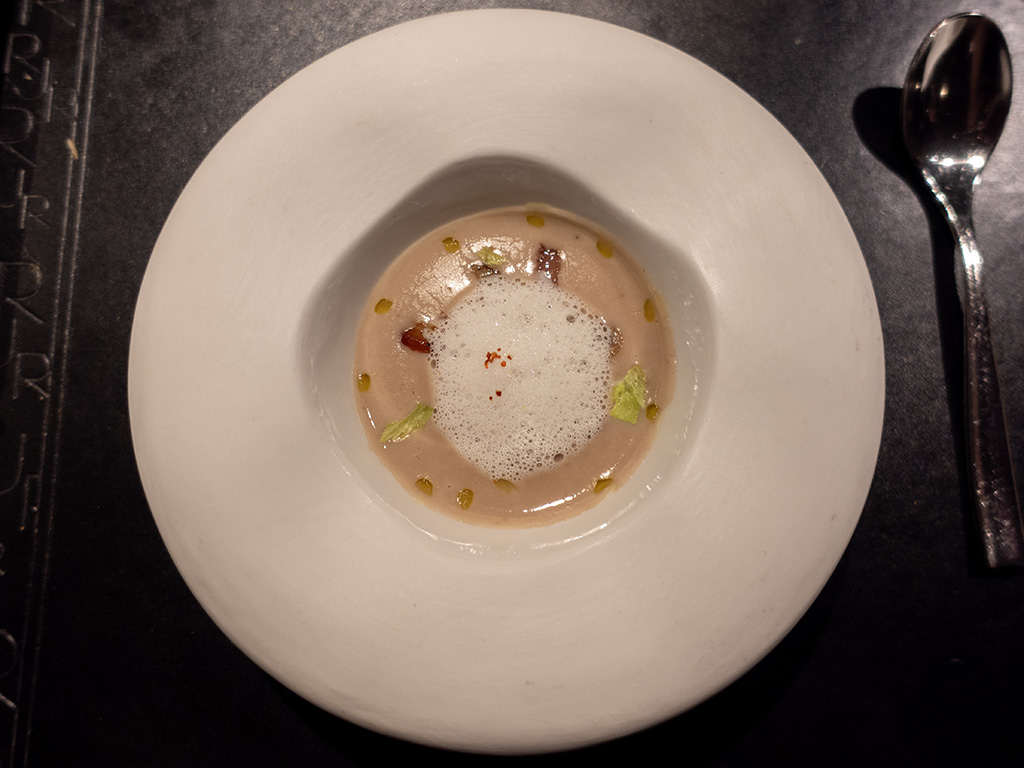
Next was la châtaigne, which was light chestnut velouté flavored with cardamom and lardons.
Although it tasted good, this was probably my least favorite dish of the night. That is probably unsurprising considering that I’m not the biggest fan of bacon, and lardons are strips of fatty pork, which is basically bacon. I particularly appreciated the miniature baguettes and the the Blushing Mule to go along with this soup, as both helped subdue and offset the intense fattiness.
The pacing of the dinner was a bit slower than I would have hoped. Usually when you’re dining solo, dishes feel like they’re coming out slower because you don’t have a conversation with any dining companions to distract you from the wait; with that being said, I go to restaurants by myself with decent frequency, so even after accounting for that factor, I thought it was still a bit slow.
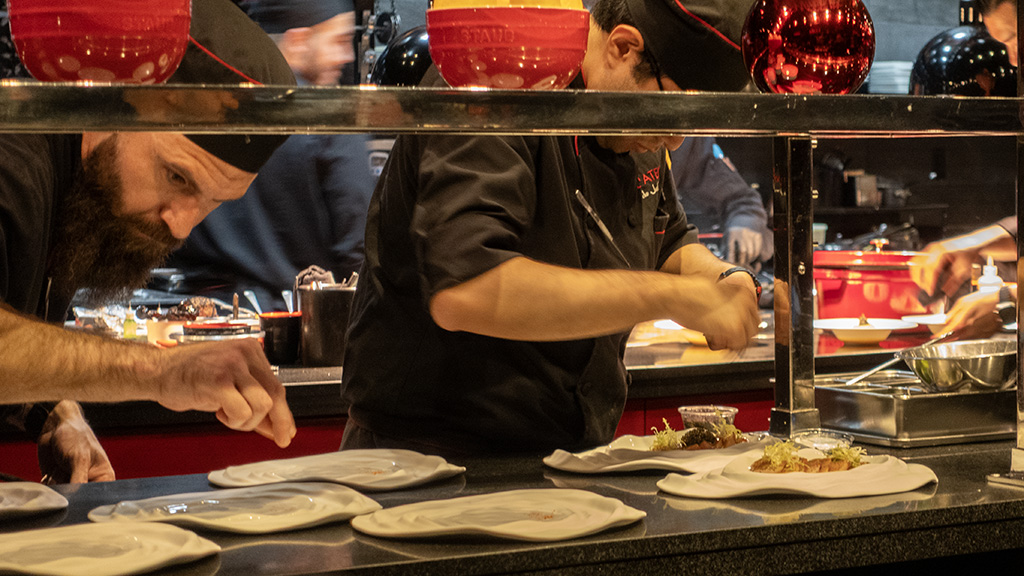
Fortunately, because I was seated at the bar, I had the entertainment factor of watching the cooks preparing other diners’ dishes.
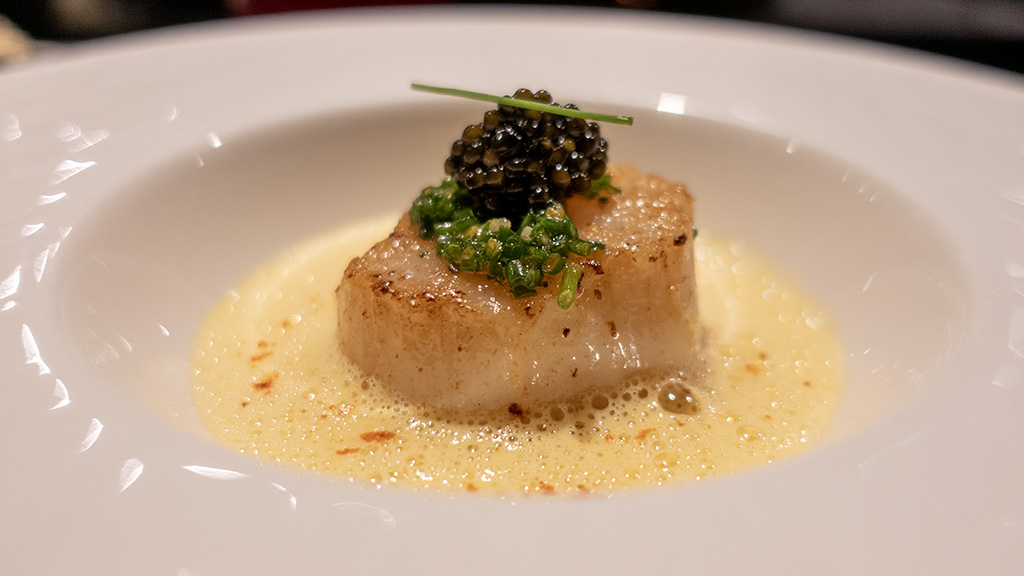
After the soup came la noix de Saint-Jacques, which translates to scallop; it was prepared seared in a kumquat and coconut sauce, and came topped with a portion of caviar.
I thought this was a great scallop. It was cooked to a great level of tenderness where each bite was soft, but the outside had a nice firmness to it from the sear. The caviar had a strong saltiness you’d expect from good caviar, and that saltiness enhanced and intensified the overall flavor profile of the dish. After finishing the scallop, I dipped some bread into the leftover sauce and finished that as well.
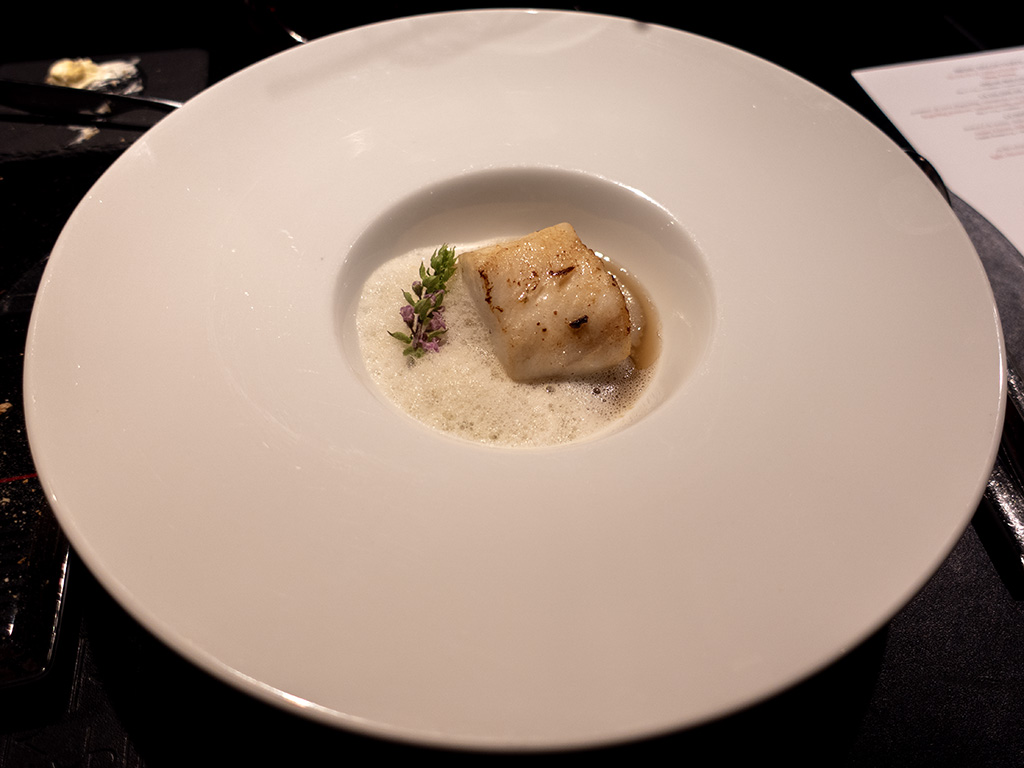
Following the scallop was la morue noire, which translates to black cod, prepared à la plancha and served with mushroom velouté and champagne foam.
I thought the way this fish was cooked made its textural perks similar to the scallop—the inside was soft and flaky, and the outside had a firmer crispiness to it that made the fish taste very good.
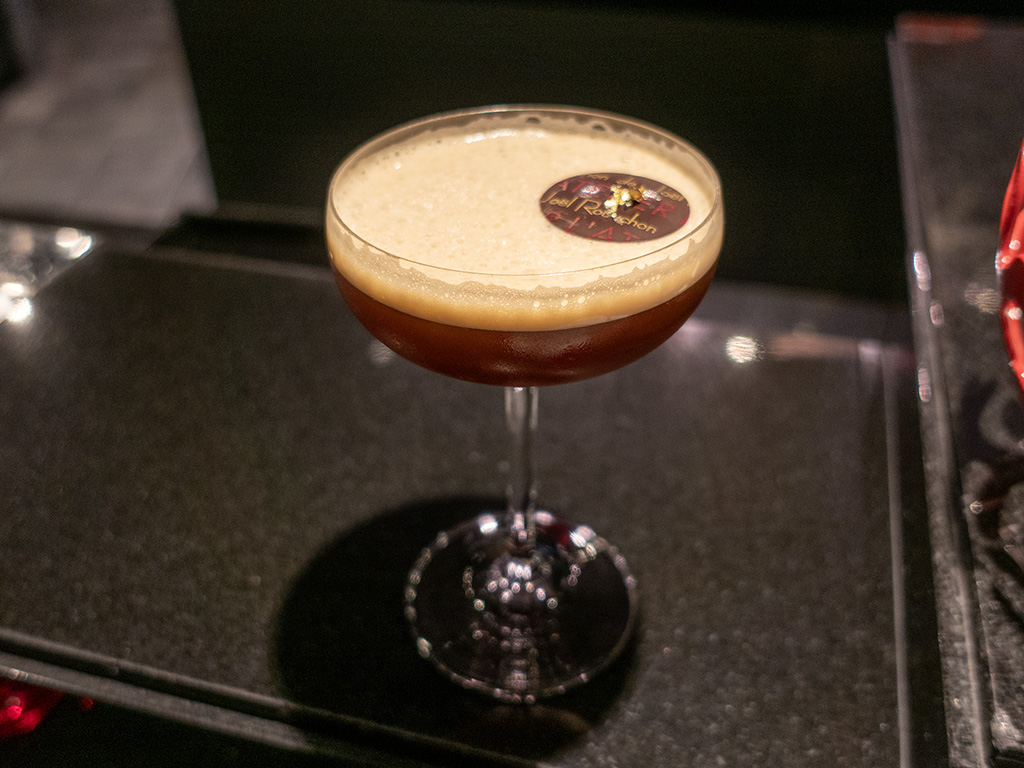
At this point, my second beverage of the non-alcoholic beverage pseudo-pairing came out. It was the café noix de coco, which translates to coconut coffee, made with espresso and coconut syrup. This may be shocking considering how much I like fruity drinks, but I actually liked this coffee better than I did the Blushing Mule.
I would describe this more like a dessert drink than what you’d expect from coffee. Although it was overall pretty sweet, it still retained a good balance of both sweetness and bitterness. When I drank it along with a regular dish, the sweetness was emphasized; when I sipped it with my desserts, the bitterness was emphasized, thus creating a great balance in flavor profile with the sweeter desserts.
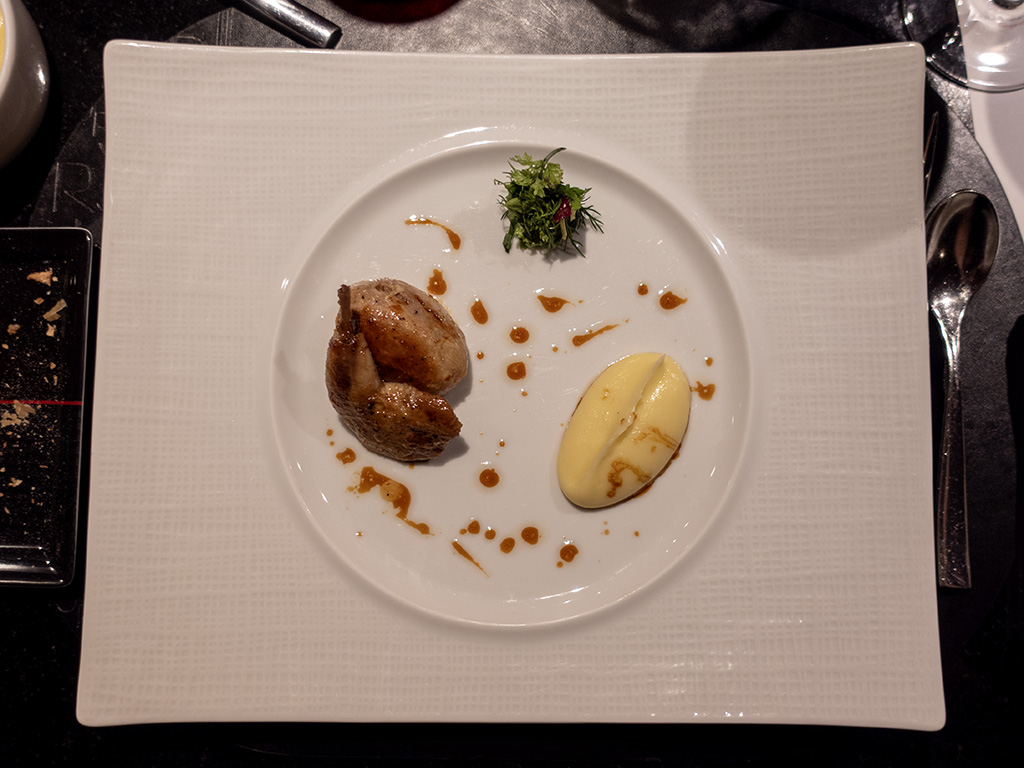
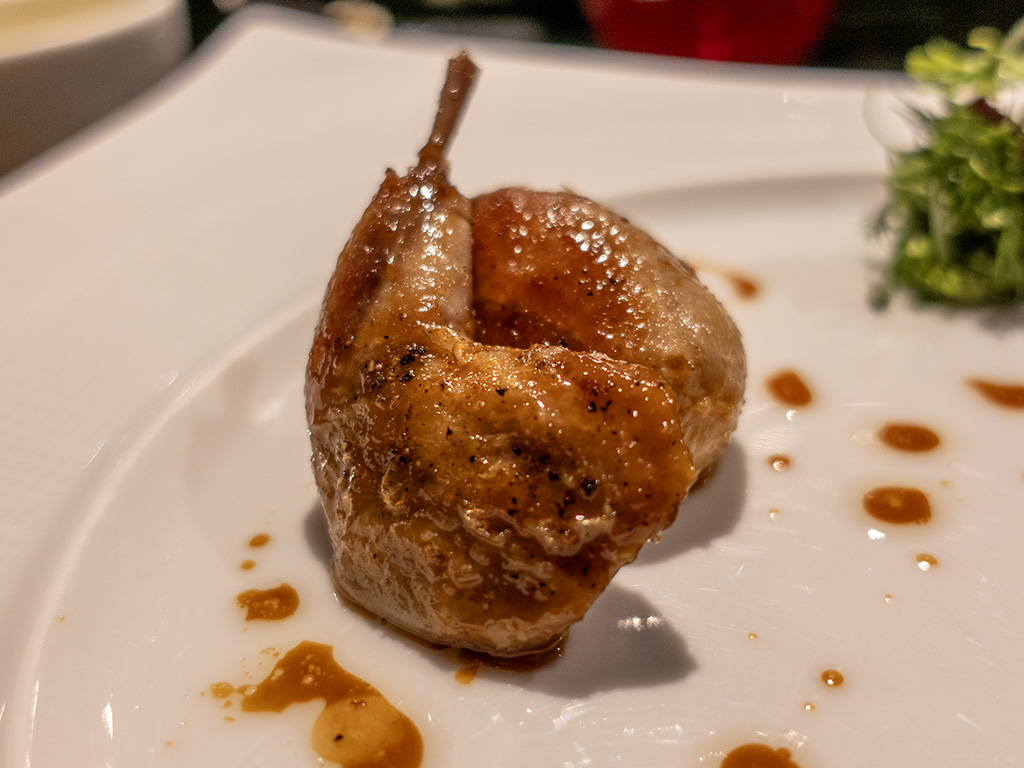
For my main dish, I opted for la caille, which translates to quail, prepared caramelized and filled with foie gras, along with a side of potato purée. There was a very small portion of potato purée served directly on the plate, but they also gave me an additional hearty portion of it on the side in a separate bowl.
The quail was cooked to perfection. The inside was already tender, but the fact that they stuffed it with foie gras made it even better. The outside had a subtle crispiness to it that enhanced the texture profile.
This potato purée might have been the best potato purée or mashed potatoes I’ve ever had. Usually, restaurants will just overload their potatoes with butter so that it tastes better, but if you’re someone who doesn’t eat much butter, the excessive butteriness becomes pretty obvious and off-putting. This potato purée had the deliciousness of a butter-loaded potato purée, but it didn’t taste insultingly fatty and it still had a strong potato flavor.
If it wasn’t for this, then the other option for the main entrée would’ve been le boeuf, which translates to beef, and was a Jack’s Creek New York Strip steak with braised endive, comté, and jambon.
Throughout my meal, some of the waiters who would come to clear my finished plates would also ask how the food was, and I gave them frank and unfiltered feedback each time. The level of detail of my feedback presumably led them to believe and conclude that I have a decent level of familiarity with food, and thus, we developed some rapport over the evening.
Part-way through eating the quail, a waiter checked in on me, and I let him know how much I liked it so far. After hearing my response, it sounded like he was eager to tell me a story that he had been holding in for the past hour or two. Earlier that evening, there was apparently a woman who ordered the quail, was shocked at how small the portion was, and started complaining about how they deceived her. He added on, “maybe she was expecting an entire chicken!”
I chuckled, but was a bit confused, so I looked down at my own plate. I confirmed that they had only served a quail leg and thigh, which is like a quarter of the bird. I looked back up and was about to suggest that maybe she was just anticipating receiving more components of the quail, but by that point… the waiter had already disappeared.
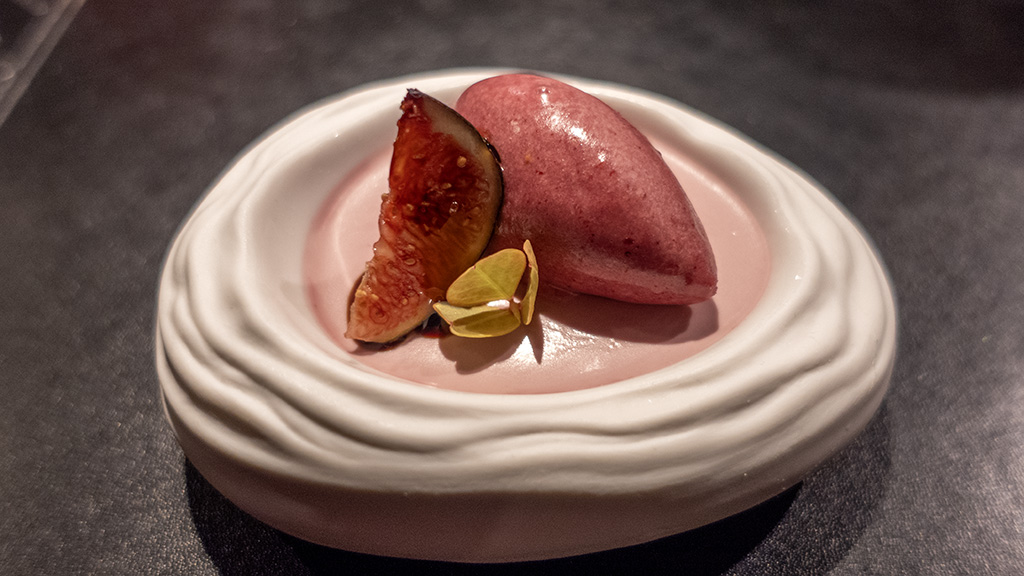
That concluded the main part of the meal, and we were now left with two final desserts. The first dessert was la figue en sorbet, which translates to fig sorbet, served with blackberry panna cotta and fig confit.
I don’t know if I’ve just been eating low-quality or underwhelming fig my entire life, but this fig sorbet and fig confit actually tasted like a naturally sweet fruit. Mixed with the coconut coffee drink I mentioned earlier, this was probably my all-time favorite fig dish.
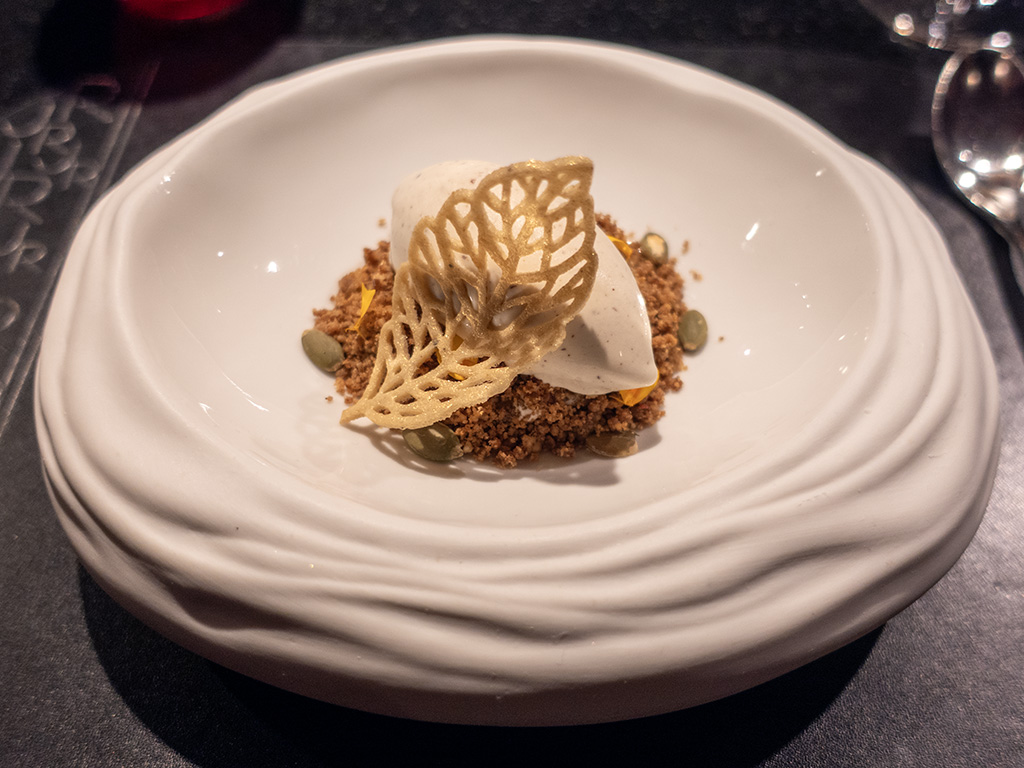
The second dessert was la citrouille, which strangely translates to “pumpkin.” The dish was actually cinnamon ice cream with caramelized honeynut squash and pecan streusel.
I like nutty flavors, so as expected, I liked this dessert. The cinnamon ice cream flavor went along nicely with the streusel, and the crumbly texture of it made the ice cream more fun to eat.
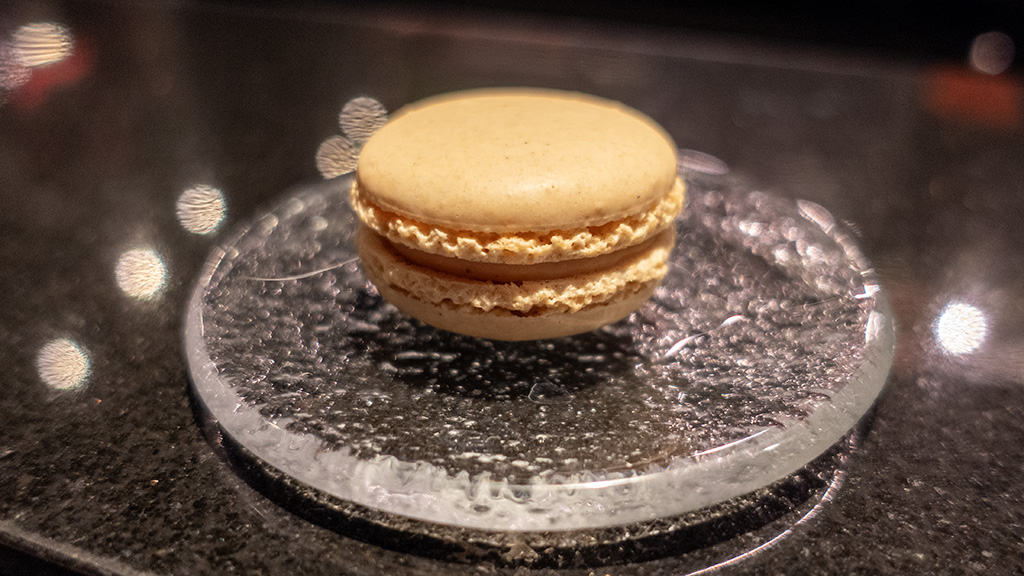
Upon the conclusion of my meal and along with my check, I was given a macaron as my mignardise, also sometimes referred to as a petit four.
After biting into this macaron, it occurred to me that L’Atelier de Joël Robuchon did an overall fantastic job at textures on everything they served me. The macaron was soft on the inside and crispy on the outside as you’d expect from a good macaron, but there was also a ring around the edge of the shell that was extra crispy that added even more depth to the contrast in texture.
I thought all the dishes played around with texture in a more “advanced” way like this, which was nice.
I was seated at the main bar with a view of the kitchen, but there was a separate alcohol bar in the corner; this is what it looked like:
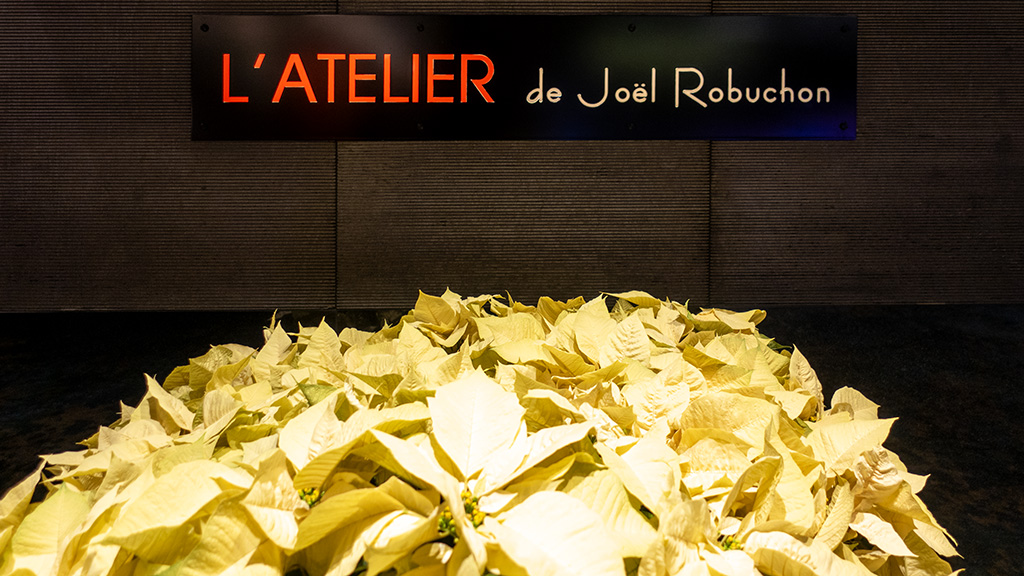
And finally, here is a shot of a flower arrangement situated outside the restaurant:
Seasonal discovery menu
$ 255.00
Blushing Mule
$ 18.00
Café noix de coco
$ 18.00
Sales tax (8.375%)
$ 24.37
Gratuity
$ 45.00
Total
$ 360.37
This table to the right shows how much I paid.
Although this was a very good restaurant, it wasn’t quite at the level of being a particularly stand-out experience. To be clear, the quality of the food was far better than many restaurants I’ve been to, and my taste buds had a great time eating everything. However, there wasn’t anything notably crazy, gimmicky, or memorable about it (which is not inherently a bad thing, and could be considered a positive for some).
This reminded me a lot of Jeune et Jolie, another French restaurant I went to when I was visiting Southern California. I was under the impression that French cuisine fundamentally relies heavily on butter, cream, cheese, and other fatty ingredients to serve as a foundation for their flavor profiles. However, both L’Atelier and Jeune et Jolie had cleaner and more refreshing dishes. This could potentially be attributed to local differences specific to regional specializations within France; if that is the case, then this region of French food is something that I much prefer over other French food I’ve had in the past.
Although I would say that I do recommend this restaurant, it isn’t such a strong recommendation that I would suggest prioritizing it if you have a limited number of days and a limited number of meals to try in Las Vegas. Also, keep in mind that this is quite a high pricepoint for a meal. Even without the two non-alcoholic beverages, this seasonal discovery menu exceeds US$300.00 per person after tax and gratuity.
With all that being said, I think this was a successful “trial” for me for the full-blown dégustation at Joël Robuchon. If I was being really picky about value for money, it might not be worth it, but in that case, I guess a lot of other fine dining restaurants also probably wouldn’t be worth it either. I heard that the complete dégustation can take up to four hours; my experience at L’Atlier took about two and a half hours, and I enjoyed it enough that I would not mind a four-hour version of it in the future as well.
I have the Chase Sapphire Reserve, a premium credit card that comes with a US$795.00 annual fee but makes up for it in cardholder perks. Towards the end of 2025, Chase reworked the Sapphire Reserve give more credits and rebates on certain kinds of spend at certain retailers or websites, in exchange for an increase in the card’s membership fee. Unfortunately, I’m not really a fan of the “coupon book” style of rewards programs where they make you go to a bunch of different places and buy a bunch of different things in order to get full value from your benefits.
For example, I absolutely hate the StubHub credit. I think these ticketing websites are a huge rip-off that charge exorbitantly high fees for providing a service that has minimal value. I am eagerly waiting for someone out there to make a great piece of easy-to-use ticketing software so that it becomes industry standard for venues to install it in-house on their own websites (similar to how my blog is run on a customized version of WordPress) and forego these ticketing monopolies like Ticketmaster altogether. For events that already do have their own in-house ticket selling systems, I checked on StubHub for those same tickets to see if it was worth tapping into the Chase credit for it instead, and tickets on StubHub were literally over double the price compared to just buying it direct from the organizer.
Luckily, Chase does have one new perk that is worth it for me: the OpenTable credit. Although their selection of restaurants that qualify for the credit is fairly limited (i.e., it’s not just any restaurant available on OpenTable), there are some decent options in there. I like going out and trying interesting new spots, and I like taking guidance from curated lists of restaurants because it encourages me to expand my scope of dining outside of my routine preferred cuisines.
The OpenTable credit refreshes every half year, and the cut-off for the first round of US$150.00 in credits was the end of 2025. So, in late December, I decided to try out Gordon Ramsay Hell’s Kitchen at Caesars Palace on the Las Vegas Strip in Paradise, Nevada. (Yes, that does indeed mean that these photos are more than two weeks old; I have been short of time lately because I did my “12 Days of Christmas” live streaming marathon event again around Christmas and New Year’s, and I am now finally finding a chance to catch up on blog posts.)
I decided to order the three-course prix fixe menu along with a non-alcoholic beverage. Although often served with predetermined dishes as designated by the chef, this prix fixe menu offered two options, one of which was for the first course.
For my starter, I ordered pan-seared scallops topped with braised short rib and served alongside Brussels sprouts and delicata squash in a celery root puree. Although the presentation seemed a bit chaotic due to the seemingly unorganized and disheveled nature of the individual food items, it was actually quite good taste-wise. The scallop was a good balance of firm and tender, and I thought the flavor combination worked pretty well together.
My friend, on the other hand, opted for something else for his first course—roasted beets and burrata with prosciutto di Parma, Medjool dates, dukkah, clementines, and shallot vinaigrette. He picked this instead of the scallop because he doesn’t eat seafood (and yes, if this sounds familiar, this is indeed the same friend from my blog post from almost 10 months ago with whom I went to Stubborn Seed at Resorts World).
I sampled some of this, just to try it out and see how it tastes, in anticipation of writing about it on my blog. I ate one piece of the beets. I don’t really know how else to describe it apart from “very beets.”
The mocktail I picked was the Hell’s Red Infusion, made from apple, strawberry, rhubarb puree, and simple syrup in ginger beer.
When I took my first sip, I don’t think I mixed it well enough, because it was almost like I took a big swig of a highly-concentrated fruit smoothie. After going back and mixing it more thoroughly though, it became much better—the texture smoothed out, and the drink was sweet but not too sweet.
I’m curious whether the sweetness ended up becoming more subdued overall because I had accidentally taken a big gulp of the sweetest part upfront. Regardless, it ended up being better that way, because I don’t like excessively sweet things anyway.
I guess my friend thought the tasting menu wouldn’t be enough for him, so he ordered an additional bowl of mac and cheese.
This was my least favorite dish of the meal. I think this would probably be fine for someone who likes intensely cheesy and greasy foods, but for me, it was mouth-coatingly cloy. I stopped eating more after a single piece of macaroni in fear that the aftertaste of the cheese would negatively affect the flavor profile of the upcoming course. Luckily, the Hell’s Red Infusion had enough of an acidic fruitiness to it that it cut through that fat and helped reset my palate.
It’s time for a short intermission.
I often don’t eat at celebrity chef restaurants. I have no issue dining at restaurants branded under the name of a chef who got famous simply for being a world-class chef, but I avoid restaurants named after celebrity chefs who earned their fame off the basis of a television show or social media. I’ve grown a significant distrust of online influencers, and with the few examples that I do have from trying out celebrity chef restaurants anyway (like Guy Fieri’s Vegas Kitchen & Bar at the LINQ), it just reinforced my notion that I should stick with restaurants run by regular chefs who focus more on their food than on being a broadcast personality.
With that being said, I still wanted to try one of Gordon Ramsay’s restaurants, just for the experience. I vaguely recall joining my friends at a Gordon Ramsay restaurant almost ten years ago when I first visited Las Vegas and before I moved here, but I didn’t order anything, and I don’t even remember which Gordon Ramsay restaurant it was. Since then, I’ve seen a lot of videos about his iconic beef Wellington, so I figured I should try it at least once so I know what it’s like.
Back to the food. Fortunately, although the prix fixe menu came with only one option for the main course, it ended up being the beef Wellington—a black truffle beef Wellington served together with potato purée and a side of glazed root vegetables atop a red wine demi-glace. There were three ways to order it: with a foie gras add-on, with a lobster tail add-on, or with no enhancements. I knew for sure that I wanted to supplement a lobster tail, but I was considering asking whether I could get both add-ons instead of just one; I ultimately just went with the lobster tail as to not make the dish too overwhelming.
Believe it or not, I actually really enjoyed the beef Wellington. The meat was cooked to a great doneness level and was very tender. The puff pastry was nice and flaky, but still had a very subtle dougheyness to it that enhanced the texture. The vegetables were cooked in a way such that they had a good balance of firmness and softness. The lobster tail, although not particularly remarkable, was still a solid addition.
For the third and final course, I was served sticky toffee pudding topped with a scoop of speculoos ice cream for dessert.
The portion size on this was quite unexpectedly large. It was a bit too sweet for my personal preference, but it was still refreshing compared to the very rich beef Wellington that I had just finished. I also particularly enjoyed trying the speculoos ice cream, as that’s not a flavor that I have tried before, and I don’t often have an opportunity to eat even speculoos-adjacent flavors of ice cream in general.
This is a photograph I took of the front entrance area upon arrival. There was a large screen right at the door displaying a video of Gordon Ramsay speaking. Funny enough, I don’t remember a single word he was saying because I was too busy staring at the fact that he was basically wearing running shoes instead of standard slip-resistant clogs or work boots…
This was the bar area right near the entrance.
Deeper into the restaurant, this was the main dining area. My friend and I were seated at an edge table in the left-side area of the photograph, while the kitchen was just off frame to the right of the photograph.
This was the kitchen area. We didn’t pay the extra mark-up to be seated near the kitchen, so we didn’t have a good view of it while we were eating, but this area was wide open enough that I was able to just walk right up to it after we were finished dining and take some close-up pictures without needing to disrupt other customers.
This is a view of the front of the restaurant. Even though this Hell’s Kitchen location is marketed as being part of Caesars Palace and has the same street address as Caesars Palace, they don’t actually share the same building. Hell’s Kitchen is right up to Las Vegas Boulevard, nearby the Caesars Palace fountains in front of their main lobby entrance.
Here’s what the view looks like if you’re standing in front of Hell’s Kitchen and looking westward towards Caesars Palace and the Bellagio (with the Cosmopolitan and a small slice of the Vdara in the far distance).
Dinner prix fixe menu ×2
$ 271.90
Lobster tail add-on
$ 25.95
Mac and cheese
$ 17.95
Hell’s Red Infusion mocktail
$ 13.95
Sales tax (8.375%)
$ 27.62
Gratuity
$ 50.00
Total
$ 407.37
This table to the right shows how much we paid. This table does not show the aforementioned OpenTable dining credit; you are supposed to pay the full check at the restaurant, and then the US$150.00 gets deducted after-the-fact on your credit card statement.
My final verdict is… I would’ve liked it if I didn’t look at the price. The food was unexpectedly quite good, but not so good that it would warrant paying over US$200.00 per person for the meal. I think if the prix fixe included either the foie gras or lobster tail as part of the menu at no additional cost, and also provided a complimentary soft drink, then I think the base US$135.95 pricepoint for the prix fixe would be reasonable. However, with all of those being supplementary, the core prix fixe menu seems marginally underwhelming.
With that being said, it was surprisingly quite packed, even though it was early on in the evening during a weekday when you wouldn’t expect it to be so busy. Considering the popularity of the restaurant, it seems that natural supply and demand has determined these high prices, so I guess there isn’t much I can say about that.
One very interesting phenomenon I experienced at Gordon Ramsay Hell’s Kitchen that I have never before seen at another restaurant is how brutally efficient everything was. When you put in an order at a restaurant, you usually have to wait a bit for the food to come out. However, at Hell’s Kitchen, the food came out shockingly fast. I realized that this was probably a side effect of making the prix fixe menu their prominent, flagship option for dinner, and with the high volume of customers ordering it, the cooks can reliably constantly pump out the three core dishes over and over again without concern of the dish not being ordered. Consequently, those three dishes are always readily available to be served to diners with minimal wait time.
Although I enjoyed my dinner, I personally would not dine here again, and I see it more as a one-time-only kind of experience. As for others, I would probably only recommend this to people who either also have the Chase Sapphire Reserve OpenTable credit to use specifically in Las Vegas, or for people who are big fans of Gordon Ramsay who want a fun Hell’s Kitchen experience and are willing to pay a mark-up for the ambiance and the significance of the brand.
To fulfill what has become a seasonal tradition for me, I just went back again to the Bellagio Conservatory & Botanical Gardens inside MGM Resorts’ Bellagio Resort & Casino on the Las Vegas Strip in Paradise, Nevada. If you’re not familiar with it already, the Conservatory is an area near the registration and check-in desk of the hotel where designers build themed sets that are decorated based on the season.
I was there to check out their winter installation, “All Aboard for Holiday Bells and Whistles.” Yesterday was actually the last day to see this installation, as they’ve already gone into their dark days to swap everything out to the Lunar New Year 2026 exhibit. In case you missed it, I took plenty of photographs during my last-minute visit before they closed down.
I talked about this in much greater detail last week in my blog post reviewing Magical Forest at Opportunity Village, but in summary, I’ve had a renewed and more positive outlook on winter over the past handful of years, and I’ve lately been seeking out some seasonal, holiday-themed places to check out in my free time.
Another popular holiday-themed spot in the Las Vegas Valley is the Ethel M Chocolates Factory and Cactus Garden in Henderson, Nevada. Each year throughout most of November and December, their cacti are adorned with holiday lights for an annual tradition that has apparently been going on for decades. I was heading out of Las Vegas soon for my next trip, so before I left, I squeezed in a visit to the chocolate factory and garden.
I timed my visit so that it was early enough that their chocolate factory was still open, in hopes of being able to see the chocolate production process and potentially get a tour, while still being late enough that the sun would set while we’re on-site and the lights on the cacti would be illuminated.
I’m not entirely sure what went wrong with the timing—I assume I was just a bit too late—but when I showed up, the little podium near the factory area was vacant (which I assume is where the tour registration attendant or docent would have be stationed), and it didn’t seem like there was much activity going on inside the production room. There were still windows looking in though, so even though I didn’t get a proper tour (if there were even some available at all), I still got to take a look at the equipment.
After seeing all the machinery, I headed over to the retail area of the store.
The only time I eat chocolate nowadays is if I get it as part of a dessert at a restaurant off a tasting menu. Otherwise, I avoid it because I taste nothing but bitterness from dark chocolate, while other sweeter kinds of chocolate just seem to be an unhealthily high source of sugar. Knowing that, it’s probably unsurprising that I didn’t want to buy anything that was for sale. However, it was still amusing taking a look at the vast assortment of different available options.
My friend decided to buy some dark-chocolate-dipped Swiss candied orange slices.
I didn’t want to be too un-fun, so I figured that grabbing a beverage from their Cactus Garden Café wouldn’t hurt. I decided to try out their peppermint hot chocolate, which came with an incredibly steep price of US$9.00 for a 16 oz. portion size, but ended up being some of the most delicious hot chocolate I think I’ve ever had.
Warm drink in hand, I headed out into the cactus garden and stood in line to purchase an admission ticket.
The line was incredibly long and was split into multiple different lanes, but I noticed that one of the lanes off to the side was not being used. I suspect that everyone else thought that wasn’t a proper lane because they saw so few people standing in it, so they all crowded into the other lanes. I, on the other hand, am a thrill-seeking risk-taker when it comes to figuring out ways to not have to wait in line, so I walked down that empty lane to find out… that it was indeed a proper lane. I got to cut what I imagine was over a hundred people who would have been in front of me.
Admission was only US$3.00, which I guess more than makes up for the expensive hot chocolate.
In no particular order, here are a bunch of photographs I took throughout the Cactus Garden.
The garden’s path was winding and self-intersecting, so there wasn’t a clear linear route to take to walk through the garden. Because of that, I ended up doubling back multiple times and going in circles to make sure I saw everything before I left.
Even though the items for sale inside the store were pretty pricey, you can’t really beat and get much more value than what you receive with the $3 admission ticket to the Cactus Garden. You can tell that the garden was designed with the community in mind, i.e., even if the retail area was intended for profit, the garden is intended to serve as a pleasant gathering place for friends and family. At that price point, it seems like their objective is simply to break even with the garden after the extra staffing and electricity costs.
If you’re within a reasonable distance of the southeast Las Vegas Valley, I highly recommend checking out Ethel M Chocolates Factory and Cactus Garden. I thought it was quite good at instilling holiday spirit, and I felt it had a blissfully joyful vibe to it overall.