Investing US$10,000.00 in the stock market – Parkzer vs. DougDoug’s Twitch chat

Disclaimer: I am not a registered investment advisor and do not have the qualifications to become one. Even if I was one, I would not be your investment advisor; to you, I am nothing more than a random guy on the Internet writing in his personal blog. This content is intended for comedic and en­ter­tain­ment purposes only. Everyone’s situation is uniquely different, so consult a certified professional if you need guidance with your own financial strat­e­gy.

 
A few days ago, my friend Doug Wreden, a broadcast personality who streams on Twitch and makes video content on YouTube, asked if I wanted to join in on a live event he was doing with his community where, together, they would invest $10,000 into the stock market. Unfortunately, I was overloaded with time-sensitive work that entire day and couldn’t join in live, but we decided to do the next best thing, which was for me to participate after-the-fact.

Thus, “Parkzer vs. DougDoug’s Twitch chat” was born.

 
Rules:

  • Invest US$10,000.00 into ten individual companies (no index funds, mutual funds, ETFs, or bonds).
  • No active trading is permitted after the initial purchase (though reinvesting dividends is allowed), and stocks must be held for one year.
  • The winner is the team with the highest account balance after one year.
  • Any profits beyond cost basis will be donated to charity.

 
Doug has very little investing experience (apart from purchasing Dogecoin as a joke and making a +800% return), so he relied on his community’s as­sis­tance to research companies and pick out the best stocks. Doug uses Robinhood as his brokerage, so that basically speaks for itself. On the other hand, investing and wealth management is one of my favorite hobbies, and I’ve taken it very seriously ever since my first paying job.

However, I knew I couldn’t let this make me get complacent. There are plenty of studies proving that even monkeys randomly throwing darts on a wall of stock ticker symbols can consistently beat investment advisors. Just because I’ve been doing this for longer doesn’t necessarily mean I am go­ing to perform better by default. I needed to es­tab­lish a plan.

 
First, I had to make some predictions and assumptions about what would happen in the coming year. Nobody can predict the future, but what I can do is use current events and cultural trends to make educated guesses. From there, I had to determine which sectors of the market are more and less likely to perform well in the given conditions. Next, I found some companies within those aforementioned sectors that I thought had potential for growth. Fi­nal­ly, I had to trim down my list to ten of my best candidates.

 
I made three major assumptions upon which I would base my investment decisions:

  1. I think the coronavirus pandemic will continue through sinusoidal phases of getting better and worse throughout the year. Although the latest var­i­ant has not been as deadly, it has evolved to become far more contagious. We don’t know how it will mutate next, and with people getting com­pla­cent, this is a ripe opportunity for COVID-19 to cause great damage when we least expect it, resulting in a stock market crash.
  2. I think it is more likely for the stock market to stabilize or fall than it is to rise in the coming year. I think the current state of the stock market is not as healthy as it may seem—it is only this high due to absurd inflation and government policy stimulating economic growth. Once things return to normal and people start repaying their COVID-19 disaster relief loans, money will be taken out of circulation and the stock market will revert back to what it “should” be.
  3. I think the development and modernization of core systems will get faster. Technology companies did well the past few years, but it will still re­quire more work to roll out their advancements infrastructurally so it turns from a luxury into something more commonplace. In simpler terms, I think we have a lot of great concepts, prototypes, and first-generation innovations, but now is the time to keep pushing development so it can be used not only by the elite, but also by the general public.

 
With my grim outlook on the future of the stock market, it is clear that I would have to pick sectors that perform well during a recession. Out of the sec­tors defined under the Global Industry Classification Standard (GICS), I knew I wanted to focus on the following:

  • Consumer staples. No matter how bad the economy, people still need to eat and use core household products. When people have less disposable in­come, they tend to shift their money away from consumer discretionary and into consumer staples.
  • Healthcare. Just because the economy is bad doesn’t mean you’re not going to get sick. On top of that, we are still in the middle of a pandemic caused by a virus that is actively mutating. The healthcare industry is booming, ignoring the fact that that’s probably not the most sensitive way to describe people’s misfortune.
  • Utilities. Similar to the above, people still use utilities during a recession, even if they might try to conserve spending and be more conscious of waste­fulness.
  • Real estate. Again, as you might have guessed, people still need a place to live, even if the economy is bad. However, real estate also bundles in de­vel­op­ment projects, which ties in with the infrastructural advancements I mentioned above that I think will happen.

 
I picked three well-established, reputable companies from each of the sectors above, plus three companies from the remaining sectors not listed above. From there, I took the list of 15 and narrowed it down to 10.

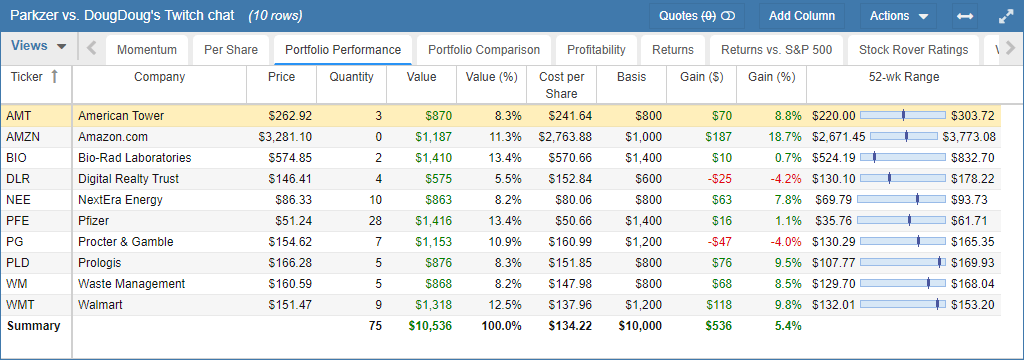
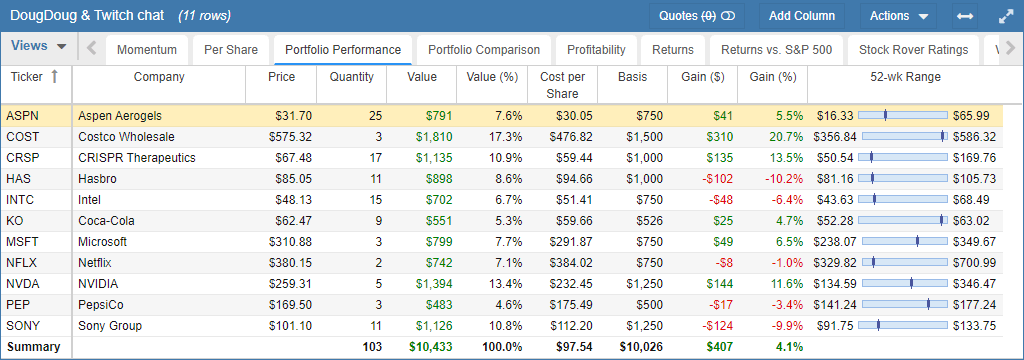
Here are my ten stocks picks with the amount of money I allocated to each company, alongside Doug and his community’s stock picks and their al­lo­ca­tions:

NextEra Energy, Inc. (NEE)

$   800.00

Waste Management, Inc. (WM)

$   800.00

Proctor & Gamble Co. (PG)

$ 1,200.00

Walmart, Inc. (WMT)

$ 1,200.00

Bio-Rad Laboratories, Inc. (BIO)

$ 1,400.00

Pfizer, Inc. (PFE)

$ 1,400.00

American Tower Corp. (AMT)

$   800.00

Prologis, Inc. (PLD)

$   800.00

Digital Realty Trust, Inc. (DLR)

$   600.00

Amazon.com, Inc. (AMZN)

$ 1,000.00
 

NVIDIA Corp. (NVDA)

$ 1,250.00 

Aspen Aerogels, Inc. (ASPN)

$   750.00 

Sony Group Corp. (SONY)

$ 1,250.00 

Netflix, Inc. (NFLX)

$   750.00 

Intel Corp. (INTC)

$   750.00 

CRISPR Therapeutics, AG (CRSP)

$ 1,000.00 

Hasbro, Inc. (HAS)

$ 1,000.00 

Microsoft Corp. (MSFT)

$   750.00 

Costco Wholesale Corp. (COST)

$ 1,500.00 

The Coca-Cola Co. (KO)
PepsiCo, Inc. (PEP)

$ 1,000.00*

*The $1000 for Doug’s final stock selection is split evenly between Coca-Cola and Pepsi as a mini-game between “A Crew” and “Z Crew,” two halves of Doug’s Twitch chat community split by the first letter of their username, to see which brand (and consequently, which crew) has a higher return on in­vestment.

From these stock picks, I think it becomes fairly clear that my portfolio was built not to grow faster, but to decline slower. Thus, if the economy con­tin­ues to do well, Doug’s portfolio will defeat mine, but the economy slows down, my portfolio’s balance will conclude the year higher.

 
I’ve loaded all of our stock picks into some portfolio analysis software, and I might do quarterly (or even monthly, depending on level of interest) re­ports on the performance of our portfolios, showing who is in the process of winning. At the very least, I’ll be providing some statistics, charts, and tables for Doug to be able to review on his live stream.

Seeing as this is ultimately going to be for charity, I wish great success for Doug and his Twitch chat… with the caveat that his portfolio yields 1¢ less profit than mine. GL


Edit (January 28, 2022):

It’s been a week since we started this little competition, so I decided to go back and edit this blog post to add in some bonus content in the form of charts and a graph.

First, one thing to note is that, if you’re attentive to the numbers, you’ll notice that Doug’s cost basis is not a flat $10,000.00. This is because, when he was picking out stocks on his Twitch stream, he intended to invest $500 in Coca-Cola (as in, the competitor to Pepsi), but instead, he accidentally invested it into the Coca-Cola Bottling Co. Consolidated. This happened because the bottling company’s ticker symbol is COKE, while the Coca-Cola Company’s ticker symbol is KO; Doug and his Twitch chat got those two mixed up.

After I informed Doug of this error, he sold all his shares of COKE and realized $26 in profit, then put all $526 into KO. I was not aware that he was going to do this, otherwise I would have advised him to only put $500.04 back into KO, because that would’ve been the equivalent return on investment from KO from that time period. Thus, because of the transaction, Doug’s numbers are going to be a little bit off.

Hopefully the final results won’t come down to $26, but if our portfolios are indeed within $26 of each other at the end of one year when we determine the winner, we’re going to need to do a bit of math to see how much this affected Doug’s earnings.

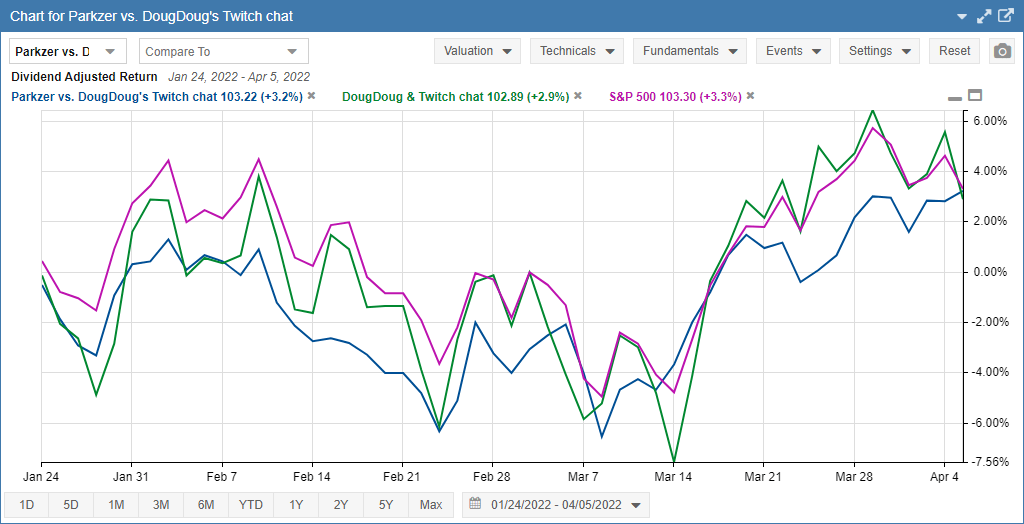
After five market days, this is how our portfolios are looking right now:

For comparison, if we had invested the $10,000 into the S&P 500 instead, it would have grown to $10,230—$97 higher than my portfolio, and $363 higher than Doug’s.

Here is a graph of the price change of each of our portfolios, alongside the chart for the S&P 500. Keep in mind that these are by percentage, and are relative values, so this might not be the most intuitive graph. I ideally would have wanted to graph the total value of each of our portfolios over time in dollar amounts, but it seems like that is not a feature offered by my portfolio tracking and analysis software.


—§—


Investment allocation breakdown for 2021 Q4

Another quarter, another investment allocation breakdown. Note that this is a series and a lot of the commentary in this breakdown builds off the pre­vi­ous breakdowns, so I recommend that you take a look at my investment allocation breakdown for 2021 Q3 first, if you haven’t already.

Like always, keep in mind that I am not a registered investment advisor, and even if I was, I would not be your advisor. To you, I am nothing more than a guy on the Internet writing on his personal website. This blog post is intended to be strictly anecdotal, and I am in no way suggesting or implying that you should copy my strategy. Everyone’s situation is uniquely different, so be sure to consult a certified professional if you have any questions or need any guidance with your own financial strategy.

Cash

Again, at the end of this quarter, I’m still a little bit high on my cash allocation.

However, I have a good reason for it this time—it’s the end of the tax year. One of my favorite things to do on January 1 of every year is to max out my retirement and tax-advantaged accounts, such as my Roth Individual Retirement Account (IRA), Health Savings Ac­count (HSA), and Simplified Employee Pension Individual Retirement Account (SEP-IRA) (to the extent that I can predict a base­line of the coming year’s net income).

Because of this, I have a hefty chunk of cash waiting for January 1, 2022 so I can dump it into all these accounts, primarily because I prescribe to the philosophy that time in the market is better than attempting to time the market, and also because I don’t particularly have a propensity towards gambling or taking financial risks.

 11.76%

Index funds – Domestic

There has been very little change when it comes to my index fund investment strategy—I put a majority of money into broad-market index funds and leave it there to passively grow. I don’t really have additional comments for this category.

 28.43%

Index funds – International

This section is the same as above—there are no substantial changes since last quarter, and I don’t have any additional commentary for this category.

  8.00%

Target retirement funds

Just to clarify, the percentage allocation in target retirement funds is shrinking not because I’m taking early distributions or anything, but because my wealth in general is growing, so I’m consistently putting money into other areas of my portfolio, while I only con­trib­ute money to target retirement funds twice a year (once on January 1 and once when I finish my annual tax return and know my max­imum SEP-IRA contribution amount for the previous year).

As a side note, I briefly touched on this the very first time I did an investment allocation breakdown nearly a year ago, but I figured I’d comment on these two points again with a bit greater detail:

First, the reason I separate this category out is because target retirement funds are managed by a brokerage as a mutual fund that auto­matically adjusts its asset mixture over time. Because of this, at any given moment, a target retirement fund can have a different allo­ca­tion of all the different kinds of categories I present in this breakdown.

For example, a portion of my target retirement fund holdings is in VFFVX, which, as of the final day of last month, is composed of 54.9% of the total domestic stock market, 35.5% of the total international stock market, 6.6% of the total domestic bond market, and 3.0% of the total international bond market. Going through and checking on the allocation each quarter and disbursing the per­cent­ages to each of my existing table categories is a hassle, so I decided to just give it its own row in the table.

Second, the reason I use a target retirement fund with a marginally higher management fee, as opposed to managing my allocation my­self, is because I want to leave my retirement accounts in a “set it and forget it” state. I already actively tweak my portfolio al­lo­ca­tions in my regular brokerage accounts, and I’m fine with letting my tax-advantaged retirement accounts grow passively without my attention.

 19.83%

Real estate investment trusts (REITs)

I’ve continued to add more money to REITs, and my percentage allocation has increased since last quarter. In my previous breakdown, I explained why I’m investing more in REITs now, and in summary, it is just a way to try and spread my money out to diversify against a potential stock market crash.

I’m also sort of treating this like my “down payment fund” on a house. If real estate prices stabilize and I end up purchasing a property sometime in the near future, I’ll probably sell some of my REITs and use it to buy the aforementioned property to ensure that I’m still maintaining good diversification and not overinvesting into real estate.

 17.76%

Bonds

I’m always doing research and learning more about finance, and I recently learned about Series I Sav­ings Bonds, a special type of bond that is hedged against inflation. I’ve owned bonds in the past and have sold them due to their poor growth potential, but seeing as the government just printed an astronomical amount of money during the COVID-19 pandemic and inflation has skyrocketed, Series I Sav­ings Bonds end up being a lucrative investment—the current rate as of today is 7.12% in annual interest.

I didn’t mention this earlier because I wanted to save it for the bond section, but another reason I’m holding onto more cash than my target is because I also want to purchase more Series I Sav­ings Bonds once the new calendar year comes around and the maximum pur­chase refreshes.

  4.21%

Charitable fund

I think one of the best ways to learn something is to just go and do it, and following my desire to master everything related to prac­ti­cal everyday finance, I created a charitable fund via a Giving Account through Fidelity Charitable. Fidelity is one of two bro­ker­ages with which I have an account (the other being Vanguard), so the Giving Account creation process was quick, easy, and straight­for­ward.

Fidelity Charitable accepts tax-deductible donations that they will then invest on your behalf, and you can use the post-growth a­mount to donate to your preferred 501(c)(3) charities without having to pay additional taxes on the growth.

I’ve set up my account to invest in the total domestic stock market, so I will likely just lump this in together with the domestic index fund category in my allocation breakdown table, but I still wanted to separate this out as its own line item for this quarter because it’s something new.

  0.43%

Cryptocurrency

Yes, I did indeed increase my cryptocurrency allocation once again. However, it’s probably not what you think… I’m not falling into the gambler’s fallacy or any other kind of obsessive or unhealthy chance- or luck-based investment strategy.

Like I mentioned in the previous two sections, I like to be a hands-on learner because I feel like being directly involved helps you un­der­stand the topic far faster and more effectively than being a bystander or observer. Because of this, I am continuing to put more money into different kinds of cryptocurrency and actively researching different kinds of blockchain technology, and in the process, seeing what’s happening with it first-hand while having a personal stake in the outcome.

This is particularly important to me because we’re going to be integrating blockchain technology in­to Tempo Games’ new upcoming strategy game, so it’s critical for me to have an intimate understanding of it, even though I’m still a degree separated from it due to primarily overseeing corporate operations (as opposed to game design or game development).

As I mentioned last quarter, I’ve lost quite a bit of money investing in cryptocurrency so far, but at the very least, it’s a decent op­por­tu­ni­ty for some tax loss harvesting. As of now, my holdings consist of approximately 60% Bitcoin, 30% Ethereum, 4% Solana, 4% Car­dano, and 2% miscellaneous coins.

  8.78%

Speculative stocks and individual companies

To my eyes, my “speculative stock” fund is almost like my “gambling fund,” in that I pick stocks that I think are going to do well, but invest with the expectation that, even if I lose everything, I won’t be upset.

I chose to slim down a bit on speculative stocks compared to last quarter because I also see a large portion of cryptocurrency investing as being on-par with gambling, and I wanted to lower the amount of money that I was putting into extremely high-risk investments. A secondary reason is, I have limited time to put into doing securities research, and if I’m going to be putting that time into researching cryptocurrency and other blockchain technology, it means I’m not going to be making as educated decisions about the securities of publicly-traded companies, so I am adjusting my allocation accordingly to ensure I’m optimizing my time-to-money ratio.

  0.80%

From what I foresee, apart from the routine spike in target retirement funds that I already justified, there aren’t going to be substantial changes during the first quarter of 2022. With that being said, if anything new does happen, I’ll be back in three months with another investment breakdown… or I might just do one anyway regardless, to maintain the cadence of analyzing my portfolio, because if anything, it’s also good to do for my own benefit.


—§—


Hello, Andreas Canyon and Murray Canyon of the Indian Canyons in Palm Springs, California

I know that I just recently said that my hike at the Grand Canyon was my new favorite hike of all time, but it’s lost its title already. Yesterday, for the second half of the day I spent in Coachella Valley, I went to the Indian Canyons.

Admission usually costs US$12 per adult, but they ran a Christmas Day special of only US$10 per vehicle, so, needless to say, the line was extremely long to get in. Once I did finally make it in, the parking area was completely packed and it took me a little while to find a place to park. Even better, a vast ma­jor­ity of the people visiting were just regular people who were touring Palm Springs (as opposed to hikers).

I’m often cold at the beginning of hikes so I like to bundle up, but I warm up quickly and end up having a sweater to hold onto throughout my hike. For this hike, I decided to do a small loop off to the side to warm up before the “main event.” The small loop off to the side was the Andreas Canyon Trail, a one-mile trail that has regular dirt paths mixed in with some rocky areas. And thus, the hilarity ensued.

Remember how I said that most people were there as tourists instead of hikers? There were people literally in skirts, fancy shoes, and other non-hiking attire trying to walk this trail. The beginning was deceptively easy, but it soon became much more involved, and this is the trail where I’ve seen the most people turn back around and retreat after making it less than a quarter mile into the hike.

After the warm-up, I stopped by my truck at the parking lot again to drop off my sweater, then walked over to the main reason I came to Indian Can­yons, which was to hike the Murray Canyon Trail. This area was a lot less busy, which I assume is because there were warning signs about main­tain­ing health and safety throughout the hike, and because the first small segment of the hike wasn’t really that scenically appealing.

However, it quickly got a lot more interesting once I arrived in the actual canyon portion of the hike. I was originally greeted by a long parade of horses being ridden by a group of people, but once they passed by, I went down into the wetter part of the hike.

At first, it seemed like I could stay dry by hopping on protruding rocks, but I quickly realized that I’m eventually going to get pretty wet, so I stopped caring and just waded through the water. It seemed like the other hikers didn’t take that approach, though; this became a lot more apparent when there was a backup at one of the stream crossings when people had trouble making it across the stepping stones.

I eventually made it to what I thought was the top of the waterfall, and the spot where most people assumed was the end of the trail. There was a nice waterfall with a nice view down to where we just climbed.

However, I looked up the trail before hiking, and something felt off—I remembered that it was supposed to be a bit longer. Having been regularly fooled by false summits in the past, I looked around and saw an extremely steep and rocky area along the side of the waterfall that looked scalable. I wondered if there was anything beyond that, so I took a chance and started climbing up the rocks.

I’m glad I did, because this is where the best part of the hike started. The constant nice views that I had experienced throughout the hike so far got even better, and the stream of water got bigger, faster, and deeper. At this point, my shoes and socks were completely soaked, and at one point, I had stepped into water that reached up to my knees, so the bottom half of my pants were wet as well.

Eventually, I made it to the final stretch, which involved walking alongside the stream on top of slanted rocks.

Just around the corner from this final stretch was the end of the trail, and the final waterfall. This photograph absolutely does not do it justice—the sat­is­fac­tion of making it to the end of the trail where you witnessed so many people give up and turn around, and having done so by scaling rocks and bas­ically half-swimming through a creek, is pretty nice. That, along with the sound of crashing water accented by the chirping birds, and if it wasn’t so tricky to get here, this would be a great place to bring a lawn chair and read a book.

A lot of hikes have stunning, breathtaking summits with sweeping views, but are fairly boring until you get there. Murray Canyon isn’t like that—the journey is just as impressive as the end. When you do get to the end, the dynamic and technical difficulty of the hike makes you appreciate it more be­cause it feels like it’s something that you’ve truly earned. For these reasons, as well as due to my biased adoration of desert oases, this has become my new favorite hike of all time.

Immediately after completing this hike yesterday, I drove back to Los Angeles County to attend a Christmas gathering (which is also why I didn’t have time to post this until today). It’s unfortunate that I only got to spend one day in Coachella Valley, but I also didn’t expect to enjoy it this much.

Seeing as I’m going to be spending a few months or so in Southern California recharging from my six-month road trip, I plan on making a few more trips to Palm Springs, considering it’s a relatively nearby place to get away and go exploring for a bit.


—§—


Hello Coachella Valley

After my hike at the Grand Canyon, I made my way back to Las Vegas for a week and a half to catch up on a bunch of errands and appointments, then arrived at the Tempo team house in Long Beach to settle down for a little bit and rest up from my road trip.

However, after sticking around there for a week and a half, I started remembering why I hate Los Angeles, and ended up just staying indoors and working all day. Realizing that this isn’t a healthy lifestyle, and trying to continue the trend of exploring the outdoors and being more active, I decided to take an impulse and unplanned trip to Coachella Valley, best known for containing popular vacation des­tinations like Palm Springs, Palm Desert, and Indio.

I wouldn’t really consider this to be a part of my road trip, and I’m only staying here for a day (as opposed to the week that I usually spend in major cities during my road trip) because I need to be back in Los Angeles County tomorrow to attend a small Christmas gathering.
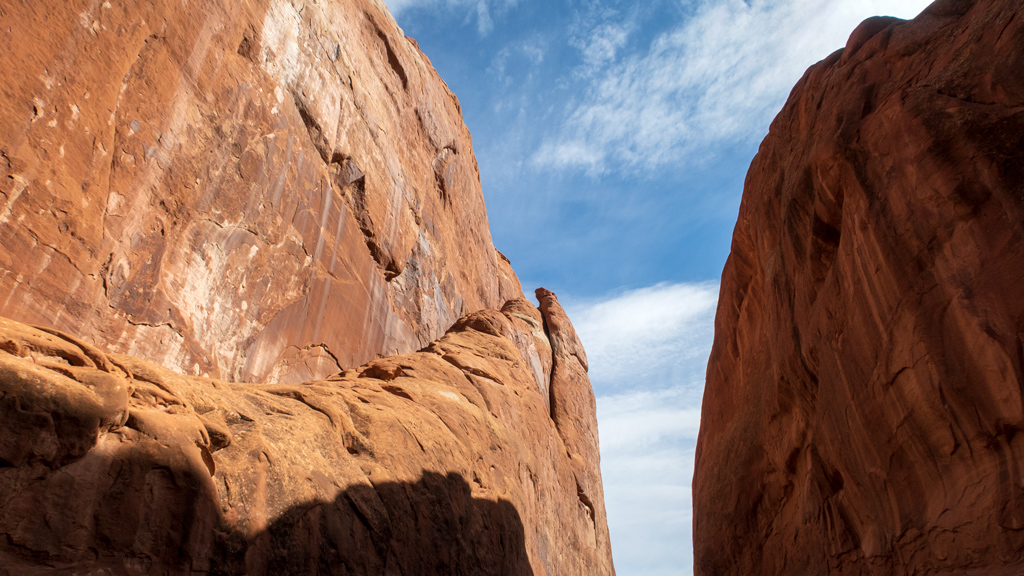
My plan was to drive from Long Beach to Palm Springs, go hiking, then head to Palm Desert and check into my hotel. I ran into an obstacle with that plan because it rained a lot and there was flash flooding on a lot of hiking trails, so a few that I wanted to go to were closed to the public. However, I eventually managed to find one near the Agua Caliente Tahquitz Visitor Center and hiked the South Lykken Trail. I’d say that it was moderate in dif­fi­culty with some fairly steep areas, but the sweeping views from the top were very rewarding.
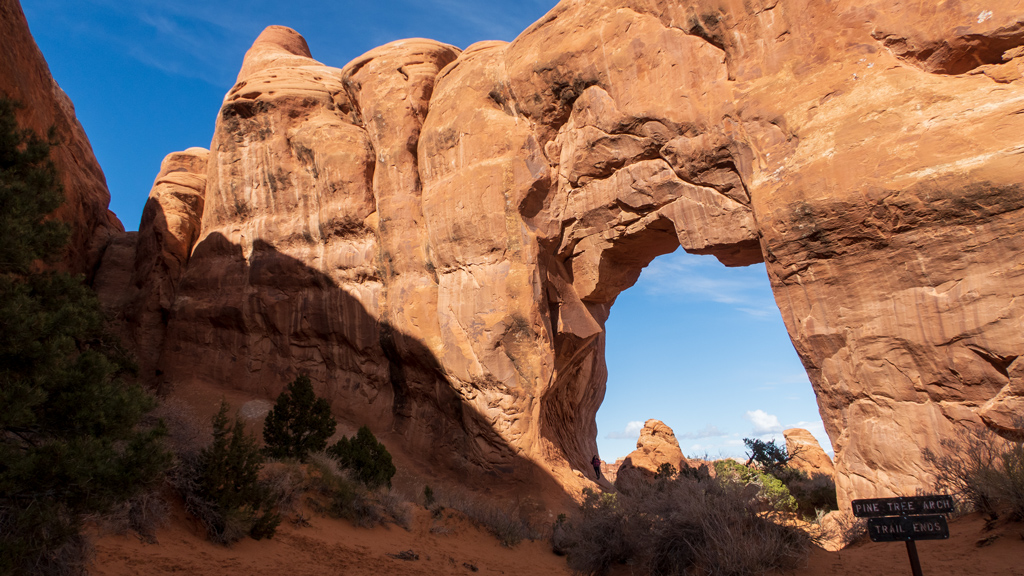
South Lykken Trail in Palm Springs, California

South Lykken Trail in Palm Springs, California

South Lykken Trail in Palm Springs, California

South Lykken Trail in Palm Springs, California

South Lykken Trail in Palm Springs, California

South Lykken Trail in Palm Springs, California

After coming back down from the summit, I took the half-hour drive from Palm Springs to Palm Desert, seeing Cathedral City and Rancho Mirage along the way. I’m not sure if the roads were emptier than usual because it’s Christmas Eve (though I would feel like a desert vacation destination like this would actually be busier during a holiday), but the drive was very smooth and refreshing.
My impression of this western rim of the valley is that it actually reminds me of the Las Vegas suburbs, but more polished, better taken care of, and with a higher attention to detail. The rows of palm trees lining the streets, the succinct but visually pleasing desert landscaping, and the clean neighborhoods made me happy to be there. People regularly ask me where I would live if I didn’t live in Las Vegas, and even though I’ve only been in Coachella Valley for half a day, I’m thinking that Palm Springs or the neighboring cities might be a strong contender to take that spot.

 
My hotel of choice for this one-day trip was the JW Marriott Desert Springs Resort and Spa. I’m usually not the biggest fan of resort-style hotels because I prefer barebones lodging that is clean, simple, and straightforward, but due to my eligibility for a great deal on a room at this property, I decided to give it a try.

JW Marriott Desert Springs Resort

JW Marriott Desert Springs Resort

JW Marriott Desert Springs Resort

I wanted to try some food from an in-house restaurant, but didn’t want to go through the hassle of going directly to the restaurant and waiting to be seated on a nearly-sold-out holiday night, so I instead requested it to be delivered to my room. I ordered some Skuna Bay salmon with sautéed mush­rooms and roasted garlic mashed potatoes, with a side of chimichurri sauce, and iced tea for my beverage.

JW Marriott Desert Springs Resort

My experience here was as expected—I wasn’t really a fan. With the long walk from the self-parking lot to the entrance (it was literally a quarter mile in each direction, which I later found out through my fitness tracker when it told me I had walked half a mile when I made a round-trip back to my truck because I forgot my charger), long wait times to check in, and constant noise coming from the hallway due to a plethora of guests with children, it made me miss the simple-but-reliable Fairfield Inns and SpringHill Suites from my recent road trip.

If I wasn’t able to qualify for the special heavily-discounted rate on this hotel, it absolutely would not have been worth it for me, as I noticed that rates were going for ~US$700 for the night. I spent (and will spend) a majority of my time out and about exploring Coachella Valley and never truly got to experience and enjoy the resort aspect of the hotel.

If I was a very regular visitor to the area and ended up hitting all the tourist spots, then a resort like this would be a nice way to keep things fresh, but for someone like me who has a massive list of things I want to see here for the first time, a resort like this is a horrible lodging selection if all you need is a clean and safe place to sleep overnight.

With that being said, I’ll be heading out tomorrow morning for another hiking trip in Palm Springs before making the two-hour drive back to Los Angeles County in time for dinner. If it wasn’t for that plan, I definitely would’ve extended my stay here, and I look forward to coming back sometime soon to see if I’m fallaciously tunnel-visioning on only the nice parts of Coachella Valley, or if it’s actually as nice as I think it is right now.


—§—


My COVID-19 booster dose vaccination experience

Back in April 2021, I wrote a blog post about my experience receiving my first two doses of the Moderna COVID-19 vaccine. Due to a special credential I held, I was able to get vaccinated a lot sooner than the general public, so I wrote it as a way to share an anecdote with my readers who may be looking to hear others’ stories.

The booster dose of the COVID-19 vaccine was approved a little while back, but because I was out traveling on my road trip when my six-month post-vaccination recommended booster period came around, I decided to wait until I returned back home to Las Vegas before getting my booster. Because of this, a lot of other people have already gotten their third dose, but I figured I would still write about my experience as a sequel to my first blog post.

 
Before I begin, I feel like the United States has evolved (or possibly devolved) into a situation where, if someone makes a statement about anything re­lated to COVID-19 (including things like the efficacy of masking by the general public, or the safety of the COVID-19 mRNA vaccines), people will draw conclusions derived from said statement that have no logical continuity. I also personally believe the United States has catastrophically mishandled the pandemic by somehow politicizing it, which has brought great division to the topic—a topic where even any divisiveness is probably too much.

With that being said, I want to clarify that I am not implicitly encouraging everyone to get vaccinated just by sharing my own personal vaccination ex­pe­ri­ence. For a combination of many reasons, I have come to the conclusion that I will respect and honor the decisions of both people who do and do not choose to get vaccinated.

Thus, if you are someone who does not trust the COVID-19 vaccine at the moment, I request that you do not leave comments on this blog post or send me messages accusing me of making other people get vaccinated, because I am not. In a similar vein, if you are someone who supports vaccine mandates and are upset that I am taking a neutral stance, I also request that you do not leave comments on this blog post or send me messages forcing me to force other people to get vaccinated.

 
Returning back to my own vaccination experience, this went a lot better and smoother than my first two doses. As a reminder, if you haven’t read my previous blog post, both of my first two doses were administered to me in the Cashman Center, a massive multipurpose facility… and it still took about two hours for each of my doses, even though I had an appointment.

This time, I went directly to the Southern Nevada Health District on 280 S Decatur Blvd. It was a huge difference compared to the Cashman Center—SNHD is supposed to be closed on the weekends, and this was a special evening and weekend COVID-19 vaccination arrangement, so there was almost nobody there except for the staff and a few vaccination recipients.

Southern Nevada Health District

Upon entering, there was a massive family in front of me that clearly had absolutely no idea what they were doing, so I had to wait a few mi­nutes for them, but after a different staff member noticed that I was standing in line, she took me off to the side and got me checked in for my appointment.

She scanned my QR code, confirmed my identity, asked which manufacturer of vaccine I wanted (I picked Moderna because it is the vaccine that seems to be performing the best against the newer COVID-19 variants), and let me into the area where tables were set up for vaccinations. There was already a spot open and ready for me, so I sat down, went through some basic questions with the nurse (such as explaining my post-vaccination experience for my previous two doses), received some post-vaccination advice (such as recommending drinking a ton of water), then got vaccinated.

From the time I stepped into the building to the time I was seated off to the side for my 15-minute post-shot waiting period, it was no more than about six mi­nutes, and I spent a total of about 20 mi­nutes at the health district.

 
My vaccination appointment this time around was also in the afternoon, just like my second dose. For my second dose, I started feeling tired in the eve­ning, so I prepared for the same thing to happen after my third dose by washing up and getting in bed after returning to my hotel room. Earlier on in the day, I had also prepared a carton of bottled water and some sugary and fatty snacks, in case I lose my appetite and need the calories.

I browsed social media and watched some videos for a bit, and I was a tiny bit more tired than usual, but I ended up having enough energy left that I got out of bed and started getting some more work done while I could, sort of as a way to cram before my inevitable suffering the following day. I worked fine throughout the evening and night, then fell asleep at 11:30 PM PST.

I woke up at 2 AM, and that’s when the side effects started. I was dizzy and had body aches, and I had the same problems regulating my body tem­per­a­ture as I did for my second dose. I fell back asleep for no longer than an hour and a half at a time before waking up again for another hour or so, with this cycle repeating throughout the night.

For the entire day following the day of my vaccination, I felt very unwell. We all know that you’re supposed to lay in bed and rest up, but I ended up in a very counterproductive situation where, the longer I would lay in bed, the worse I would feel. I would eventually manage to get up, and I would pro­gres­sively start feeling better… but then I would reach a point of exhaustion that I would have to lay back down, then I would pro­gres­sively feel worse a­gain and continue the cycle.

As I predicted, I did indeed lose my appetite. The fatty and sugary snacks helped maintain my caloric intake, and I also ordered a large portion of ice cream on a food delivery app, which helped me reach at least 2,000 calories for the day. I eventually fell asleep at 9:30 PM.

My second night of sleep was much better than the first—after falling asleep at 9:30 PM, I slept uninterrupted until 5:30 AM, when I woke up already feeling much better and very thirsty. I drank some water, went to the bathroom, took some deep breaths, and stretched a bit. My body temperature reg­u­la­tion was back to normal. I actually felt like I had already gotten enough sleep and was rested enough to start my day, but figured that I should still get a few extra hours of sleep in, just to ensure that I’m fully recovered. I fell back asleep at 6:00 AM and woke up for a second time at 9:00 AM.

Throughout the second full day post-vaccination, I was still slightly dizzy, but I was able to resume life as normal. I was able to take a shower and drive safely to a fast food restaurant nearby to get some breakfast in the morning (because I had just barely missed free breakfast hours at the hotel by the time I was ready), then I took on a twelve-hour workday to catch up on stuff I missed from the previous day.

 
One thing that I want to note is that my heart rate monitor alerted me that my heart rate was unusually high throughout the entire first full day after vaccination—so much so that it logged me as having been in fat burn zone for a majority of the day, and miscalculated how many calories I burned that day because of it. One of my co-workers also notified me about this and confirmed that he had the same thing happen to him for his vaccination.

Prior to receiving the vaccination, I had to check a box acknowledging that young men have a higher chance of inflammation of the heart after receiving an mRNA COVID-19 vaccine—specifically, myocarditis, which is the inflammation of the heart muscle, and pericarditis, which is the inflammation of the outer lining of the heart. I clearly did not develop either of these conditions from the vaccine, considering that these are both very serious conditions and I was perfectly fine after a day, but I’m curious if a very high heart rate was a sort of milder version of the side effect related to this warning.
By the third full day post-vaccination, I was entirely back to normal health-feeling-wise, and my heart rate seems to have returned to within ~10% of nor­mal levels.
 
If you choose to get a COVID-19 vaccination, may it be your first or third dose, I wish you the best of luck, and also highly recommend leaving a day or two free after your scheduled vaccination appointment so you can rest up and recover, in case you experience side effects like I did.


—§—


Hello, Grand Canyon National Park in Arizona

After my one-day “layover” in Gallup, the next and final destination of this segment of my road trip was in Flagstaff, Arizona. As you might have guessed, my main reason for stopping by Flagstaff was to visit the Grand Canyon National Park.

I’ve always heard great things about the Grand Canyon, ranging anywhere from people saying it was one of their favorite vacation destinations, to one person alleging that he had heard from all his friends that it was life-changing. Although I personally disagree about the “life changing” part, I do think that it’s an amazing place to visit, and it has been my favorite hiking destination so far.

I have to make it back to Las Vegas soon for some time-sensitive stuff, so I only scheduled one day at the Grand Canyon. As a secondary point, it is also a bit inconvenient to get to the Grand Canyon, because the closest Marriott-branded hotels are in Flagstaff, and the lodging options closer to the Grand Canyon all seem a bit underwhelming and expensive. Because of that, I opted to stay at the SpringHill Suites by Marriott Flagstaff and made the three-hour round trip to the Grand Canyon on my visitation day, an hour and a half there and an hour and a half back.

My hike of choice was the West Rim Trail. I took a shuttle out to Hermit’s Rest and walked the path back to Grand Canyon Village. Along the way, I stopped at Pima Point, Monument Creek Vista, The Abyss, Mohave Point, Hopi Point, Powell Point, Maricopa Point, and Trail View Point.

I took 143 photos throughout my hike, and I’ve picked out my favorite ones to feature here. Although I don’t precisely remember exactly where each of these photos were taken, the progression of the photos follows the order of the scenic overlooks that I just listed.

Grand Canyon

Grand Canyon

Grand Canyon

Grand Canyon

Grand Canyon

Grand Canyon

Grand Canyon

Grand Canyon

Grand Canyon

Grand Canyon

Grand Canyon

Grand Canyon

Grand Canyon

Grand Canyon

Grand Canyon

Funny enough, my main takeaway from my hike at the Grand Canyon is that I should probably get laser eye surgery soon. The Grand Canyon in person was incredible, but after browsing through the photographs I took and zooming in all the way, there is an immense amount of detail that I missed out on due to my poor vision. It left me speechless as to just how massive the scale of the Grand Canyon is, and how intricate the rock formations are.

In a similar vein, there are no photographs that do the Grand Canyon justice. Looking back at the pictures I took is reminding me how big the Grand Canyon is, but that’s only because they are simply acting as a memory trigger for me to immerse myself back into my experience of being there in-person. Prior to this, I’ve obviously looked at plenty of other people’s photos of the Grand Canyon, but that wasn’t enough to prepare myself for how much I was impressed when I first saw the canyon in-person.

The route I took for my hike was fairly easy and straightforward, but there are a plethora of more difficult hikes that I can tackle when I am better pre­pared. One of the hikes I definitely want to do is to go down into the canyon. The depth of the Grand Canyon is right around 6,000 feet (or 1,829 me­ters), so I probably will not be fit enough to head all the way down to the bottom anytime soon, but I’m eager to be able to go down part-way during my next visit.

Grand Canyon


—§—