Following the recommendations of some overwhelmingly good reviews, a friend and I decided to give the chef’s tasting menu at Sparrow + Wolf a try. Located in the Chinatown neighborhood of the unincorporated town of Spring Valley in the Las Vegas Valley in Nevada, Sparrow + Wolf is an American restaurant with some menu items inspired by and integrating elements of Vietnamese cuisine.
If you’re familiar with my blog and have read past posts where I share my experiences dining at restaurants, you may be expecting some thoughtful insight about my opinions of each dish. However, today, you will notice that I won’t have that kind of depth about every plate. There is an intriguing reason for that, which I will describe at the end.
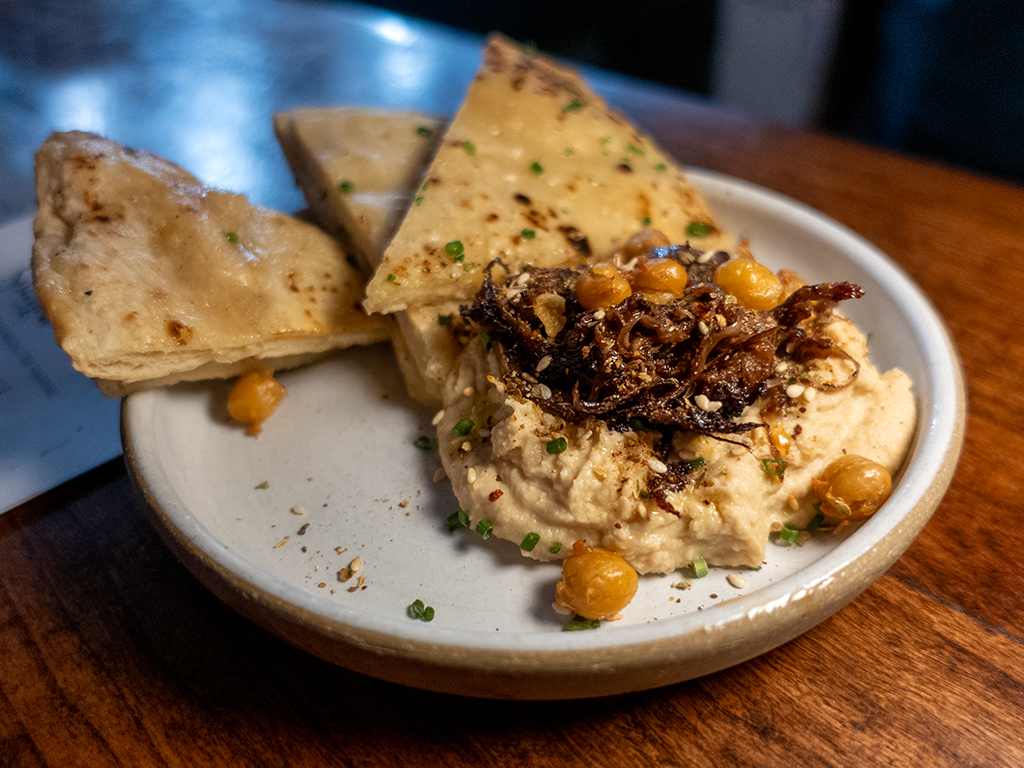
The meal started with bread service, but with a twist—we received oxtail hummus with crispy chickpeas and curry oil, to go along with some warm naan.
Visually, I thought that the oxtail would be a bit dry due to how thin it was cut and how dark it was, but somehow, it still had a high level of tenderness. Preliminary bread service at restaurants usually just comes with an assortment (or sometimes even just a single type) of bread accompanied with butter, so it was a nice change to have bread service here be comparable to an actual dish.
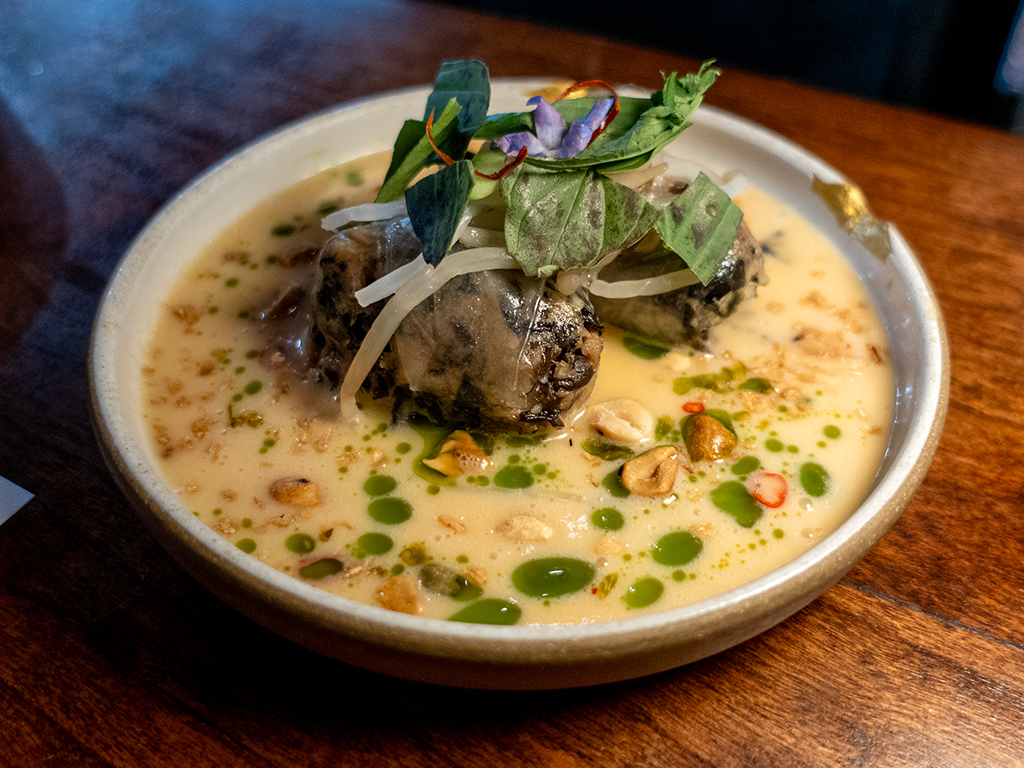
After bread service was a trio of dishes forming the first of three courses. First up was bánh cuốn with ground duck, wood ear mushroom, habanero, and coconut.
Next was a duo of oysters. The raw one had cold-pressed rhubarb, strawberry, and opal basil flower; the cooked one had red yuzu kosho butter, kaffir lime, and rock miso.
I really like the flavor of oysters, up to the point where I will still like extremely pungent oysters that other people would otherwise call too fishy or oceanic. Knowing that, I’m wondering whether this raw oyster might have been too strong for the average person, but I personally thought it was amazing.
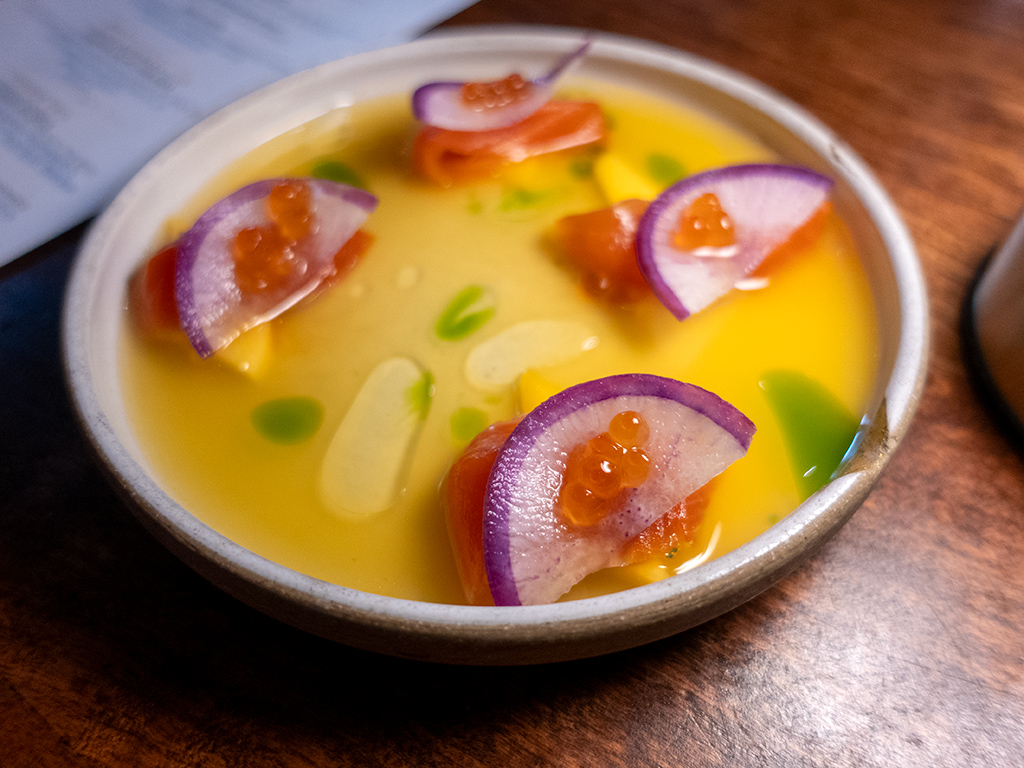
To conclude course one came Peruvian steelhead trout topped with ikura roe, Koji mango, and ninja radish.
The sauce was my favorite part of this dish and I ended up drinking all of it like soup after I was done with my trout.
Before transitioning to the next course, we opted to add on a supplement of Hudson Valley foie gras with milk bread, pineapple, onion chili compote, and mole blanco.
Foie gras is one of the favorite foods of my friend who joined me for this dinner, so of course, we had to get it as a supplement. Foie gras is very calorically dense and high in saturated fat, so we opted to only get one to share between us.
This was high-quality foie gras that we both liked. The pineapple worked great to cut through the fattiness and balance out the flavor, while the milk bread and sauce added a multi-faceted element of umami to the dish.
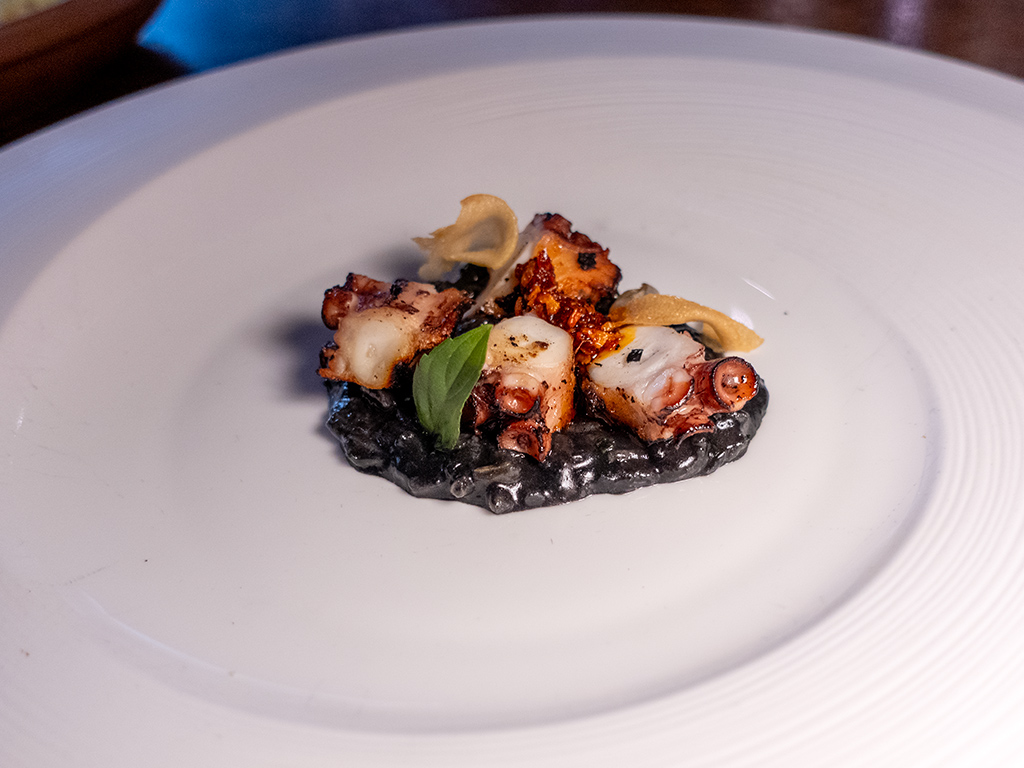
Course two started with Spanish octopus atop squid ink risotto adorned with garlic chili crunch and Thai basil.
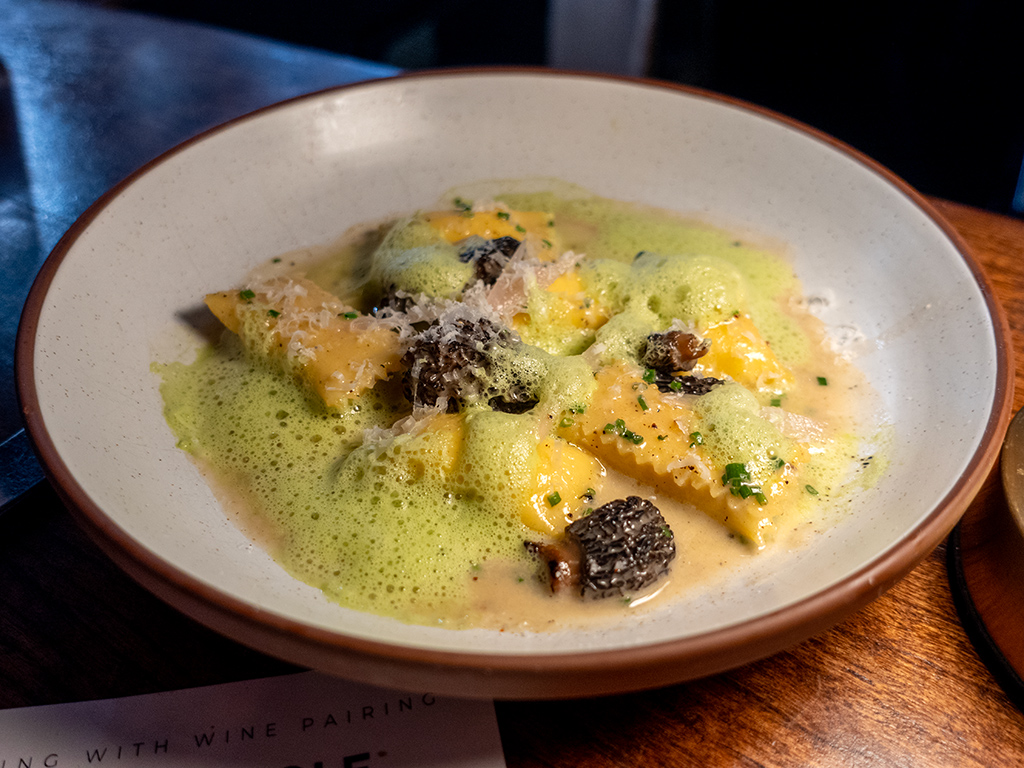
Next was robiola agnolotti with pickled ramps, morels, and shiitake mushroom powder.
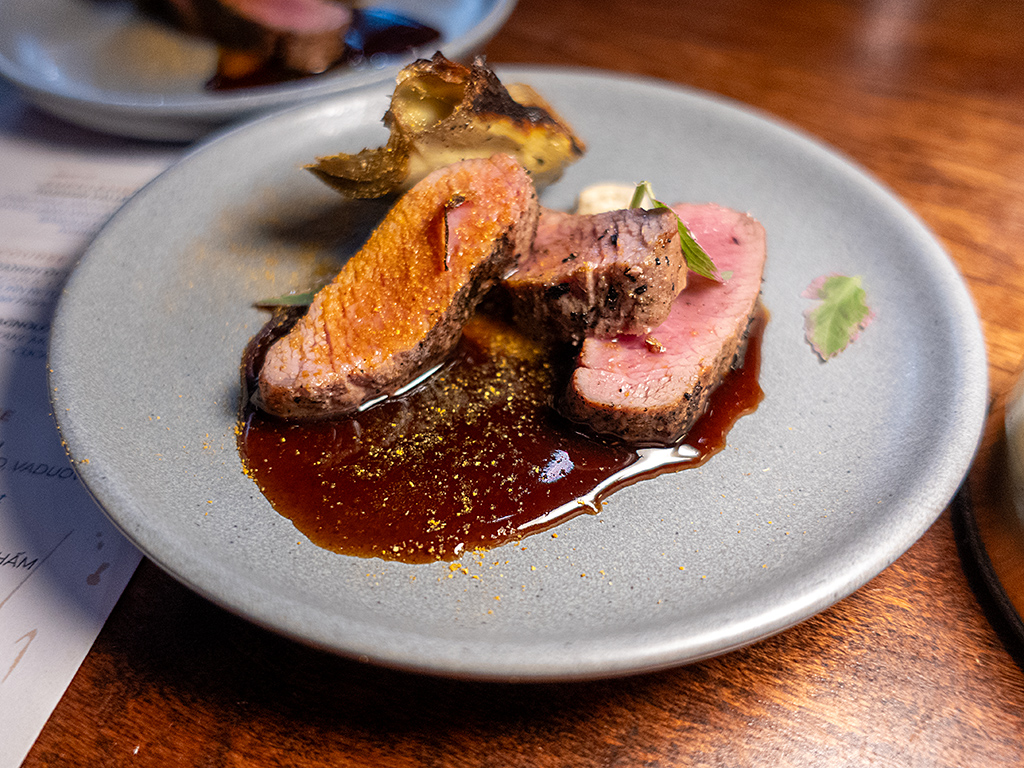
Lumina Farms lamb loin with artichoke, saffron, matbucha, almond, and vadouvan marked the start of course three.
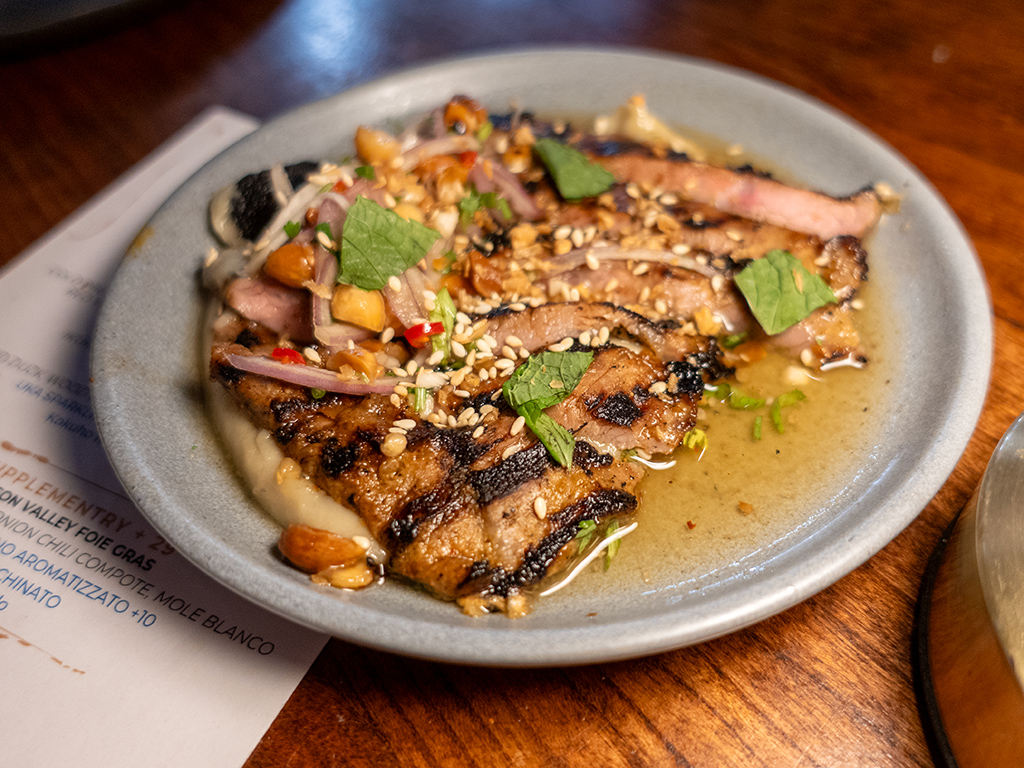
Our final entrée of the night was black pepper and honey pork flank with sweet potato banana puree and peanut nước chấm.
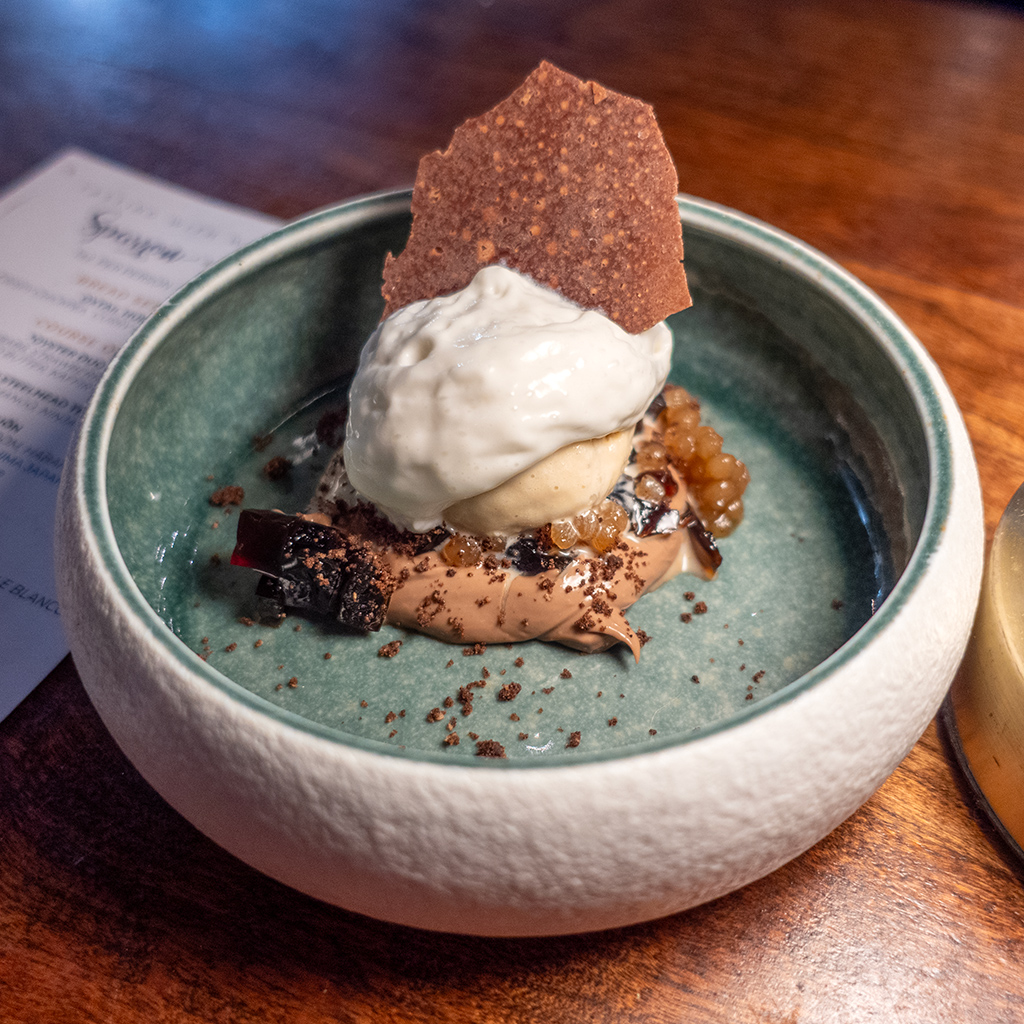
To close the tasting menu, we were served a dessert made from Maracaibo crémeux, Vietnamese coffee ice cream, Okinawa black sugar, and condensed milk espuma.
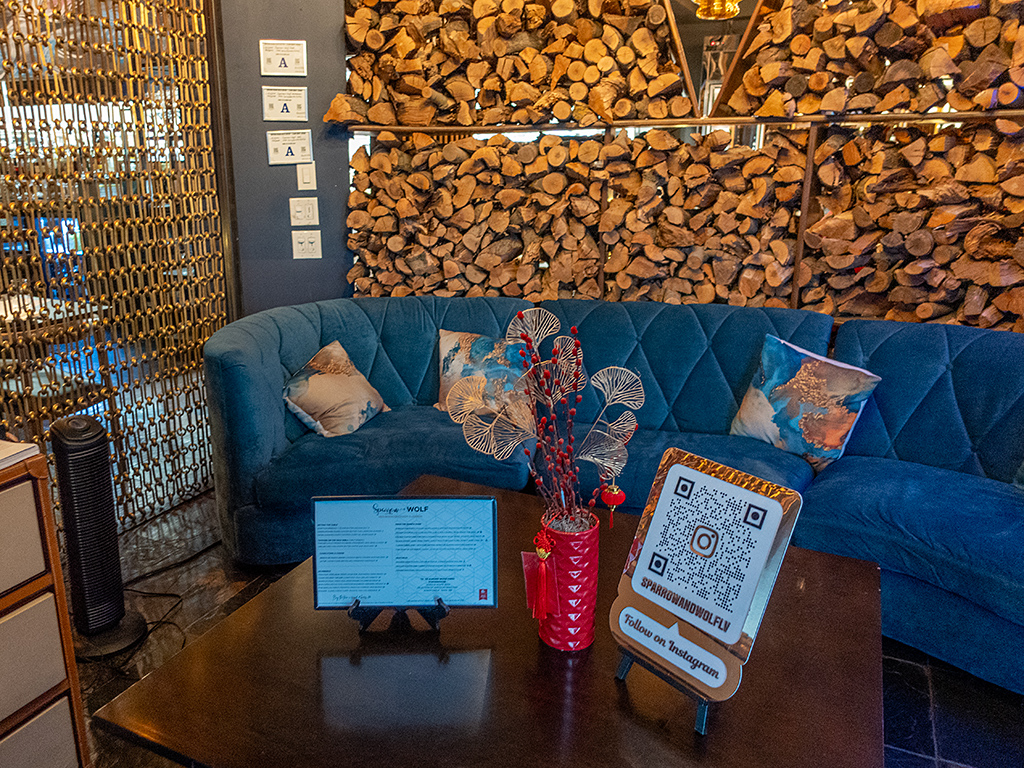
This is the waiting area at the entrance of the restaurant. I had a reservation and was brought inside right away so I didn’t get to take a seat in the miniature lounge, but I snapped a photo on the way in.
We were fortunate enough to be seated at what I thought were the best seats in the restaurant. The bar had a little two-person section nestled on the edge where the perpendicular cut-off was from the main bar. Being seated here allowed us to get a nice partial view of the kitchen while dining, while also being able to see the rest of the bar and half of the restaurant’s dining area. This area was also isolated away from the main areas of foot traffic, which made for a much more private experience.
This was a small art installation outside near the front entrance of the restaurant.
Chef’s tasting menu ×2
$ 284.00
Foie gras supplement
$ 29.00
Sales tax (8.375%)
$ 26.20
Automatic gratuity (20%)
$ 62.60
Total
$ 401.80
The table to the right shows how much we paid.
So by this point, surely you are wondering what the intriguing reason is that made it difficult for me to give in-depth feedback or analysis about each dish.
To put it as simply as possible, every bite of the same dish tasted different. No, I do not know how or why. I did take care to ensure that each bite had a little portion of all the ingredients, but even then, each bite was very diverse in flavor.
To be clear, this is not a situation where the ingredients were not mixed properly during preparation or anything. It wasn’t that there was a skew or imbalance of flavors at all. Each bite tasted like it had its own whole and complete flavor profile, yet still different than it was mere seconds ago.
As a result, for most of the main entrées, it literally felt like each dish had four or five miniature dishes in it at the same time. I’m sure that now you can imagine how difficult it is to not only describe, but even just remember, my thoughts on every dish when it tastes like I actually had about 25 main entrées.
Overall, this is one of the most eye-opening and captivating dining experiences I remember having for a long time based purely on the quality of the food. Because I go to a lot of chef’s tasting menus, even a lot of the really good ones sort of just blend in with each other when I look back on them after several months. I really appreciate restaurants like Sparrow + Wolf that experiment with their dishes in a way that makes them stand out as memorable.
Sparrow + Wolf has both a chef’s tasting menu and an à la carte menu, so if you don’t want to commit to a dinner that’s US$200.00+ per person, you can order individual items for a smaller meal instead. If this pricepoint is within your budget, I highly recommend the food here. I especially encourage trying it to people who have at least exceeded an intermediate level of past dining experience, because I think that additional degree of culinary understanding will help you truly realize how impressive the food is here.
While going down my rabbit hole of researching afternoon tea, I came across the Petrossian at the Bellagio Resort & Casino on the Las Vegas Strip. The photographs on the restaurant’s website made it look classy and elegant, and reservations for the afternoon tea experience were booked out weeks in advance, so I reasonably assumed it would be a great experience. After having such a pleasant time with afternoon tea at Peacock Alley in the Waldorf Astoria Las Vegas, I was looking forward to trying afternoon tea at Petrossian as well.
… It was horrible.
Do not go to afternoon tea at Petrossian.
The pictures on the restaurant’s website are conveniently cropped and color-graded to look far better than what the restaurant is in reality. I found out that I have actually walked past Petrossian tens of times before without even realizing what it is, because it’s not actually a special restaurant—it’s just the little bar by the hotel registration desk at the Bellagio at the intersection of the entrance to the casino.
My friend and I were seated deeper into the restaurant, but all of it was basically right alongside the casino. As you’d expect, it reeked pungently and repulsively of cigarette smoke. I’m pretty sure we inhaled enough second-hand smoke during our afternoon tea to be the equivalent of smoking a few actual cigarettes. I can usually tolerate cigarette smoke in casinos short-term while walking through to the hotel elevator or something, but it was borderline unbearable when sitting down stationary. I got a pretty bad headache within several minutes of entering the restaurant.
It was dark and gloomy inside. I had to increase the exposure and enhance the shadows in my photographs by quite a bit for the interior of the restaurant to actually show through in my pictures. The interior looked like my great-grandmother was contracted to handle the design and decor.
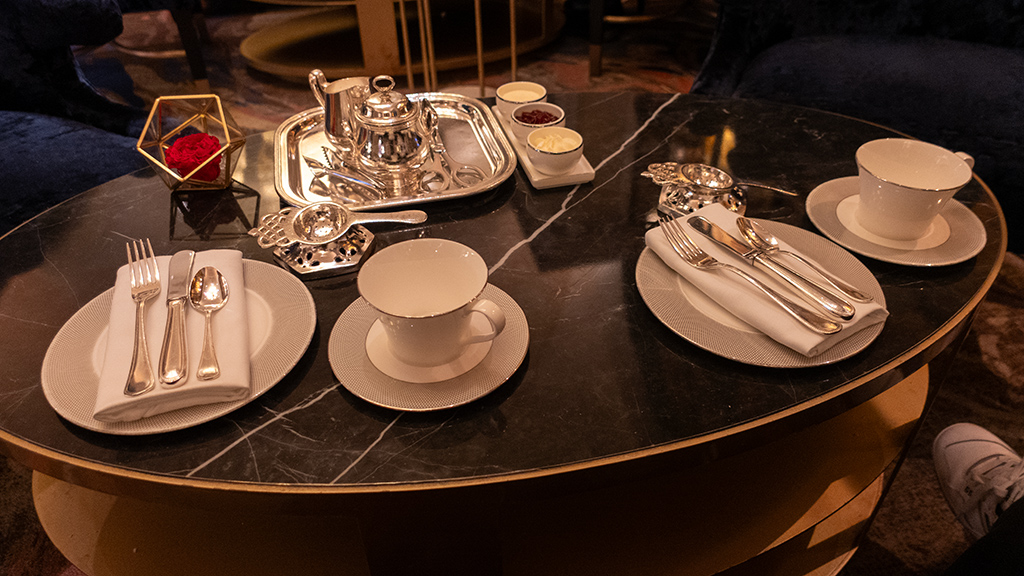
This was how our table was set upon our arrival. We never at any point were given or even offered any water.
The sauces we were given were clotted cream, Bordier butter, and seasonal jam. I did not use any of the clotted cream or Bordier butter because I found that most of the food already tasted very fatty, greasy, and/or heavy. I thought the seasonal jam was unremarkable and was comparable to generic, unbranded jam you’d find as the cheapest option available at your local chain grocery store.
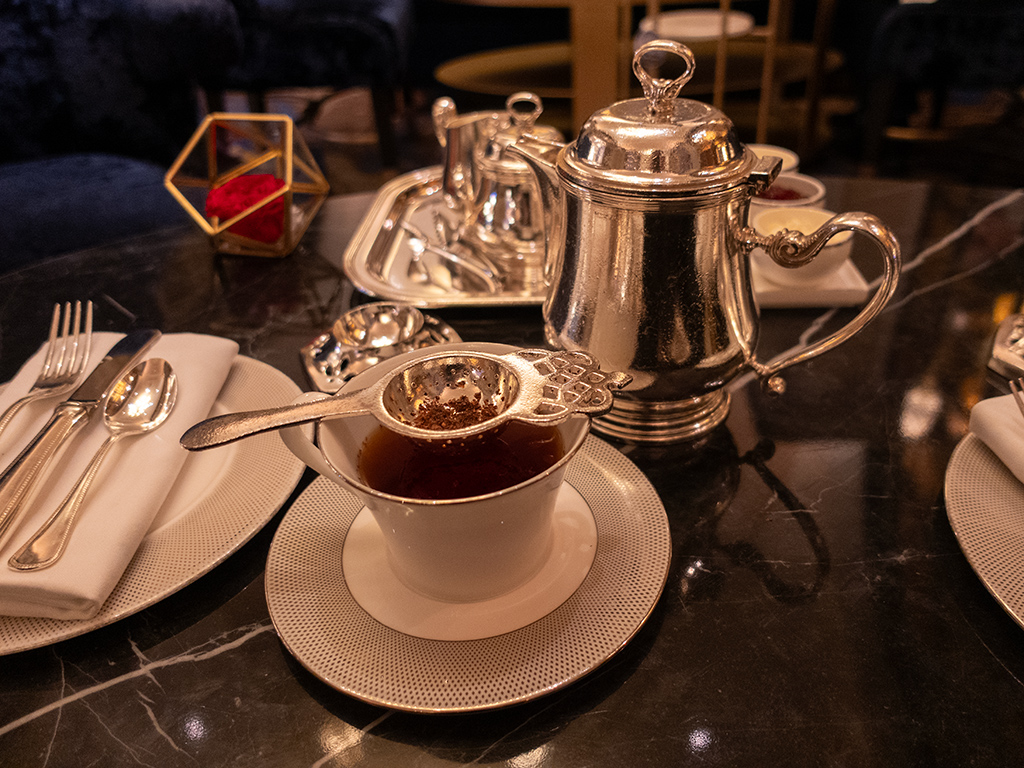
For my tea, I selected the organic vanilla rooibos, described by their menu as “Madagascar vanilla bean naturally sweetened with caramel fragrance and creamy on the palette.” I’m not sure if I received the wrong tea or something, because this just tasted to me like generic earthiness without any distinct flavors.
For our sandwiches, we got a farm egg salad on pumpernickel bread with tarragon and cornichon, English cucumber on pea flower bread with boursin and lemon, jamón ibérico with Spanish ham and honey butter, and a truffle gourgère pâte à choux with black truffles and Parmesan.
My farm egg salad sandwich was dry and had a very flat flavor. It reminded me of a pre-made sandwich you’d find in a grocery store in their open-top refrigeration section. The greens on top of the sandwich were shriveled and rubbery.
My English cucumber sandwich was just a bunch of regular, plain cucumbers on top of very dry bread. I would’ve preferred to just take a bite out of a fresh cucumber and then call it a day.
My jamón ibérico was passable, but it was put on top of what looked like a regular roll you’d find packaged bulk in plastic bags in the shelves next to your grocery store’s deli… but somehow worse, because these rolls were insanely dense and dry in my mouth. To clarify, the roll itself was literally just a roll. None of the ham, honey butter, or toppings were inside the roll. The roll itself was just a completely plain roll with nothing in it.
My truffle gourgère was a big glob of unstimulating greasiness that I found to be unpalatable. It was similar to what I imagine it would taste like after you cooked some bacon in a frying pan, let the rendered fat slightly coagulate as the pan naturally cools, then poured the leftover fat and grease into your mouth.
Next, we were served Daurenki caviar bites—a caviar timbale with hazelnut crème fraîche, caviar taco with hamachi and gold leaf, caviar tuna cone with feuille de brick and calamansi dressing, and caviar potato Darphin with herbed crème fraîche.
The timbale, taco, and cone were so fatty and greasy that they masked the flavor of the caviar. I also suspect that they might have added even more salt to each of these bites, because they were overwhelmingly salty to the point where it felt like the inside of my mouth was getting pickled, and not in a naturally-salty caviar kind of way.
The potato Darphin was the closest thing that I ate to a satisfactory caviar bite, but even then, it was still far too fried for my preference. I think using high-quality potatoes and relying on the natural flavor of the potato to complement the caviar would’ve worked nicely, but this tasted like someone put a chunk of potato in the deep fryer, went to go do their laundry, and forgot about the potato until they finished folding two entire loads of underwear and socks.
On the side, we had Bellagio’s signature scones.
This reminded me of grocery store corn bread. It was so thick, dense, and heavy that I am pretty sure this singular plate of four scones could potentially be enough calories to cover the entirety of my day’s basal metabolic rate and non-exercise activity thermogenesis.
For dessert, we got three French pastries: a raspberry macaron, an old-fashioned chocolate cake, and a spiked lemon tartelette.
The raspberry macaron was delicious and was probably one of the best macarons I’ve ever had. The texture was perfect, and the outside of the macaron had a very satisfying consistency where it had an amazing balance of resistance and crumble with each bite. Each raspberry was light and refreshing. It had a reasonable amount of sweetness comparable to what you’d expect from natural raspberries, but slightly toned up.
The chocolate cake and lemon tartelette were closer to the other food items I had during the afternoon tea, i.e., excessively heavy and greasy, without any perceivable depth or specialty to the flavor. The chocolate cake in particular was so sweet that I believe it registered in my brain as bitter.
There was live piano music during certain segments of our meal. Normally, this would be a nice touch, but the fact that this was basically right on the casino floor created a very strange phenomenon where the sound of the classical music coming from the piano and the sound of the pop music blasting through the speakers from the casino were fighting for your attention. It was auditory sensory overload and made both sound somewhat unsettling.
Caviar afternoon tea ×2
$ 176.00
Sales tax (8.375%)
$ 14.74
Gratuity
$ 30.00
Total
$ 220.74
The table to the right shows how much we paid.
In case you forgot from the beginning of the blog post, do not go to afternoon tea at Petrossian in the Bellagio. And in case you couldn’t tell from my review, I absolutely hated it.
If you’ve read some of my past blog posts, you know that I really appreciate restaurants that try to be subtle and inconspicuous, yet clearly cannot hide the fact that they are at the level of fine dining due to the amazing food, great service, and impeccable attention to detail. Petrossian is the exact opposite of that. The environment at this restaurant is built to shove the idea of fine dining down your throat, but it’s all a disguise—I wasn’t able to perceive any qualities that truly define real fine dining at Petrossian.
There was one funny thing that my friend and I noticed during our dining experience. The friend I went with to Petrossian is the same friend I went with to Peacock Alley, so we had two afternoon teas side-by-side as comparison. Neither she nor I are particularly the emotional type, so even when faced with an experience that we find unpleasant, we both handle it pretty well and take it practically. Throughout the meal, we were both poking fun at how bad we thought the food was and discussing what we would do to make it better. We are also okay with occasionally having experiences we find unsatisfactory, because that keeps us aligned with reality and helps us appreciate the good experiences even more.
There was a pair of women who were also having afternoon tea at the table right next to us. Because of the way that the tables and couches were set up, they were in clear and direct view of us. Now, I’m not a mind reader, but based on their expressions, they seemed to be having an absolutely miserable time. Both of them were completely silent and eating their food as if the Grim Reaper was overhead and ready to perform an execution if they didn’t clean their plates. This was in stark contrast to everyone at Peacock Alley, who all seemed happy to be there.
I genuinely do not understand why afternoon tea reservations at Petrossian are in such high demand, or how there are so many positive reviews online. I guess if you’re going for just the caviar, then maybe it might be worth the money, considering that popular restaurants in major cities have been selling caviar bumps for US$20.00 each lately, and Petrossian seems to give you a decent portion size of caviar? But otherwise, if you’re not a caviar enthusiast, then my suggestion is to go to Peacock Alley at the Waldorf Astoria Las Vegas instead (and this is coming from a Marriott and MGM loyalist—which Bellagio is a part of—while Waldorf Astoria is a member of the rival Hilton family).
Once in a while, something new catches my attention and I start going down a deep rabbit hole of research about the topic. Lately, one of these new things was afternoon tea, a British tradition where you consume sandwiches and pastries, among other treats, while sipping some tea during the middle of the day. There is apparently a variant of this called high tea, which people thought was for high-class individuals, but was allegedly actually simply called high tea because it would be served at tables that had chairs with high backs.
The association with tea time and high-class individuals apparently stuck in the United States, because a lot of American afternoon tea services exaggerate the elegance and classiness of the tea experience. I did some scouting for some good options so I could try my very first afternoon tea, and I decided on Peacock Alley at the Waldorf Astoria Las Vegas.
Upon our arrival, we were seated at one of the inner tables. When booking the reservation, I was given the option of getting a guaranteed window table for an additional US$25.00 per person for US$50.00 total (i.e., that was just the extra fee for the table, and did not include any food or beverage and did not act as an off-setting credit on the bill). I thought that was not at all worth it, especially considering that the photographs on their website showed how already bright and airy it was throughout the entire restaurant thanks to the floor-to-ceiling windows and the north-facing view.
When we got to our table, we were greeted with some nice silverware along with a trio of sauces—Devonshire cream, lemon curd, and homemade berry jam.
The berry jam was my favorite out of the group, and it was probably the best jam I have ever had in my entire life. It went well with literally every single item that we were served, and my friend and I finished the entire portion of it. The cream and lemon curd was also good, though those two tended to go better with certain pastries more than others (while the jam was just an overall universal enhancement).
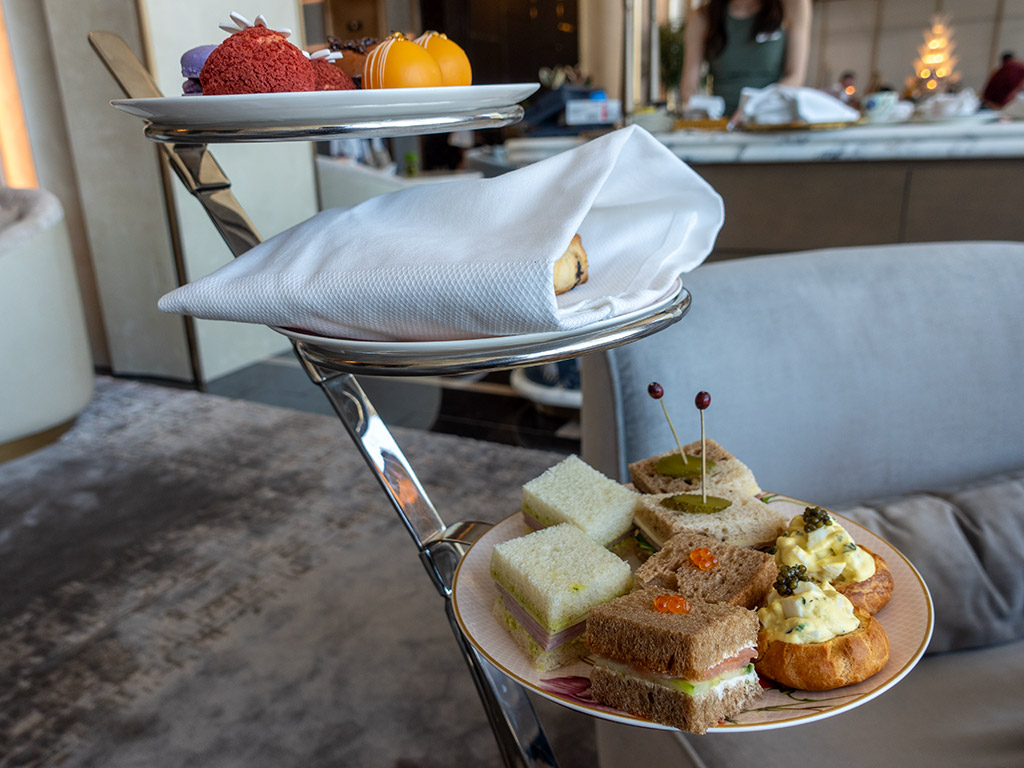
This afternoon tea was a three-course experience, and we received plates with all three courses at once in this tiered serving stand.
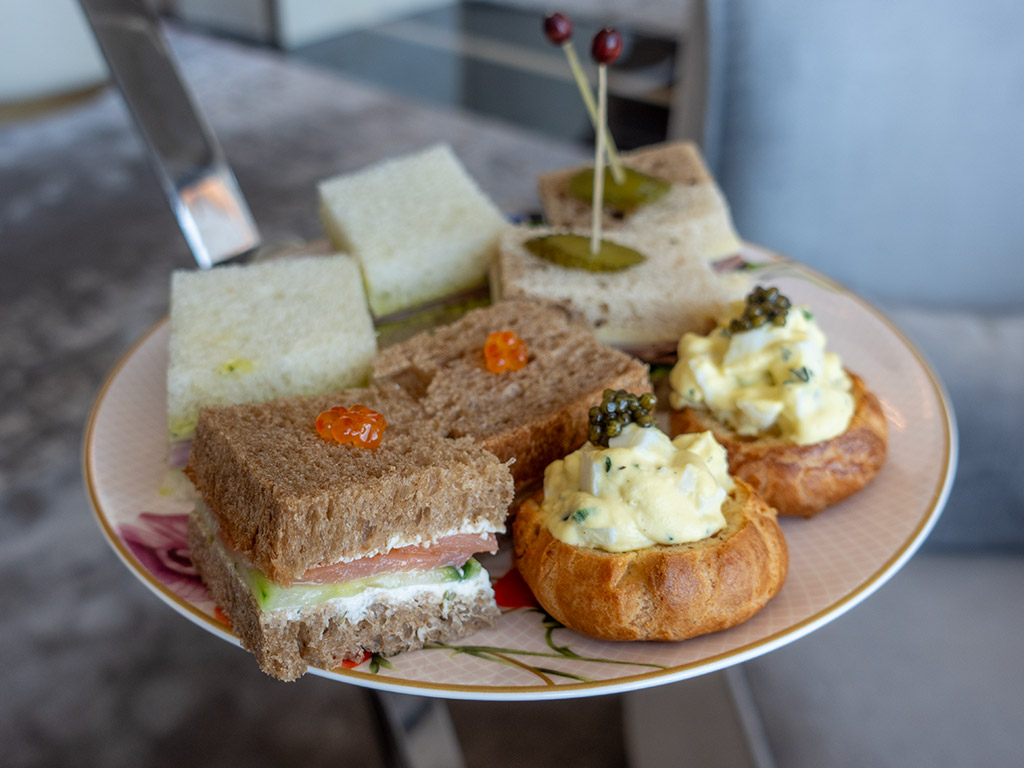
We started our meal with the sandwiches. Pictured in the front and rotating counter-clockwise, we ate (1) egg salad and Kaluga caviar gougères with fines herbes; (2) smoked salmon with dill and chive boursin and cucumber on pumpernickel bread; (3) French ham and Swiss with salsa verde on soft white bread; and (4) roast beef with horseradish, provolone, and arugula on rye bread.
Everything was good, but I was especially impressed at the construction and texture of the sandwiches. Small sandwiches like this usually have an issue with the innards sliding around when you bite down, but for these, everything was somehow very easy to hold and keep in place.
The bread also had a perfect consistency—it was just barely dry enough that it was firm and convenient to grip without it collapsing under your fingers, but still soft enough that it tasted like high-quality bread.
The next plate contained freshly-baked signature scones. They were kept inside a cloth so they could retain their warmth. They were nice and flaky, and biting down on these scones was a very fun and satisfying experience due to their great balance between crispiness along the edges and softness on the inside.
The last plate was our desserts. These looked nice enough that I took individual photographs of each one, so I will share what they are shortly.
For my tea selection, I picked an herbal tea called Mountain Berry which had a blend of Saskatoon berries, red and black currants, raisins, and wild blueberries. This tasted strangely similar to chocolate at first when the tea was extremely hot, but after it cooled, I was able to detect more of the berry flavors.
For my friend’s pot of tea, she opted for a special pear blend that was not listed on the menu.
The first dessert we had was the lavender blueberry macaron. This tasted like any good macaron you’d find at any high-quality bakery or dessert shop.
Next was a banoffee tart with Italian espresso, roasted banana, and caramelized toffee. I liked the roasted banana on the inside, and the caramelized toffee crumbles along the edge were delicious, but otherwise, the rest of the tart was just overwhelmingly chocolatey and sweet.
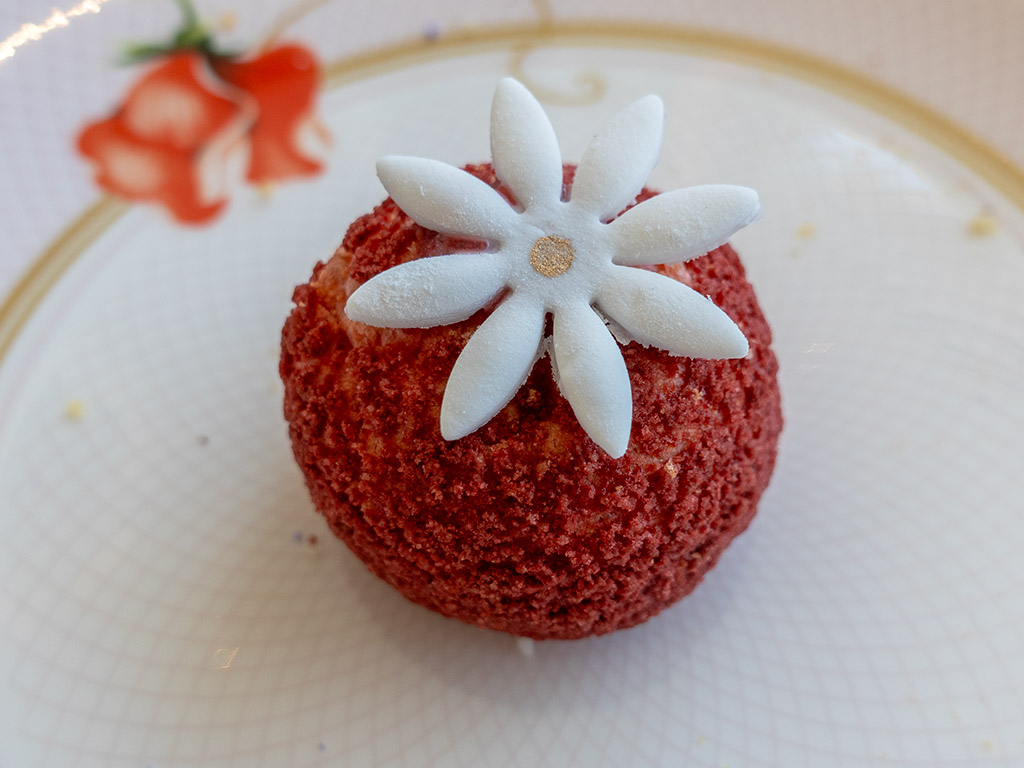
Then we had a strawberry basil petit choux. This was a decent sweet treat, and the flower on top added a nice crunchy texture.
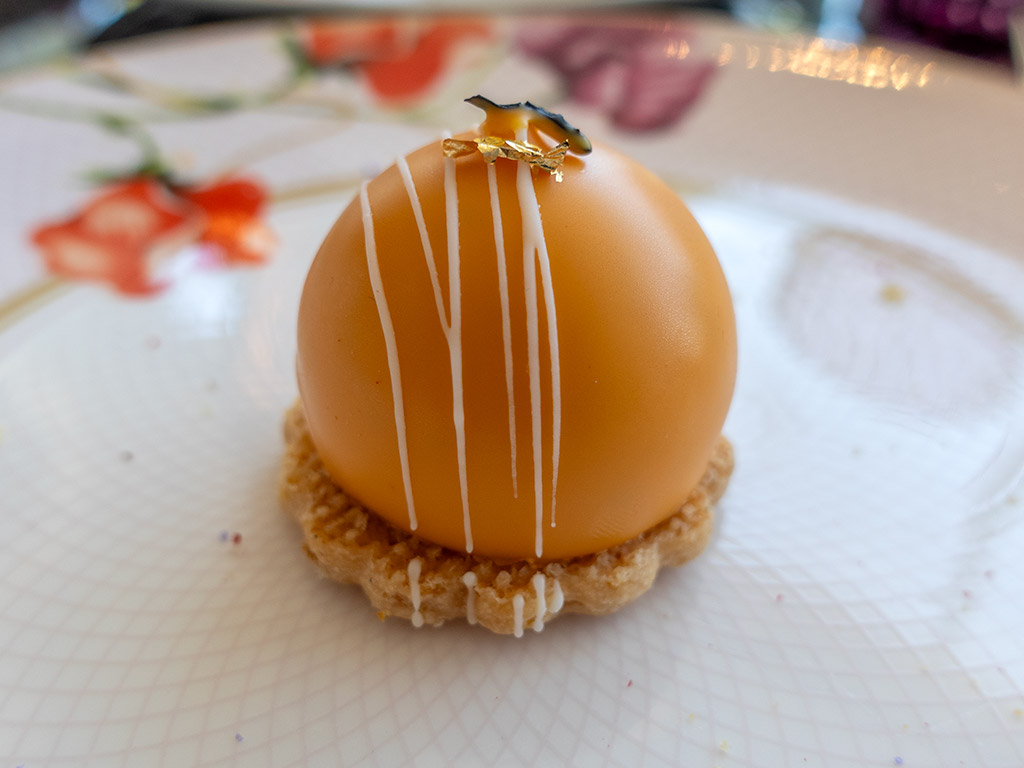
Finally, our last dessert was a Thai tea mousse dome with condensed milk and white chocolate. By this point, I was getting pretty full and getting a bit of “sweetness fatigue,” but I still liked this and appreciated the contrasting cookie base.
Back when we arrived, it took a few minutes for the wait staff to get our table ready, so I had an opportunity to walk around and take some pictures of the restaurant.
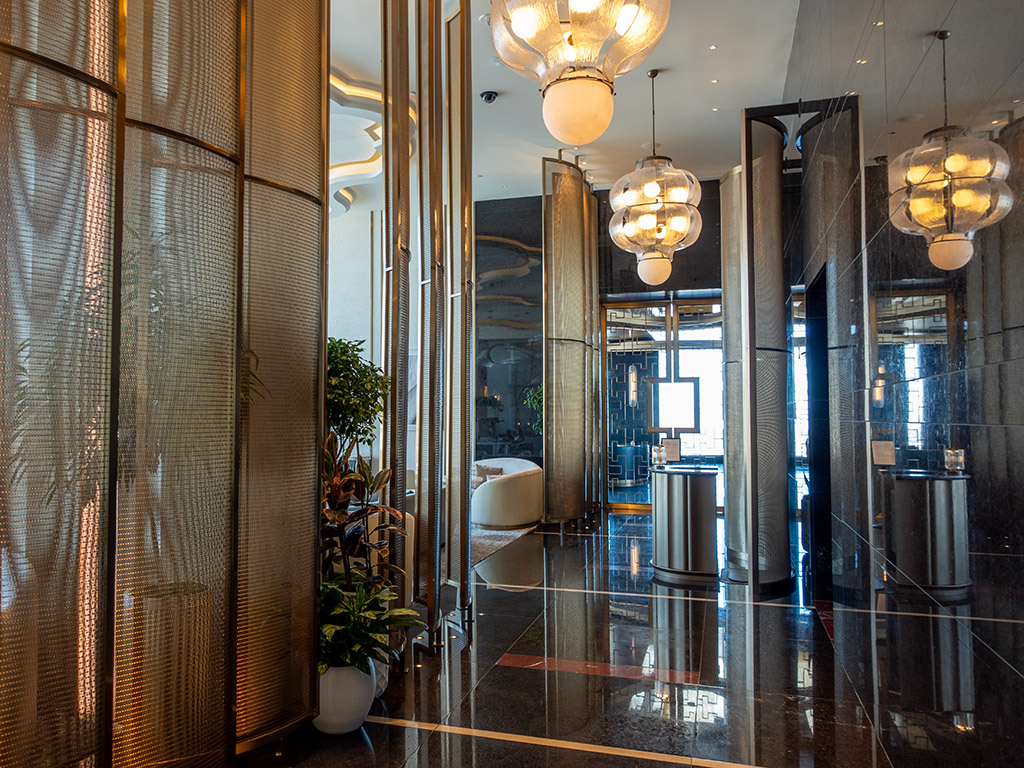
After exiting the elevator on the 23rd floor, you step out into this waiting area with the host’s podium.
This is the hallway that leads deeper into the restaurant and towards the other dining section of the restaurant.
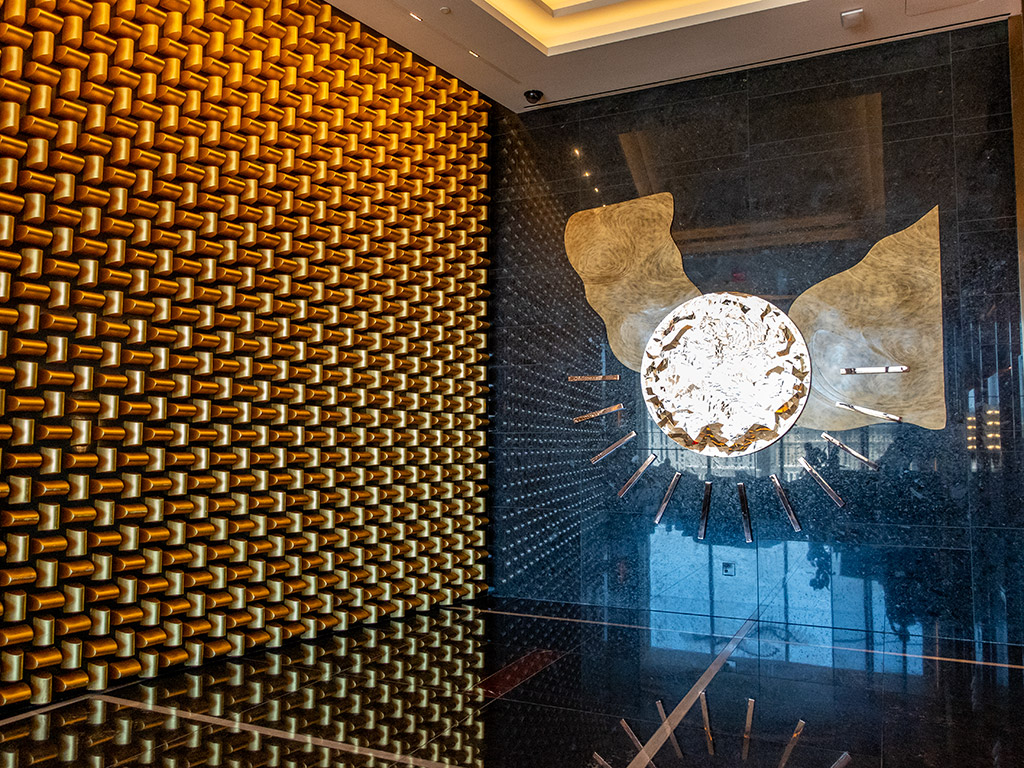
The elevator foyer on the 23rd floor had this interesting gold art on the walls.
The restaurant also had a bar for people who were there for an à la carte experience, rather than the afternoon tea.
Upon the conclusion of our meal, I stopped by the restroom, which had a nice design.
Although we didn’t get a window-side table, another party that was seated window-side left shortly before we did, so I snuck over to that area to grab a picture of the view. In the left, the eastern Veer Tower is on the side, with the Shops at Crystals below it and the Cosmopolitan behind it. To the right, there was a nice view looking northbound onto the Las Vegas Strip, as well as some of the city to the east.
Afternoon tea ×2
$ 128.00
Sales tax (8.375%)
$ 10.72
Gratuity
$ 20.00
Total
$ 158.72
The table to the right shows how much we paid.
Almost US$80.00 per person after tax and gratuity for what is functionally a fancy brunch is a little bit pricey, but also not too crazy considering the circumstances.
With four sandwiches, two scones, four desserts, and one pot of tea per person, that comes out to 11 “items,” and if you divide that into the base price of US$64.00 per person, each item ends up being US$5.82. Account for the fact that you’re not only on the Las Vegas Strip where everything basically already has a tourist mark-up, but also inside a luxury hotel, and it ends up being expensive, but not a rip-off.
CityCenter is my favorite area of the Las Vegas Strip. I have stayed at the Aria Resort & Casino, the Aria Sky Suites, and the Vdara Hotel & Spa; I have toured the Veer Towers in the past as a prospective resident; and I have spent multiple thousands of dollars buying gifts for friends at the Shops at Crystals. Interestingly, I had never been inside the Waldorf Astoria, even back when it used to be the Mandarin Oriental. This was my first time stepping foot inside the building, and it was a great experience.
I enjoyed my afternoon tea experience. There are obviously plenty of other places where you can get better value for your money, but I really enjoyed the atmosphere and environment of Peacock Alley. I wouldn’t say I would come here often, but I think this is a decent spot for me to be a seasonal regular every handful of months and stop by whenever they make changes to their afternoon tea menu.
I’m not too picky of a person, especially when it comes to food, but there are still some things that I prefer and don’t prefer. With that being said, I do still like to experience things that I know I don’t like for two main reasons—to make sure that my preferences haven’t changed over time, and to make sure I keep my understanding of my dislikes up-to-date to ensure that I can articulate myself in case I ever need to justify myself in the future.
One type of food I don’t prefer is anything with a large amount of hot liquid. Obviously, this isn’t a severe dislike—I still consume soup, ramen, and tea, among other similar things. However, having too much of it induces an interesting phenomenon for me where it feels like the inside of my body is itchy. There are no other symptoms, i.e., I don’t have difficulty breathing and I don’t get any external inflammation, but it can still be a bit uncomfortable.
Now of course, although I don’t go to hot pot or shabu-shabu restaurants too often, I still want to visit once in a while under the philosophy I just mentioned. So, last night, I had dinner at The X Pot, a Chinese restaurant by the Chubby Group in the Grand Canal Shoppes at The Palazzo in the Venetian Resort on the Las Vegas Strip in Paradise, Nevada.
Normally, The X Pot has a few different menu options, ranging from standard à la carte to some special chef’s and VIP tasting menus. However, in celebration of their five-year anniversary, they currently have a 100-minute all-you-can-eat special offer from mid-June to the end of July 2025, which is what my friend and I got.
My friend ordered the oxtail tomato soup base, while I got the X special spicy. I should’ve know that this was Asian levels of spicy, considering that the menu had Chinese translations for everything. Unfortunately, my brain did not make the connection at the time, so I ended up ordering this soup base that was tolerable, but still too spicy for my preference. I ended up handling this by removing almost all the spicy peppers in the soup, which actually ended up being a substantial pile, and that helped a lot.
While we were waiting for our meat to arrive, we ordered an appetizer feast, a set of four premium items limited to one order per customer per meal. The feast included ribeye nigiri, wagyu tartare, foie gras with caviar, and a wagyu and uni roll.
For our first round of meat, we got Japanese A5 wagyu ribeye, ribeye cap, chuck roll, and shoulder clod. We also got some Australian stone axe chuck roll and domestic thin-cut wagyu tongue.
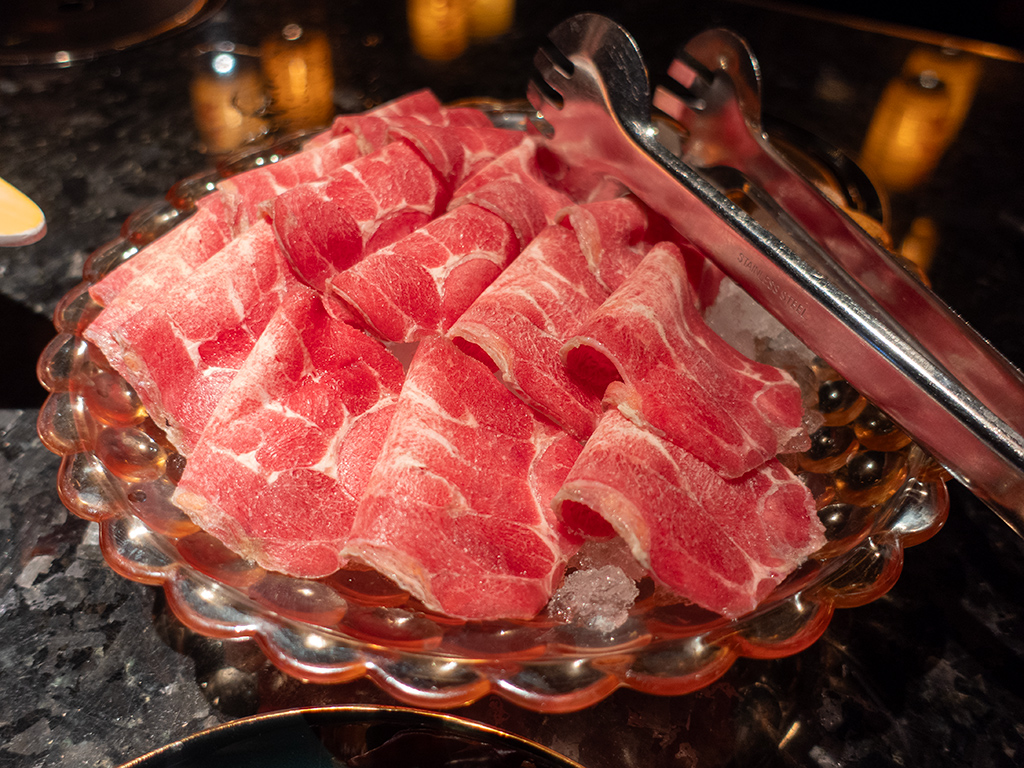
I forgot to take a photograph of our first round of meats; instead, here is a photograph of the second round, which is a plate of only tongue, my favorite cut of beef.
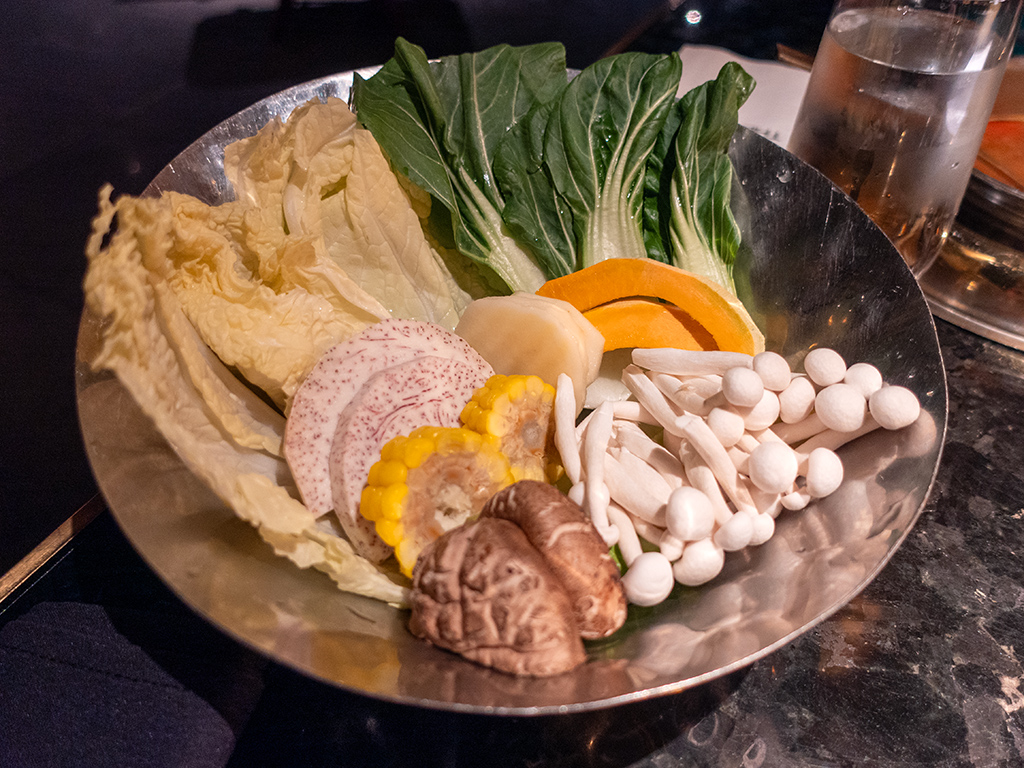
To go along with our soup and meat, we also got a bowl of assorted vegetables.
There were two all-you-can-eat options—one with unlimited wagyu, and one with both unlimited seafood and wagyu. My friend and I both like seafood, so we went with the option that also included unlimited seafood. I’m glad we went with this, because this also included Boston lobster, spotted prawn, oyster, and scallop. In addition to the set pictured, we also got several more orders of oyster and scallop.
My friend also wanted to try a bunch of different signature and specialty dishes from the menu. These are truffle fries, which came with a special house ketchup mixture that I liked.
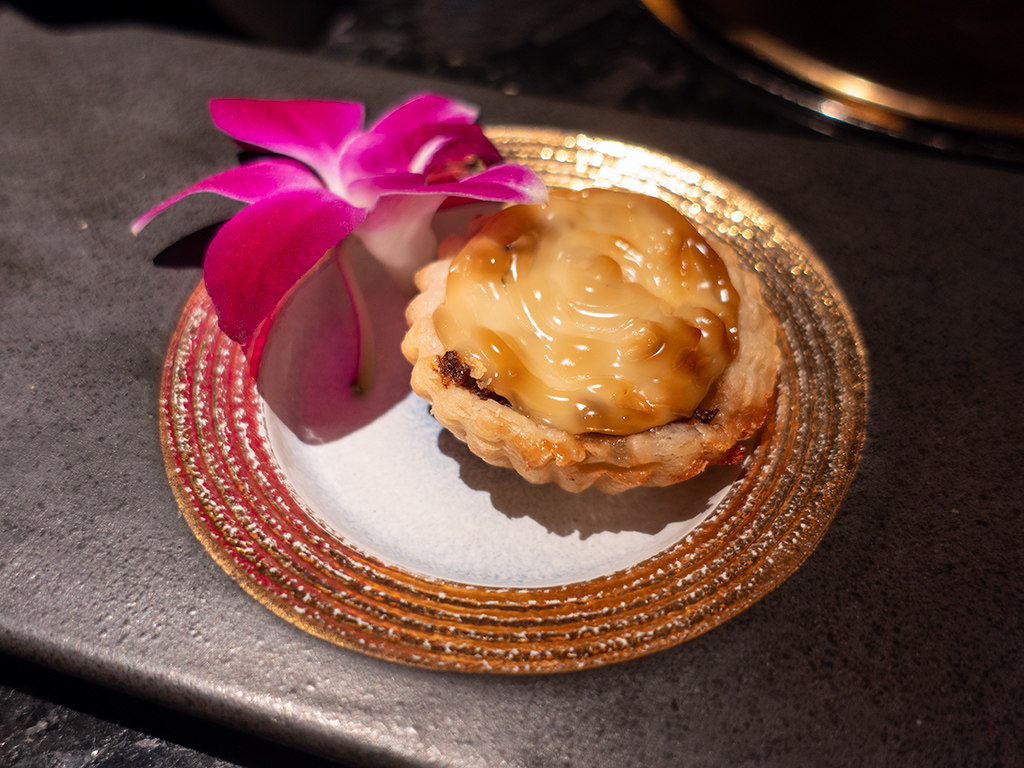
This is a wagyu tart. I wasn’t the biggest fan of this—the meat inside was minced and didn’t have as clean and straightforward of a wagyu flavor as the other items.
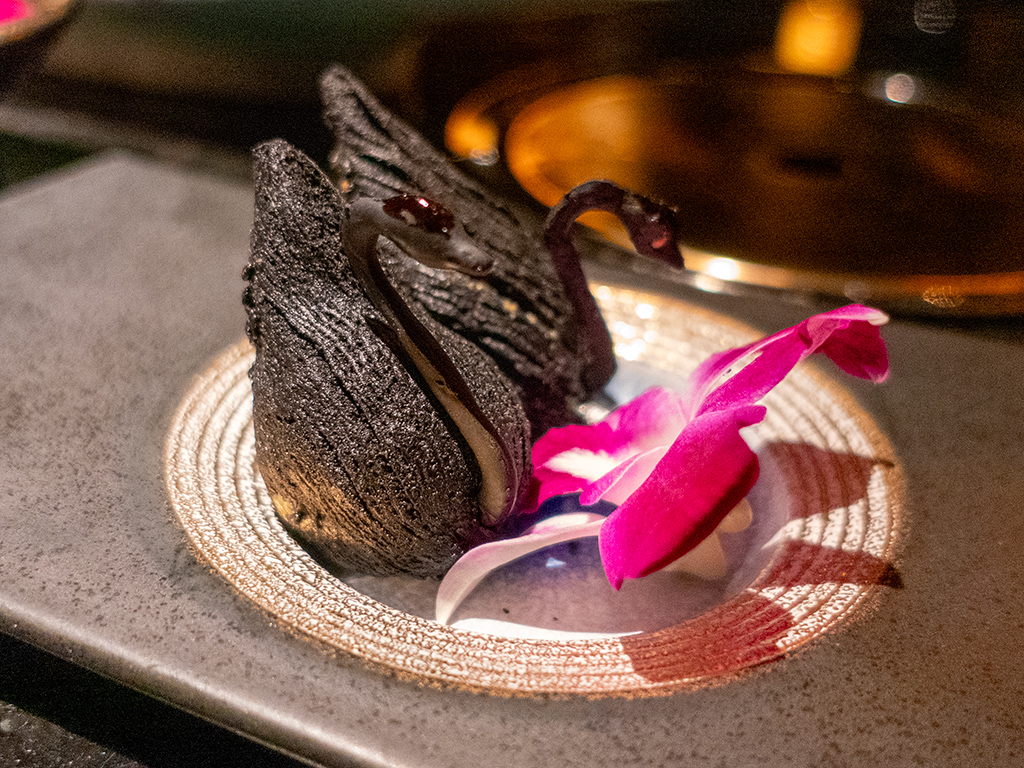
We also each got one swan cake. The presentation on this dish was very nice.
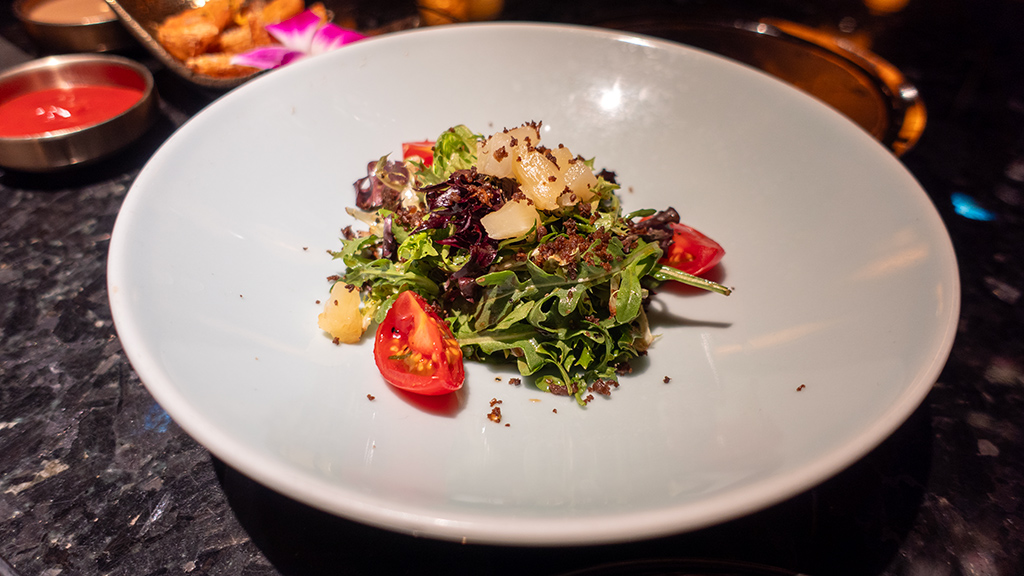
We ordered some wagyu salad as well, but found out that it was basically just a regular salad with some tomatoes and pineapple, and the wagyu element of it appeared to just be crumbled dried wagyu sprinkled on top.
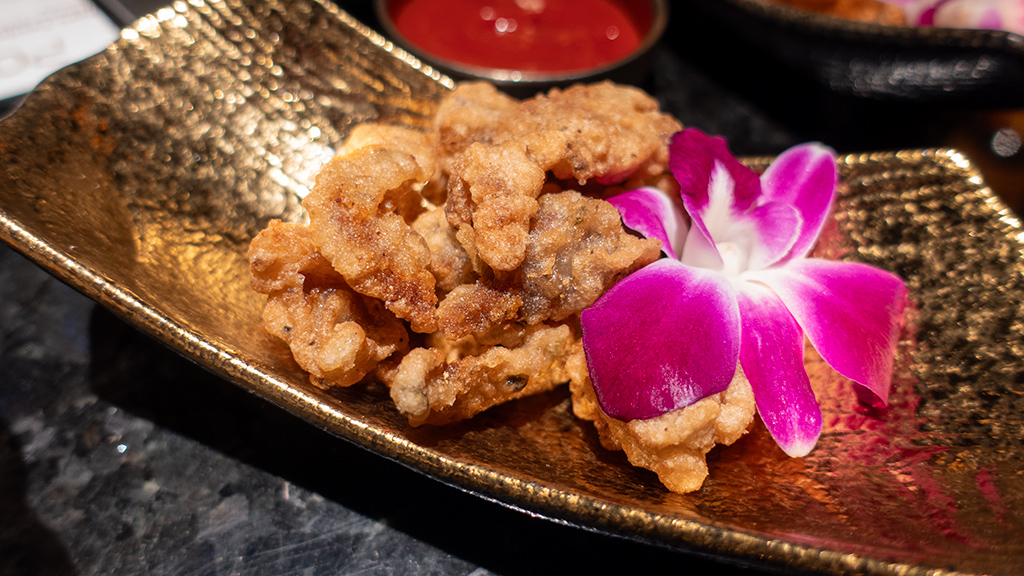
This is crispy pork. I thought it was fine, but it tasted pretty underwhelming compared to how good all the other meat dishes were.
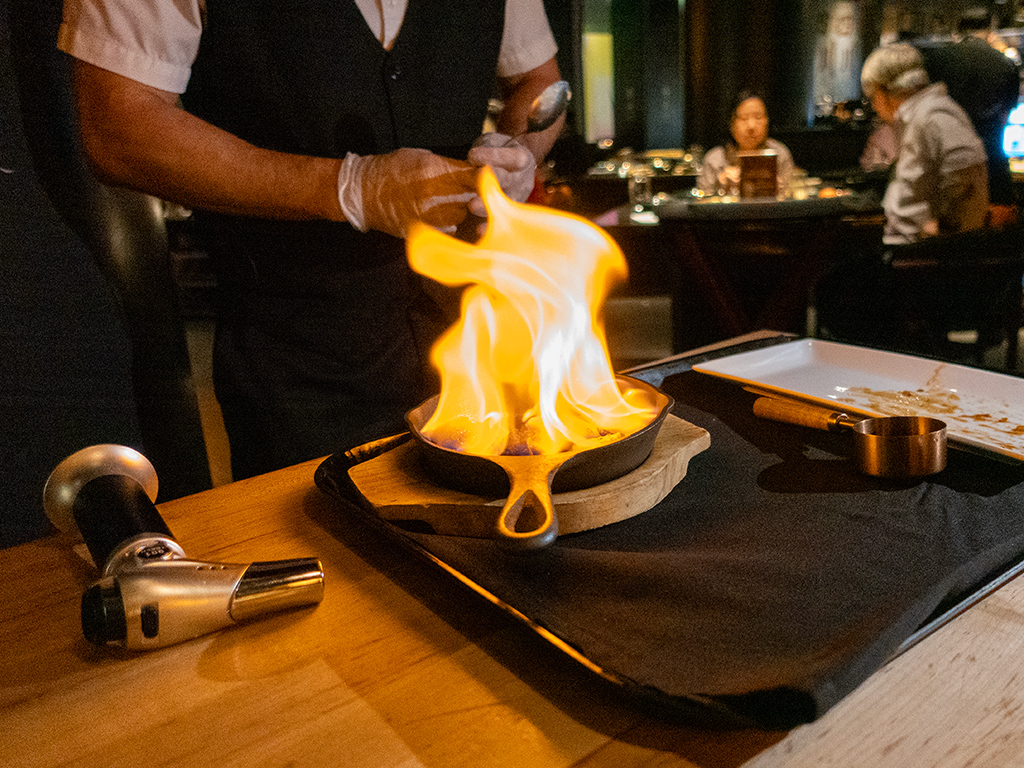
Our order of black pepper A5 wagyu was cooked tableside. This was my favorite item of the dinner—it came with a nice little preparation performance, and the meat was incredibly thick and tender.
This is the wagyu carpaccio.
We also got one wagyu foie gras slider to share. By this point, I was already pretty full, so I only had a few bites of it. I’m sure this was an amazing burger and I would’ve liked it a lot in any other context, but during the dinner, I just preferred the plain wagyu that I could cook in my hot pot soup base.
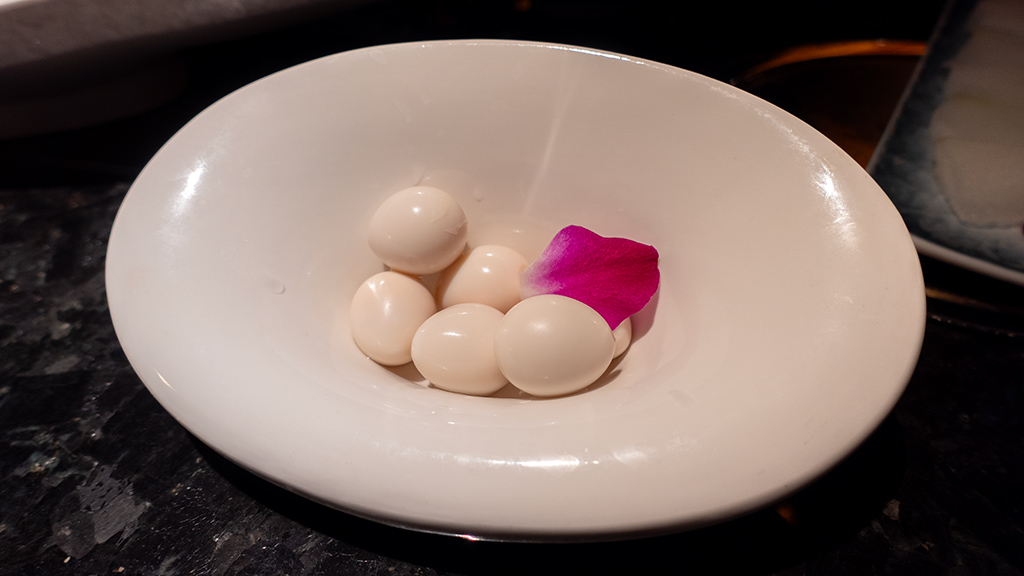
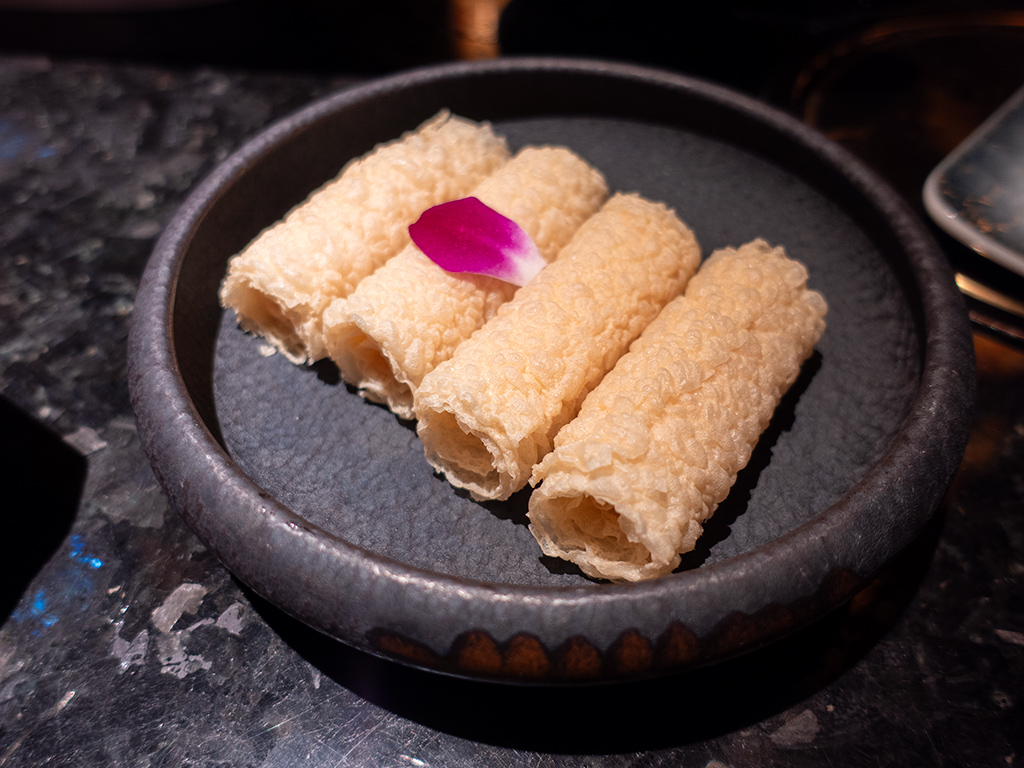
My friend also got some healthier sides with less saturated fat so that we weren’t clogging our arteries too much with all the wagyu—she ordered some quail eggs, bean curd, and wintermelon.
For dessert, we received the chef’s choice special dessert, which was matcha macarons today.
This is what the dining area around us looked like.
Unlimited live seafood and wagyu menu ×2
$ 318.00
Chubby Club Plus member discount ×2
–$ 40.00
Sales tax (8.375%)
$ 23.28
Gratuity
$ 50.00
Total
$ 351.28
The table to the right shows how much we paid.
My friend goes to Chubby Group restaurants once in a while, so she signed up for a Chubby Club Plus membership at the restaurant using a promotional discount and got US$20 deducted from each of our meals. It seemed like it was a good deal if you go to Chubby Group restaurants at least a couple times a year, as the membership seems to pay for itself via member discounts fairly quickly. (Of course, you would have to keep track of and remember to cancel the membership after a year if you don’t want to renew at full price.)
I had a very fun time at The X Pot. They curate the experience such that they keep things interesting, whether it be through the logistics of the meal (like having a combination of hot pot and plated items, or preparing one of the dishes tableside), or through the wide variety of plates and methods of presentation of the food items being served. I also noticed that The X Pot doesn’t cut corners to try and save money and minimize costs—everything seemed to be executed thoughtfully, and all the components of the restaurant seemed classy.
Unsurprisingly, I think I would’ve probably just preferred a high-end all-you-can-eat Japanese or Korean BBQ experience instead of hot pot. However, I’m glad I got to try out The X Pot, because it definitely adds a unique twist to what you’d expect from other restaurants in its class.
If this pricepoint is within your budget and you like hot pot, then I think The X Pot is worth experiencing at least once. It might not be reasonable to go here as a regular, especially with all the other amazing and more affordable all-you-can-eat BBQ and hot pot restaurants in the Las Vegas Valley, but if you’re looking for more than just a barebones experience and want to have a good time treating yourself with some friends, then I think The X Pot would be a good candidate for that.
One of my friends just flew in to visit for a while, so once I picked her up from the airport this evening, we wanted to get a relatively quick and light dinner afterwards. We both like sushi, so we decided on trying out Kase Sake and Sushi at the Spanish Palms Plaza in Spring Valley, Las Vegas, Nevada.
They had five different kinds of tasting menus of varying different price points—the four-course Hanban for US$32, six-course vegan Yasai for US$29, six-course Nami for US$48, seven-course Oomori for US$56, and premium nine-course Kase for US$120. As you might have guessed, we went for the premium tasting option that was named on their menu after Chef Toyonishi.
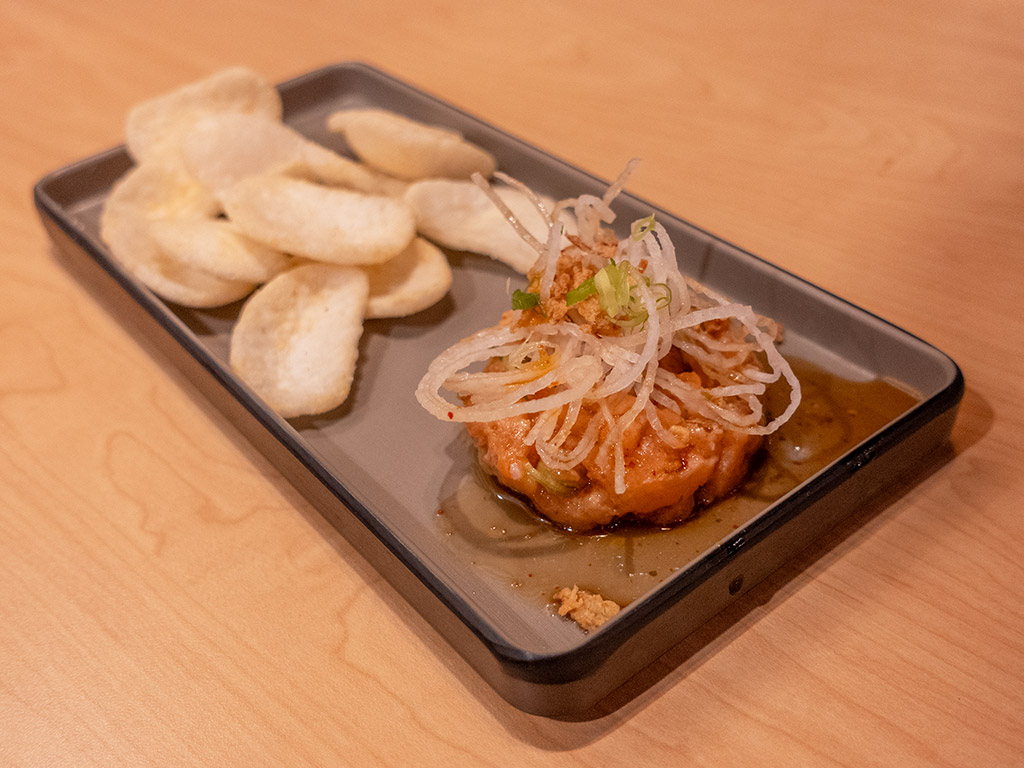
First was some salmon tartare with a side of chips. The chips were very good, but the tartare was a bit oversauced for my preference.
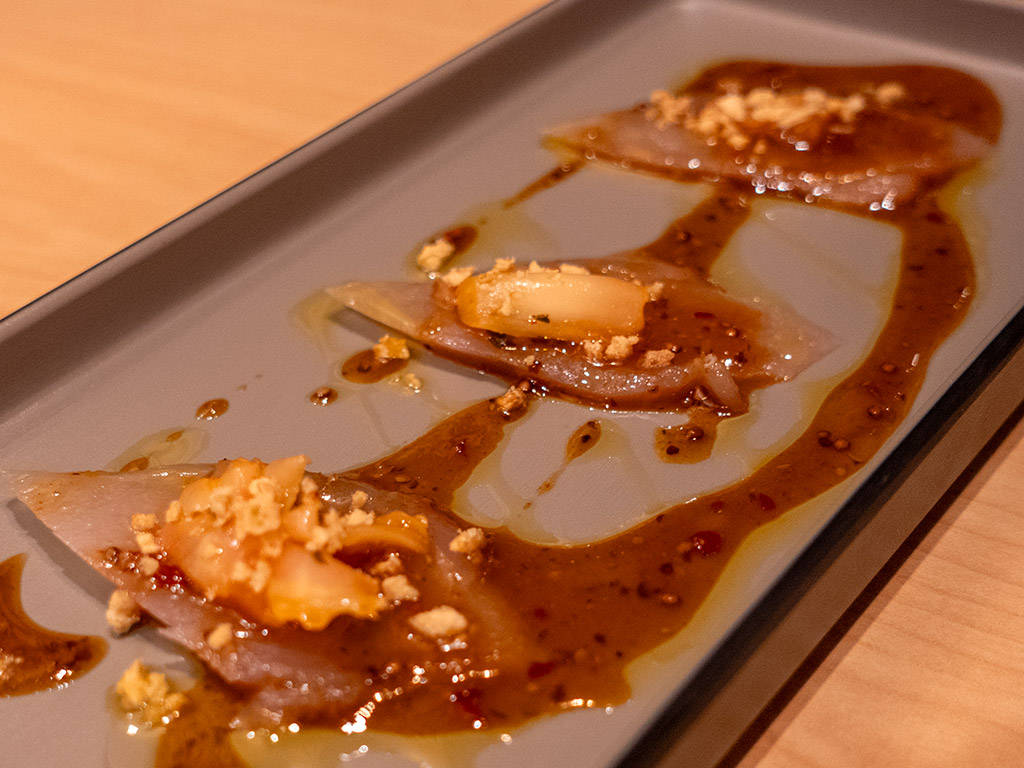
Next was yellowtail carpaccio topped with kimchi. This was a little bit of a mess of flavors because it felt like there was way too much going on in this dish, but if you consider it without trying to analyze the flavors too much, it was still pretty decent.
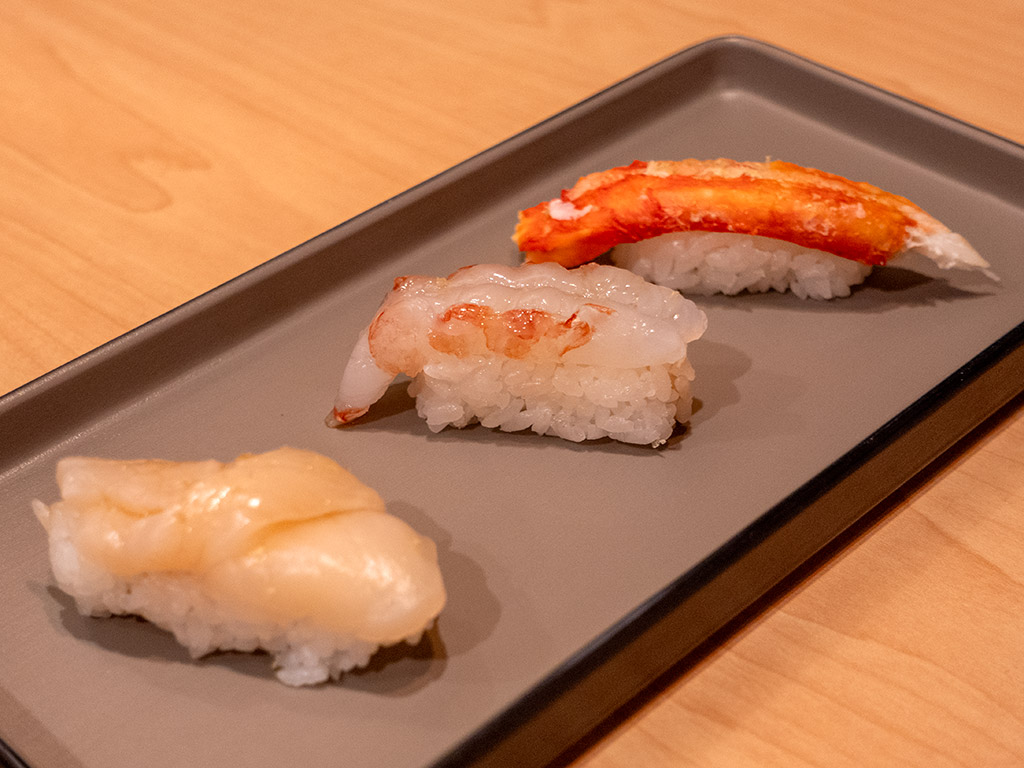
Next up was nigiri service, which came out three pieces at a time.
The scallop and sweet shrimp were good, but the portion of the fish was way too small relative to how much rice they gave—so much so that the flavor of the rice sort of just overwhelmed the taste of the fish.
The crab was… interesting, to say the least. It was a bit rubbery and wasn’t exactly the best in quality. My friend said that she would’ve rather just preferred to eat a stick of imitation crab, and that probably would’ve been better than this crab.
As an intermission from nigiri service, we got a spicy tuna hand roll. I’m usually not a fan of spicy tuna at sushi restaurants because I feel like it’s probably one of the cheapest items you can get, but this one was actually done pretty well—something crunchier was mixed in with the spicy tuna to give it an extra flavor and texture enhancement. My friend and I both commented that we liked this.
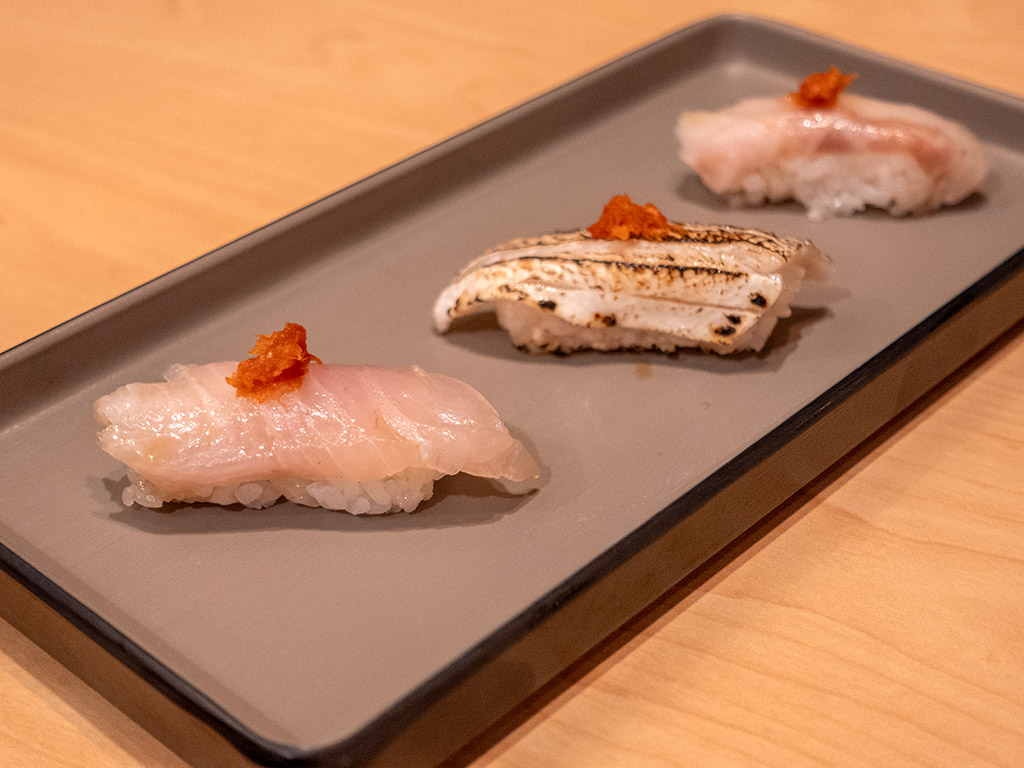
We went right back to nigiri service afterwards, with our next plate being tuna done in three ways—akami, chutoro, and otoro.
This had the same problem as the previous pieces of nigiri, in that the portion size of the tuna was so small that it just tasted like we were taking bites of rice with a sprinkling of fish. You can actually sort of tell that the akami is so ridiculously thin that it’s almost see-through on the edges.
The next set was seared wagyu beef, salmon roe, and what was supposed to be uni topped with caviar and gold leaf… but they ran out of uni. Instead, they substituted it with more of that spicy tuna mixture because the waiter had overheard us talking about how much we liked it, though I guess he missed the context about how I liked it only in comparison to other sushi restaurants’ spicy tuna, and not that I would prefer it over any other premium fish.
The salmon roe was interesting here, because it almost tasted like it had been diluted. Usually when popping the eggs in your mouth, you get a burst of thick liquid that coats the inside of your mouth with ikura flavor, but this tasted much milder and thinner, as if it had somehow been watered down.
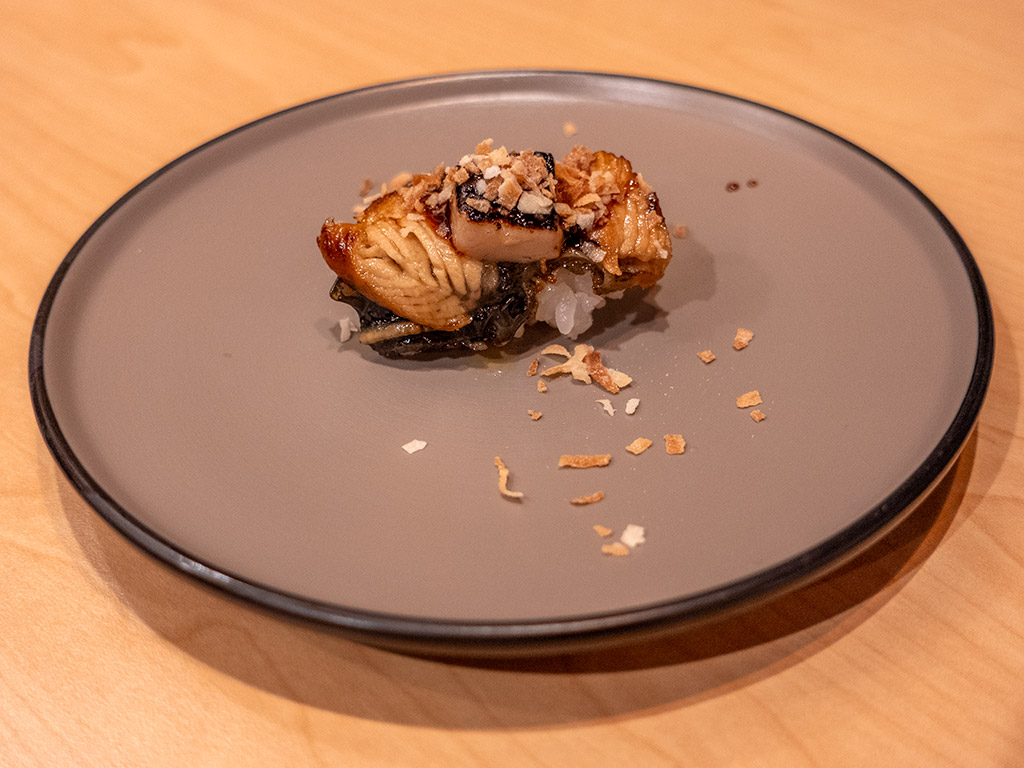
Our last piece of nigiri was eel under a square of foie gras and topped with toasted coconut flakes. This was the one and only truly satisfying and deeply delicious item of the entire tasting menu. The amount of fish and foie gras was reasonable compared to the amount of rice, and the toasted coconut added a nice supplement to both the texture and the flavor.
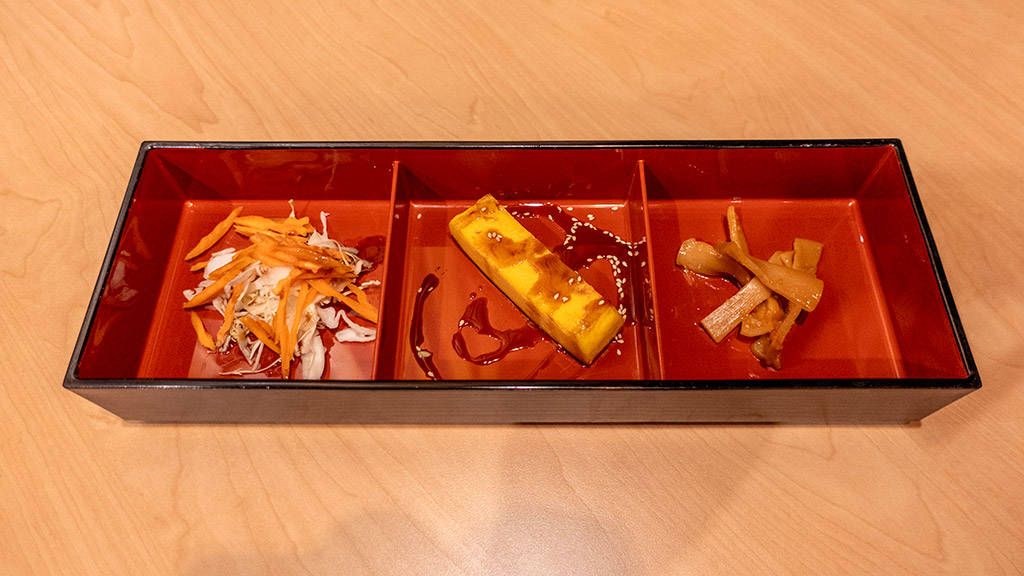
Our final course of the meal was… a little lunch tin of side dishes.
This would have been fine as an appetizer or something, but this is probably one of the most confusing final courses of an omakase-inspired tasting menu that I’ve ever had. The quality of this was very underwhelming and did not even exceed regular side dishes you’d receive for free while, for example, dining in at any Korean restaurant (i.e., their “banchan”).
When I said that little lunch box was the final course, I meant it—they included no dessert in the nine-course tasting menu. They gave us some peach and watermelon gummy candy along with our check instead.
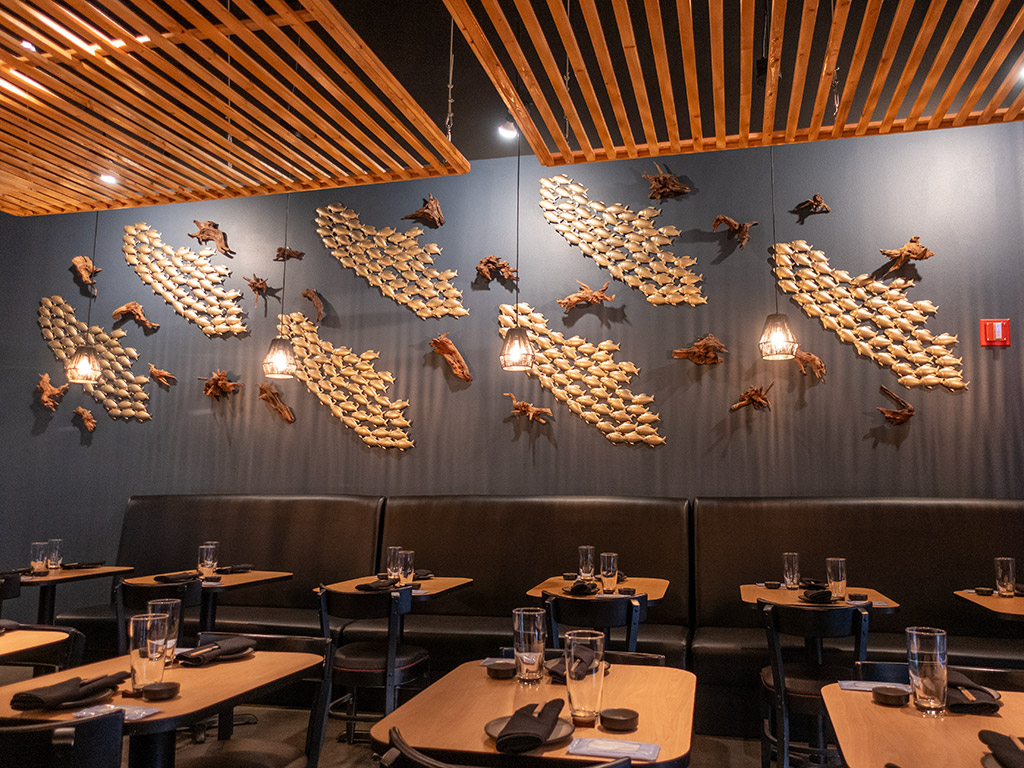
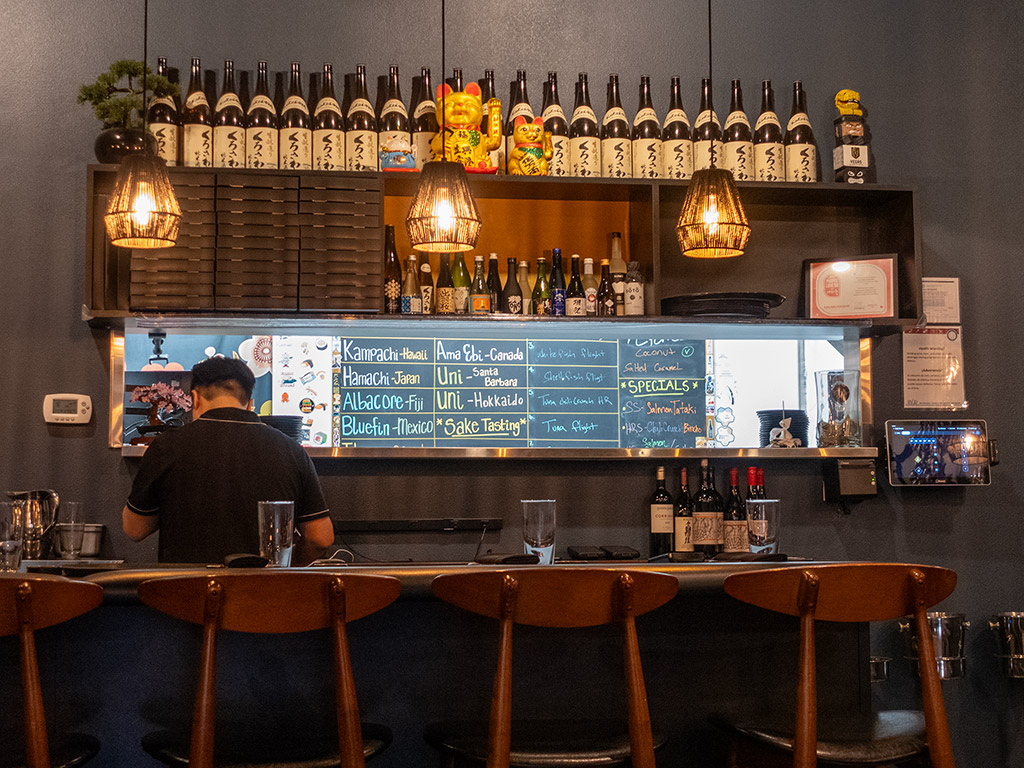
Here are some photographs I took of the interior of the restaurant.
Except for one single other group, it remained empty throughout the dining room during our entire meal, even though we went at a reasonable time for dinner. Based on my experience with this “premium” tasting menu, I guess it makes sense why they’re not doing too well.
Upon our arrival, I requested to be seated at the bar area so that we could see into the kitchen and watch the chef prepare our food while dining, but apparently that is not something that they offered, and we were seated at a booth instead.
The bar also remained empty throughout our entire meal.
Kase premium tasting menu ×2
$ 240.00
Sales tax (8.375%)
$ 20.10
Gratuity
$ 35.00
Total
$ 295.10
The table to the right shows how much we paid.
This was absolutely not worth it. Especially for an off-Strip restaurant, I would expect much, much more from a meal that costs almost $150 per person after sales tax and gratuity.
In the waiter’s defense, he did recommend the smaller seven-course tasting menu for $56 per person instead. The fact that he took initiative to point that out to us as the most popular option indicates to me that I probably would’ve had a better experience with the $56 option, but if it’s the case that the $120 version is so poor in value that the waiter wants to draw attention away from it, then they should probably just remove it from the menu.
I think there are two ways that they can rework the premium nine-course tasting menu to make it work. First, they can either reduce the price down to somewhere in the $70-80 range, which would keep it as a strange tasting menu, but at least it wouldn’t be egregiously overpriced. Alternatively, they can double the portion size of fish on each piece of nigiri, get rid of the weird trio of side dishes at the end of the meal, replace it with a different warm specialty dish, expand the tasting menu to ten courses, and add in a dessert at the end.
Oh, and they should never, ever let themselves run out of sea urchin, but in the outerworldly chance that they do, they should replace it with a different premium item, not spicy tuna.
They have sake in their name, so I’m guessing maybe they’re better at serving alcohol than they are at crafting premium tasting menus? Regardless, in the state that this restaurant is in now, and on the basis of my experience today, I cannot recommend Kase Sake and Sushi.
After my quick trip to the East Coast earlier this month, I flew back to Southern California in preparation for my two-year Twitch moderator anniversary dinner with @PhummyLW. If none of that has any meaning to you, I have a very detailed explanation in last year’s blog post about dining at the Capital Grille in Costa Mesa, California that may serve as prerequisite reading if you’re interested in the backstory of what has now become an annual tradition.
This year, Phummy asked me to take him to Bello by Sandro Nardone, an Italian restaurant in Newport Beach, Orange County, California. They had apparently been experimenting with a newer format of their chef’s tasting menu, and after trialing it for a few weeks, they came up with a system that works best for them—two weekly seatings of up to six people each, every Friday at 6 PM and 8 PM. The first session of this finalized chef’s tasting menu was today, Friday, May 23, 2025 at 6 PM, so I got Phummy and myself booked as their very first customers for this iteration.
We were fortunate enough that, out of the six available seats, Phummy and I were the only two attendees, so we got a very personalized experience with Chef Frank DeLoach. On top of that, I realized that their system in general was very unique, and part-way through our meal, I realized why they called it their chef’s table instead of just a regular tasting menu.
Chef’s tasting menus are often composed of a set number of courses that come out in a certain order as predetermined by the chef. This allows you to experience a culinary story through the food, as told by the chef, in the chef’s style. I love chef’s tasting menus (and omakase experiences, which are the Japanese counterpart), and I scout out the best-rated ones whenever I’m in search for a good restaurant.
On the contrary, a chef’s table, as explained by Chef Frankie, focuses on the diner rather than the chef. There are dishes that the chef will suggest, but otherwise, it is more of a freestyle experience where the chef makes realtime adjustments with the food offerings depending on the feedback and preferences of the diners. Thus, it functionally ends up being less of a traditional chef’s tasting menu experience and more of just having a private chef custom-curating you a multi-course meal over the span of a couple hours.
I was headed over to the restaurant from deep into Los Angeles County, so the estimated travel time was about an hour and a half. In typical Southern California fashion, the traffic got increasingly worse the longer I drove, and while originally anticipating arriving 15 minutes early, I ended up being 12 minutes late.
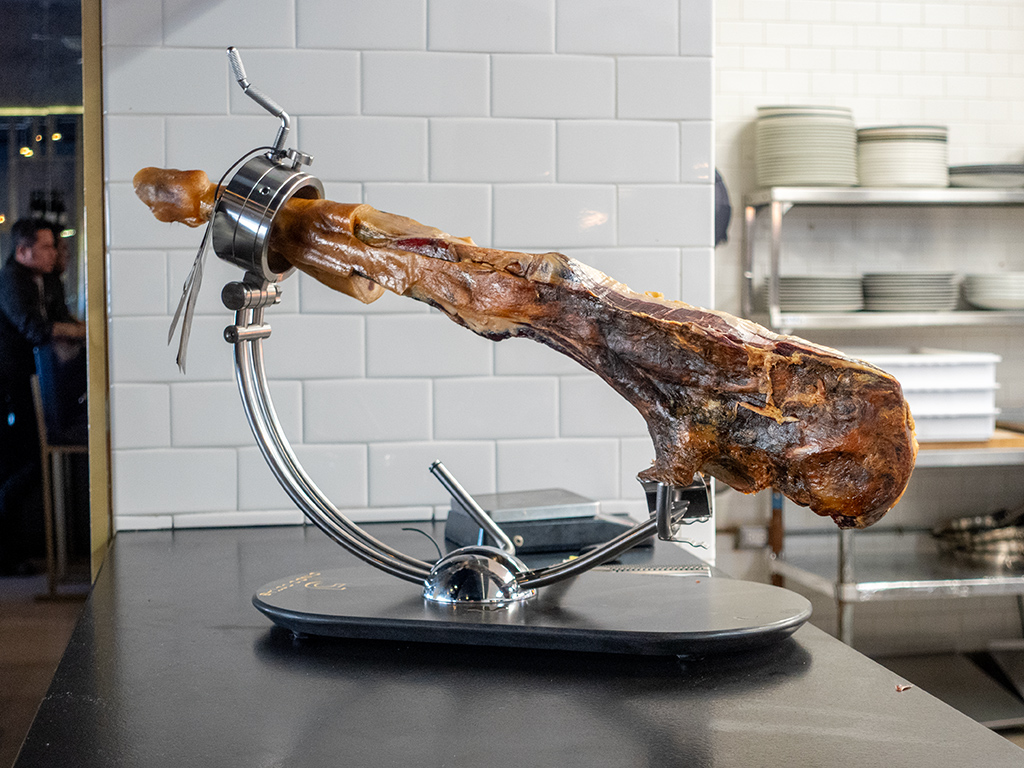
Upon my entrance, Phummy had already been seated and was nibbling on some prosciutto. I joined in and ate my portion. I don’t particularly like prosciutto, especially when it is just the dry-cured ham on its own without anything else to go along with it, but with that being said, this prosciutto still had a very rich, intense, clean flavor that I think fans of prosciutto would enjoy and appreciate a lot.
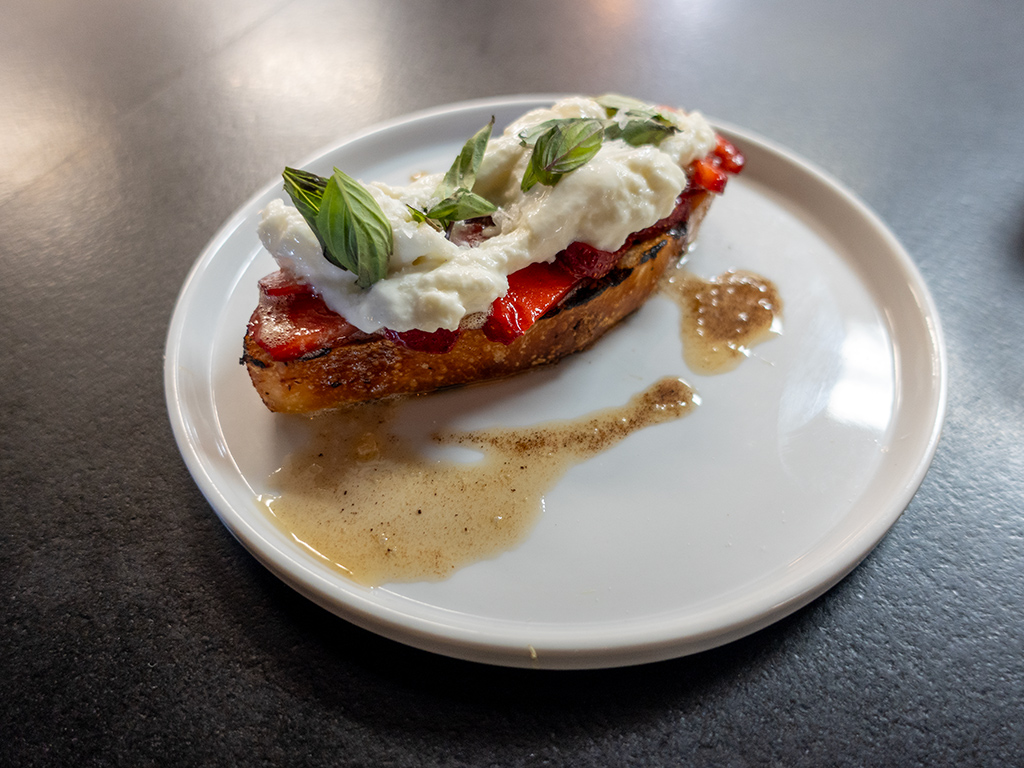
Our first antipasto dish was a bruschetta topped with strawberries, cheese, and herbs. This is literally the best bruschetta I have ever had in my entire life.
I’m generally not a fan of cheese because my taste buds love to pick up and focus on only the moldy flavor of cheese, but this cheese atop the bruschetta was gloriously delicious. It was smooth and creamy, and the flavor only had the “nice” parts of the cheese without any of the pungency, intensity, or moldiness. The texture was soft and delicate, and it coated the inside of my mouth in a way that contributed its flavor uniformly across every time I bit down to chew.
The bread was prepared to perfection. To me, bruschetta doesn’t have the best reputation because the bread usually comes out at such an inconvenient texture where it’s not exactly the consistency of a cracker, but it’s still hard and sharp enough that it cuts the inside of your mouth. This bruschetta’s bread had the perfect amount of resistance given to each bite where it added a great balance of firmness and softness.
Lately, I’ve seen some viral online videos about egregiously expensive but orgasmically delicious strawberries, and although I have not tried those strawberries, I feel like they would be on par with the ones on this bruschetta. These strawberries tasted like nature-made candy, but rather than pure sweetness, it was somehow like a combination of sweet and umami.
Next was some crudo topped with macadamia nuts, cucumbers, red onions, and other greens, bathing inside a coconut sauce.
With how much sushi I eat, I have obviously eaten a lot of crudo. Crudo at Japanese restaurants is often a hit-or-miss, and rather than hamachi crudo, I have almost always just preferred plain yellowtail sashimi instead because of how sour crudo ends up being.
This crudo had none of the downsides that I have experienced in the past with crudo. The coconut sauce was mild but still flavorful, and the vegetables were only pickled to a point where they had a subtle kick, so neither the sauce nor the toppings pierced through or overwhelmed the flavor of the raw fish.
Next was a minced chicken dish wrapped in some leaves (I forgot what kind of leaves, and I also forgot what other ingredients were included in the dish).
This had a balanced meaty and earthy flavor, but unfortunately, it was so overwhelmingly salty for me that it distracted and detracted from some of the flavor. I mentioned that to the chef, and I am pretty sure he took that into consideration for future dishes, as nothing else served later during the dinner was too salty anymore.
Next up was our pasta dish. I think this shape of pasta is called strozzapreti, but I don’t recall with certainty.
The sauce was made with a mixture of seafood and other portions of leftover ingredients that would otherwise not make it into main entrées. It had somewhat of a nostalgic flavor to it that reminded me of homemade stew.
Some people take their leftover scraps from home cooking and throw it all into a simmering soup; this dish’s sauce was basically similar to that. When restaurants prepare dishes for presentation, a significant portion of perfectly-fine ingredients don’t make the final cut due to their physical appearance, so it is great when it ends up being used in a sauce rather than being wasted. With that being said, when this dish’s sauce was prepared, it seems like it was aiming for that “scrap stew” kind of flavor, but the quality of the ingredients were so high that you could easily tell it wasn’t just scraps.
This is probably unsurprising if you know how much I like fish and seafood, but this pasta dish ended up being my second favorite course of the meal (behind the bruschetta).
After our pasta, we were served some fish alongside tomatoes, cucumbers, fennel fronds, and olive oil.
I was impressed at the preparation of the tomatoes and cucumbers—the chef managed to reduce it down to only the tomato and cucumber flavor, without any of the other tanginess, tartness, or sourness that you might find with some fruits. It was almost as if these tomatoes and cucumbers were real-life examples of what flavor you would aim for if you were manufacturing a perfect tomato and cucumber flavor in a laboratory.
The fish was unremarkable, but in a good way. It was a clean, straightforward, smooth, untarnished fish flavor that I could happily eat everyday and would enjoy it every single time.
I also appreciated the temperature difference between the slightly chilled fruit and the warm fish—that added a fun dynamic to the consumption experience.
Coming up next was a beef entrée.
As what was supposed to be our final entrée, we were served steak with beet sauce topped with leek and pistachio.
This is some of the strongest beef flavor in a steak that I’ve ever had. Normally, steak with this level of intensity also usually comes with some gameyness, but this steak was very clean and pure in flavor. The ratio of fat cap to lean meat was perfect. Adding a bit of leek to each bite served as a decorative but subtle enhancement to the texture. The beet sauce helped amplify the beefiness of the steak, making it taste even deeper and richer.
The presentation was also quite unique, in that it basically came out like a piece of abstract art. I don’t see that too often because it’s tricky to properly straddle the line between a dish appearing as abstract art as opposed to just a mess, but I think this one pulled it off decently well.
While eating our steak, I asked Phummy if this was his favorite dish of the night, which he confirmed. I figured as much, because it was one of the more basic dishes without too many complicated flavors; it just took the concept of steak and took it far, doing it in the best way possible without any extra fanciness added to it.
Of course, preferring basic flavors is not inherently a negative thing. Just because you like simple dishes does not mean that you’re not able to discern the quality of the ingredients and the excellence in culinary preparation. With that being said, the chef made sure Phummy understood as such, and let him know that there is no problem with the steak being his favorite dish.
This evolved into a conversation where the chef mentioned how some people just really love pizza and will ask for pizza at the chef’s table, and Phummy pointed out that he too loves pizza. Chef Frankie was happy to hear that, and made us a Neapolitan pizza for us as a complimentary supplement to the regular tasting menu.
This was a great pizza. I would describe it as pristine simplicity—it used only the core and minimum ingredients needed to make a pizza, so there were no distracting flavors. With each bite, all you got was pure, blissful pizza, and nothing else. The crust was also a perfect consistency that made chewing it satisfying.
From what I noticed, I think there was very minimal seasoning on it. Instead, the char on the crust and base of the pizza served as a substitute for seasoning, adding a more natural-tasting enhancement to the overall pizza flavor profile.
For dessert, we got a piece of cake and some mashed pineapple with roasted almond ice cream on top.
Even now, I’m unsure how I feel about this dessert. Pineapple is my second-favorite fruit behind kiwi, so I obviously liked that. However, I couldn’t really pinpoint how I felt about the cake. On top of that, this was the first time I had ever had roasted almond ice cream, so this was a very new flavor combination for me.
Here is a wider shot of the kitchen; at the chef’s table, we were able to get a clear view of everything going on during our meal.
Each ticket to the Chef’s Table cost $185. They charged a 20% service fee in lieu of gratuity, which was prominently disclosed during booking by way of just adding that 20% directly onto the marketed price when selecting the Chef’s Table. There are some restaurants that say a service fee is charged and that tips are not expected, yet they give you a receipt at the end of your meal to add on an optional tip anyway; Bello by Sandro Nardone did not do that, and they did not even give us the possibility of adding an extra gratuity at the end. The booking fee was charged by Tock and did not go to the restaurant.
Everything was prepaid at the time of booking the reservation. Pricing-wise, this was one of the most refreshing and honest payment experiences I’ve ever had at a restaurant. It’s always annoying when a restaurant advertises a certain per-person price for a multi-course meal or special dining experience, but because of optional add-ons and mandatory fees, you end up paying double what you expected. Because of having to regularly deal with that, I especially appreciated Bello by Sandro Nardone’s transparency.
This is probably some of the best service I’ve ever received at a restaurant. I’m used to receiving personalized attention from chefs when sitting at sushi bars for omakase, but Bello took it to an entirely new level. It was blatantly obvious that they wanted to ensure we had a great time, and they were querying and keeping track of our preferences to maximize our satisfaction with the meal.
The overall quality of the food was amazing. The portion sizes were also refreshingly large and filling. I felt like I concluded my dinner full of only great food, with no “filler dishes.”
This is definitely an expensive meal, but if this is within your budgetary means, I highly recommend the Chef’s Table with Chef Frank DeLoach at Bello by Sandro Nardone. I don’t know what the à la carte menu is like, and I did not have an opportunity to meet Sandro Nardone himself, but Chef Frankie (and one other staff member whose name I regretfully forgot) gave us a top-tier experience.