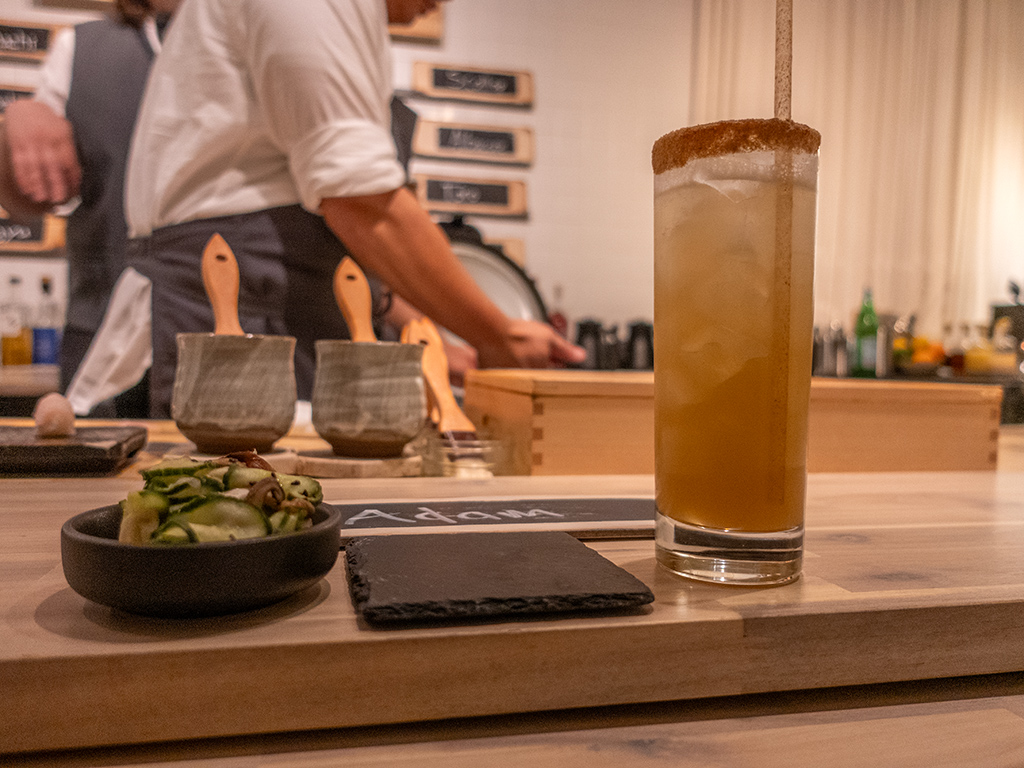
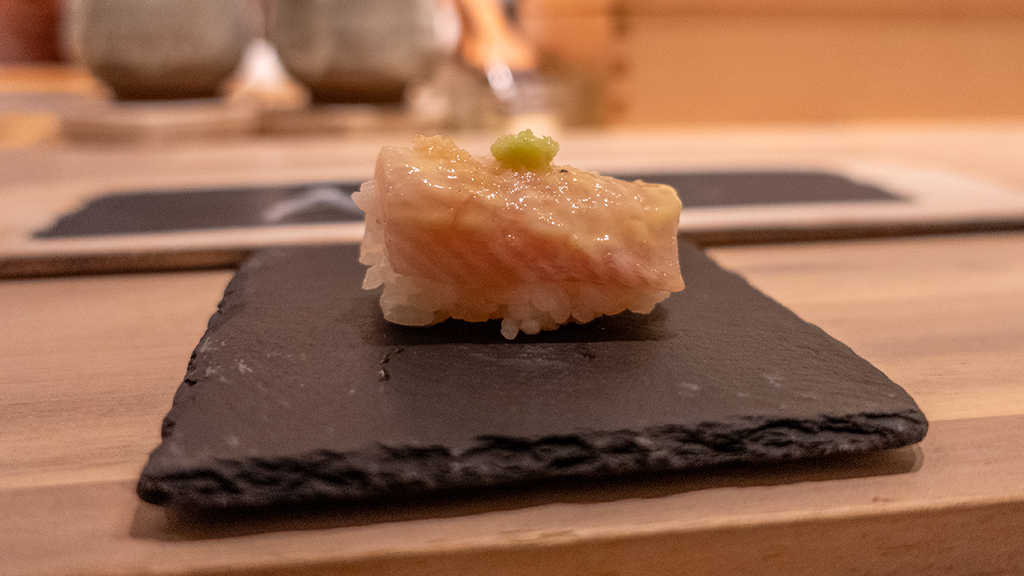
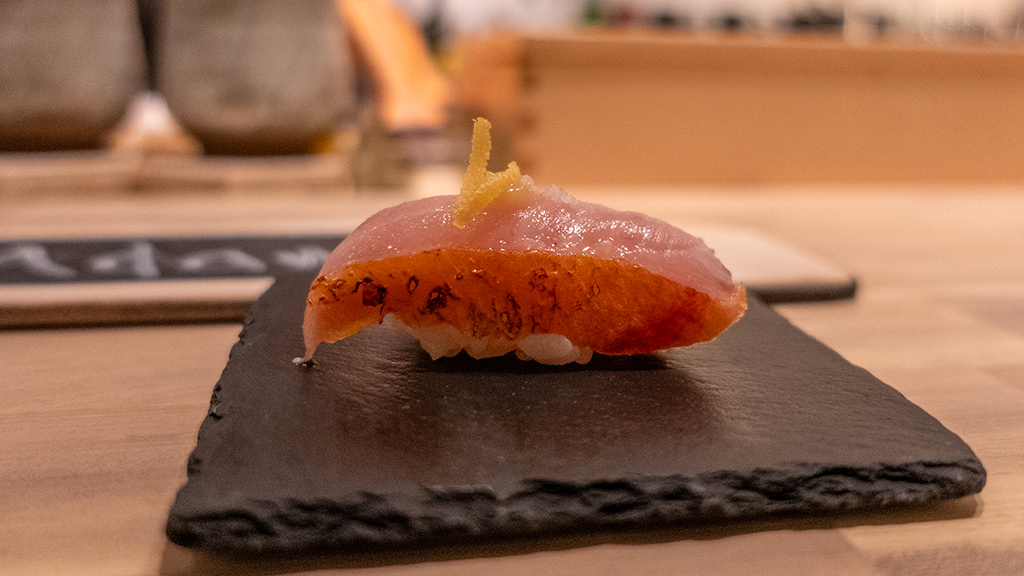
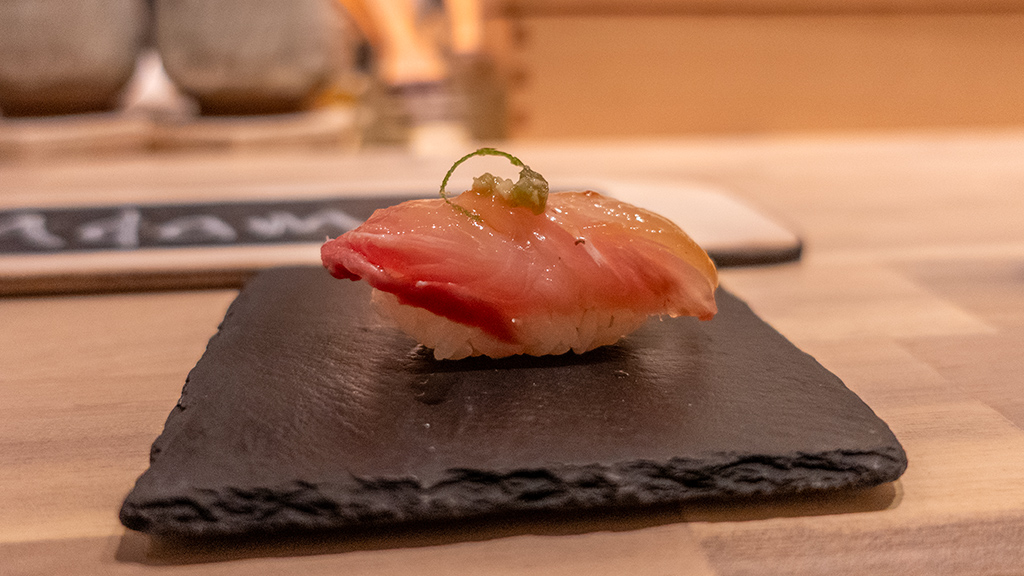
Food photo dump from New Zealand

I’ve posted a lot of photos from tourism activities during my New Zealand trip with my friend Doug Wreden so far, but I haven’t shared what we’ve eaten, which may be surprising considering how frequently I blog about food otherwise. That’s mainly because most of the food we’ve gotten has been quick stops in between being tourists, and we didn’t really go to a lot of multi-course sit-down restaurants that would warrant entire blog posts for them. Instead, I decided to collect all my food pictures and do a photo dump at the end.

(As a side note, I took all these food photos with my phone out of convenience, so they won’t be quite as high quality as those in my other restaurant recap and review blog posts where I take my actual camera to take photos.)

Being a Marriott loyalist, my hotel of choice upon arriving in Auckland was the JW Marriott Auckland. Unfortunately, they are undergoing renovations so basically every single amenity was closed, but luckily, that did mean that they were offering their rooms at fairly significant discounts and we did not have to pay regular JW prices.

Upon checking in, I often get a special welcome gift due to my Ambassador Elite status. We booked two rooms so Doug and I could each have our separate rooms, but the staff didn’t know who was going to take which room, so they put the cheese and nuts plate in Doug’s room instead. Because of that, he managed to swipe a few crackers before I managed to take a photo.

After going to SEA LIFE Kelly Tarlton’s Aquarium, we walked back to Auckland’s Central Business District and stopped by The Godfather Pizza on the way.

I ordered a margherita pizza and was a bit disappointed with what I got. Usually it comes with large round cuts of tomato and fresh basil on top, but it looks like this had some sort of basil paste under the cheese instead, and the presentation wasn’t very good. Flavor-wise, it wasn’t particularly delicious; I don’t think any of the ingredients were really that high in quality, so it tasted like I was eating a bread-cheese-tomato porridge instead of a pizza.

Before we set off on our coast-to-coast walk across Auckland, we stopped by Best Ugly Bagels where I ordered a Butter Up!, which was advertised as a toasted bagel with a “lick” of butter. Instead of a lick, I received a bagel absolutely drenched in butter.

I’m usually not a fan of using an insane amount of butter or otherwise using extreme amounts of fats when cooking, but surprisingly, the Butter Up! was great. I later came to find that New Zealand butter in general seems to be pretty mild, so this went down smooth and did not leave a greasy aftertaste in my mouth. The apple, lemon, ginger, and turmeric juice was also great—it had an interesting flavor profile and was not too sweet.

As an added perk, I got to enjoy the bagel at a table-side window with a nice view of the Central Business District.

After our walk, we went to Eden Noodles on Dominion Road in Mount Eden. The noodles weren’t anything particularly special, but it was a solid dish that served as a good meal. I think I did a poor job at mixing everything together, because it got pretty spicy near the end.

For dessert, we went to Wheatz Bakery on Lorne Street in the Central Business District. I got an almond croissant and a taro waffle.

The almond croissant was good, but I especially liked the taro waffle because the waffle had medium sweetness while the taro filling had fairly mild sweetness, so they complemented each other well and allowed for the true waffle and taro flavors to shine through without being too overwhelmingly sweet.

Before we started our day at the Waitomo Glowworm Caves, we stopped by the on-site café for breakfast. Doug and I each ordered a breakfast roll, which included bacon, eggs, potatoes, and greens. The potatoes were prepared in a unique way that I hadn’t seen done in a sandwich in the United States before; I thought it was decent, but Doug did not like it.

In between the Waitomo Cave and Ruakuri Cave tours, I took a quick break at the on-site restaurant and ordered a BLT.

My favorite part of the sandwich was the bread—it was crispy on the outside and very soft on the inside. The rest of the sandwich was passable, though I think they put way too much ranch, because it sort of just tasted like a ranch sandwich with toppings of bacon, tomato, and mixed greens.

My favorite part of the meal in general was the drink. I got a bottle of apple black currant juice because I don’t really see that being sold too frequently in the United States, and it was delicious. Not only was it a flavor that I don’t get to try often, but I noticed that New Zealand beverages have substantially lower sugar in general, so the juice tasted like I was drinking actual real fruit juice, as opposed to just flavored sugar water like in the United States.

Afterwards, we stopped by the General Store Waitomo to get snacks and dinner. Doug and I shared a pizza, which hardly tasted like a pizza and was more like thin, cheesy bread.

We also each got a plate of fish and chips, which was much better than the pizza. The fish was tender, the ratio of breading to fish was reasonable, and the breading didn’t leave an excessively greasy aftertaste.

On the day we arrived in Rotorua, we went to The Fat Brother for lunch.

We got an order of Monster Nachos to share, which contained nacho chips, slow-cooked beef, meat lover’s mixed cheese, salsa, and sour cream. It lived up to its name when it came out and was comically gigantic. The nachos were surprisingly good—the cheese had a uniquely meaty flavor to it (which I imagine comes from the “mixed” aspect of it as described by the menu), and the beef was tender. The shell tasted like a healthier and less greasier version of Taco Bell’s Chalupa Supreme® shell.

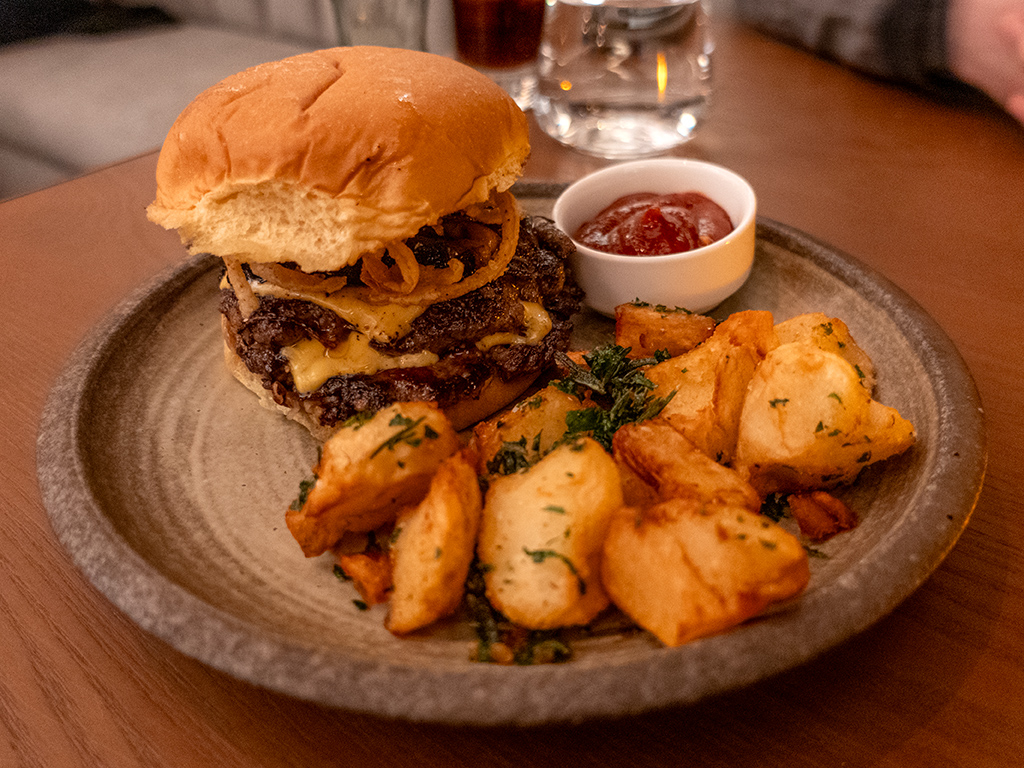
We also each got a chicken sandwich. Doug ordered a “Fat Girlfriend,” which came with fried chicken, lettuce, American cheese, and signature sauce on a brioche bun. I ordered a “Fat Chick,” which came with grilled chicken, lettuce, tomato, and red onion on a brioche bun. My sandwich was fine, and it tasted like a fairly average grilled chicken sandwich.

On the day of our departure from Rotorua, we stopped by Ambrosia Restaurant and Bar after checking out of our lodge. I had already eaten free breakfast at our hotel so I wasn’t too hungry, but Doug slept in and needed food.

We ordered a bread plate to share. The garlic bread was good, but everything else was fairly average.

Doug ordered some lamb as his meal, and I tried one cut of it. It was the most delicious lamb I had ever tasted. Usually in the United States, a majority of lamb’s flavor comes from the fat, and the leaner portions are generally milder. However, from the very small sample size of New Zealand lamb I tried, it seems like it is far more flavor-packed as a whole—not only in the fat, but also in the muscle as well.

After looping back around and returning to Auckland, we had dinner at Kajiken Auckland on O’Connell Street in the Central Business District. The expected 15-minute wait time for a table for two ended up being over half an hour, while it seemed like many people who arrived after us got seated first. Food service was slow and strange—we added a strawberry cheese cake for dessert, and it was the first item to come out, as if it was supposed to be an appetizer instead.

I ordered “The Original,” which was noodles with chashu, menma, nori, and scallion. I wanted to add a half soft boiled egg or two, but the ordering system they had with a QR code did not make it seem like it was possible to do so. The dish was way too salty, up to the point that if I had gotten this as takeaway instead, I would’ve rinsed off the noodles before eating them.

I got white peach cider as my beverage, which was very strong, but still had good flavor.

Doug ordered two bowls. The first was noodles with mayonnaise-flavored crab meat and fish roe, deep-fried prawn, nori, scallion, and corn. The second was tonkotsu, which came with thin noodles in pork broth topped with pork belly chashu, soft-boiled egg, menma, nori, and scallion.

And now, for the grand finale. As our final dinner in Auckland, Doug and I went to Depot Eatery.

While we were deciding what to order, we received some bread with a delicious sauce. I couldn’t tell what the sauce was, but it was as if it almost had undertones of curry without any of the pungency.

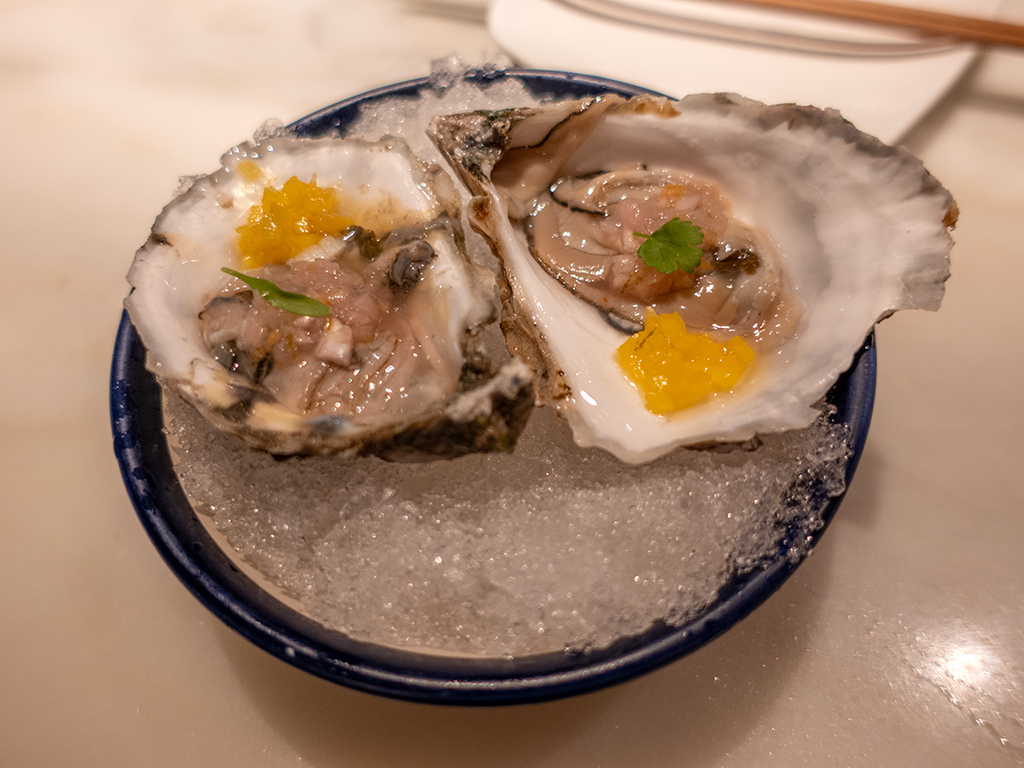
For our first appetizer, we ordered three Orongo Bay oysters and three Mahurangi oysters for NZ$6 each, and I ate two of each. All of them had clean, rich, deep oyster flavors, and I enjoyed them all.

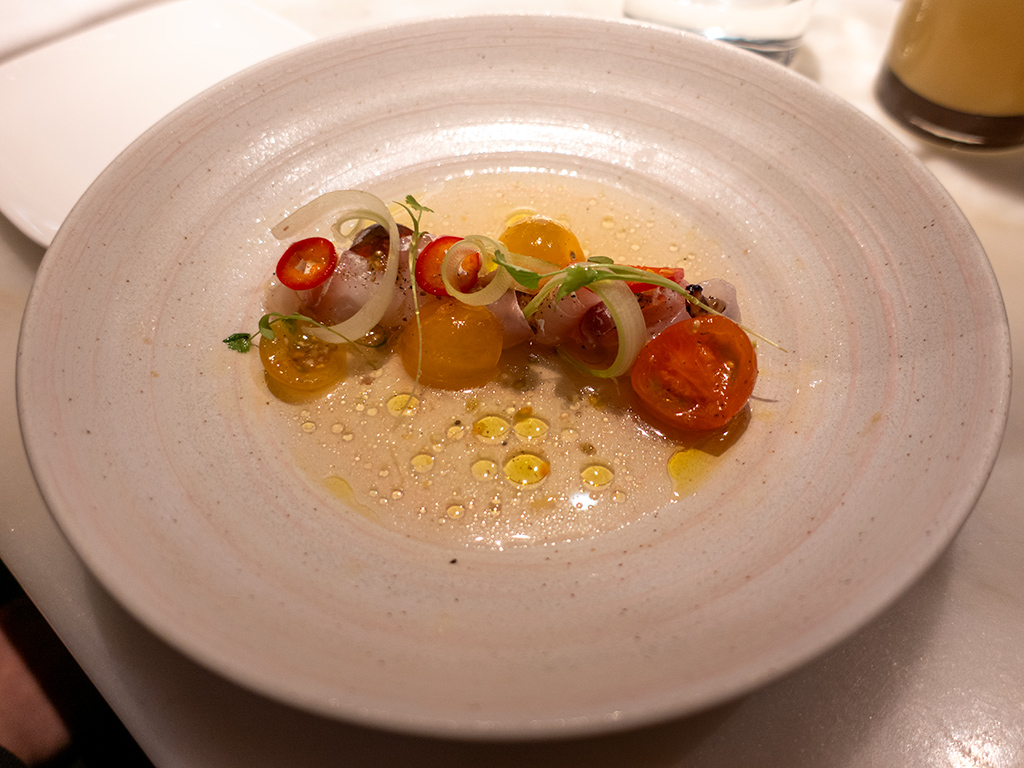
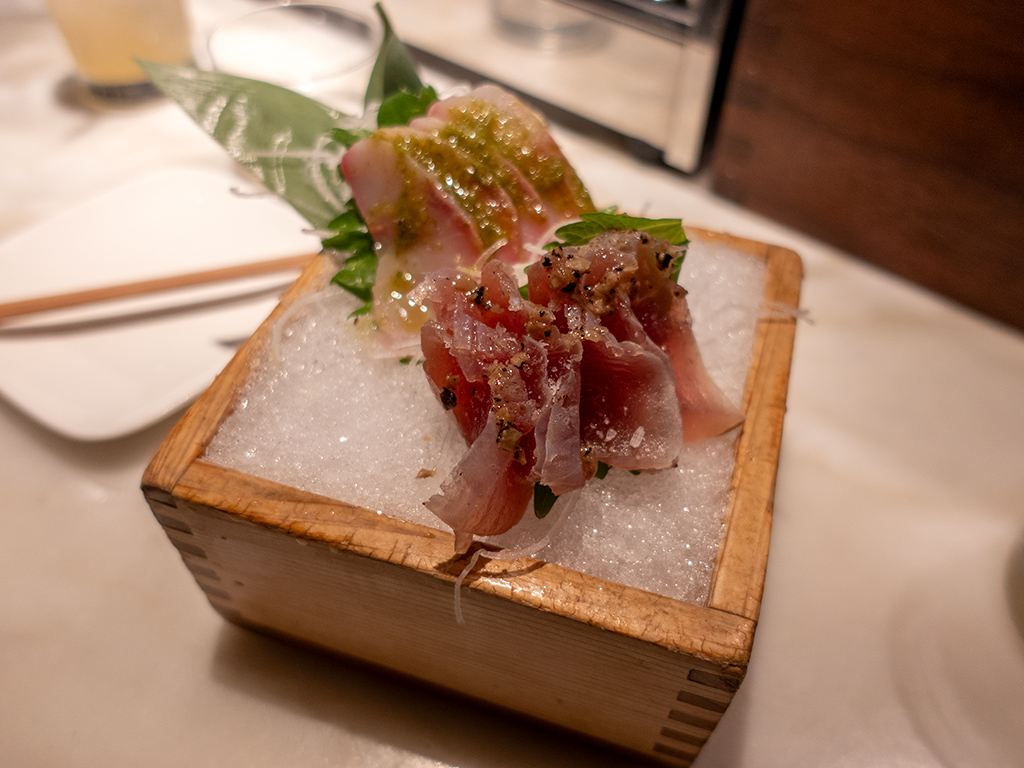
Our second appetizer was trevally sashimi with soy syrup, wasabi peas, kewpie mayo, and basil for NZ$25. There was a little bit too much soy syrup, but otherwise, this recipe was incredible. Not only did it have a great flavor profile that I haven’t seen done before, but the contrast of texture was also very satisfying to chew.

From the charcuterie board, our next dish was wild rabbit and pork rillette with cherry relish, cornichons, and sliced baguette for NZ$24.

I’ve had rabbit a few times before, and each time, including this one, it has tasted fairly similar to turkey, regardless of how it was prepared. Doug was not a fan of this dish, so I ended up having most of it; it wasn’t my favorite either, but I still thought it was fine.

As an intermission, we got a small dish—snapper sliders with pickled lemon mayo and watercress for NZ$24.

The fish was melt-in-your-mouth good, the sauce was perfect, and the bread was incredibly soft on the inside but had the perfect amount of resistance on the outside. The flavor profile was pure, clean, and minimalistic so that there weren’t any excess tastes interfering with the core fish.

This was the best fish sandwich I have ever had in my entire life.

Our first main dish was wood-roasted Fergus’ bone marrow with parsley and shallot salad for NZ$29.

This was pretty underwhelming. One of the three bones barely had any marrow on it. The vegetables weren’t diced small enough to be able to effectively mix in with the bone marrow. We also wouldn’t have been able to even if we wanted to, because we did not receive a side bowl.

Our second main dish was Freedom Farm pork hock with apple and horseradish salsa verde and parsnip purée for NZ$45.

I tried some of the pork meat, which was much more tender than I expected. I also tried some of the pork skin, which I usually don’t like, but this dish’s pork skin had a much cleaner flavor and wasn’t gamey at all. Overall, I thought the dish was fine. Doug loved this, so I let him eat a majority of it instead.

To go along with our main entrées, we got grilled fennel with macadamia romesco and bitter greens for NZ$16. This was the only dish that I actually disliked.

We ordered two desserts. The first was a cookie with ice cream and chocolate for NZ$15.

The cookie tasted like a gourmet cookie made from high-quality ingredients, but there was such an egregious amount of chocolate on it that it completely destroyed the overall flavor profile. I had a bite of it to try it out, but Doug finished the rest.

The second dessert was strawberry panna cotta topped with rice crispies for NZ$14. This was strangely sour and tasted more like raspberry than strawberry, but it was still a good sweet treat to close out the meal.

Depot Eatery was an interesting experience. Usually, there is some degree of consistency with regards to how “good” a restaurant is, i.e., the dishes are on a certain level and all share a similar style or theme of preparation. However, Depot Eatery didn’t seem to have that kind of consistency at all whatsoever, and instead, was sort of all over the place. Some dishes were orgasmically good (e.g., the snapper sliders), while others made me question whether it was edible (e.g., the grilled fennel).

I didn’t really go into New Zealand expecting world-famous cuisine like one might when traveling to a place like Japan, and New Zealand met that fairly middle-of-the-road expectation. I will remember those snapper sliders forever, but for everything else, I would say that, when averaged out, my New Zealand food experiences met my level of contentment.


—§—


Hello, Good Sushi in Lincolnshire, Illinois

With PAX West having just wrapped up earlier this month and TwitchCon starting two weeks later, I took this lull in my schedule in between the two events as an opportunity to visit my parents in the Chicagoland suburbs.

I’ve been going to a lot of chef’s tasting menu and omakase restaurants lately, but I found out that my parents had never been to an omakase experience before, so I decided to treat them to their very first one at Good Sushi in Lincolnshire, Illinois.

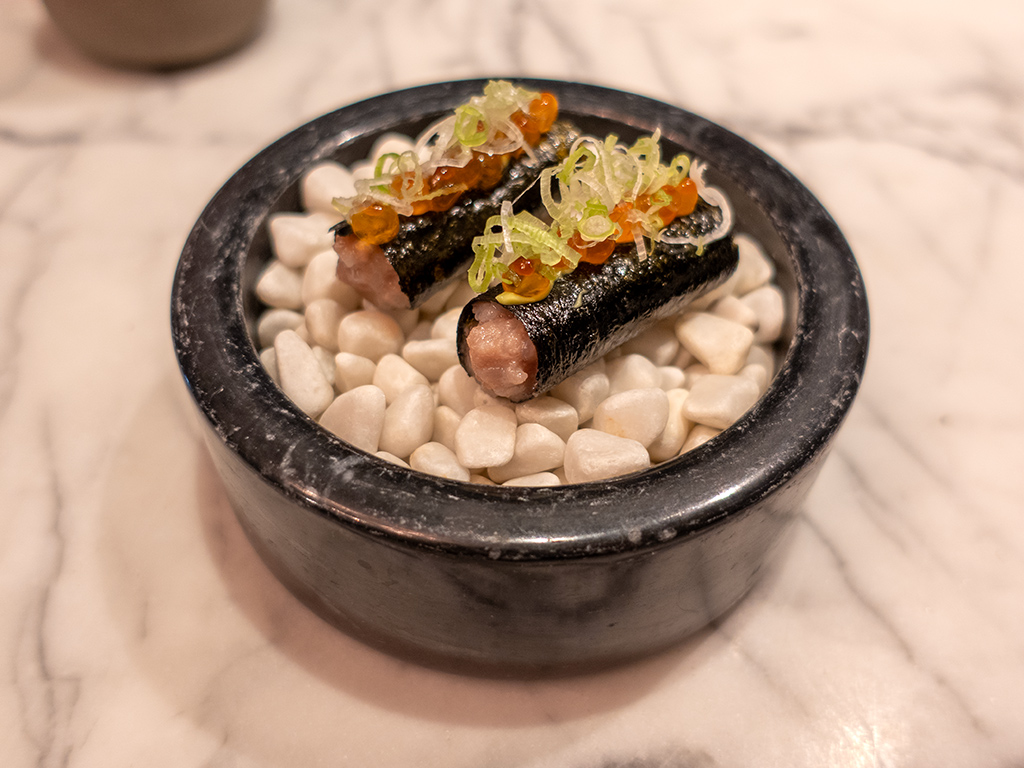
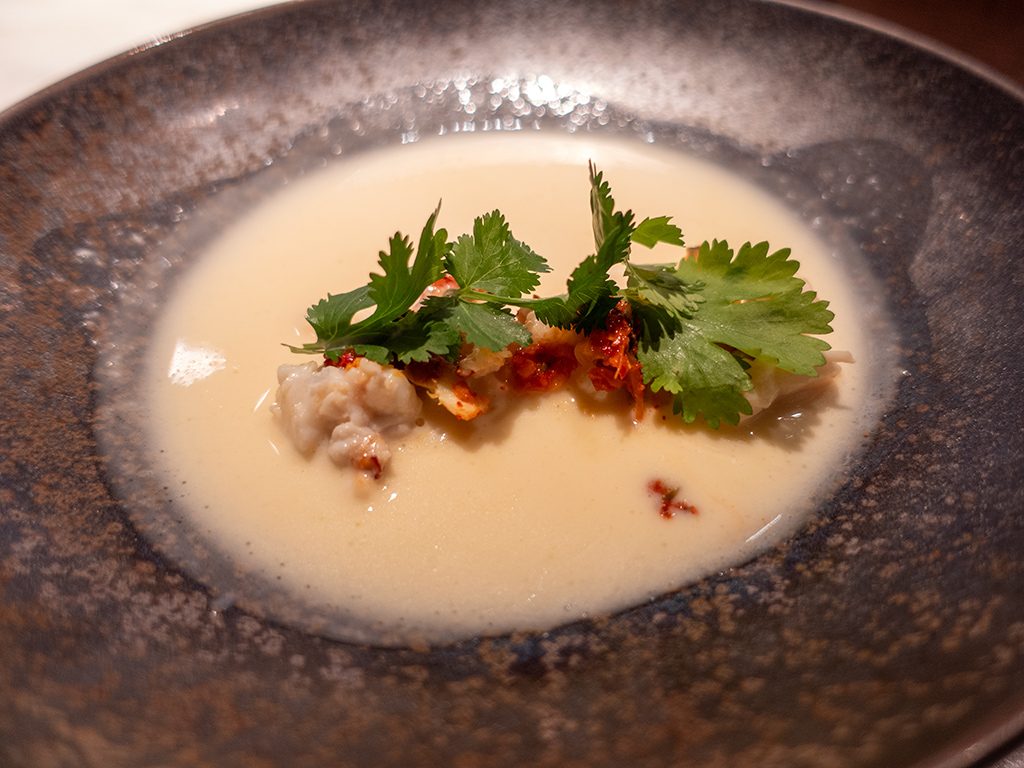
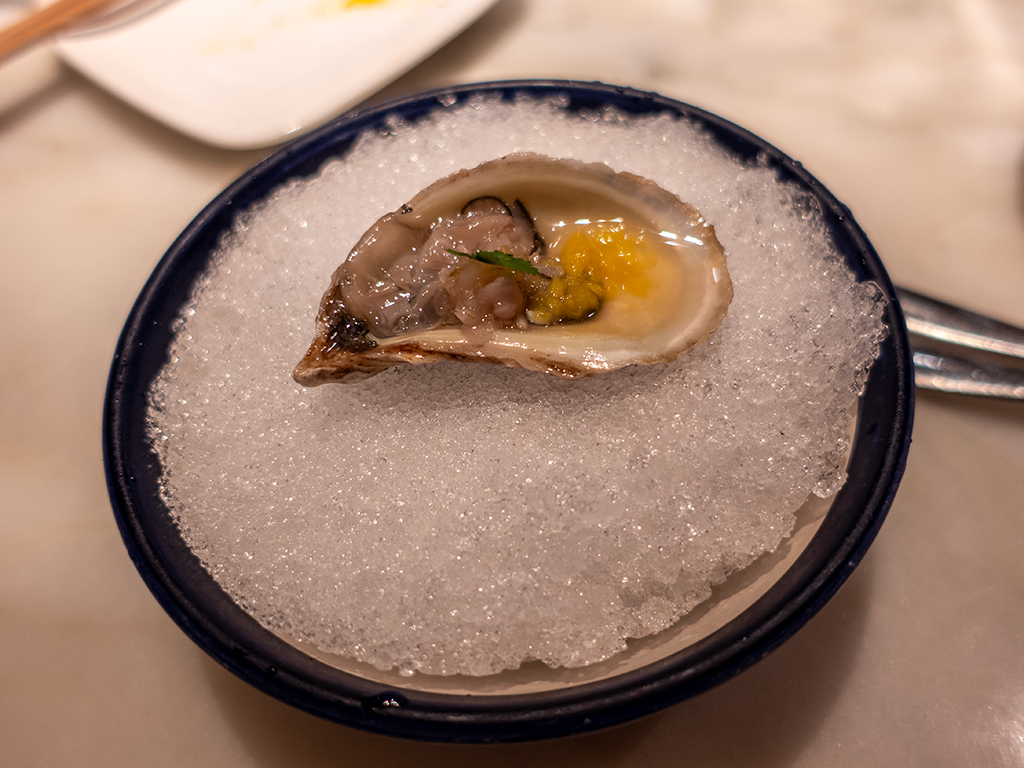
As our first course, we received a vinaigrette shot with oyster and ikura. All my photos of the glass were out of focus so I don’t have any to share, but it was a good opener that had a strong kick of sourness to get us primed for our meal.

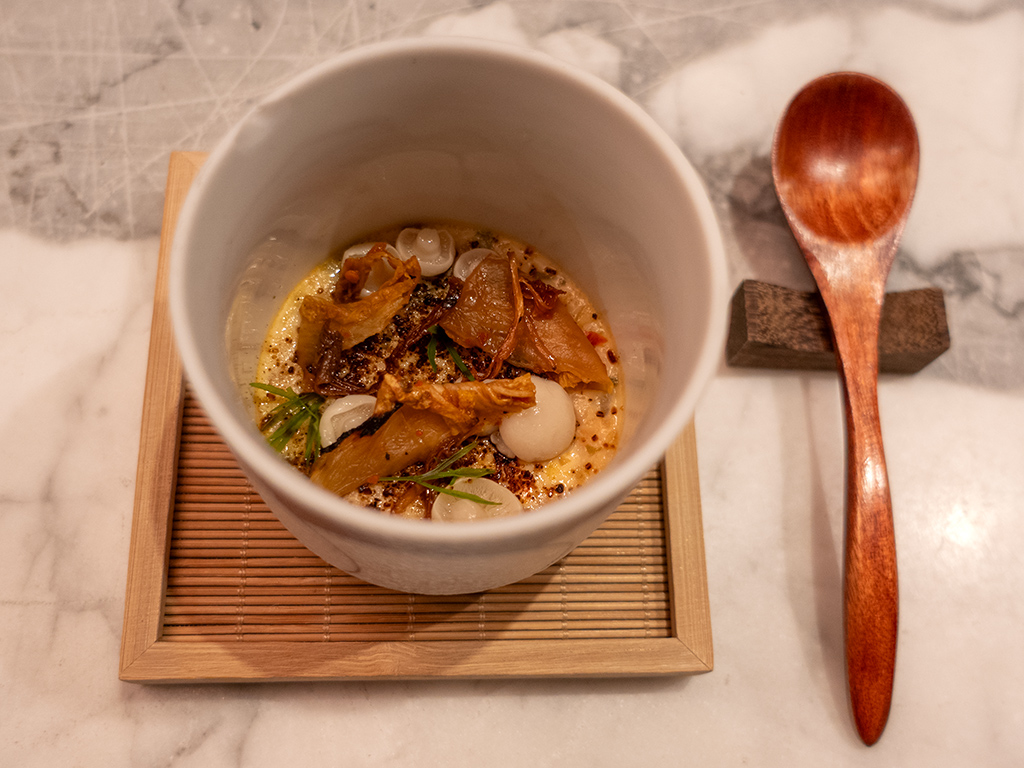
Next was chawanmushi, which is Japanese steamed egg custard. This was pure chawanmushi with nothing added into it, which was a bit unexpected (as there is usually mushrooms, sea urchin, roe, and/or vegetables added in), but it was still good in quality and had a clean flavor.

Next was octopus atop a medium tomato filled with cheese. I’m usually not a big fan of cheese, but whatever type they used was mild enough that it didn’t overwhelm the dish. The taste of the octopus had something distinct and different to it that I couldn’t quite figure out, but the flavor was good and the texture was sat­is­fy­ing.

Afterwards, we received abalone topped with sauce made from abalone intestines.

This was my favorite dish of the meal. This was the most tender abalone I had ever had, and the chef said that it was probably because he prepares it by steaming it over six hours. This was my first time ever having abalone intestines, and it wasn’t quite like anything else I’ve ever tasted before; the closest thing I can think of is monkfish liver, but even then, the intestines still had something very unique to it that I can only explain as a weighted blanket of umami.

Our next dish was fish shoulder, though I managed to miss what kind of fish it was, and I somehow couldn’t tell just by the taste. This was thoroughly marinated with a house-made sauce, so it tasted like generic but very clean fish with a good amount of saltiness and a very light tinge of sweetness.

The chef added a nice touch to this shoulder dish—he made sure to keep track of the plates so that my parents each got one shoulder off the same fish.

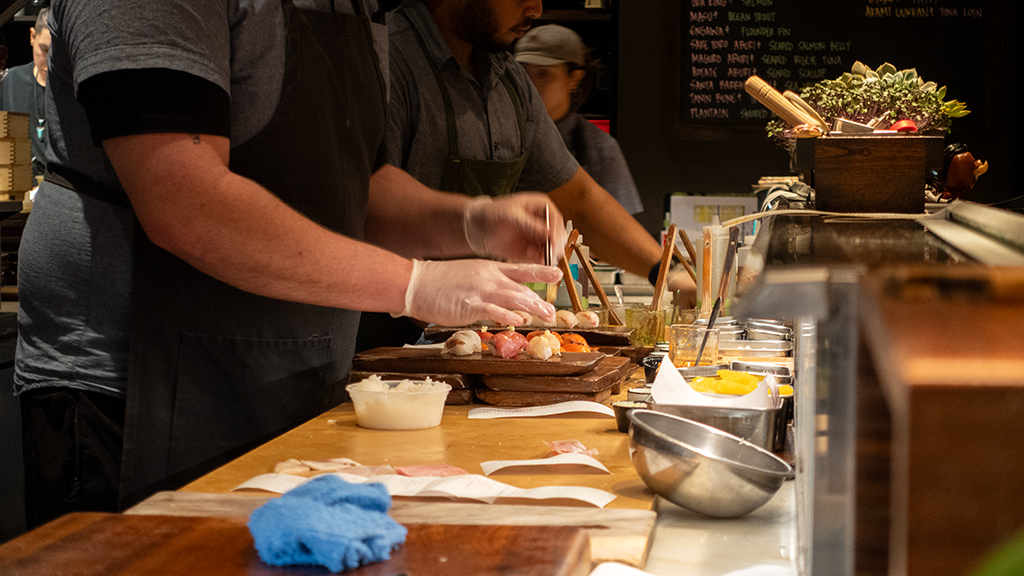
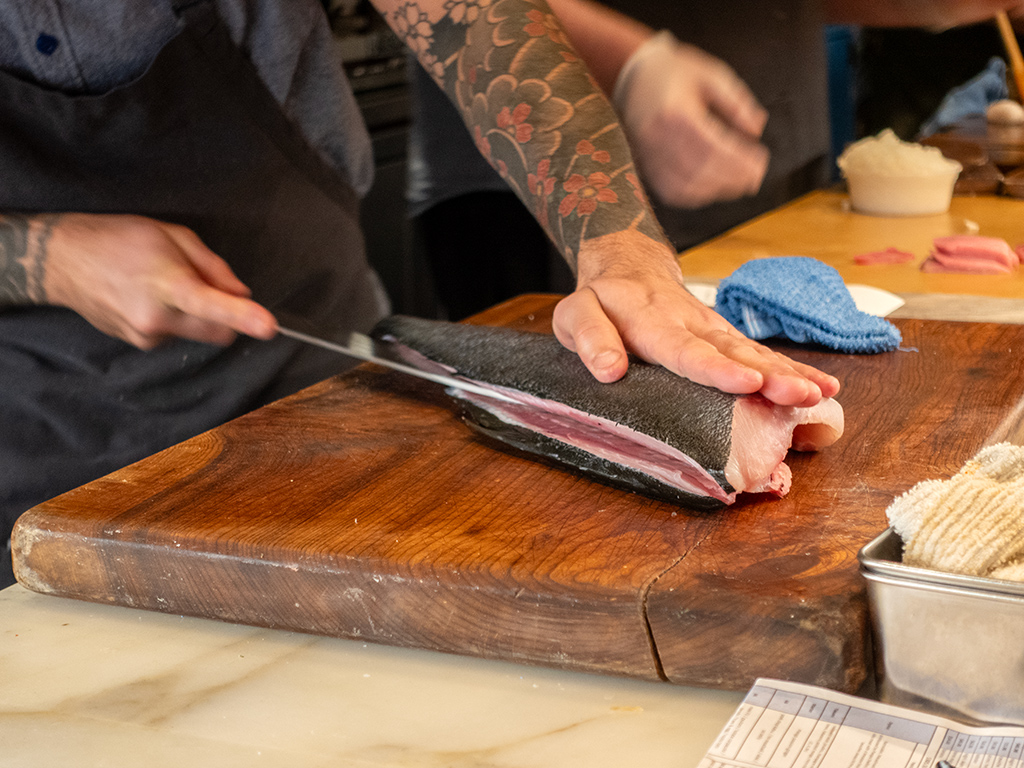
While we were consuming the previous dishes, the chef started preparing the sashimi for our nigiri.

While the chef continued to slice the sashimi, the waiter came out with some miso soup and side dishes.

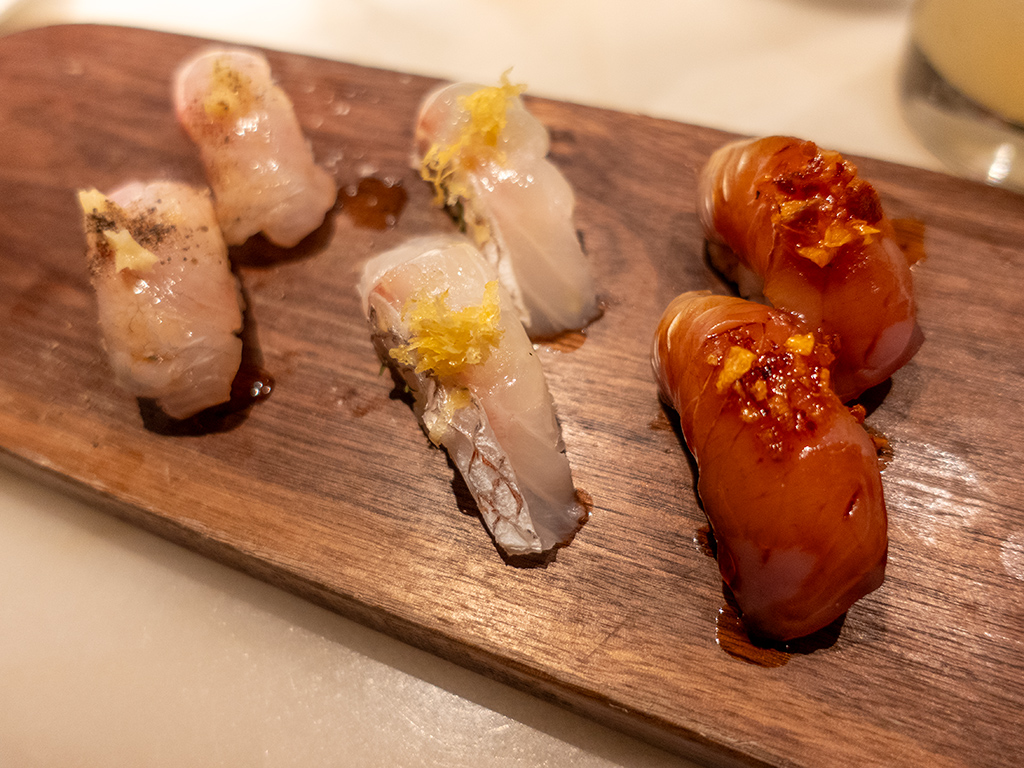
Our next eight items were eight pieces of nigiri.
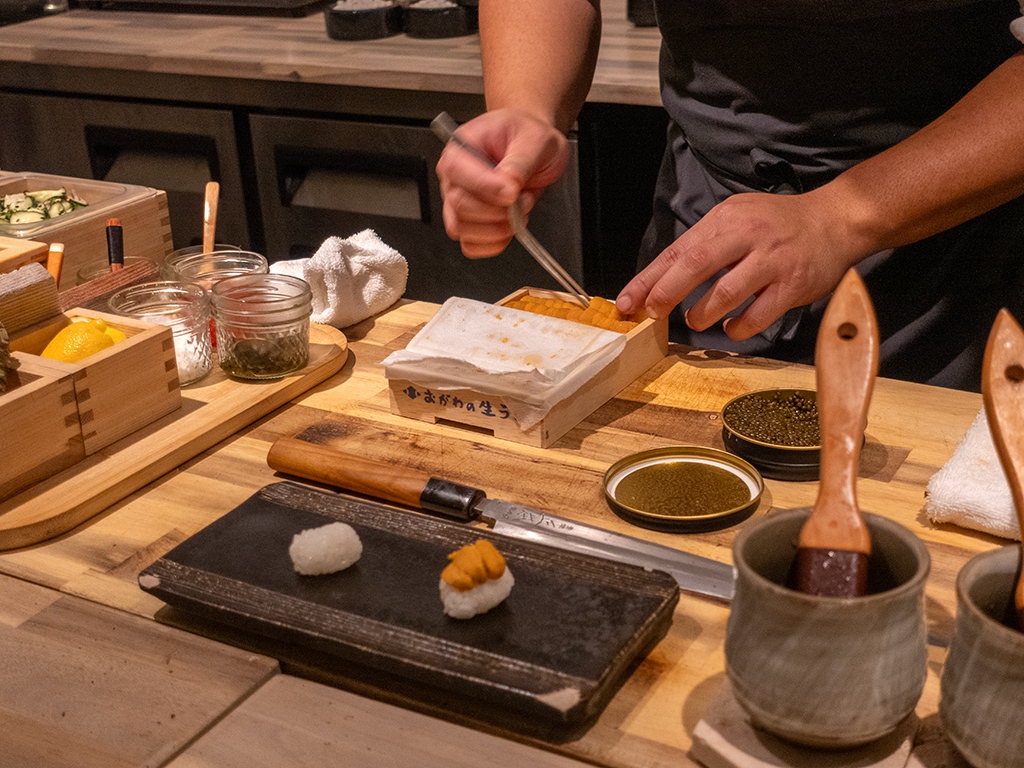
The fish for all eight pieces were cut very thick. Usually at countertop omakase experiences, you grab each piece of nigiri with your fingers and finish it in one bite, but these were large enough that I had each in two bites. Because of that, the portion size added up quickly and was pretty filling and sat­is­fy­ing.

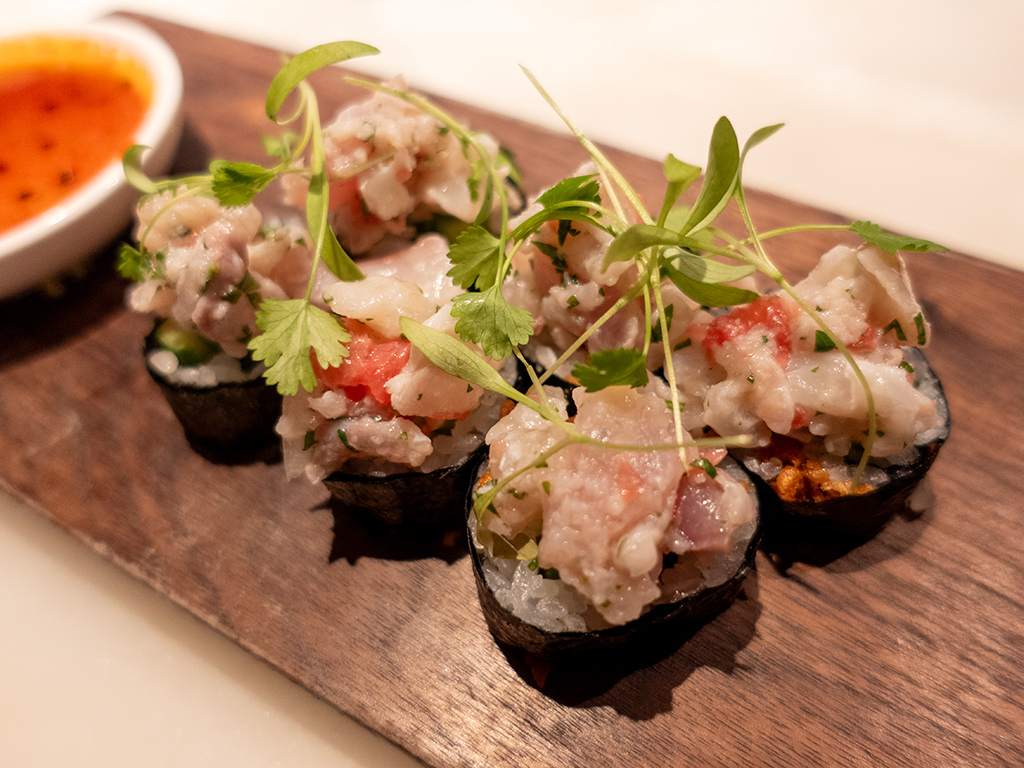
As our final piece of sushi, we received a spicy tuna hand roll. I’m personally not the biggest fan of spicy tuna because I think the sauce overwhelms the flavor of the tuna, but still, this was a nice addition to the menu to have some variety.

For dessert, we each got a fairly sizable portion of matcha tiramisu topped with strawberry.

This was a little bit too sweet for my preference, but the earthiness of the matcha powder helped balance things out a bit.

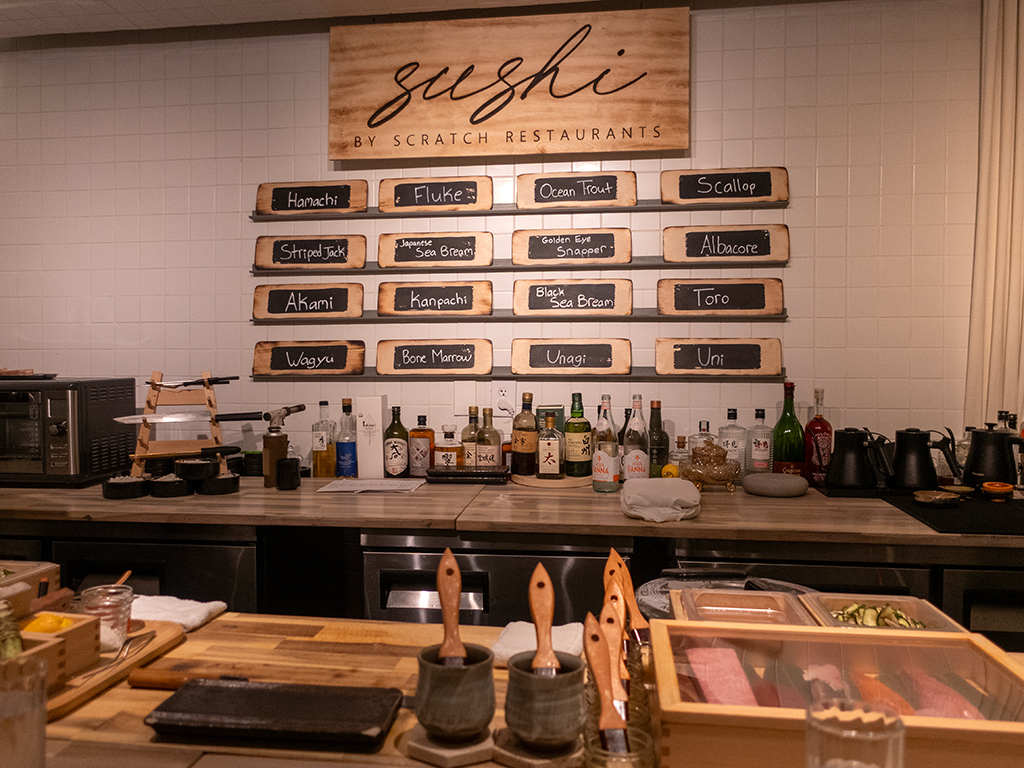
Here’s a shot of the kitchen area beside the bar where we were served.

Omakase was $125 per person, and with $33.75 in taxes and $72 for gratuity, the total came to US$480.75.

The omakase chef is the owner of the restaurant, and he is Korean. That wasn’t too helpful for me because I didn’t get to interact with him much considering his somewhat limited English, but it was great for my parents, because they were able to talk with him in their native language and learn more about the food they were served.

I thought this was a solid omakase dinner landing squarely within satisfactory expectations of a meal at this pricepoint. To add some context, I’ve been to a lot of nice restaurants in major coastal cities, so my rating has that kind of perspective behind it; with that in mind, you could argue that this restaurant was actually very good, considering that it is out in the suburbs over 30 miles away from downtown Chicago and likely does not have access to the same resources and quality of ingredients as coastal cities.

If you’re interested in checking it out, note that you’ll need to book a reservation at least 48 hours ahead. I imagine this is one of the side effects of being in a less populated area—they have an à la carte menu, but it seems like omakase is not always fully booked, so you’ll need to give the chef a heads up so he can shop for fresh ingredients and put together the day’s menu for you.


—§—


Hello, 84 Yesler in Seattle, Washington

While in Seattle, Washington for PAX West, I met up with my friend Dani (who you may remember as the owner of Mina) and had dinner at 84 Yesler, a restaurant in the Pioneer Square neighborhood of downtown.

We wanted to try as many different dishes as possible, so we ordered a combination of their six-course tasting menu and a few items à la carte.

To start, we received an amuse-bouche with fig, goat cheese, and edible flower.

I’m usually not a big fan of goat cheese (or much cheese in general), but this goat cheese had a mild flavor that lacked the moldiness that cheeses usually have. The fig had a smooth flavor without having too much of a kick. The texture of the fig was a perfect balance between firmness and softness. This actually ended up being Dani’s favorite dish of the entire meal.

As our appetizer, Dani is a big fan of oysters, so we got a half dozen oysters, which came with a side of gin cocktail sauce, mignonette, and lemon.

The oysters tasted great—they were neither too strong nor too mild. The juices were also great, and their flavor contributed nicely to the overall flavor of the oysters. There was no grit or other unwanted textures from slurping straight out of the shell.

Next, our first dish of the tasting menu came out—tempura squash blossom with whipped goat cheese and garlic honey.

This was the one and only dish that I disliked from this restaurant. Even though the goat cheese from the amuse-bouche was fine, the goat cheese from this tempura was not fine and had the typical moldy smell and taste to it, which masked any other flavor of the tempura squash from coming through.

Our first à la carte small plate came out next, beef tartare with crispy shallots, egg yolk jam, crostini, parmesan, and capers.

I think this is the best beef tartare I’ve ever had. The beef was extremely rich in flavor, and all the toppings served a perfect purpose balanced between adding their own flavor while also enhancing the existing flavor of the beef tartare. These were also the mildest capers I’ve ever tried, which worked very well—their sourness was far more subtle than what you’d usually expect from capers, so they managed to add all the core flavor of capers without causing too much extra intensity.

I portioned out our brick of tartare and ate them one bite at time atop the bread. Even the crostini was prepared perfectly—I’m used to it being a bit too crispy and sometimes hurting the inside of my mouth, but this crostini was overall pretty soft while still retaining some of the crunch around the edges.

The second course of the tasting menu was grilled unagi, also known as saltwater eel, atop brioche and with ponzu and micro herbs.

This eel was very tender. At other restaurants, eel is usually served with too much eel sauce already on it, but this eel was only lightly sauced, so it let the true flavor of the eel shine through well. At first, I was confused about and questioned the choice of serving it on this kind of bread, but I was quickly proven wrong with my first bite when I realized how well the bread went along with the eel.

The third course of the tasting menu was kelp gnocchi with red pepper caviar sauce and fumet.

The gnocchi had a deep earthiness to it, and somehow managed to capture that flavor without any bitterness whatsoever. The sauce was indescribably delicious and was a great example of how a whole is greater than the sum of its parts. If you really focused in on the flavors, you could technically detect the individual ingredients, but overall, it was an entirely different experience.

The portion of the sauce was too much compared to the amount of gnocchi we were served, but that was no problem at all—Dani and I just drank the sauce like it was soup.

We also ordered a second pasta dish to go along with the tasting menu one—fine herbs pappardelle with lemon beurre blanc, Dungeness crab, and fine herb oil.

This was the most unique pasta I’ve ever seen. Each piece of pappardelle was extremely thick and long, and you could see that there were herbs placed and trapped directly inside the pappardelle in layers. This dish wasn’t otherworldly like the gnocchi, but it was still very delicious.

Fourth from the tasting menu was dry-aged salmon with toasted kombu dashi, zucchini, and pickled garlic scape.

I have never before seen salmon skin prepared this perfectly. Usually, when you cook salmon skin, it ends up somewhere on the gradient of rubbery and brittle, and the more you cook it, the more rubberiness it loses and the more brittle it becomes in a mutually exclusive way. This salmon skin somehow leapt off the standard gradient and captured both at the same time—it had the texture of fish skin, but it wasn’t dry or crumbly.

The zucchini was also notably nice. You can tell by the photo that it looks fairly burnt, but surprisingly, it was merely a bit charred. You’d expect that much black to yield a very bitter flavor, but this wasn’t bitter at all, and the burned portions added a very subtle charcoal grill-esque addition to the zuc­chi­ni.

The tasting menu’s fifth course was short rib with baby patty pan, wild mushrooms, and truffle jus.

The short rib wasn’t bad, but it wasn’t anything special. This tasted like generic short rib that you’d find from any other restaurant.
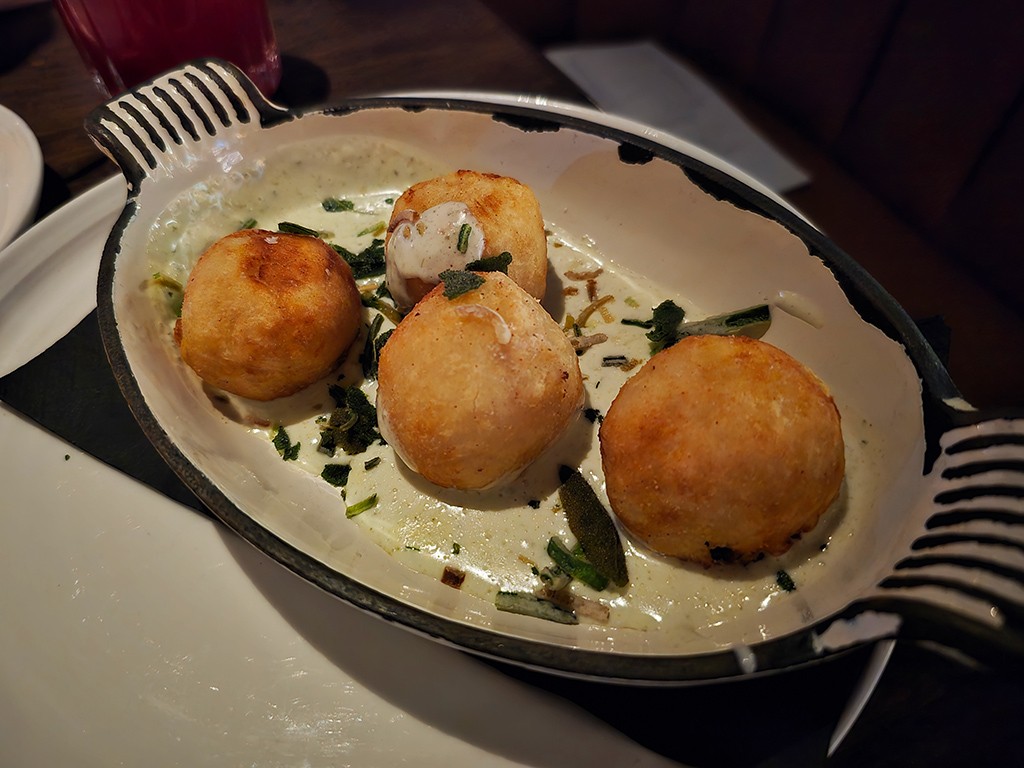
To accompany the main course of the tasting menu, we also added on American wagyu ribeye with crispy polenta, parsnip, and pesto.

This ribeye was much better than the short rib. I could tell that it wasn’t exactly the utmost highest grade of wagyu, but the marbling was still great and it had the familiar, satisfying taste you expect from high-quality wagyu.

Dani and I each had a couple strips of this wagyu, then she got the rest packaged to-go so she could share it with her boyfriend and housemate back at home. Dani reheated it for them in the oven and reported back to me that they both enjoyed the food.

For the tasting menu’s dessert, we received sweet corn with white chocolate coconut ganache, candied jalapeño, and fresh blackberries.

This dish was magical. Popcorn often has some of the leftover residue in the center from the popped kernel, but somehow, all of this popcorn was completely soft all the way through. The sweetness of the caramel coating was subtle, which allowed the actual flavor of the caramel to shine through in a way I’ve never seen before. Every aspect of this dessert was incredible, and I made sure to get a small portion of each ingredient in every bite because of how well everything complemented everything else.
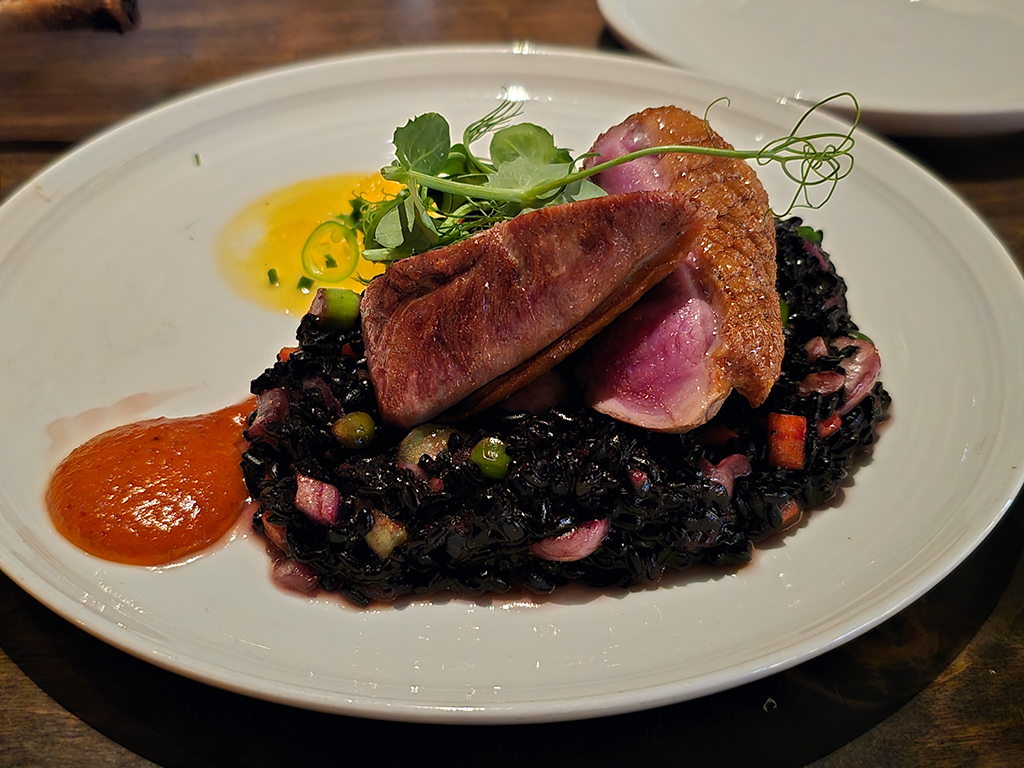
The sweet corn and blackberries was so good that it convinced Dani to order a second dessert à la carte. We decided on apple cake with honeycrisp sorbet, sweet apple brandy cream, and a candied apple slice.

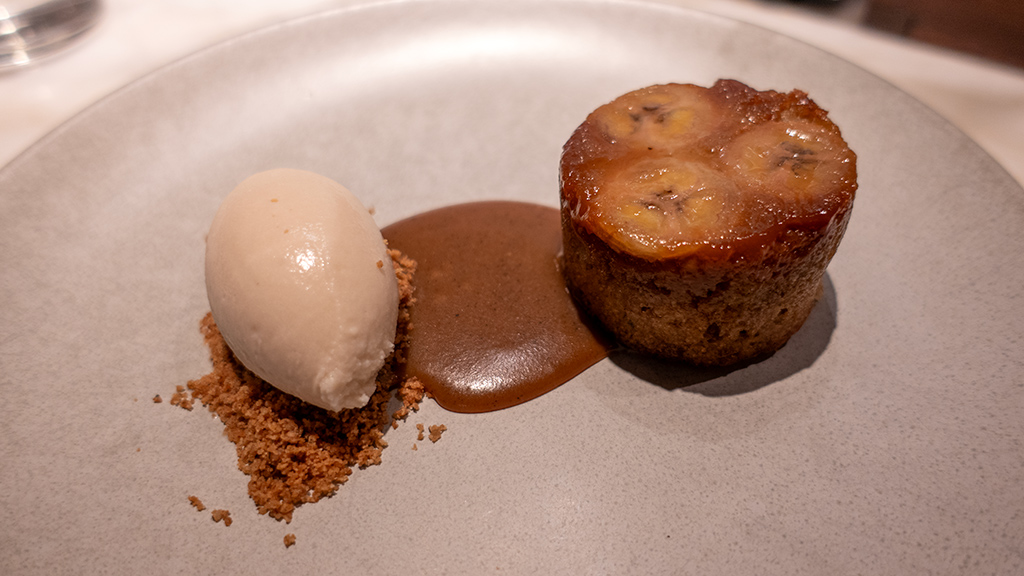
This one wasn’t as miraculous as the previous dessert, but it was still delicious. They did a great job of balancing sweetness with sourness, as well as mixing together a good variety of textures so your mouth always has something interesting to experience.

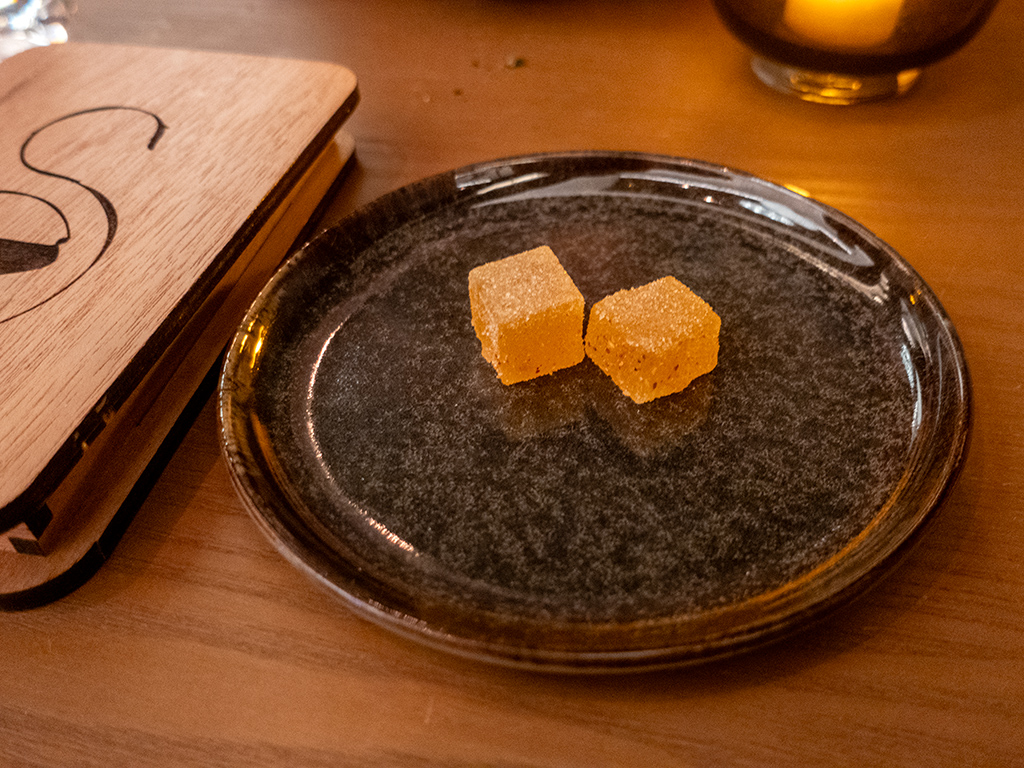
To close the night, we received complimentary chocolates along with our check.

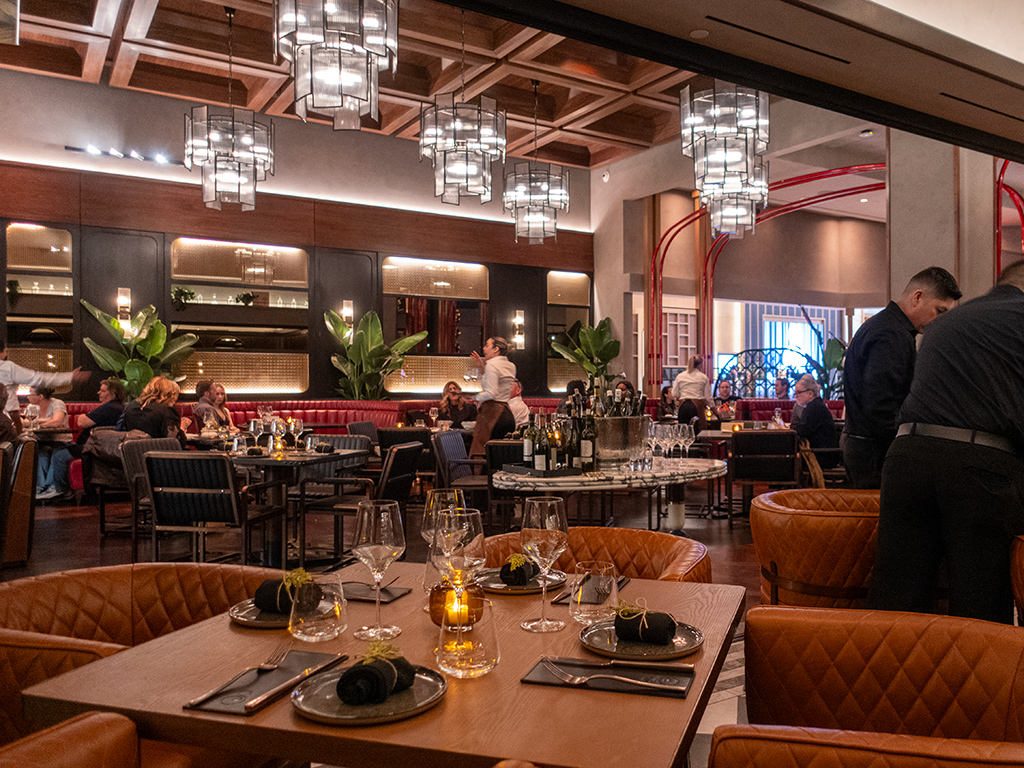
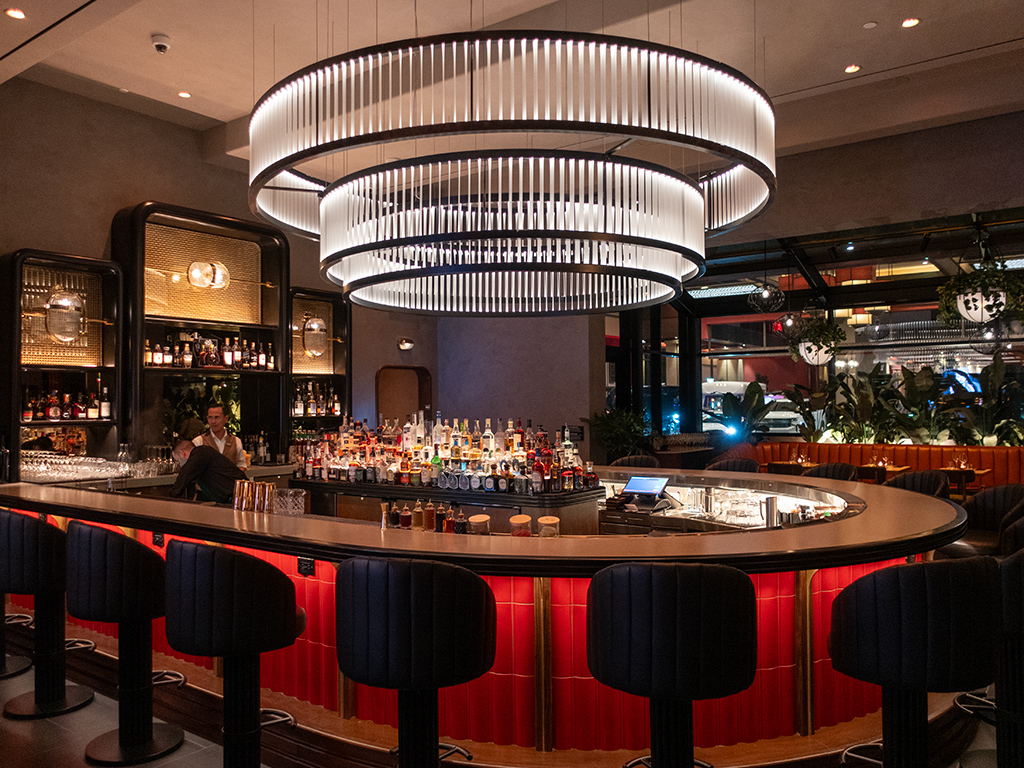
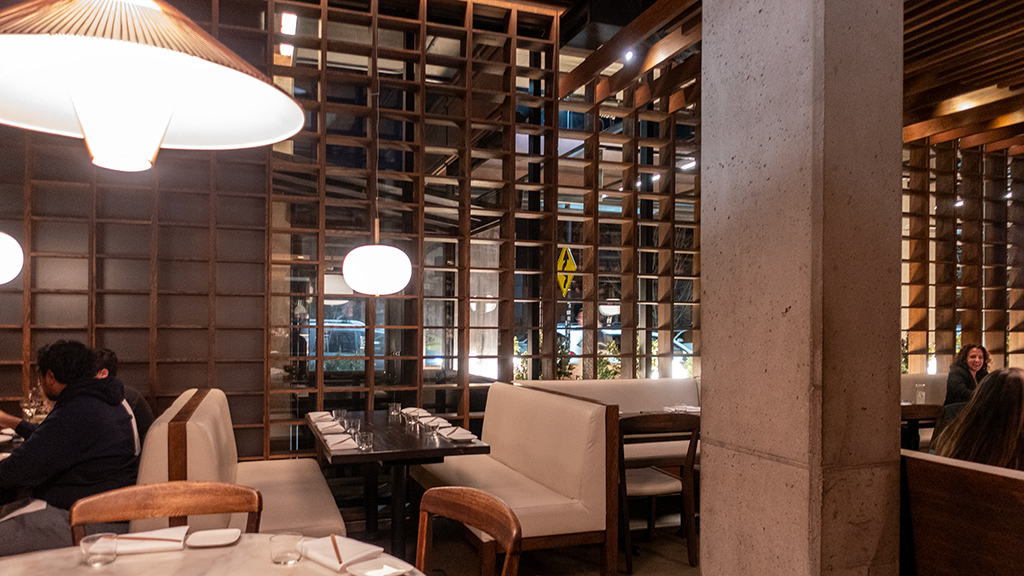
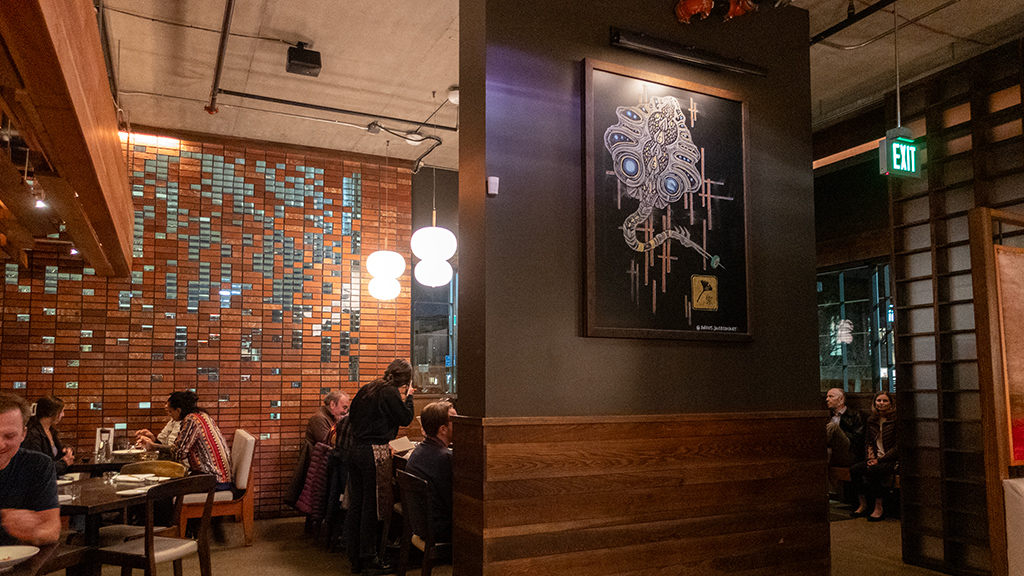
Here are some photos I took of the restaurant before it got dark. We spent almost three hours eating at 84 Yesler because the food was so good and we kept on ordering more and more, so if you pay attention to the photos, you can tell that it was still bright outside and my photos were illuminated by natural sunlight at the beginning of our meal, but our desserts have a warm glow from the overhead lighting after nightfall.
Six-course tasting menu$ 160.00
Oysters$  30.00
Beef tartare$  29.00
Fine herbs pappardelle$  40.00
America wagyu ribeye$  80.00
Apple cake$  15.00
Automatic gratuity (20%)$  70.80
Sales tax$  43.97
Total$ 468.77
The table on the right shows how much we paid.
84 Yesler has solidly landed itself as one of my top favorite restaurants that I’ve been to this year, alongside Yakiniku Shodai and Masamitsu.

Just because I’ve historically been so outspoken about this, I wanted to address this point first—I’m not a big fan of mandatory service charges, and if a restaurant wants to do that, I believe they should just increase the price of their menu items and then decline gratuity instead. However, in 84 Yesler’s defense, they made the 20% automatic gratuity very clear and apparent on both their website and their paper menus, so the way they executed on it was done in a very transparent and honest manner.

Back to the food. 84 Yesler’s style of cooking might not be for everyone, but for me, it feels like the chef custom-catered the cooking style to match my preferences perfectly. Nothing was too much of anything—not too salty, not too sweet, not too bitter, not too fatty. No single ingredient stood out or was noticeable, but working together, they created new flavor profiles that I had not tasted before at any other res­tau­rants.

In other words, pretty much every ingredient they used was mild, but because each dish had a very well-calculated recipe to it, the mildness worked favorably. To create an analogy: if you have a very strong strawberry, very strong blueberry, and very strong raspberry, each berry’s flavor will stick out and it will taste like you are eating a strawberry, blueberry, and raspberry. However, 84 Yesler’s style is comparable to using a mild strawberry, mild blueberry, and mild raspberry so that you can’t distinctly taste each individual berry, but instead, it tastes like you are consuming a well-balanced medley of fresh fruit.

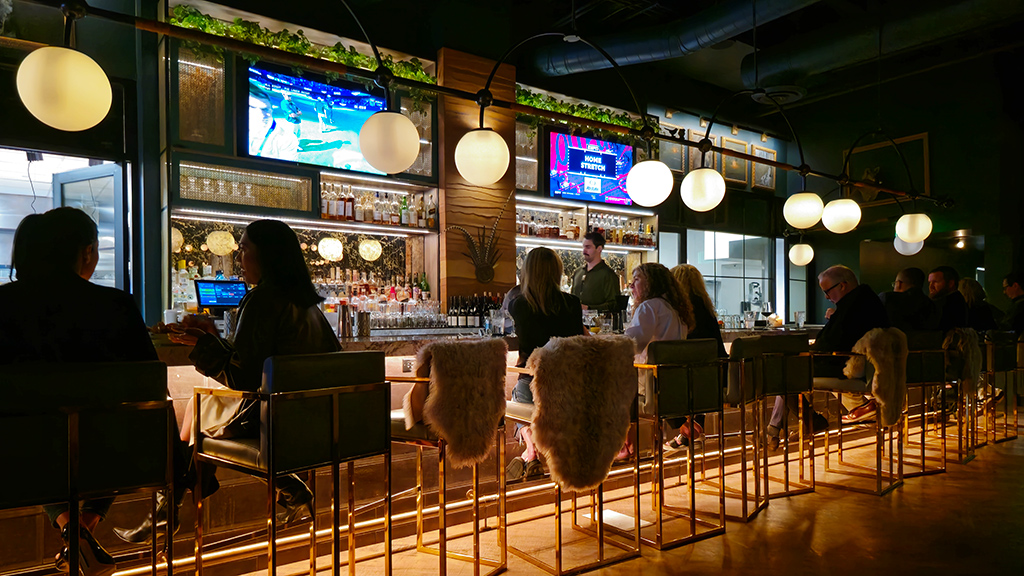
The ambiance of the restaurant was also very unique. Dani and I were seated at a small table in the corner right next to the window, and I think it was the best possible seat we could’ve gotten. It let us get some sunlight for a good portion of our meal, we were able to people-watch on Yesler Way, and we were in a secluded area so we weren’t surrounded by other patrons. The kitchen was open and viewable by diners, which allowed us to watch our food get prepared, but because we were towards the corner, we didn’t get affected by the heat of the kitchen, and the smells didn’t reach our table so it allowed us to purely enjoy our dishes as the chef intended without any other scents.

Speaking of purity, one thing I appreciated was the fact that the waitress fully swapped out our utensils and plates in between every single course. Not all restaurants do this, but I think this is a great indicator of how much the chef cares about the flavor profile of all the dishes. Having clean tableware for every dish means that no sauces or residue from previous dishes interfere with future dishes, and that level of attention to detail shows that 84 Yesler is actual fine dining.

On the note of fine dining, 84 Yesler doesn’t really present itself as fine dining. In fact, they actually seem pretty casual, and the way to recognize their level of fine dining is by experiencing the quality of the food and service. I hate when other restaurants pretend to be luxurious by aggressively doing exaggerated things often associated with luxury and then inflate their prices, but something just feels off. 84 Yesler is the exact opposite—they actively keep things subtle, but their indisputable classiness speaks for itself.

If you can’t tell by now, I highly recommend 84 Yesler. The pricepoint is definitely on the higher end, but if it’s something that is financially doable for you, I think the ratio of value you get per dollar from this restaurant is very high.


—§—


Hello, Sushi Sasabune Glendale in Los Angeles County, California

I’m back in Southern California for a little bit again in preparation for joining one of my friends for a fundraising event, which is coming up this weekend.

While in town, I met up with my friend Kelsey Bunner, who I don’t get to see often because she travels a lot for work, but I managed to catch her this week to go on a food adventure together. She likes sushi but doesn’t go to omakase experiences too often, so I figured this would be a good opportunity to check out Sushi Sasabune in Glendale of Los Angeles County, California.

For our appetizer, we got a plate of three items: baby tuna with radish…

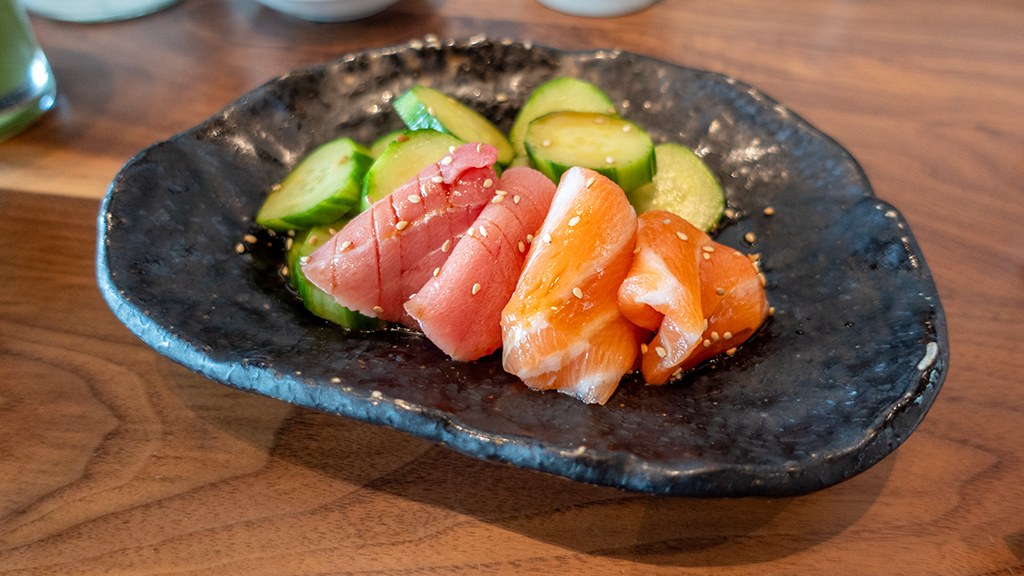
… salmon with mango…

… and abalone.

Our second opening dish was scallop.

Next was our first batch of nigiri. We got red snapper…

… mackerel…

… and tuna.

Only one piece of tuna is pictured here, but we got two—one akami and one chutoro. The chef told us that both cuts were from the same fish. I couldn’t tell whether he intended to say that they were both from the same type of fish, i.e., tuna, but it would be interesting if he actually meant that it was from the same physical fish.

As an intermission, we got another specialty plate, this one containing oyster, baked mussel, baked crab, and radish.

I have never seen any restaurant prepare a whole baked baby crab like this, and I thought this was very clever and creative. Kelsey couldn’t bring herself to eat her baked crab because it looked too cute, so I solved that by amputating all its limbs and flipping it upside-down so that it would look more like food and less like an animal.

Next were two more pieces of nigiri: sea perch…

… and sweet shrimp topped with caviar.

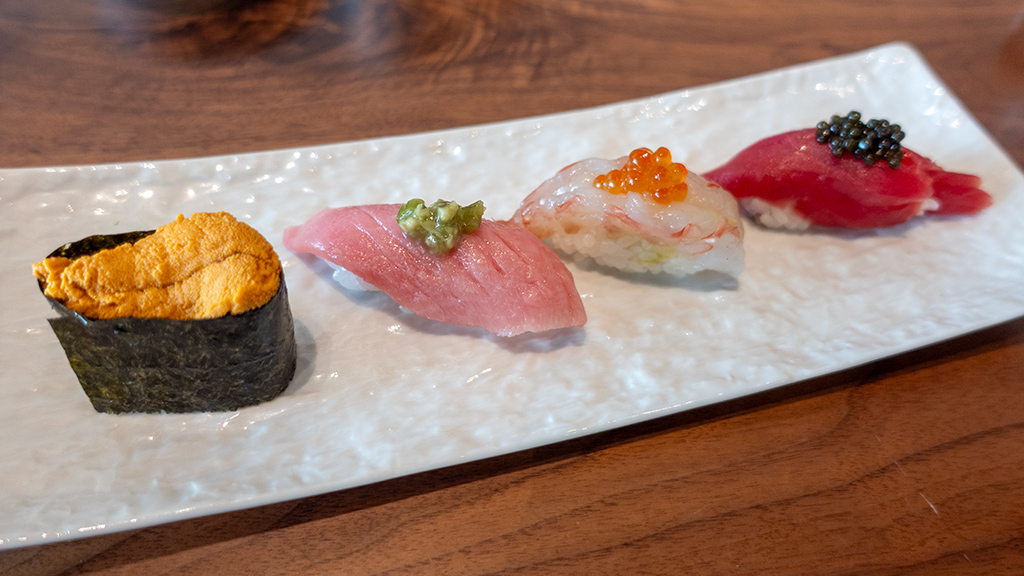
Next were three pieces of gunkan: sea urchin…

… salmon roe…

… and black cod.

We were nearing the end of our meal and had two more pieces of nigiri left: eel…

… and skipjack.

As the grand finale, and the last dish of the night, we each got a blue crab hand roll.

We opted not to order dessert à la carte, so the chef treated us with some Japanese grapes instead.

Omakase was $150.00 per person, and along with iced green tea for $3.50, $31.11 in tax, and $50.00 as gratuity, our total came to US$384.61.

Overall, I enjoyed my experience at Sasabune Glendale. All the fish was high in quality, and the way they prepared the specialty dishes was very unique and creative.

With that being said, the portion size of the meal was disappointingly small for the cost (and this is the only reason why I wouldn’t wholeheartedly rec­om­mend Sasabune Glendale). For an easy comparison, one of my favorite restaurants of all time, Masamitsu, also cost $150 per person, but I am pretty sure the amount of food I got at Masamitsu was literally about double of what I got at Sasabune—not only due to there being way more dishes, but also because the cuts of fish on the nigiri were much larger and thicker.

There seem to be multiple Sasabunes across the Los Angeles area. Some of the reviews of the one in Beverly Hills, which has omakase at the same price­point, say that the meal there was very filling. I’ve added that onto my list of restaurants to eventually try—I’m hoping that the Beverly Hills location maintains the same spirit of creative and distinct dishes, while having larger portion sizes.


—§—


Food photo dump from June and July 2024

I like reviewing high-end restaurants, but sometimes, I like to step out for a quick meal with friends without having to sit through an entire tasting menu or ordering multiple courses to properly assess a restaurant’s offerings. I still take photos at those spots too, but never enough of them to warrant an en­tire blog post dedicated to that restaurant. I still want to share those photos though, so here is a photo dump of some of the food I’ve had over the past two months.

Here is a chirashi bowl from Izakaya Osen in the Silver Lake neighborhood of Los Angeles, California.

The following three photos are from Summer Canteen in Burbank, California. Here is some slow-braised pork belly with Thai herbs. It was a bit dry.

This is stir-fried shrimp with fresh garlic, black pepper, and a side of steamed vegetables. This tasted clean and refreshing.

We had mango sweet sticky rice for dessert, which I liked.

Here is a Greek yogurt strawberry blueberry waffle bowl from Jamba.

The next four photos are from President Thai in Pasadena, California. Here is some orange chicken…

… garlic sole with mixed vegetables…

… green curry with zucchini, green beans, and basil leaves…

… and a side order of broccoli and sliced carrots.

The next three photos are from one of Noodle World’s full-service locations. This is chicken Thai noodle soup…

… charbroiled pork chop over vermicelli noodles served with fried onions, peanuts, and fresh vegetables…

… and deep-fried egg rolls stuffed with ground pork, carrots, bean thread noodles, onions, and black mushrooms served with a side of sweet sauce.

Here is a pack of pink Kit Kats my friend Billie-Rae brought back for me from Japan.

The next batch of photos is from Wa Sushi & Izakaya in Alhambra, California. Here is some soft shell crab…

… an avocado cut roll…

… some specialty sushi roll, but I forgot its name…

… a rice bowl with blue crab, sea urchin, salmon roe, caviar, egg yolk, and tamago…

… two pieces of eel nigiri topped with avocado slices…

… mixed vegetable tempura…

… and two pieces of salmon belly nigiri topped with salmon roe.

Taking a brief intermission, here is a Spicy Spring™ pizza with pepperoni, mozzarella, pecorino romano, and fra diavolo sauce from Prince Street Pizza. It looked extremely unhealthy and I could almost feel my cholesterol rising from all the processed meat and saturated fat, but it was delicious.

Back to some more sushi. Here is some salmon carpaccio…

… another specialty roll, but I forgot the name of this one too…

… a rice bowl with salmon, sea urchin, salmon roe, caviar, egg yolk, and tamago…

… and a cut roll with yellowtail and avocado, topped with slices of yuzu.

This is a chicken sandwich from Hattie B’s at their Las Vegas location inside the Cosmopolitan.

This is a Korean pork shoulder sandwich with house kimchi, chili mayo, cilantro, and lime from Lardo in Las Vegas, Nevada.

And finally, these last two dishes are from Raffi’s Place in Glendale, California—Scottish salmon…

… and chicken, charbroiled with tomato and bell pepper.


—§—


Hello, YakiYa in Pasadena, California

While still in California for a string of travel and before heading back home to Las Vegas, I met up with one of my friends and her parents to try the chef’s tasting menu dinner at YakiYa in Pasadena of Los Angeles County, California.

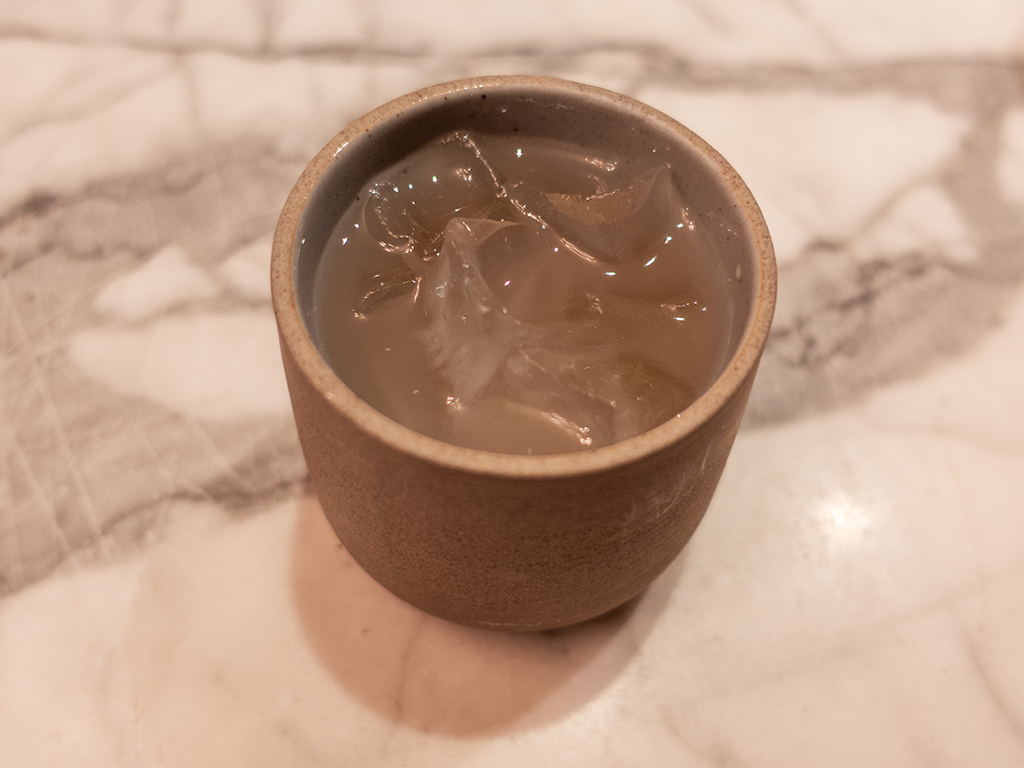
When we arrived, we were given warm hand towels and yuzu refreshers to prepare us for our meal.

Our appetizer was raw ground A5 Miyazaki wagyu with ponzu jelly, truffle, and arimo sancho pepper.

The wagyu had a surprisingly mild flavor and was a bit gelatinous. I didn’t spend any extra time to carefully inspect it before eating it, but I’m guessing that it was intentionally made to be lighter. It was overall pretty refreshing.

Here is a random photograph of our golden utensils.

Next was USDA Prime ribeye tataki with ponzu, garlic, and Kaiware. This was served raw like carpaccio. I thought it would have probably been better with a light sear on the outside, but it wasn’t bad as served either.

My friend and I got two non-alcoholic beverages. Mine was the Soft Pagoda with yuzu, honey, lime, and a yuzu gummy; my friend’s was the Cherry Blos­som with Amareno cherry, grenadine, and lemon. The Soft Pagoda tasted almost exactly like the yuzu refreshers we got at the beginning of the meal; the Cherry Blossom tasted like a citrusy sweet cherry juice.

Our next appetizer was bluefin tuna and hamachi with Kaluga caviar, scal­lion oil, and wasabi. The fish had very low fat content so it was fairly firm, but it was still very clean and fresh. The caviar was as expected, and the scal­lion oil added an interesting uniqueness to the sashimi.

From here, I started questioning the ordering of the dishes, because our next dish was chawanmushi with Dungeness crab, ikura, and shiitake mush­room. I feel like this could’ve been better served between some of the meat dishes or later on in the meal, but it still had good flavor and wasn’t bad early on in the menu. The texture was a bit strange, though—it started out with the slightly firmer and custardy texture you’d expect from chawanmushi, but it was way too watery once I got to the bottom.

Next was local farmer’s market crudité with multigrain rice cracker and red miso. This, again, felt like it would’ve been better elsewhere in the meal—namely, near the beginning. The rice cracker was good, the vegetables were clean and refreshing, and the red miso added a nice richness to the veggies.

At this point, we were confused if we would ever actually use the grill in front of us, because the waitress brought out wagyu meatballs and radish in ox­tail broth. Again, it tasted great, but this would’ve been better in between meat dishes as somewhat of a palate cleanser to change up the texture se­quence of the dishes, as opposed to just having back-to-back non-grill dishes right at the beginning.

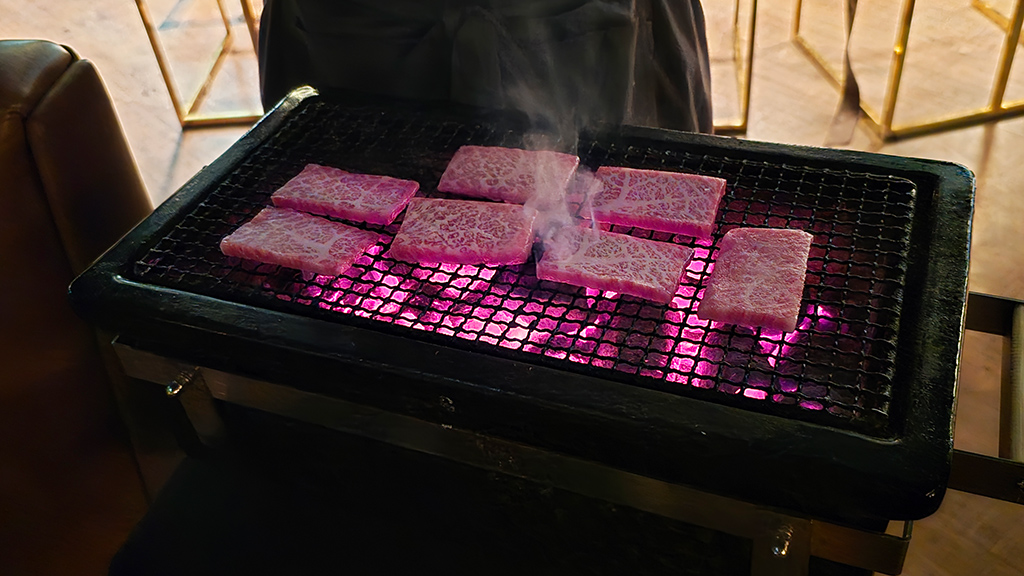
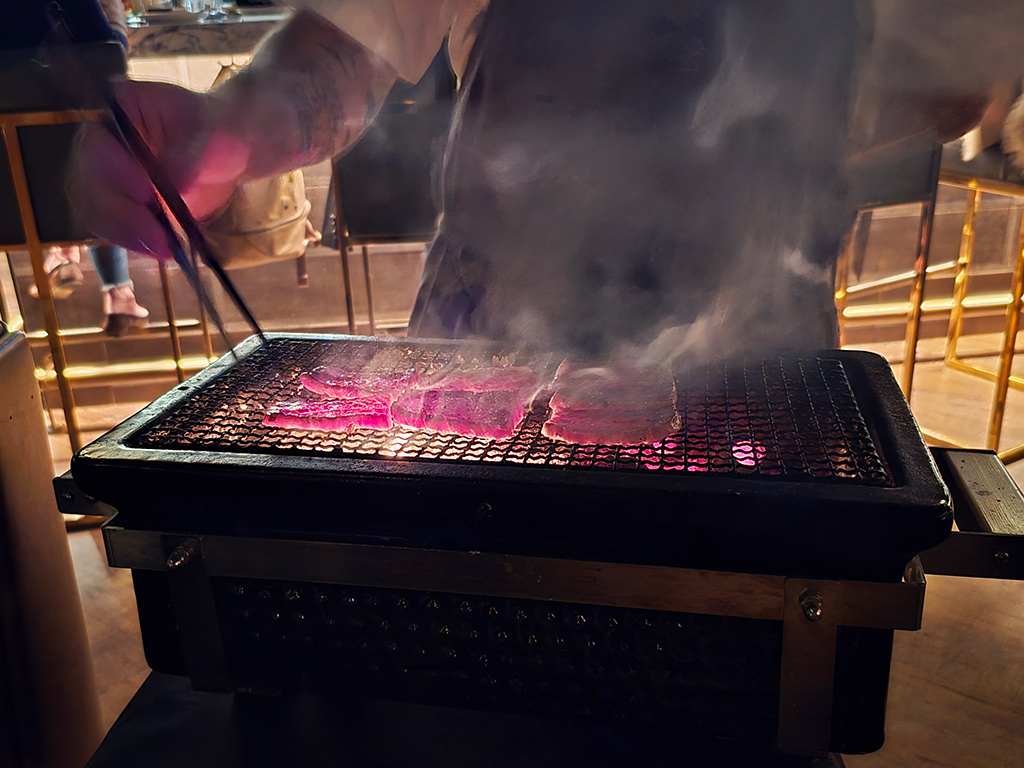
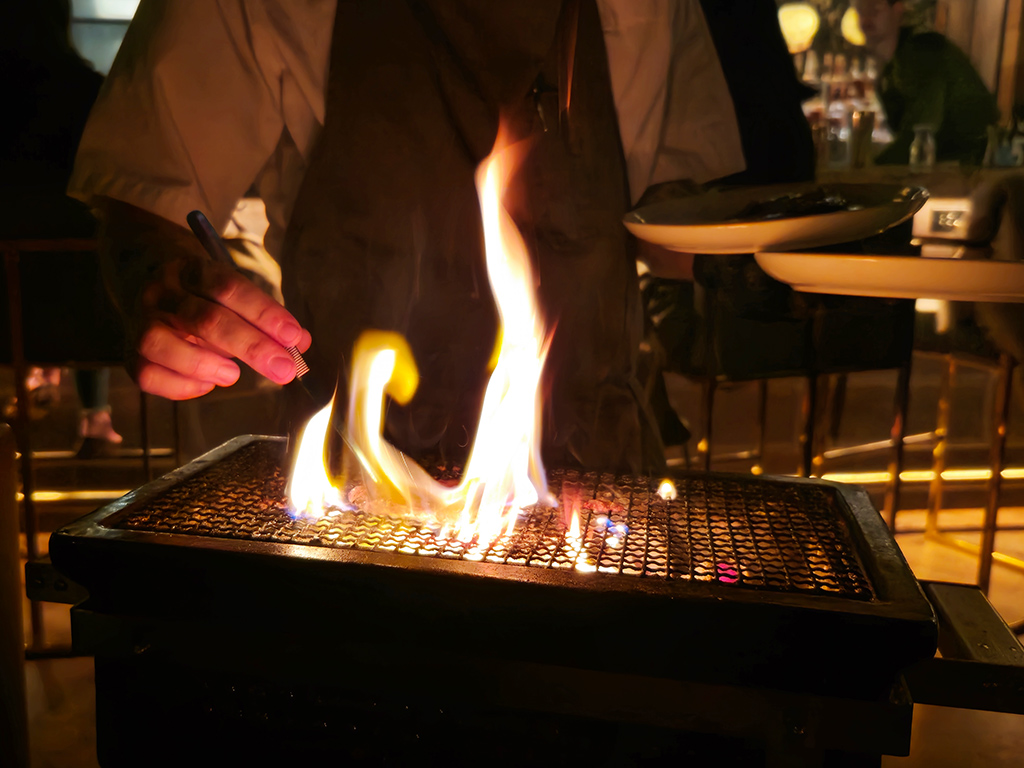
It was finally time for the grill… and unfortunately, this is where things sort of started going downhill. First up was American wagyu beef tongue with scal­lion kosho. Tongue is my favorite cut of beef, so I was looking forward to this one.

Unfortunately, we found out that it wasn’t actually a real chef who was cooking our wagyu for us, but instead, just our waitress. A big part of good wagyu is making sure it is cooked properly, and just by looking at the way our waitress even picked up the tongs, it showed that she was neither experienced nor confident.

The tongue came out overcooked.

Our next batch of meat was USDA Prime ribeye, USDA Prime outside skirt, and A5 Miyazaki chuck with a side of wasabi sauce.

By the time the waitress thought she was done grilling this and moved it onto our plates, it was still very undercooked. I’m someone who likes meat rare, and it was still raw to my standards. After I took a bite into it, I put it straight back onto the grill.

Our palate cleanser between plates was heirloom tomato, shishito pepper, and truffle mushroom.

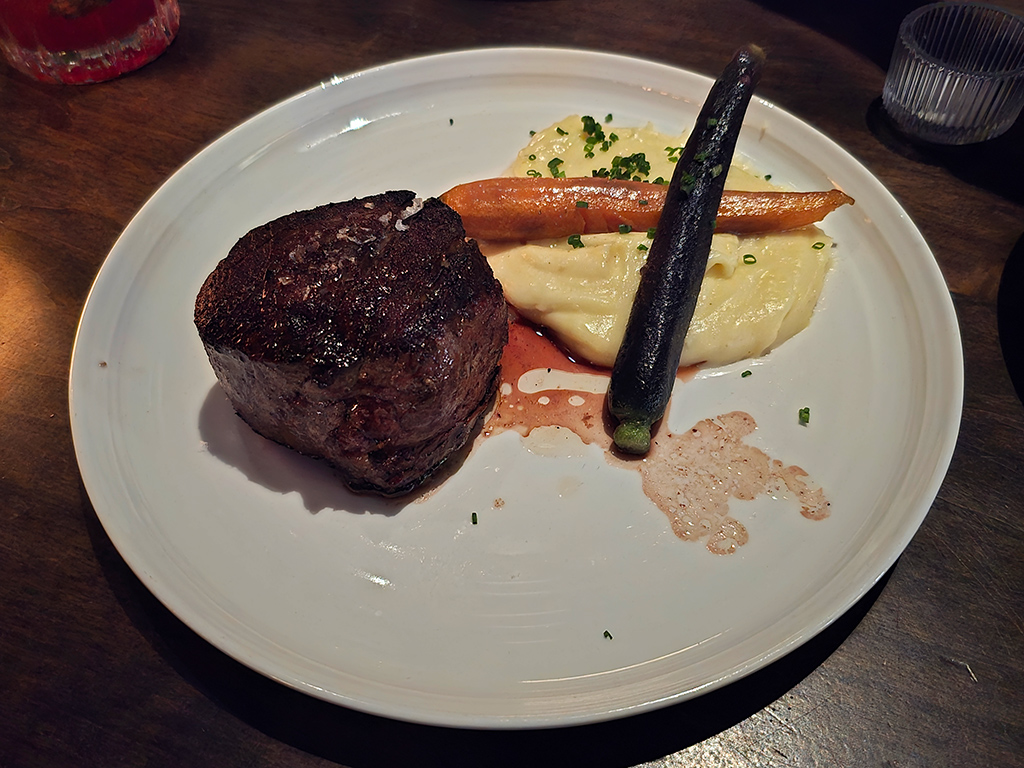
Our next batch of meat was American wagyu short rib and USDA Prime filet mignon chateaubriand.

The filet mignon was served with bone marrow, garlic miso, kimchi, and nori.

Our final meat dish was A5 Miyazaki wagyu strip loin with poached egg and a sprinkle of Maldon sea salt.

The waitress once again improperly cooked the meat—not only did she take it off the grill too quickly, but she immediately placed it in cold raw egg (which was not poached enough), and that killed all the heat momentum on the meat and left it as-is. This left the consistency of the meat too stringy and the egg too watery.

Our first dessert was lemon sorbet with basil oil.

This was my favorite dish of the meal. The basil oil added a very special and one-of-a-kind twist to the lemon sorbet. I had never tried this combination be­fore, and this was a fun introduction to a new flavor profile.

Our second dessert and final dish of the dinner was matcha balls.

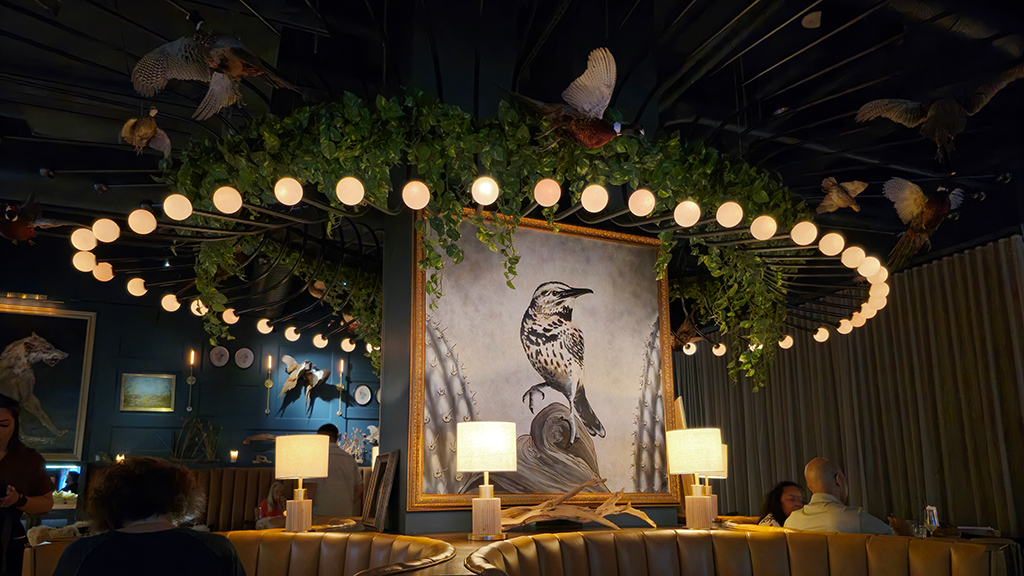
Here are some photos of the interior of the restaurant…

… and one of the front entrance.

Chef’s Tasting Menu ×4$ 512.00
Soft Pagoda$  13.00
Cherry Blossom$  13.00
S.Pellegrino sparkling water$   8.00
S.Pellegrino still water$   8.00
Gratuity$  90.00
Sales tax$  56.79
Total$ 700.79
The table on the right shows how much we paid.

I mentioned this a handful of times throughout this blog post, but I cannot emphasize this enough—the ability to cook wagyu properly is just as important as the quality of the wagyu. You can have a wag­yu steak worth hundreds of dollars, but it’s not going to reach anywhere near its peak potential if you don’t prepare it well.

Wagyu also needs a lot of salt to bring out the rich flavor. Yakiniku restaurants will always give you a side of salt—either a salt-and-pepper mixture or some flaky salt—to dip your wagyu in to enhance the taste. YakiYa did not give us a side of salt… or a side of any seasonings or sauces, for that matter.

Overall, I was a bit disappointed by YakiYa. I feel like they took the chef’s tasting menu concept and tried to mass-produce it to be able to serve a lot of people at once. Chef’s tasting menus and omakase experiences are usually done in an intimate setting bar-side next to the chef and are usually capped at about eight people per round so each diner can get an appropriate amount of attention from the chef. YakiYa had a chef build the menu, but then del­e­gated the rest to regular staff members who are unable to properly execute on the chef’s instructions.

The portion size of everything also seemed underwhelming. For some of the shared dishes that came combined in the same bowl or plate, it made me won­der whether we ended up with less food, e.g., rather than each person getting 1 portion, it might have gotten scaled down to 0.8 each as more por­tions were being added. I ended the dinner pretty hungry and drank a Soylent meal replacement shake right after to get some more calories.

Considering this is in Los Angeles, US$128.00 per person isn’t too bad, but I still wouldn’t consider it to be a top pick. For example, the omakase at Masamitsu, a restaurant less than a ten-minute drive away from YakiYa and still out in the suburbs, was absolute top-tier for only $22 more per person—good enough to be one of my all-time favorite restaurants.

So, the final verdict? It was fine, but there are better alternatives for the price. If you do still end up going to YakiYa anyway, just keep in mind that, at least in the way that they structured it when I was there, this is not indicative of what you should actually expect at a real high-end chef’s tasting menu res­tau­rant.


—§—