After my quick trip to the East Coast earlier this month, I flew back to Southern California in preparation for my two-year Twitch moderator anniversary dinner with @PhummyLW. If none of that has any meaning to you, I have a very detailed explanation in last year’s blog post about dining at the Capital Grille in Costa Mesa, California that may serve as prerequisite reading if you’re interested in the backstory of what has now become an annual tradition.
This year, Phummy asked me to take him to Bello by Sandro Nardone, an Italian restaurant in Newport Beach, Orange County, California. They had apparently been experimenting with a newer format of their chef’s tasting menu, and after trialing it for a few weeks, they came up with a system that works best for them—two weekly seatings of up to six people each, every Friday at 6 PM and 8 PM. The first session of this finalized chef’s tasting menu was today, Friday, May 23, 2025 at 6 PM, so I got Phummy and myself booked as their very first customers for this iteration.
We were fortunate enough that, out of the six available seats, Phummy and I were the only two attendees, so we got a very personalized experience with Chef Frank DeLoach. On top of that, I realized that their system in general was very unique, and part-way through our meal, I realized why they called it their chef’s table instead of just a regular tasting menu.
Chef’s tasting menus are often composed of a set number of courses that come out in a certain order as predetermined by the chef. This allows you to experience a culinary story through the food, as told by the chef, in the chef’s style. I love chef’s tasting menus (and omakase experiences, which are the Japanese counterpart), and I scout out the best-rated ones whenever I’m in search for a good restaurant.
On the contrary, a chef’s table, as explained by Chef Frankie, focuses on the diner rather than the chef. There are dishes that the chef will suggest, but otherwise, it is more of a freestyle experience where the chef makes realtime adjustments with the food offerings depending on the feedback and preferences of the diners. Thus, it functionally ends up being less of a traditional chef’s tasting menu experience and more of just having a private chef custom-curating you a multi-course meal over the span of a couple hours.
I was headed over to the restaurant from deep into Los Angeles County, so the estimated travel time was about an hour and a half. In typical Southern California fashion, the traffic got increasingly worse the longer I drove, and while originally anticipating arriving 15 minutes early, I ended up being 12 minutes late.
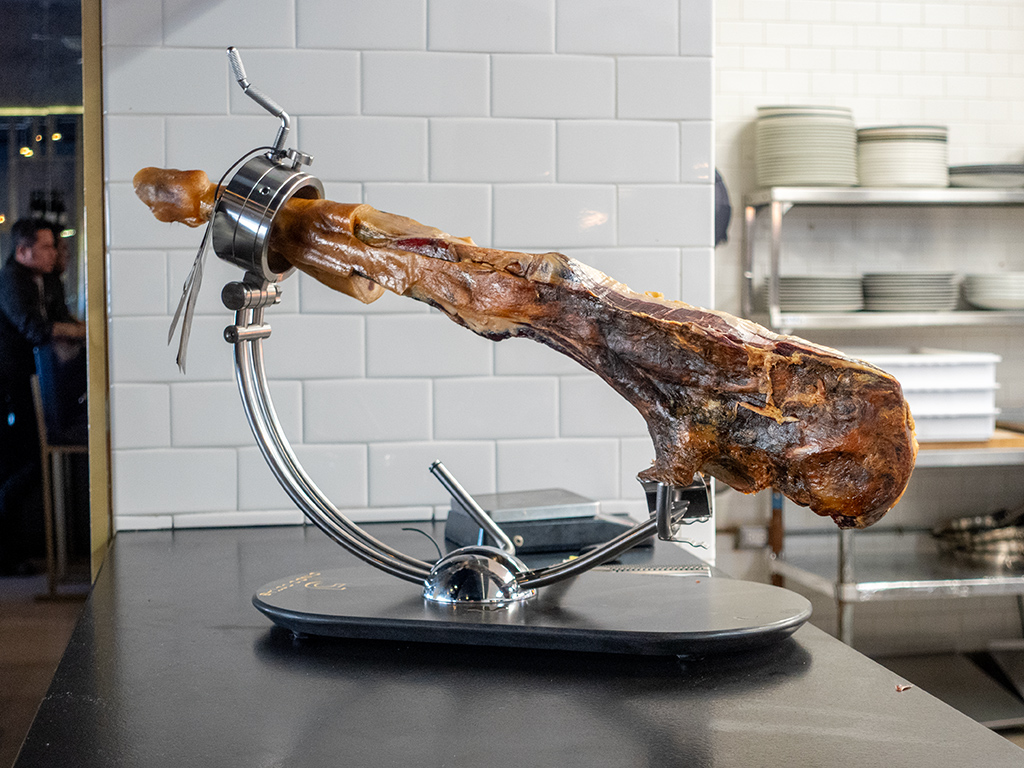
Upon my entrance, Phummy had already been seated and was nibbling on some prosciutto. I joined in and ate my portion. I don’t particularly like prosciutto, especially when it is just the dry-cured ham on its own without anything else to go along with it, but with that being said, this prosciutto still had a very rich, intense, clean flavor that I think fans of prosciutto would enjoy and appreciate a lot.

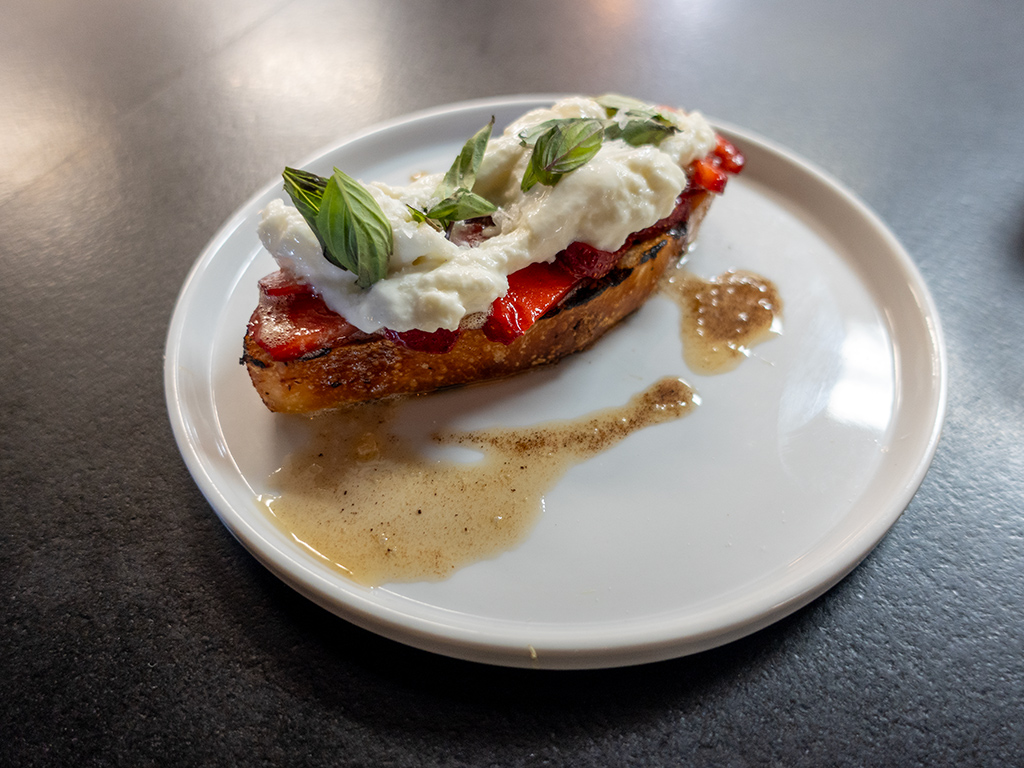
Our first antipasto dish was a bruschetta topped with strawberries, cheese, and herbs. This is literally the best bruschetta I have ever had in my entire life.
I’m generally not a fan of cheese because my taste buds love to pick up and focus on only the moldy flavor of cheese, but this cheese atop the bruschetta was gloriously delicious. It was smooth and creamy, and the flavor only had the “nice” parts of the cheese without any of the pungency, intensity, or moldiness. The texture was soft and delicate, and it coated the inside of my mouth in a way that contributed its flavor uniformly across every time I bit down to chew.
The bread was prepared to perfection. To me, bruschetta doesn’t have the best reputation because the bread usually comes out at such an inconvenient texture where it’s not exactly the consistency of a cracker, but it’s still hard and sharp enough that it cuts the inside of your mouth. This bruschetta’s bread had the perfect amount of resistance given to each bite where it added a great balance of firmness and softness.
Lately, I’ve seen some viral online videos about egregiously expensive but orgasmically delicious strawberries, and although I have not tried those strawberries, I feel like they would be on par with the ones on this bruschetta. These strawberries tasted like nature-made candy, but rather than pure sweetness, it was somehow like a combination of sweet and umami.
Next was some crudo topped with macadamia nuts, cucumbers, red onions, and other greens, bathing inside a coconut sauce.
With how much sushi I eat, I have obviously eaten a lot of crudo. Crudo at Japanese restaurants is often a hit-or-miss, and rather than hamachi crudo, I have almost always just preferred plain yellowtail sashimi instead because of how sour crudo ends up being.
This crudo had none of the downsides that I have experienced in the past with crudo. The coconut sauce was mild but still flavorful, and the vegetables were only pickled to a point where they had a subtle kick, so neither the sauce nor the toppings pierced through or overwhelmed the flavor of the raw fish.

Next was a minced chicken dish wrapped in some leaves (I forgot what kind of leaves, and I also forgot what other ingredients were included in the dish).
This had a balanced meaty and earthy flavor, but unfortunately, it was so overwhelmingly salty for me that it distracted and detracted from some of the flavor. I mentioned that to the chef, and I am pretty sure he took that into consideration for future dishes, as nothing else served later during the dinner was too salty anymore.

Next up was our pasta dish. I think this shape of pasta is called strozzapreti, but I don’t recall with certainty.
The sauce was made with a mixture of seafood and other portions of leftover ingredients that would otherwise not make it into main entrées. It had somewhat of a nostalgic flavor to it that reminded me of homemade stew.
Some people take their leftover scraps from home cooking and throw it all into a simmering soup; this dish’s sauce was basically similar to that. When restaurants prepare dishes for presentation, a significant portion of perfectly-fine ingredients don’t make the final cut due to their physical appearance, so it is great when it ends up being used in a sauce rather than being wasted. With that being said, when this dish’s sauce was prepared, it seems like it was aiming for that “scrap stew” kind of flavor, but the quality of the ingredients were so high that you could easily tell it wasn’t just scraps.
This is probably unsurprising if you know how much I like fish and seafood, but this pasta dish ended up being my second favorite course of the meal (behind the bruschetta).

After our pasta, we were served some fish alongside tomatoes, cucumbers, fennel fronds, and olive oil.
I was impressed at the preparation of the tomatoes and cucumbers—the chef managed to reduce it down to only the tomato and cucumber flavor, without any of the other tanginess, tartness, or sourness that you might find with some fruits. It was almost as if these tomatoes and cucumbers were real-life examples of what flavor you would aim for if you were manufacturing a perfect tomato and cucumber flavor in a laboratory.
The fish was unremarkable, but in a good way. It was a clean, straightforward, smooth, untarnished fish flavor that I could happily eat everyday and would enjoy it every single time.
I also appreciated the temperature difference between the slightly chilled fruit and the warm fish—that added a fun dynamic to the consumption experience.

Coming up next was a beef entrée.

As what was supposed to be our final entrée, we were served steak with beet sauce topped with leek and pistachio.
This is some of the strongest beef flavor in a steak that I’ve ever had. Normally, steak with this level of intensity also usually comes with some gameyness, but this steak was very clean and pure in flavor. The ratio of fat cap to lean meat was perfect. Adding a bit of leek to each bite served as a decorative but subtle enhancement to the texture. The beet sauce helped amplify the beefiness of the steak, making it taste even deeper and richer.
The presentation was also quite unique, in that it basically came out like a piece of abstract art. I don’t see that too often because it’s tricky to properly straddle the line between a dish appearing as abstract art as opposed to just a mess, but I think this one pulled it off decently well.

While eating our steak, I asked Phummy if this was his favorite dish of the night, which he confirmed. I figured as much, because it was one of the more basic dishes without too many complicated flavors; it just took the concept of steak and took it far, doing it in the best way possible without any extra fanciness added to it.
Of course, preferring basic flavors is not inherently a negative thing. Just because you like simple dishes does not mean that you’re not able to discern the quality of the ingredients and the excellence in culinary preparation. With that being said, the chef made sure Phummy understood as such, and let him know that there is no problem with the steak being his favorite dish.
This evolved into a conversation where the chef mentioned how some people just really love pizza and will ask for pizza at the chef’s table, and Phummy pointed out that he too loves pizza. Chef Frankie was happy to hear that, and made us a Neapolitan pizza for us as a complimentary supplement to the regular tasting menu.

This was a great pizza. I would describe it as pristine simplicity—it used only the core and minimum ingredients needed to make a pizza, so there were no distracting flavors. With each bite, all you got was pure, blissful pizza, and nothing else. The crust was also a perfect consistency that made chewing it satisfying.
From what I noticed, I think there was very minimal seasoning on it. Instead, the char on the crust and base of the pizza served as a substitute for seasoning, adding a more natural-tasting enhancement to the overall pizza flavor profile.

For dessert, we got a piece of cake and some mashed pineapple with roasted almond ice cream on top.
Even now, I’m unsure how I feel about this dessert. Pineapple is my second-favorite fruit behind kiwi, so I obviously liked that. However, I couldn’t really pinpoint how I felt about the cake. On top of that, this was the first time I had ever had roasted almond ice cream, so this was a very new flavor combination for me.

Here is a wider shot of the kitchen; at the chef’s table, we were able to get a clear view of everything going on during our meal.

Here is a photo of the front of the restaurant—just an unassuming building in the Newport North Shopping Center.

| Chef’s Table ×2 | $ 370.00 |
| Service charge (20%) | $ 74.00 |
| Sales tax (7.75%) | $ 28.68 |
| Tock booking fee | $ 5.00 |
| Total | $ 477.68 |
Each ticket to the Chef’s Table cost $185. They charged a 20% service fee in lieu of gratuity, which was prominently disclosed during booking by way of just adding that 20% directly onto the marketed price when selecting the Chef’s Table. There are some restaurants that say a service fee is charged and that tips are not expected, yet they give you a receipt at the end of your meal to add on an optional tip anyway; Bello by Sandro Nardone did not do that, and they did not even give us the possibility of adding an extra gratuity at the end. The booking fee was charged by Tock and did not go to the restaurant.
Everything was prepaid at the time of booking the reservation. Pricing-wise, this was one of the most refreshing and honest payment experiences I’ve ever had at a restaurant. It’s always annoying when a restaurant advertises a certain per-person price for a multi-course meal or special dining experience, but because of optional add-ons and mandatory fees, you end up paying double what you expected. Because of having to regularly deal with that, I especially appreciated Bello by Sandro Nardone’s transparency.
This is probably some of the best service I’ve ever received at a restaurant. I’m used to receiving personalized attention from chefs when sitting at sushi bars for omakase, but Bello took it to an entirely new level. It was blatantly obvious that they wanted to ensure we had a great time, and they were querying and keeping track of our preferences to maximize our satisfaction with the meal.
The overall quality of the food was amazing. The portion sizes were also refreshingly large and filling. I felt like I concluded my dinner full of only great food, with no “filler dishes.”
This is definitely an expensive meal, but if this is within your budgetary means, I highly recommend the Chef’s Table with Chef Frank DeLoach at Bello by Sandro Nardone. I don’t know what the à la carte menu is like, and I did not have an opportunity to meet Sandro Nardone himself, but Chef Frankie (and one other staff member whose name I regretfully forgot) gave us a top-tier experience.