When visiting Seattle this time for PAX West, I traveled with one of my friends who likes searching for and trying out good food. We went to a lot of different restaurants, and I captured enough food pictures that I decided to do a dedicated blog post solely spotlighting the food I ate during my trip.
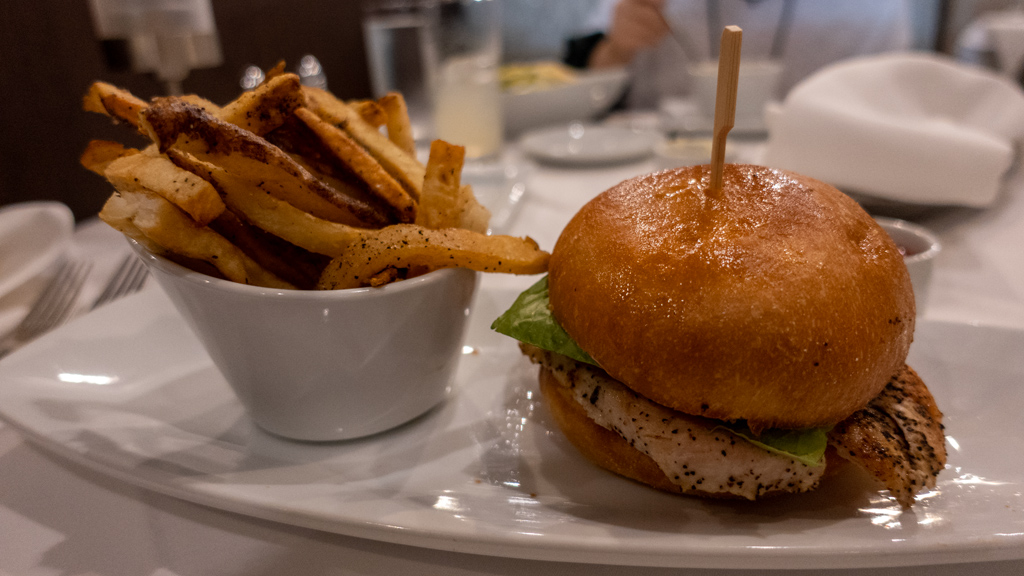
On the first day of PAX, we left the convention center for a little bit to find some lunch. We decided on Ruth’s Chris Steak House, where I ordered a grilled chicken sandwich and some fries.
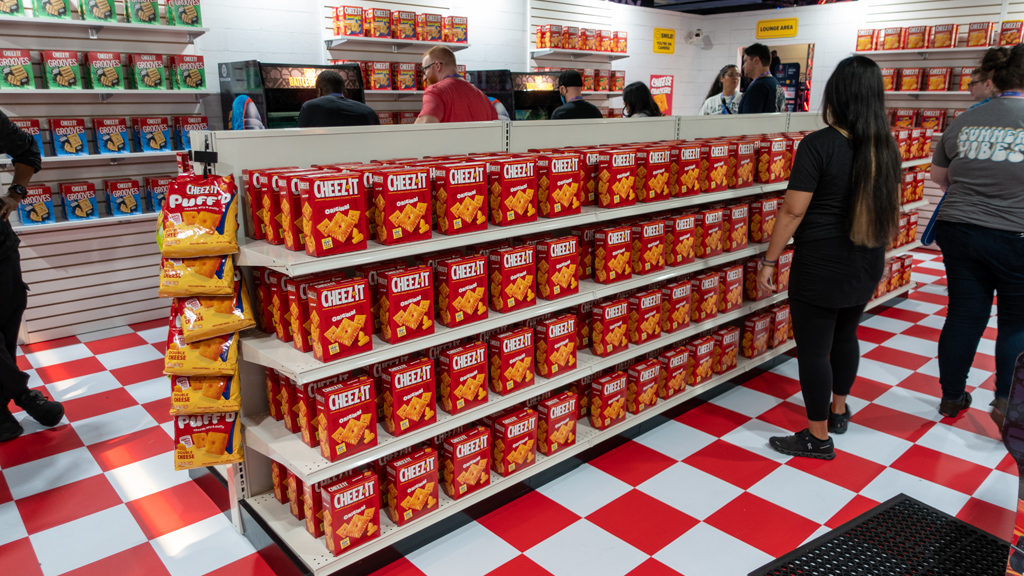
I’m not entirely sure if this actually counts as a food picture, but inside PAX, apparently Cheez-It decided to partner up with a gaming company to run their own exhibition booth. Funny enough, the booth was literally just entirely filled with Cheez-Its.
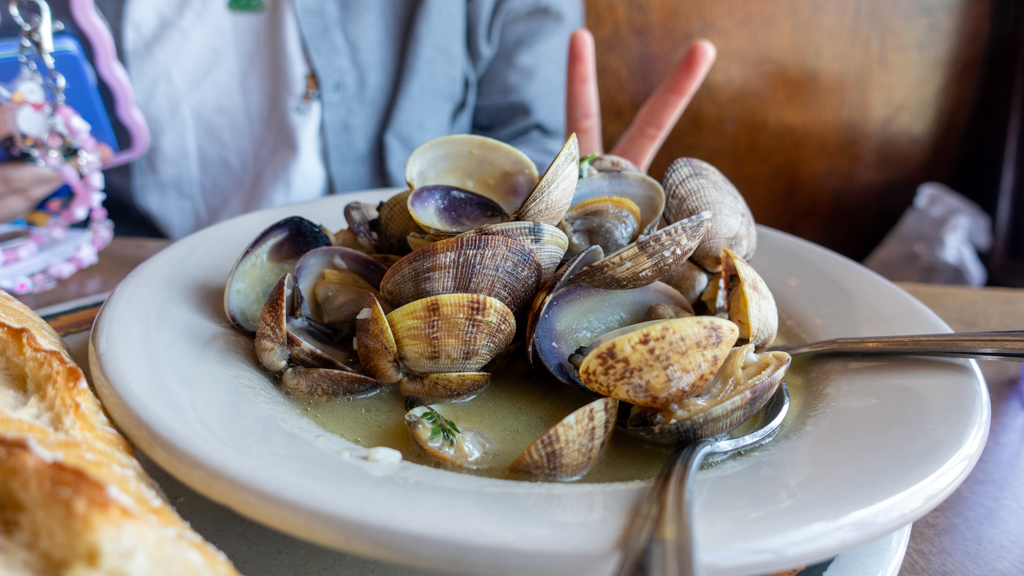
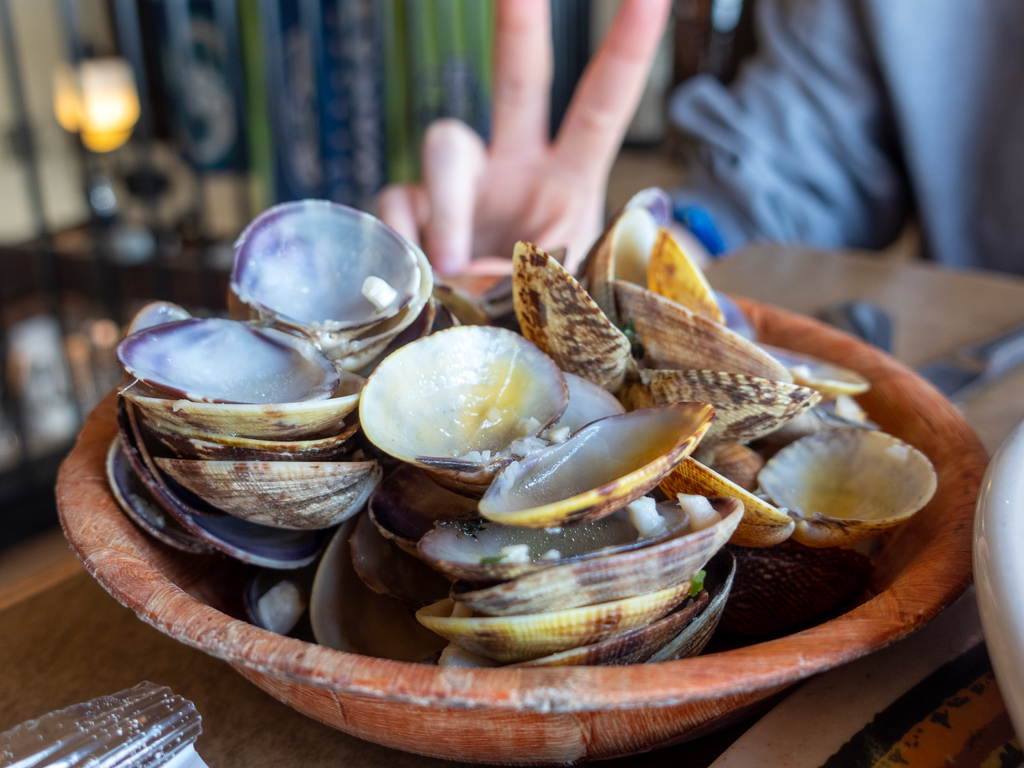
Although I had a four-day badge, my friend only purchased two one-day badges, so on one of the days where she couldn’t get into the convention center, we went to downtown Seattle and did a bit of exploring. For lunch on Saturday, we went to The Athenian Seafood Restaurant and Bar where we ordered some clams in garlic sauce.
Here is the aftermath.
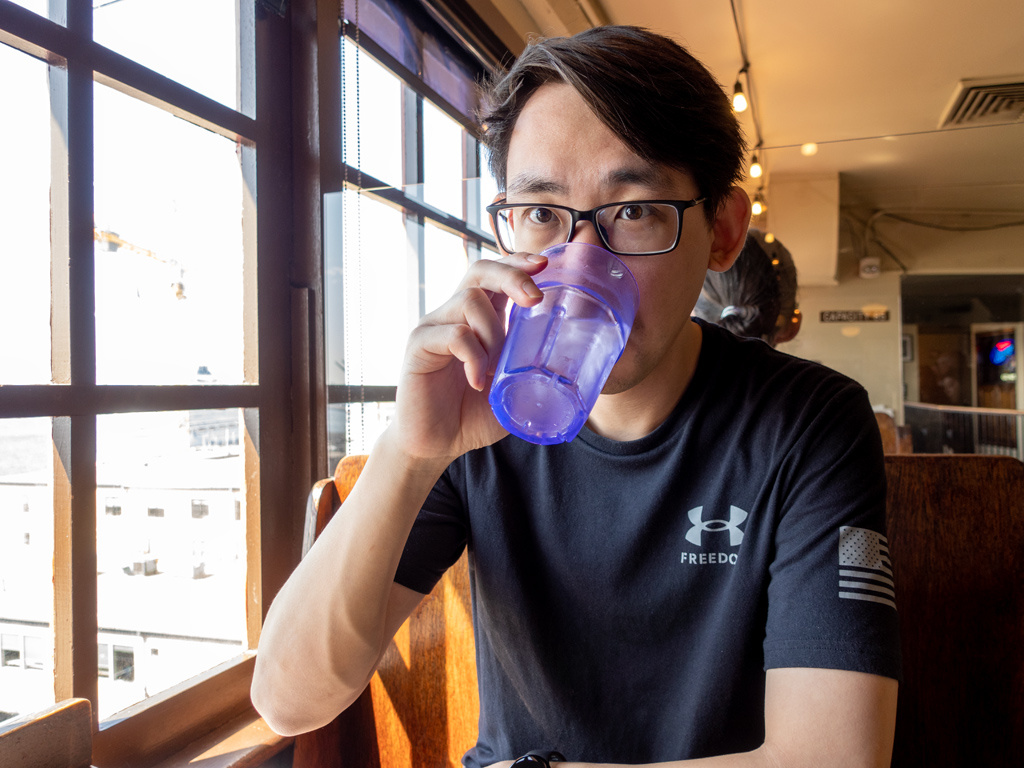
Does water count as food?
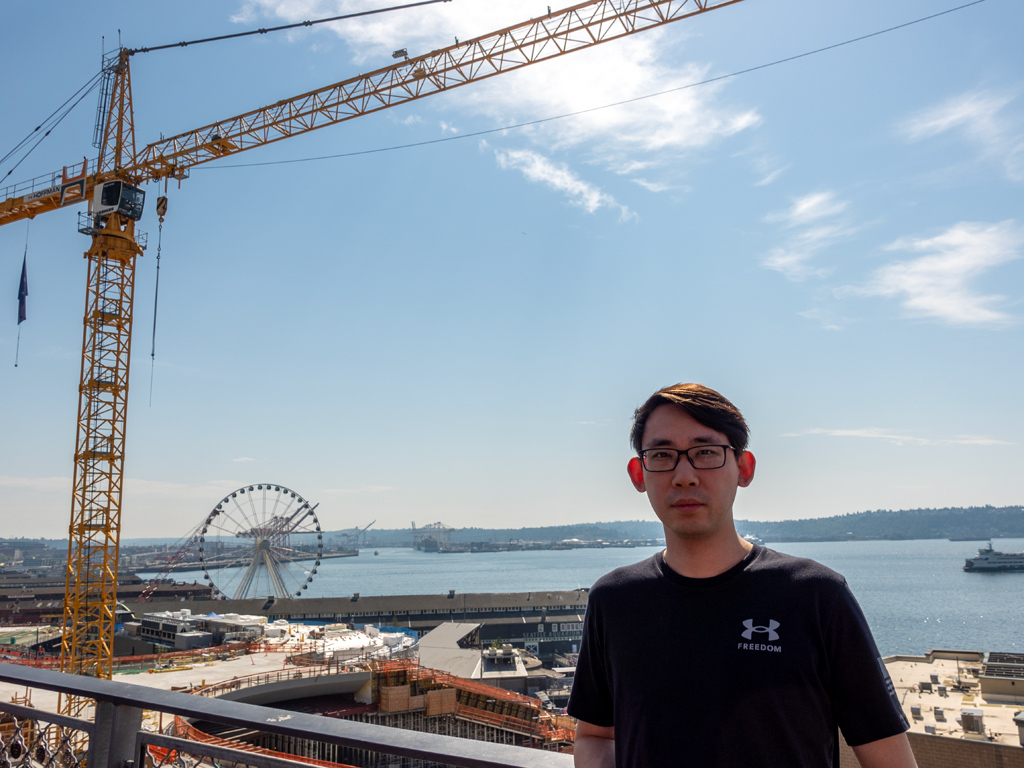
My friend took a picture of me in front of Puget Sound because she specifically wanted me to have more photos of my face to post on my website. I guess you can technically argue that this could possibly be a food picture if you consider the fish in the water that you could hypothetically go out and eat…
🍆 … 💦?
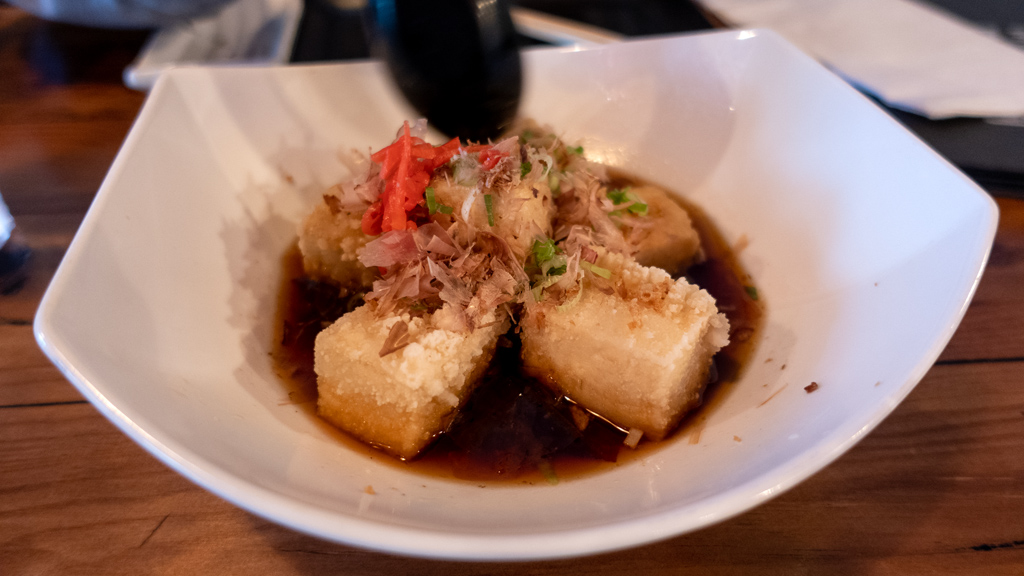
The next day, we went to Noren Sushi, where we ordered agedashi tofu for our appetizer.
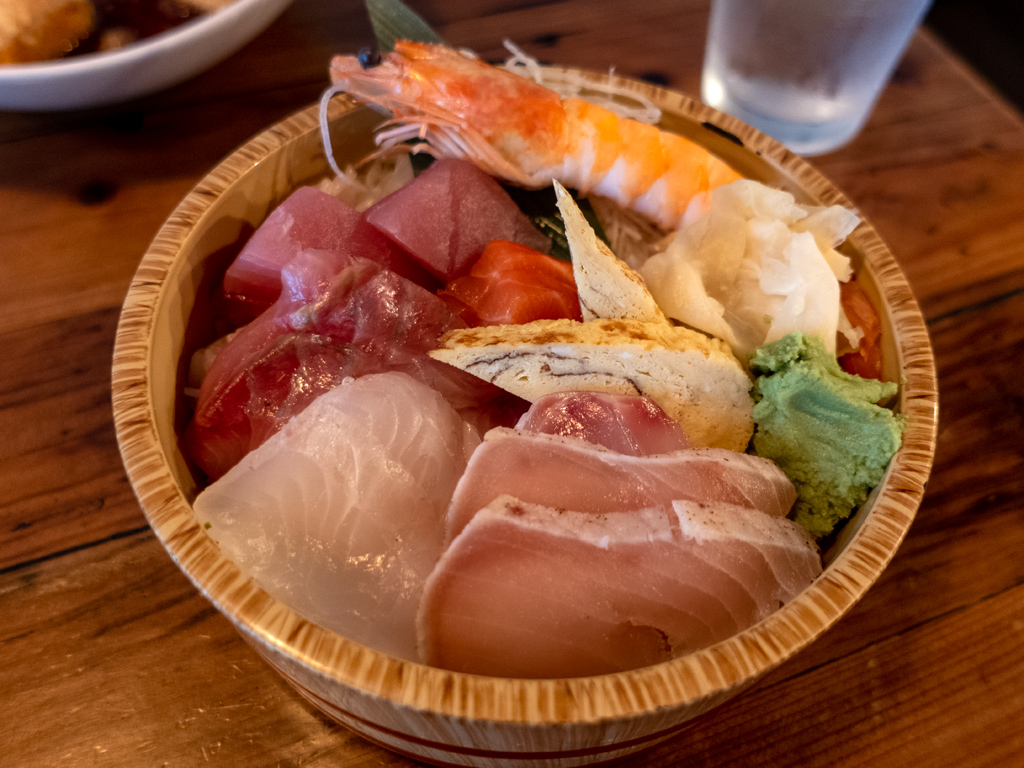
My lunch was a chirashi bowl.
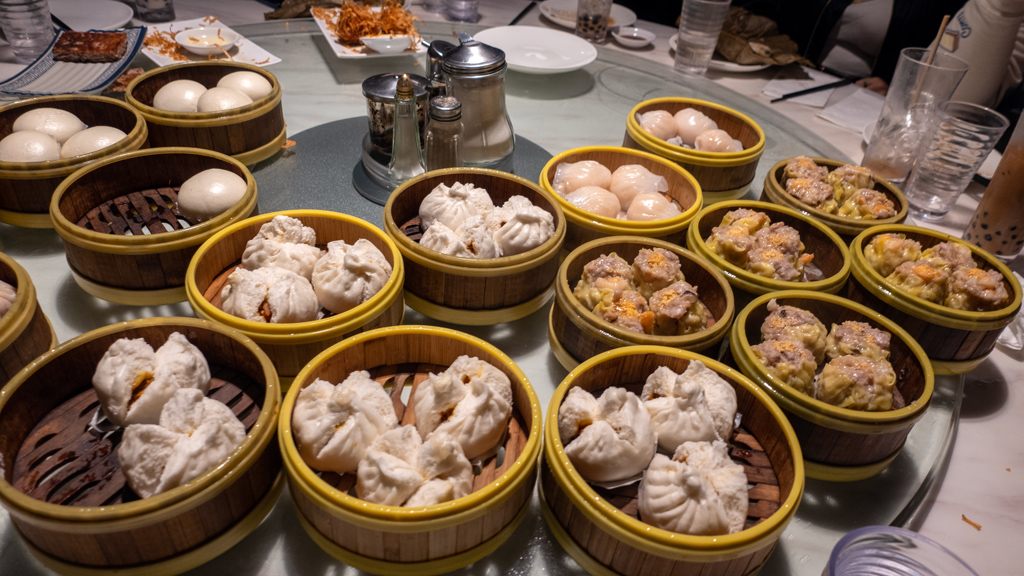
That night, after the “Fight Mii” panel, we went to Hong Kong Bistro for some dim sum. The service was horrifically bad, but the food was decent. We accidentally ordered about 50% more food than our party of nine needed.
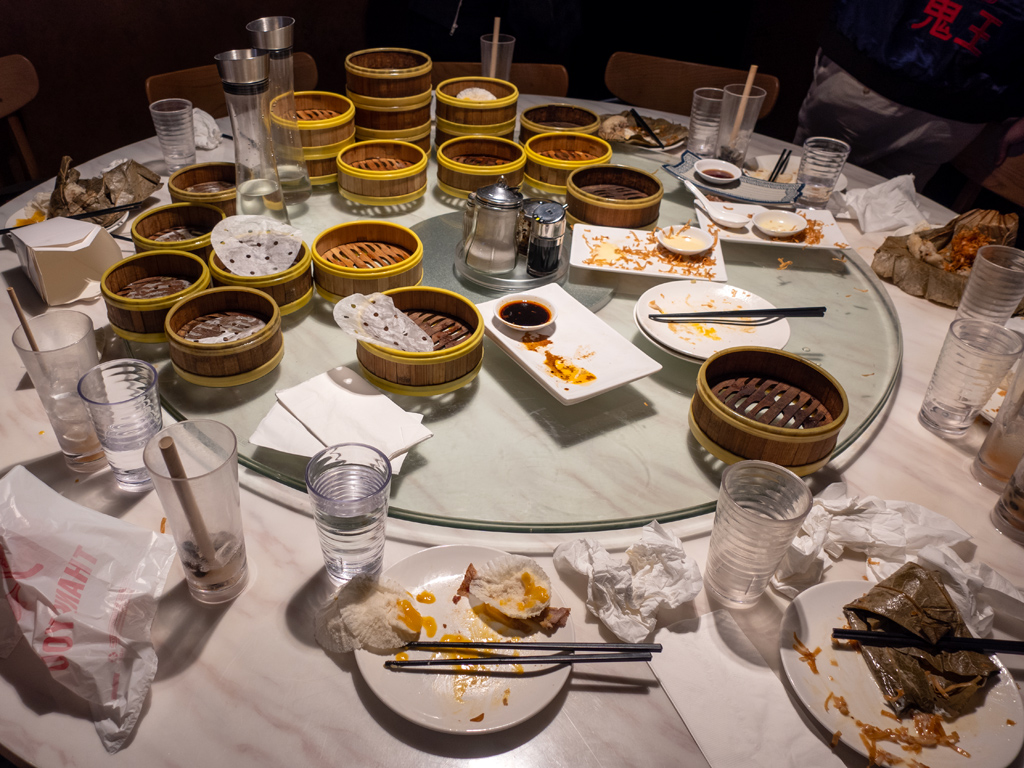
I overate, and we still had a ton of leftovers that we packed up in to-go containers; here is the aftermath after we were done:
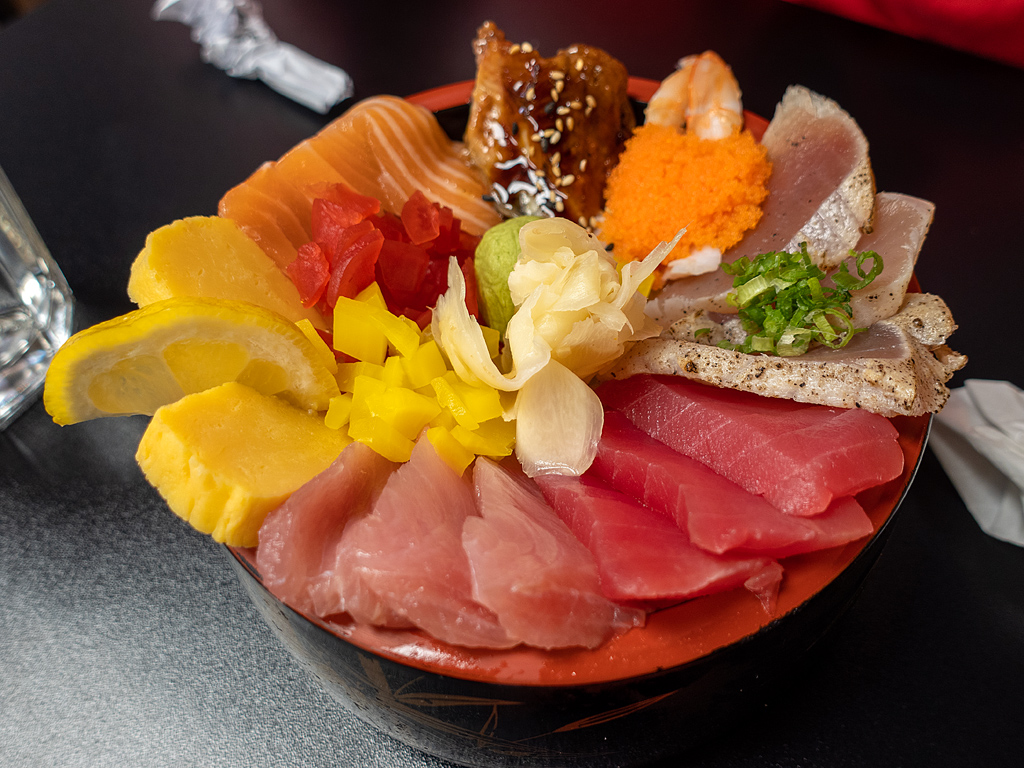
For lunch the next day, my friend and I went to Musashi’s. We shared our entrées half-and-half, with the first one once again being a chirashi bowl.
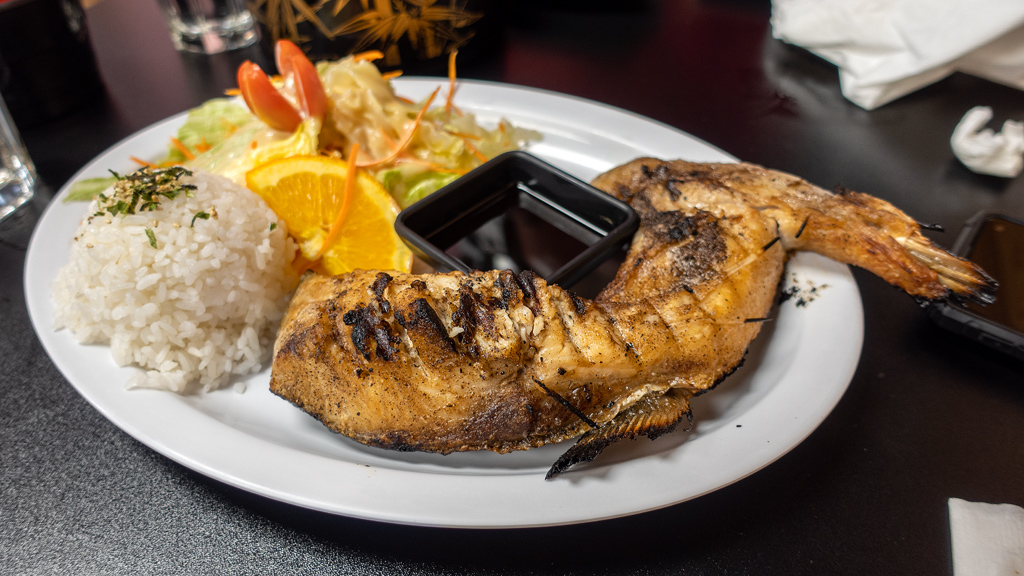
The second entrée we got was grilled yellowtail collar.
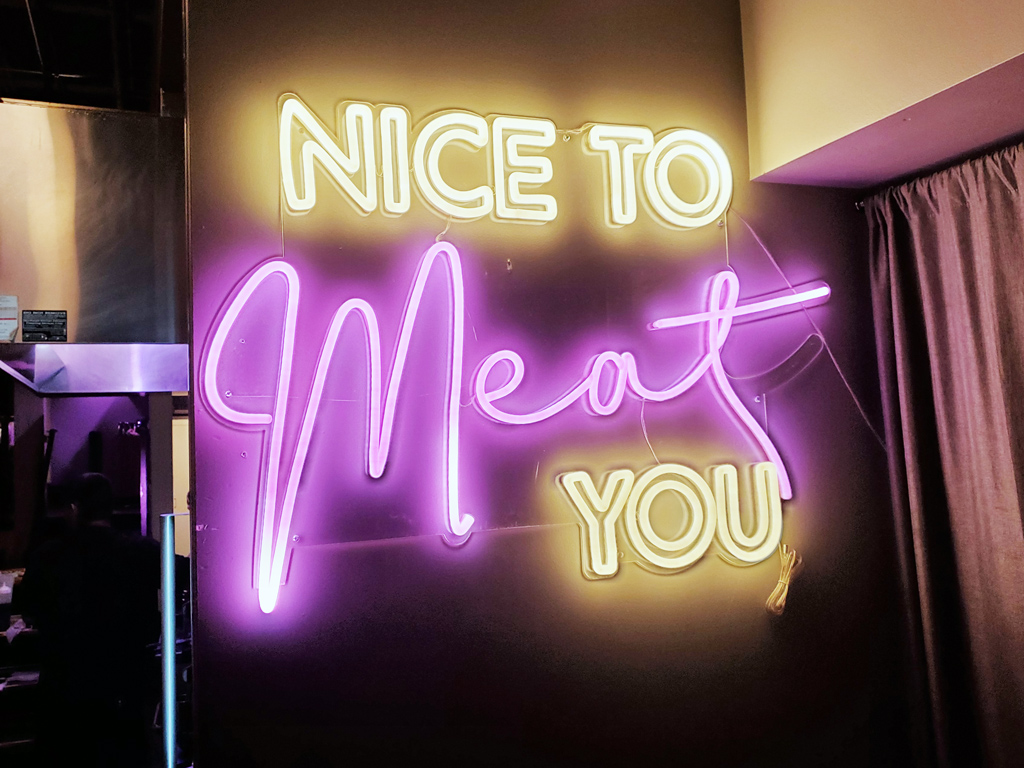
For the final restaurant of the trip, we went to Meet Korean BBQ. Our cook was great, the meat was extremely high quality, and the restaurant quickly became one of my all-time favorite restaurants.
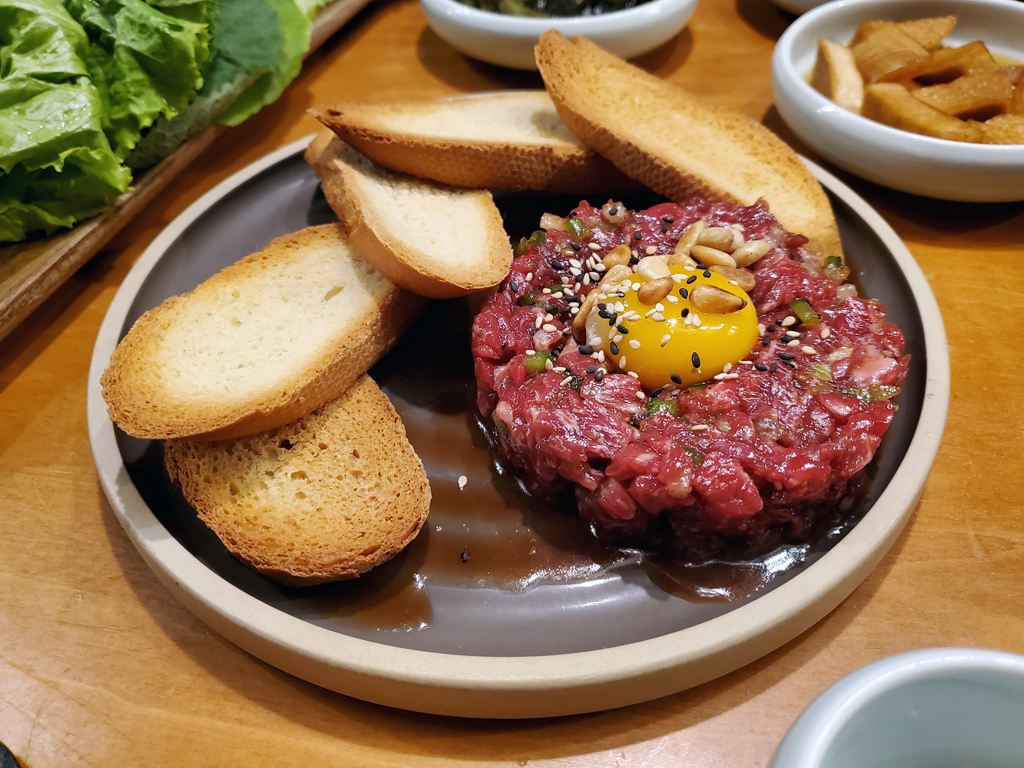
For our appetizer, we ordered steak tartare with American wagyu chuck, Asian pear, jalapeño, pine nuts, egg yolk, honey soy marinade, and toasted baguette.
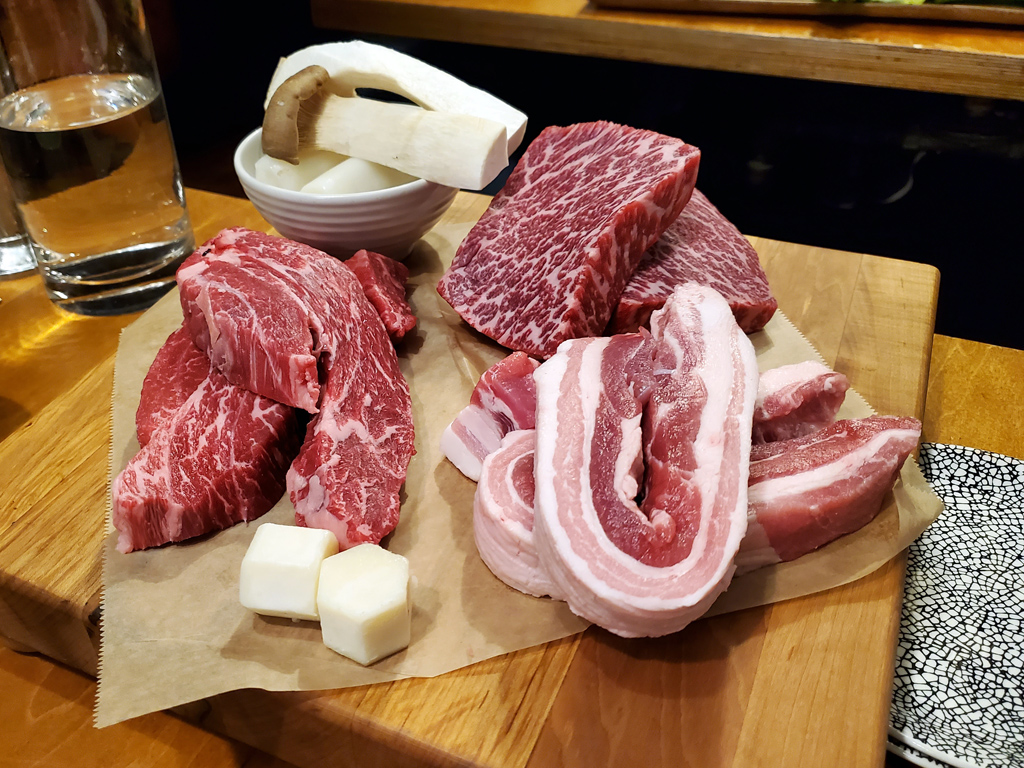
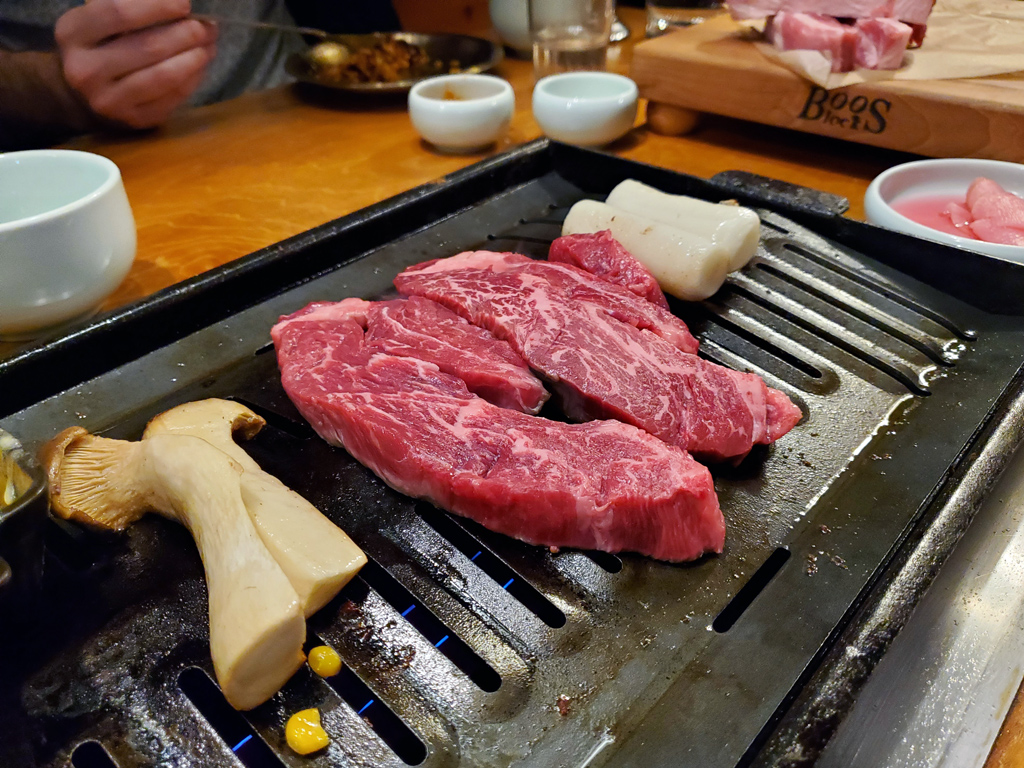
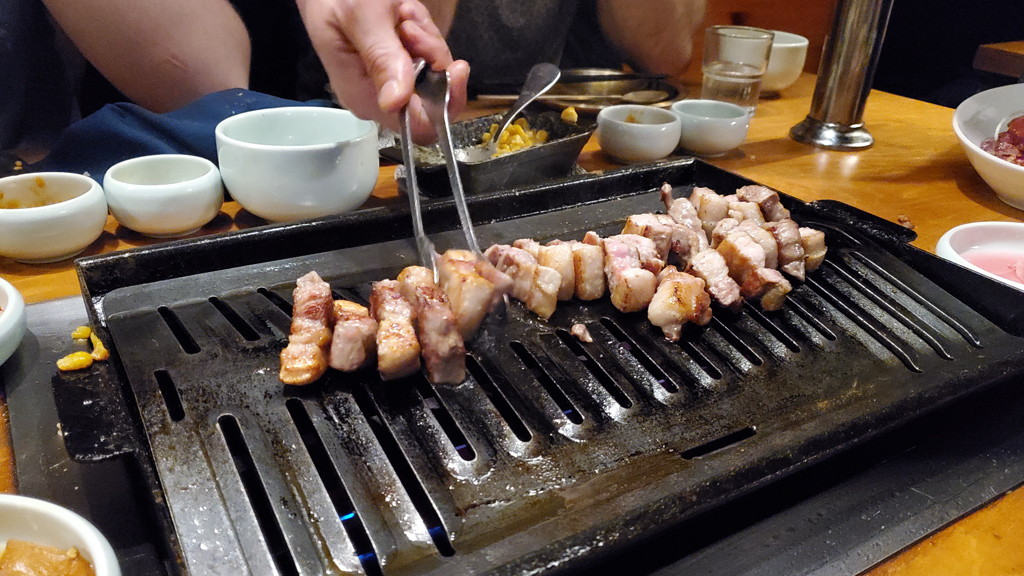
As our main entrée, we each ordered the signature feast. This round came with American wagyu gold grade bavette, American wagyu gold grade chuck eye steak, and Kurobata pork belly. The feast also included kimchi fried rice, corn cheese, egg soufflé, and wagyu soybean stew.
Meet was very pricey, but if you’re flexible in budget or just want to treat yourself, it was an amazing experience and I highly recommend it.
That wraps up a brief overview of my food adventures in Seattle. I’m glad I traveled with a friend this time around, because it’s always nice to have someone else scouting interesting places to visit and pulling me out of my hotel room where I otherwise would just be working until my scheduled events at the convention.
I’m about to go on a lengthy chain of back-to-back travel, so before I leave, I decided to meet up with a friend and get some food at Boom Bang Fine Foods & Cocktails in Henderson of the Las Vegas Valley in Nevada.
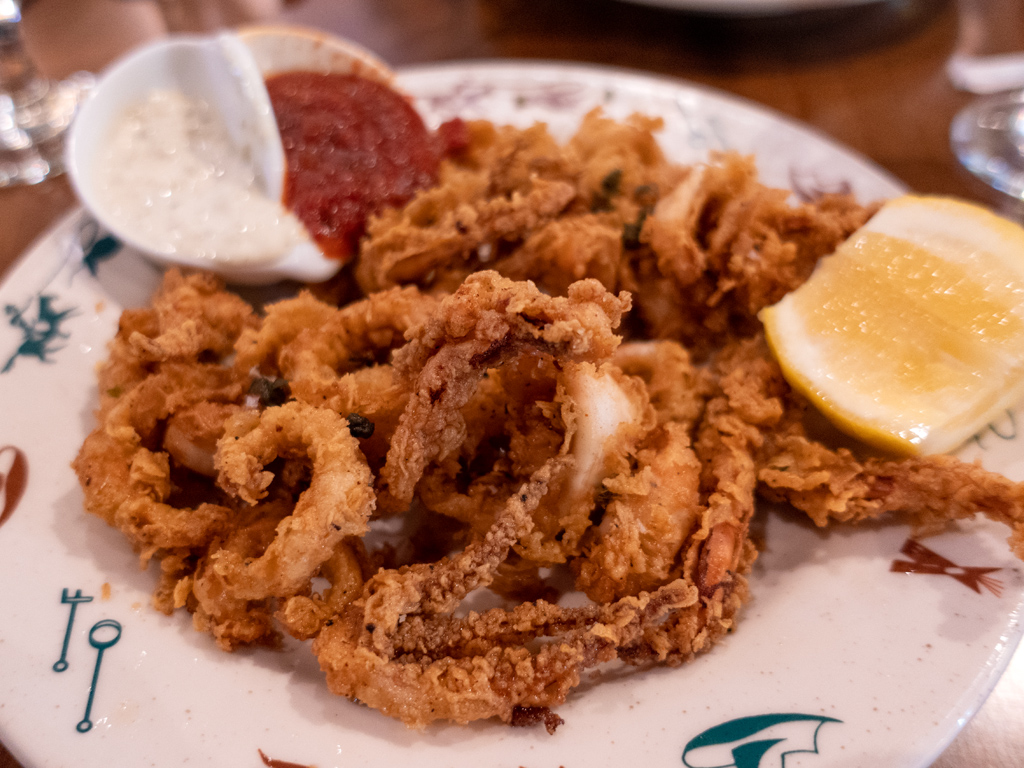
For my appetizer, I ordered the waitress’ recommendation of mushroom tart. Instead, I received wild Rhode Island squid and capers with a side of housemade tartar sauce and chipotle marinara. I like calamari so I didn’t mind the mix-up; when I let our waitress know, she said that the buttons for the calamari and mushroom tart were right next to each other, so the wrong dish was put into the order. She offered to give me a complimentary mushroom tart for the error.
The calamari was decent. I liked the squid a lot, but the breading was a bit intense in some areas, and it was somewhat over-fried. My dinner companion is not much of a fish and seafood person, so I ended up finishing the entire plate on my own.
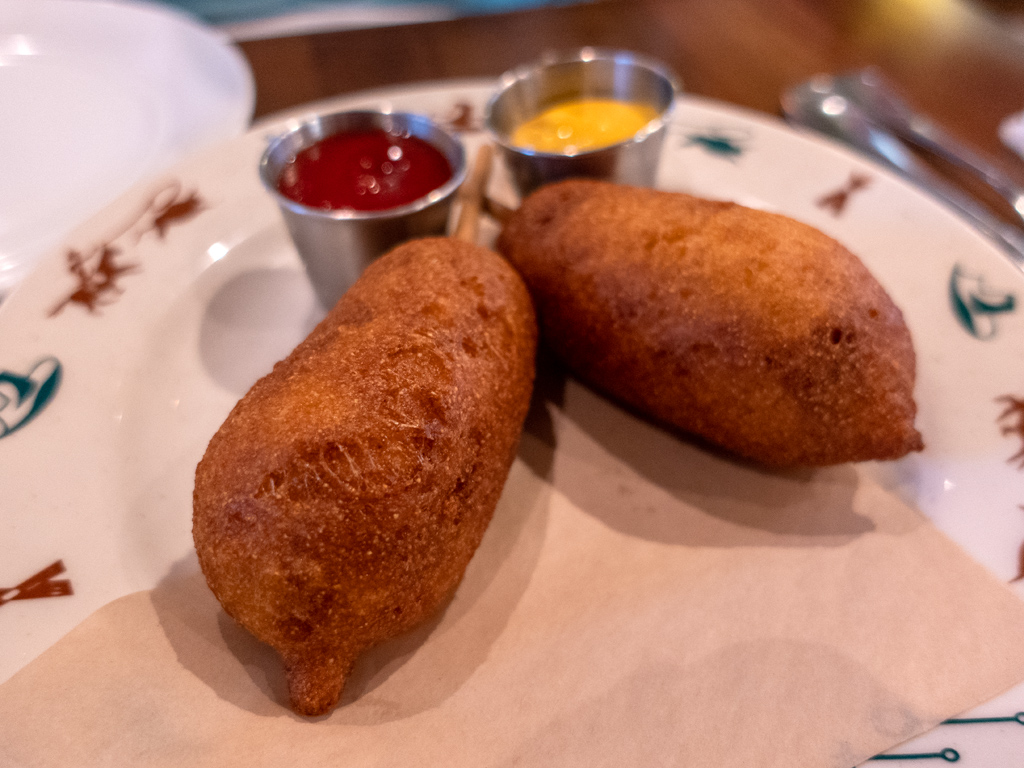
For his appetizer, my friend ordered corn dogs made from artisan frankfurter and Boom Bang’s “best batter ever,” with a side of ketchup and Boom Bang mustard sauce.
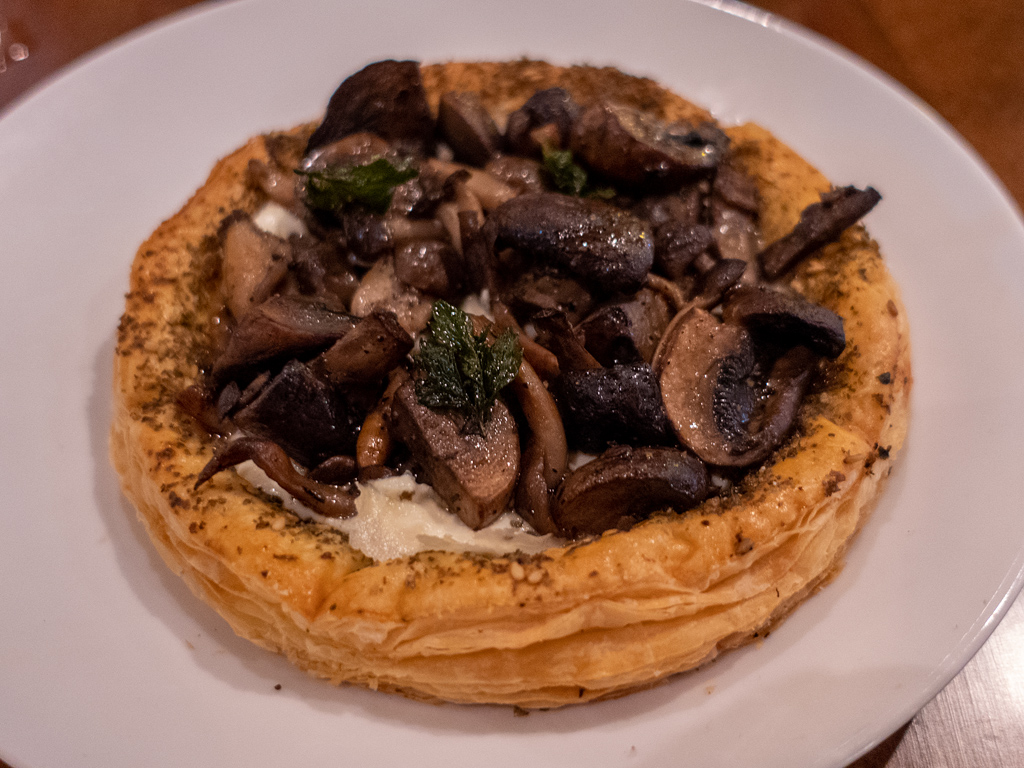
Shortly afterwards, my second appetizer came out—the complimentary mushroom tart that was previously promised. It came with wild and cultivated mushrooms, goat cheese mousse, and verjus. The mushrooms were great and the tart was nice and flakey, but the goat cheese smelled like vomit and made the whole dish pretty unpleasant. … I still finished the entire thing anyway, though I scraped off most of the cheese.
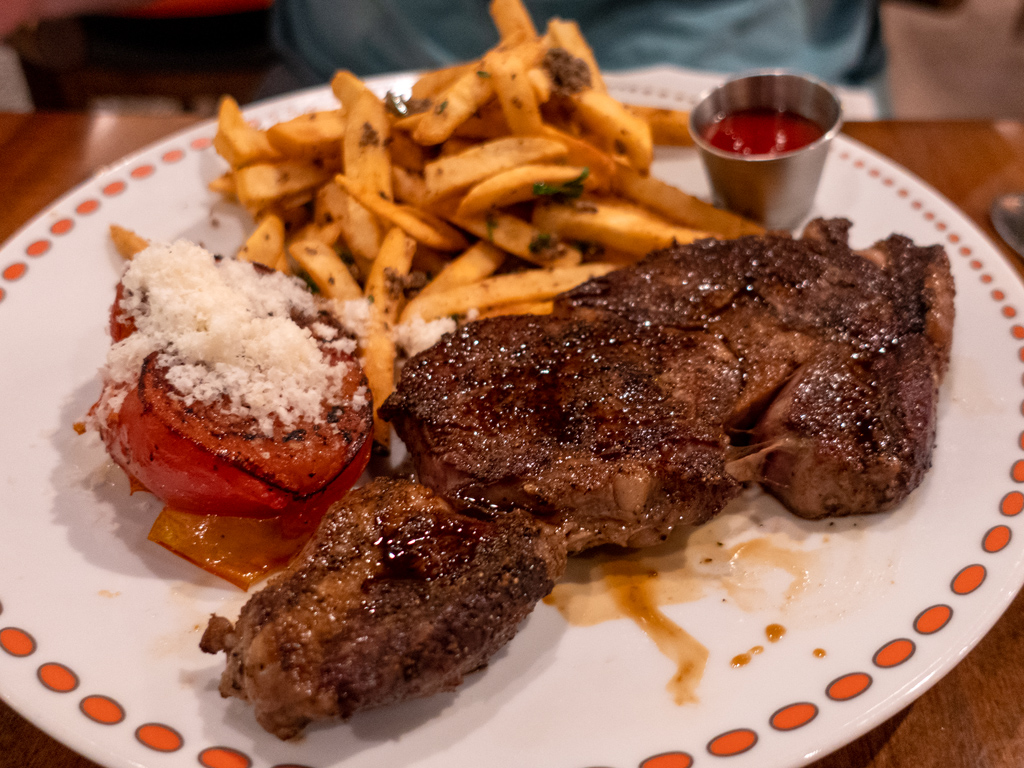
My friend ordered the daily special for his main entrée—14 oz. Cedar River ribeye with bordelaise sauce, truffled French fries, and roasted tomato.
For my entrée, I decided to do something a bit unusual—I decided to order the “small action” seafood plateau, which is usually ordered by a table as a shared platter of appetizers, but I instead chose to have it as my dinner. It came in a hilariously large plate, and everything was kept chilled atop a bed of ice.
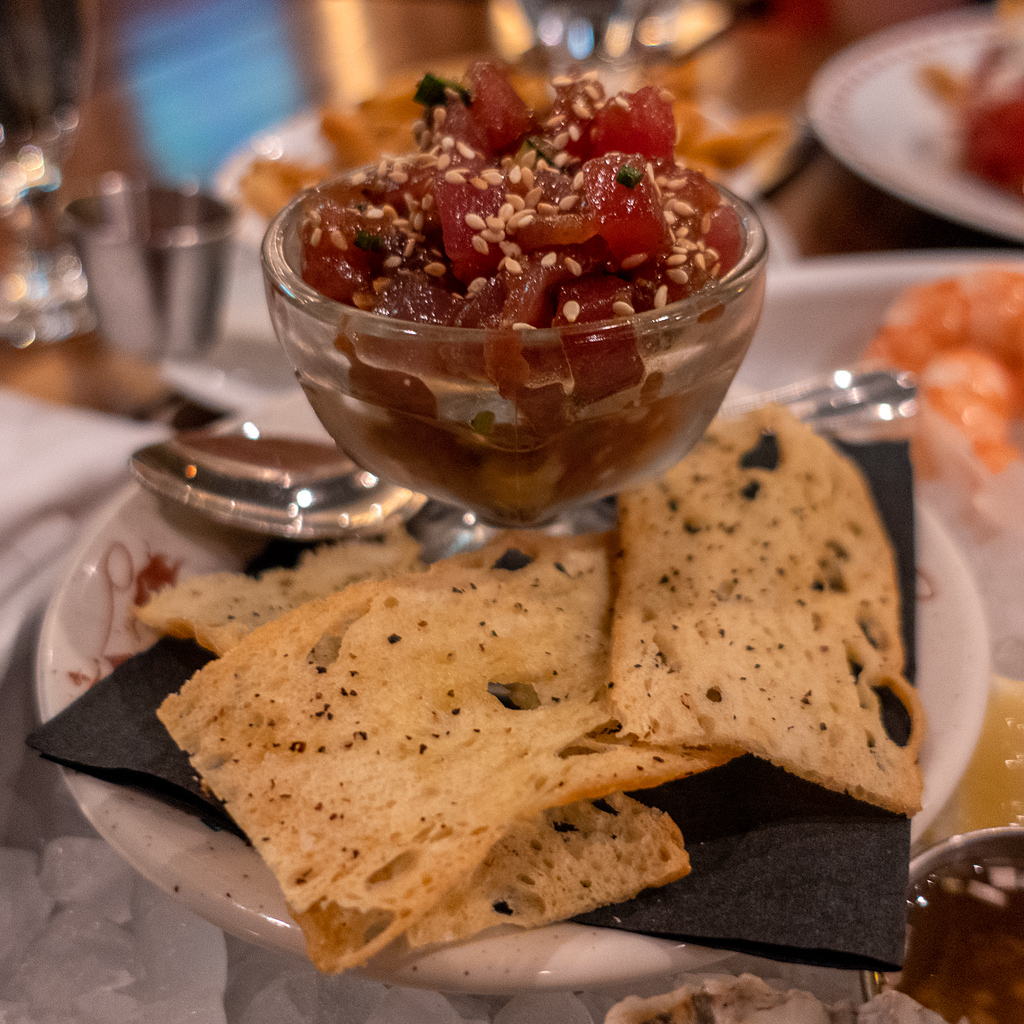
First was some tuna tartare, seasoned with whiskey barrel-aged soy sauce, sesame, and avocado, and a side of baguette croutons. I found it funny that they called it tartare, as that is usually a term used for non-fish dishes. The tuna was exactly what I expected from good-quality tuna, but there was also nothing particularly stellar about it—it basically tasted like I was just eating a premium tuna poke bowl.
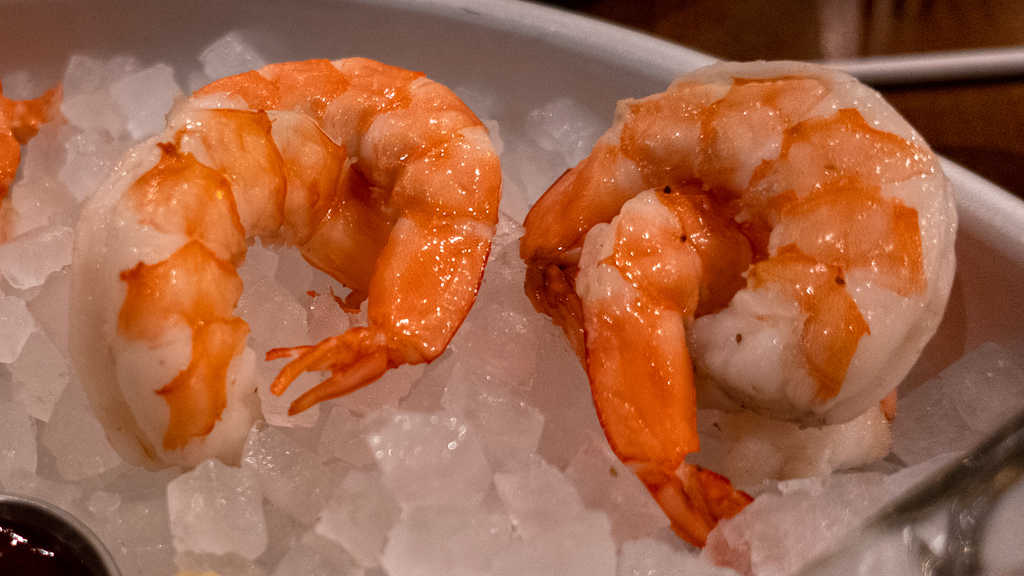
The plateau also came with Oiishi shrimp and a side of Mexican cocktail sauce. The shrimp was incredibly satisfying—it had lots of rich flavor, each one was very large, and its texture had just the right balance of tender and firm.
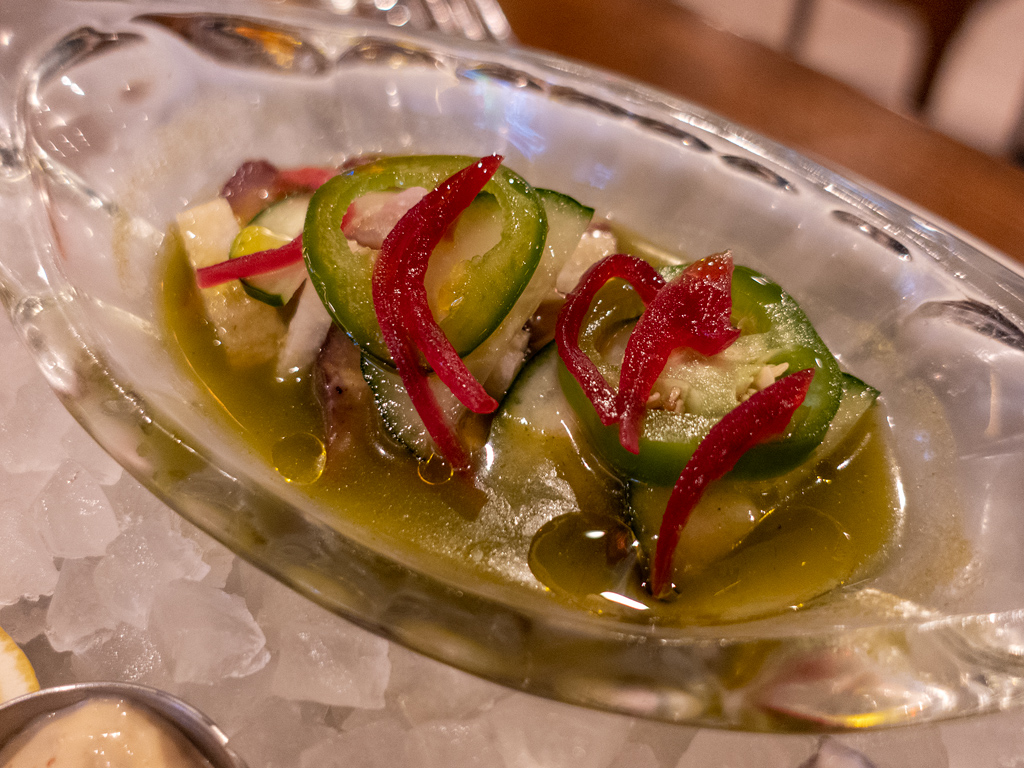
Third was hamachi aguachile seasoned and served with avocado, serrano, pickled red onion, and cilantro. Notably missing from my serving was the avocado, which was instead substituted with cucumber. The yellowtail also did not actually resemble the flavor of yellowtail, though whatever fish it was, it tasted good. The dish as a whole was a bit too sour for my preference, but it wasn’t as overwhelming as other aguachile or ceviche dishes I’ve had.
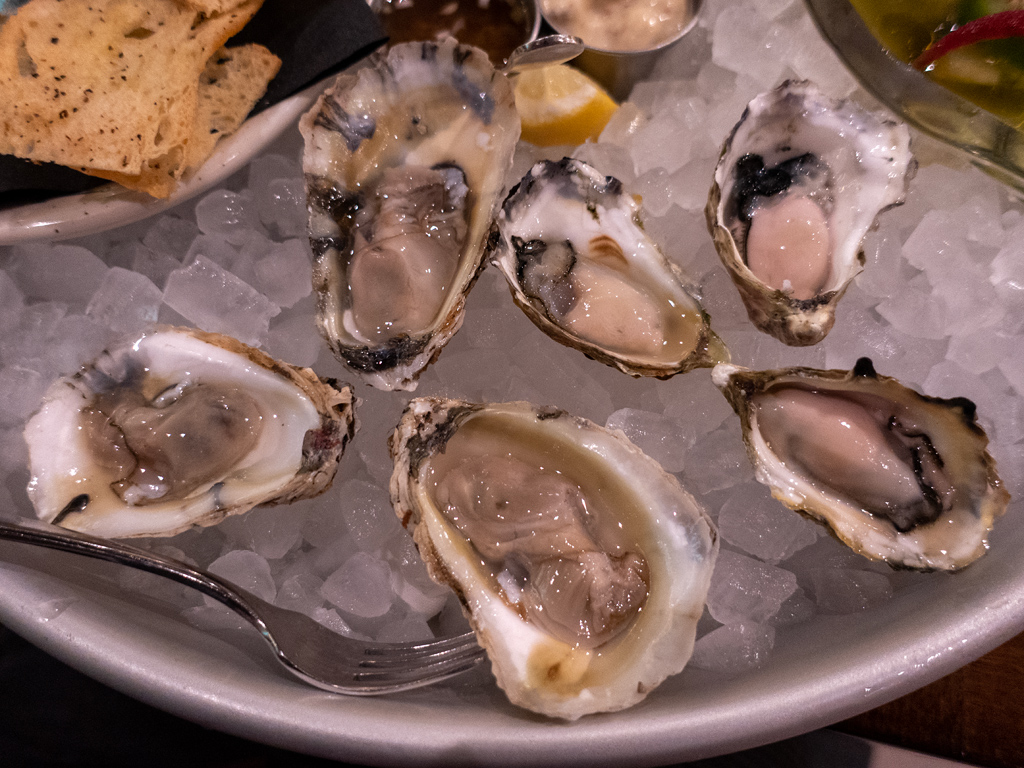
And finally, a seafood platter would not be complete without oysters. I received half a dozen oysters, three of which were East Coast oysters. They tasted like normal, good oysters.
I also received three West Coast oysters, which were some of the best oysters I’ve ever had. The West Coast oysters had a mysteriously high intensity of deep, delicious oyster flavor, so much so that it was almost as if additional oyster flavoring had been injected into them. Each bite extracted more and more juices, repeatedly covering my tongue and replenishing the flavor until there was nothing left of the oysters but bolus. To be clear, I have had plenty of West Coast oysters before, and they weren’t all like this, so there were definitely something special about the ones from this restaurant.
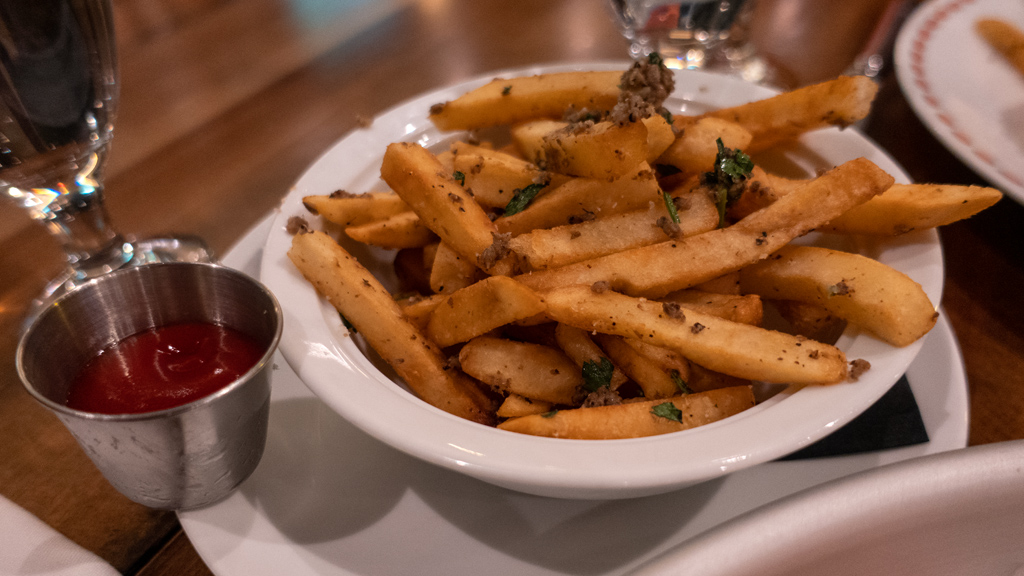
Considering that I was getting a lot of seafood, I also ordered a side of truffle French fries to balance things out. I prefer my French fries to be a bit on the underfried and thicker side, but I still enjoyed these.
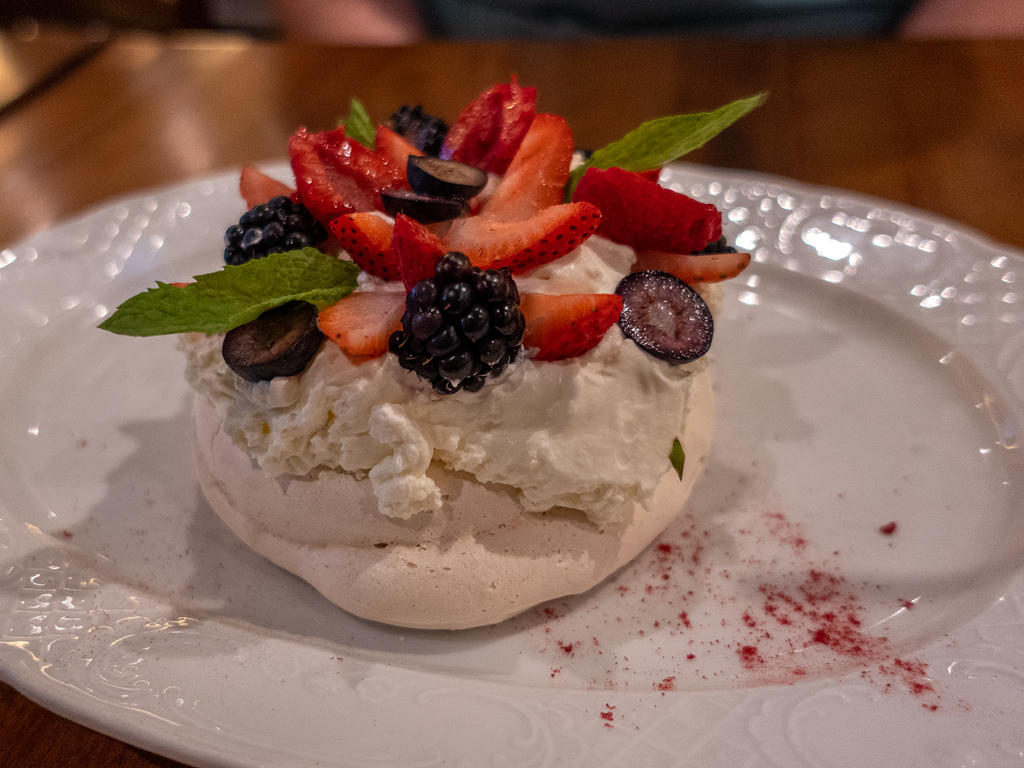
At this point, I had finished a full portion of two appetizers plus a large seafood platter and some fries, so I was pretty much at my limit for food. However, my friend still had room for dessert, so he ordered pavlova with crisp meringue, Bavarian cream, and fresh berries. I tried one bite, and it was clean and refreshing; if I wasn’t so full, I would’ve definitely liked a serving of this.
Calamari
$ 16.00
Corn dogs
$ 9.00
Mushroom tart
$ 15.00
Ribeye and truffle fries
$ 69.00
Small action seafood plateau
$ 56.00
Truffle French fries
$ 12.00
Diet Coke
$ 3.00
Pavlova
$ 14.00
Manager’s comp
–$ 15.00
Tax (8.375%)
$ 14.99
Gratuity (20%)
$ 38.80
Total
$ 232.79
The chart to the right shows how much we paid.
One funny thing about this restaurant was that there was a DJ by the entrance playing very loud music the entire time we were there. It is absolutely not what I was expecting from a restaurant that advertises themselves as being fine dining… though maybe that is what the “boom bang” is supposed to represent? I was there to catch up with my friend, so after a lot of yelling over the music, I concluded my dinner with a sore throat.
I think the consistency and quality of the food was a bit scattered. There was nothing that was bad, but everything wasn’t excellent either. Some of the dishes were fairly average, and I sometimes don’t notice right away because of my desensitization to prices, but if I go back and think about it, there were a few things that made me think “I could get this exact same thing of the exact same quality at a different restaurant for less than half the price.”
If you’re someone who likes a more “youthful” and upbeat environment, I think you’d enjoy Boom Bang. However, if you’re looking for traditional fine dining, this restaurant might not have the type of experience that you’re looking for. I also think it could be worth it for the restaurant to do a quick review on pricing and ease a bit on the intensity of the fried foods.
As a disclaimer, note that I do not drink alcohol and did not try any of the cocktails—which I imagine must be good, considering that they literally put “cocktails” in their restaurant name. If you like cocktails, wine, spirits, and champagne, they have a large drink menu, so you are probably closer to the target audience for Boom Bang and you may end up having a much more fulfilling experience than I did.
During my recent one-week trip to Seattle, I met back up with my friends Doug and Dani to enjoy another dinner at a nice restaurant. Last time we went to Shiro’s Sushi; this time, Dani selected Shaker + Spear in the Belltown district of downtown Seattle.
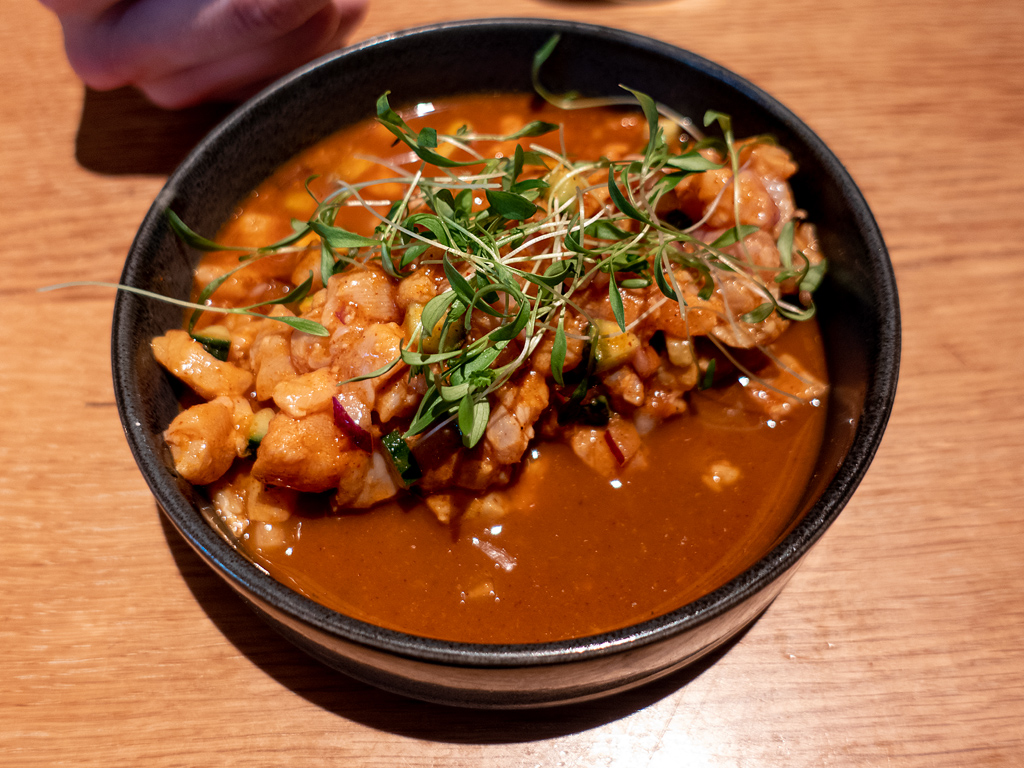
Our first appetizer was rockfish ancho ceviche with red onions, cucumber, lime, and cilantro.
This was a little bit too sour for my personal preference, but I think it was still very tasty. The rockfish had a nice spongy texture that was very satisfying to chew down on, and the crispiness of the cucumber provided a pleasant contrast. The overall proportions of the ingredients in the dish were also good—you only need a little bit of cucumber to complement the rockfish, and accordingly, the dish was mostly rockfish and a lesser ratio of cucumber.
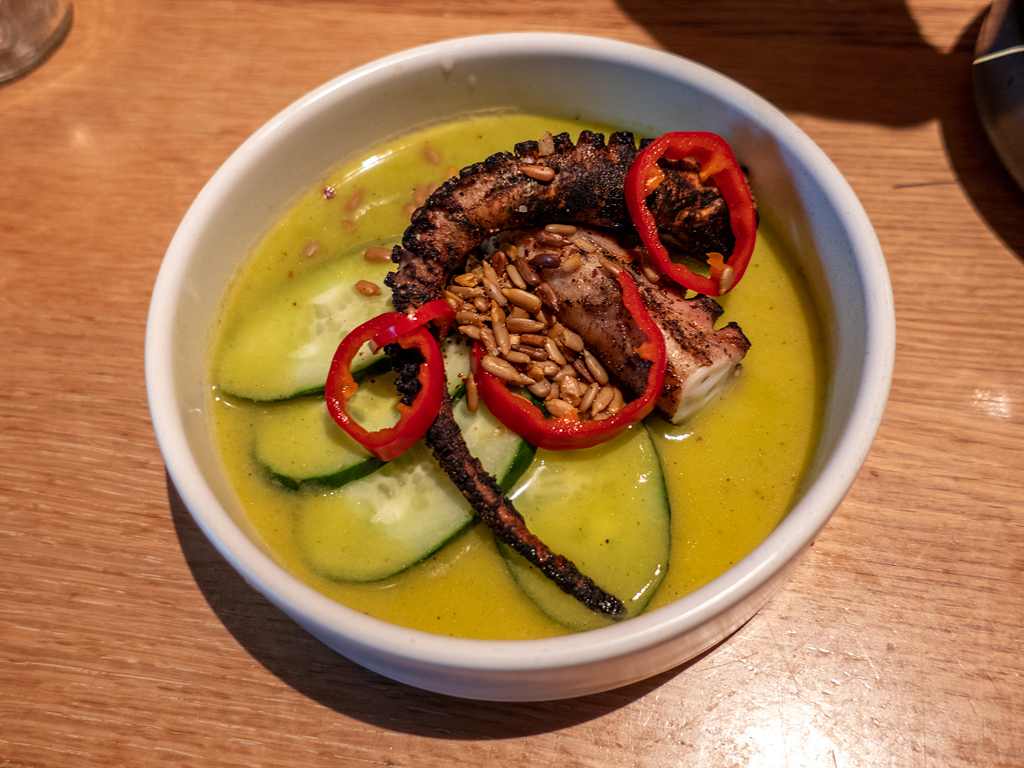
Next was charred octopus with cucumber, Fresnos, mirin, sunflower seeds, cilantro, aji amarillo, lime, and olive oil.
This was probably one of my favorite dishes of all time. The firmness of the octopus was perfect—soft enough that it was effortlessly edible, but firm enough that it had the satisfying resistance you’d expect from meat. The sauce was indescribably delicious. The cucumber added the perfect amount of freshness when drenched in the sauce. The seeds added a fun element of crunchiness to the dish while also contributing a deep nuttiness. The peppers were subtle enough that they didn’t distract from any of the core flavors.
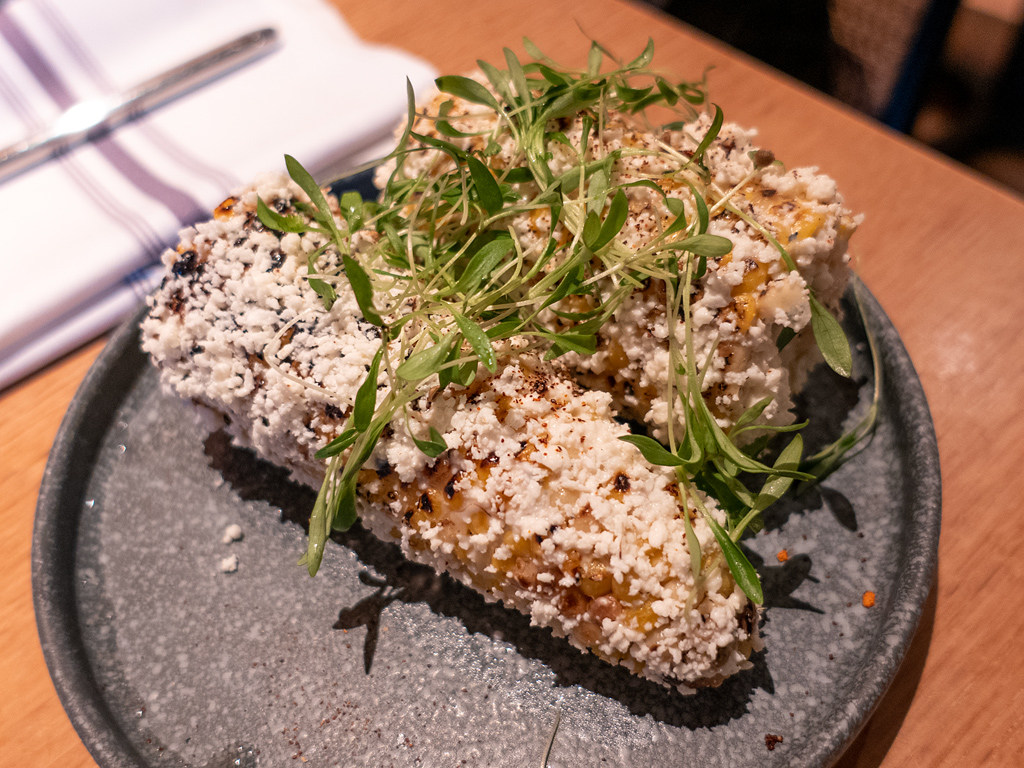
Dani wanted to get some street corn with chili, cotija, lime vegan mayo, lime zest, and cilantro.
I think most cheeses smell like vomit. I think I can just leave it at that and you can probably guess how much I liked the corn.
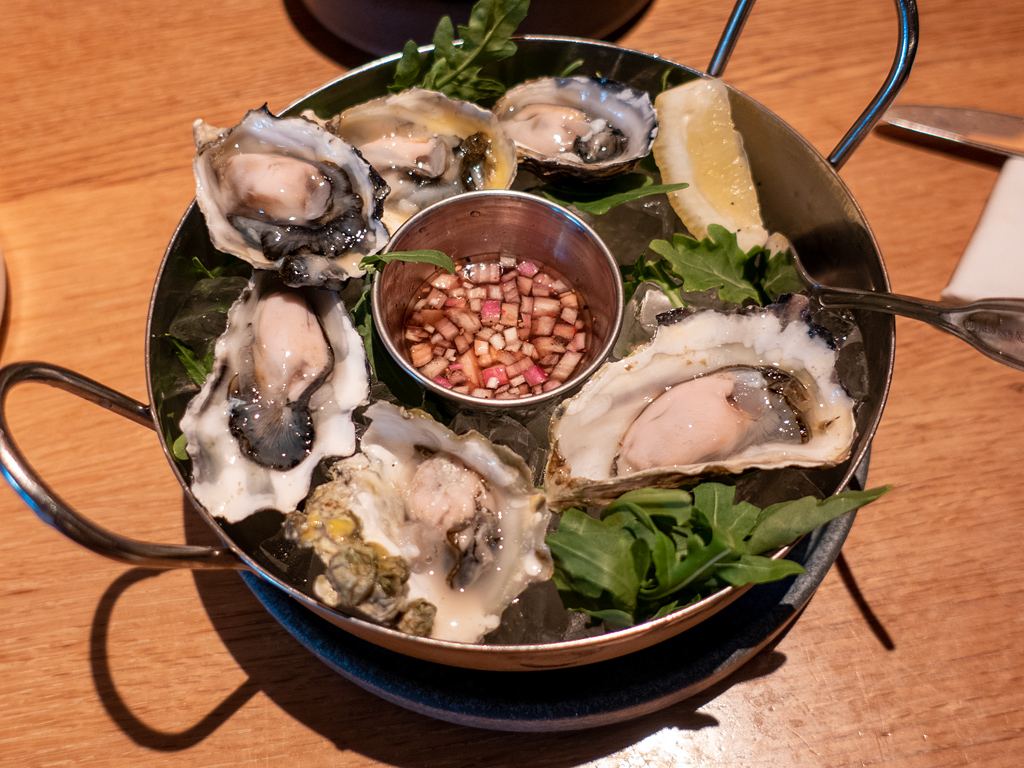
If you know me, then it’s probably unsurprising that I also got an order of Pacific Northwest oysters with red wine mignonette and lemon.
I eat a lot of oysters. I like the flavor of them untarnished by any sauces, so I always eat them plain. I found these particular oysters to be of pretty good quality, but not notably special.
Doug, on the other hand, found them to be absolutely stellar; he said that he doesn’t often eat oysters, but these were some of the best he has ever had.
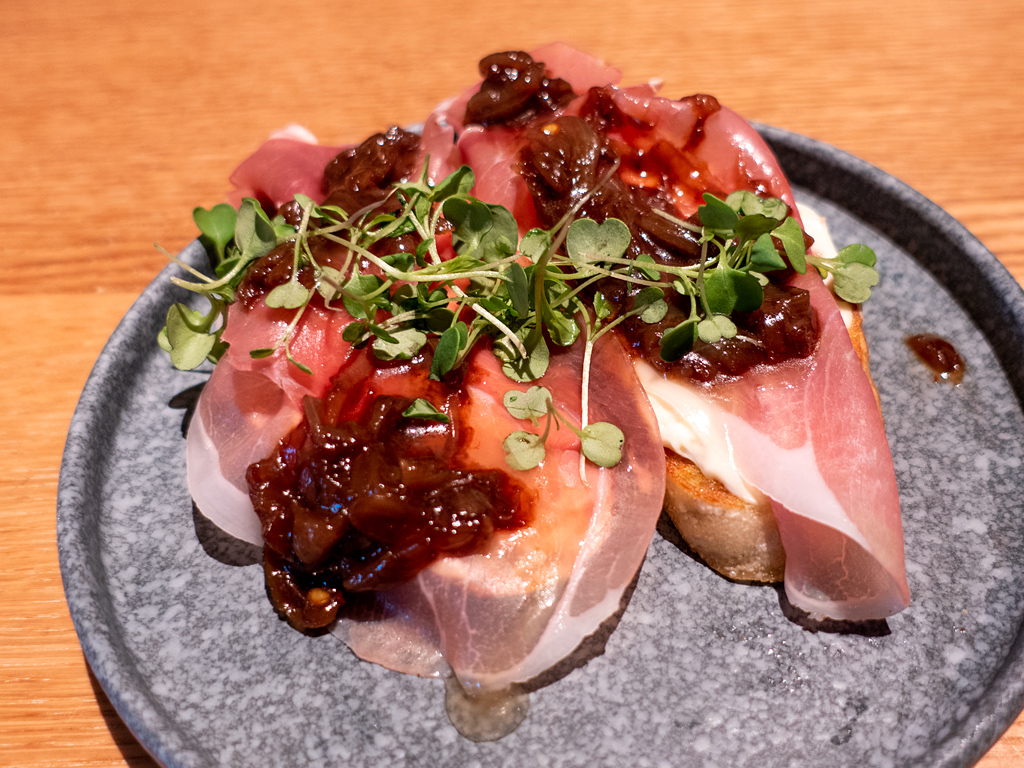
Our main entrées were taking a while to come out, so while we were waiting, we were served a fifth starter/appetizer, compliments of the chef—honey prosciutto toast with chili onion jam, honey, and brie atop house sourdough.
Doug and Dani only had one quarter of one piece each, so I ended up eating one and a half out of the two pieces. If it was up to me, I would’ve reduced the amount of brie because the prosciutto was just slightly lacking in sufficient intensity to balance out the taste of the brie, but overall, I thought it was pretty good. It had a decent amount of sweetness to it because of the jam and honey, so it was a great way to mix up the flavors on my taste buds a bit prior to jumping into the main courses.
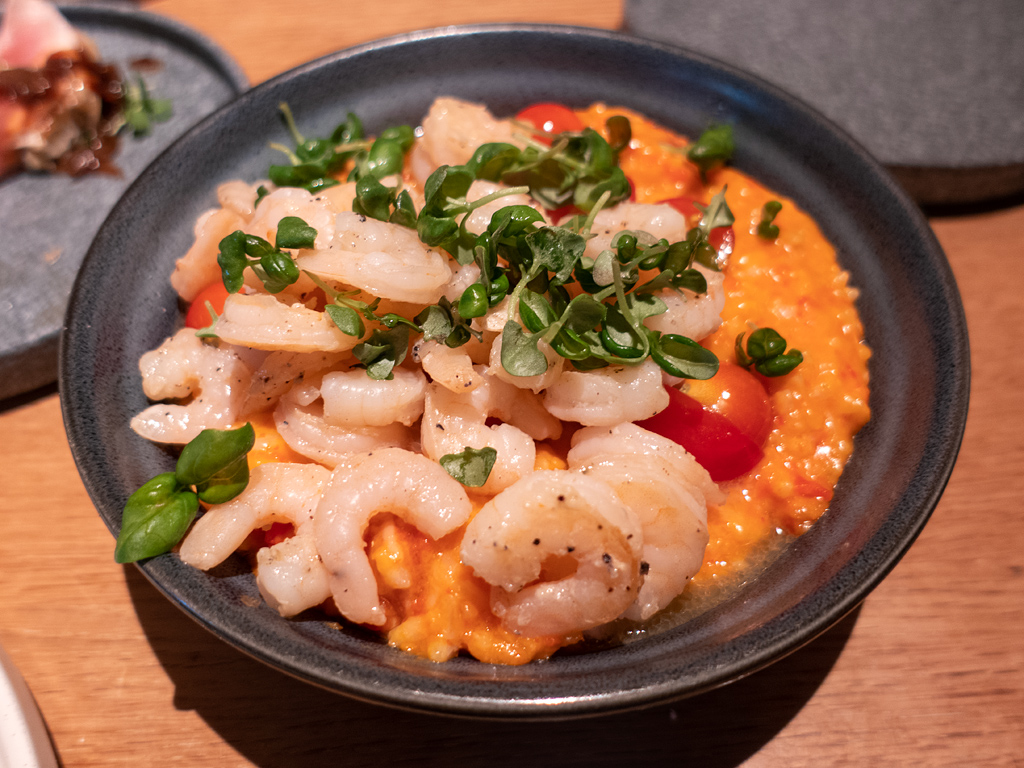
Dani ordered sundried tomato risotto with heirloom cherry tomatoes, sautéed shrimp, Grana Padano, and butter.
I took a small bite of a small portion of risotto, and it wasn’t much different than if I had just taken a bite out of a block of mushy cheese. I am literally not exaggerating when I say that I did not taste anything, at all, except cheese.
I’m sure it would’ve been better if I had mixed some shrimp into my bite, but note that including shrimp in the dish is an add-on; I am confused about the people who would order this without any add-ons and practically just eat … cheese.
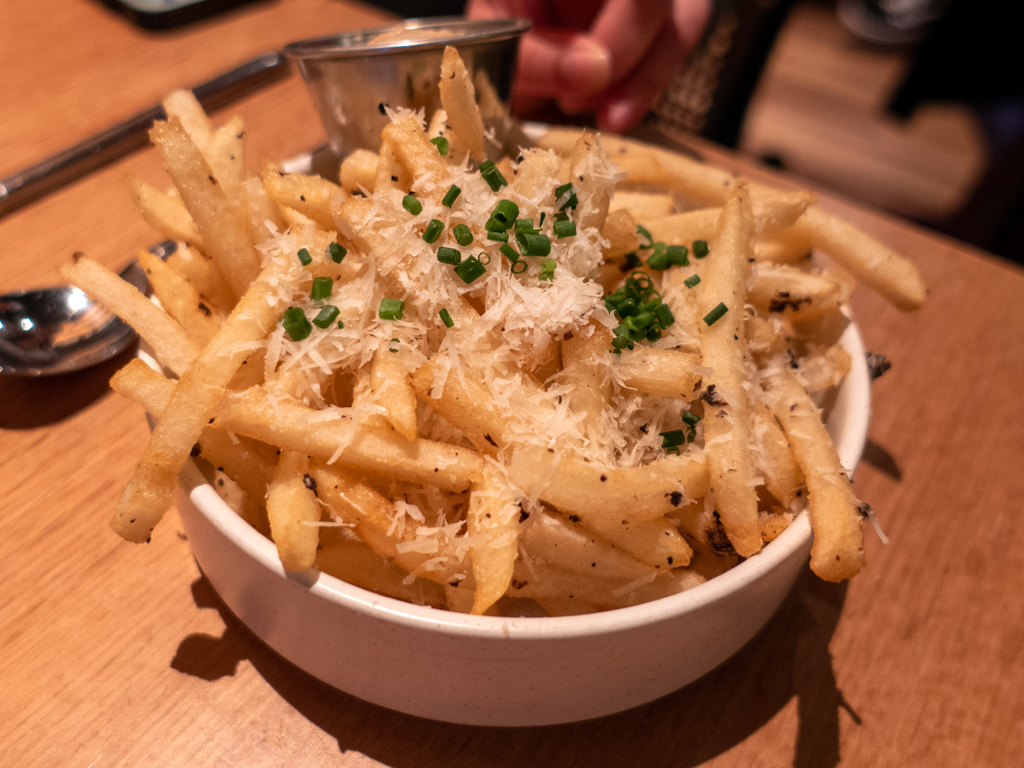
Dani also ordered a side of truffle parmesan fries with black garlic aioli, which we shared as a table.
I like potatoes, so unsurprisingly, I liked the fries. I think it would’ve been a lot better without the parmesan (or at least a whole lot less of it), but I managed to just dodge it and eat the fries that didn’t have any cheese on them.
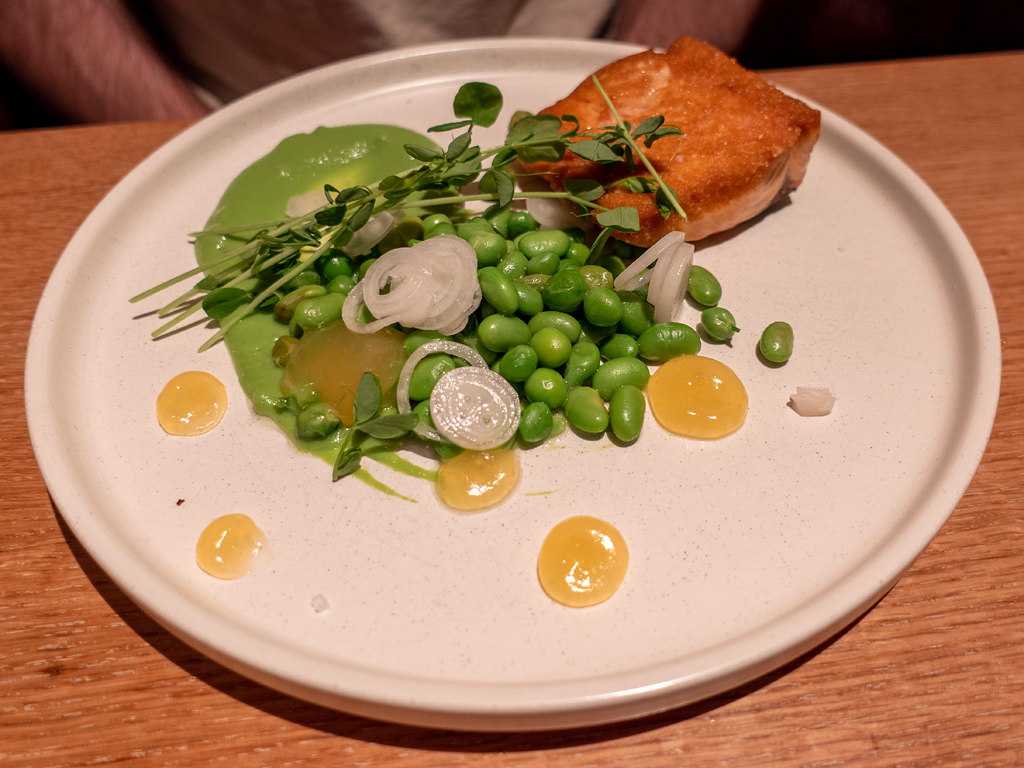
For his entrée, Doug selected pan-seared king salmon with pea purée, yuzu gel, pickled pearl onions, and peas.
Doug and I ended up splitting our entrées half-and-half, so I got to taste some of both his salmon as well as the pork pictured below. The portion size on the salmon was disappointingly small, but it was still good salmon. The peas and yuzu gel complemented the salmon nicely and enhanced the flavor of the fish.
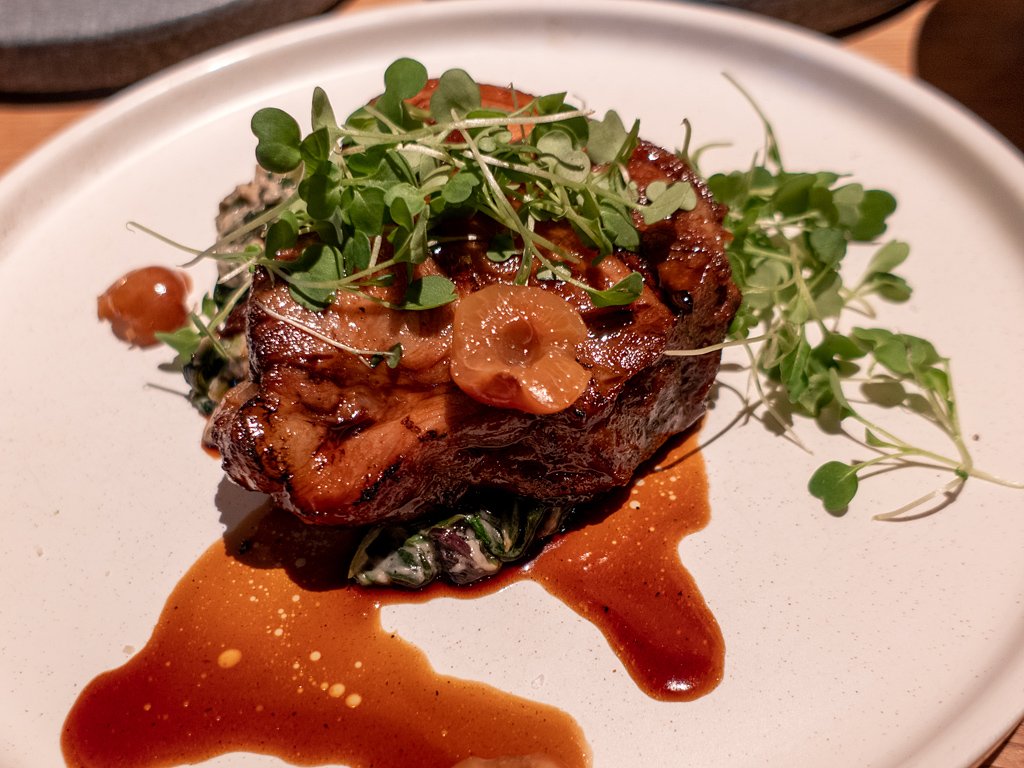
Upon recommendation by the waitress, I ordered roasted pork shoulder with creamed local greens, pickled Rainier cherries, and cherry pit jus.
This was probably one of the best cuts of pork I’ve ever had in my life. The meat was amazingly tender and had an intensely strong pork flavor without being too overwhelming or gamey at all. As you may know, a lot of the flavor of meat comes from the fat; this cut of pork shoulder had a great ratio of fat to meat, and it had just enough that I was able to add some pork fat to each bite without it being so much that it was slimy.
The pickled Rainier cherries and cherry jus added a very unique facet to the dish which I enjoyed a lot. They were slightly sweet, but the sweetness was subdued enough that it was clearly prominently a pork dish and not a jumble of different flavors.
Doug also gave a glowing review of the pork shoulder. He didn’t give too many details, but he liked it a lot.
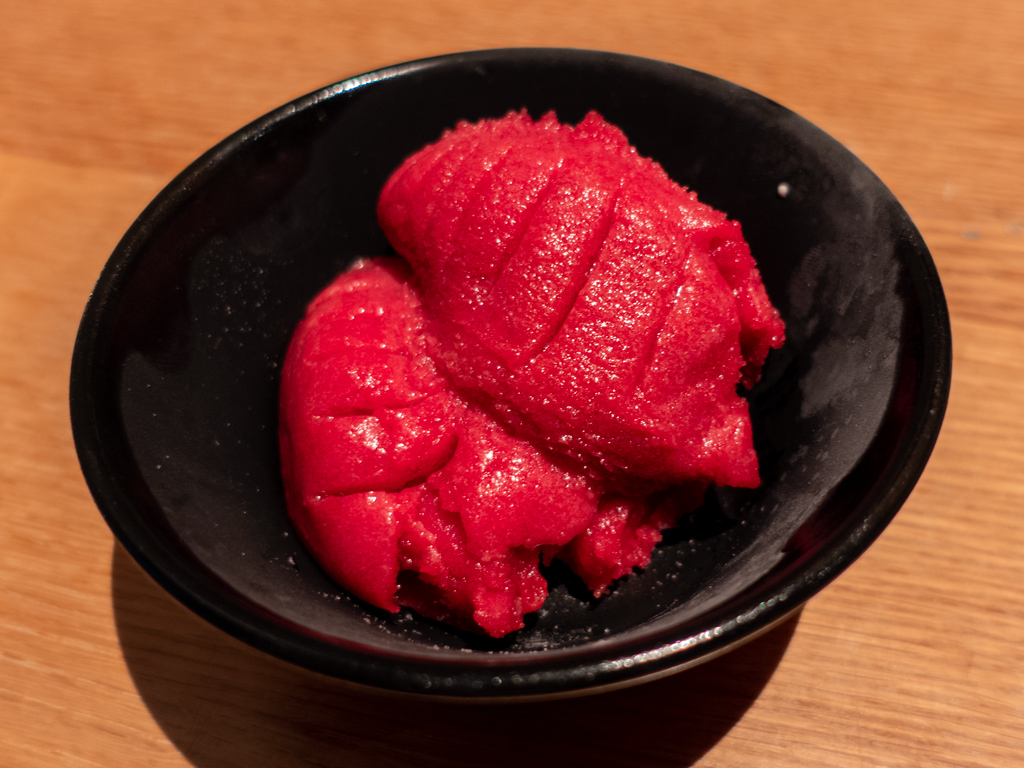
For dessert, we got a scoop of the seasonal sorbet—prickly pear.
In case it wasn’t blatantly obvious from the photograph, the sorbet didn’t actually come with those ridges. Doug accidentally started eating before I got to take a photo, but when he realized, he pulled the spoon out. He noticed that the spoon had left an indentation in the sorbet, but instead of just putting the spoon back into the ridge for a more natural photo, he proceeded to create artificial ridges throughout the entire serving. So the only picture I have shows the sorbet with some … decorations. 🤦
Another mildly funny story… I was originally under the impression that prickly pear was actually Pyrus pyrifolia, colloquially known as the Asian pear. When I tasted the sorbet, the flavor also resembled an Asian pear. Shortly afterwards, Dani looked up what prickly pears actually were, and apparently, they are the fruit of a certain type of cactus. That was an incredibly confusing thing to find out, especially while I had a bite of the sorbet in my mouth and could’ve sworn it was Asian pear.
Rockfish ancho ceviche
$ 14.00
Charred octopus
$ 23.00
Street corn
$ 12.00
Half-dozen PNW oysters
$ 24.00
Honey prosciutto toast
$ 0.00
Risotto with shrimp
$ 34.00
Truffle fries
$ 13.00
King salmon
$ 40.00
Roasted pork shoulder
$ 36.00
Prickly pear sorbet
$ 6.00
Surcharge (5%)
$ 10.30
Tax (10.25%)
$ 22.18
Gratuity
$ 50.00
Total
$ 288.48
The chart to the right outlines how much we paid for each item. Yes, that is indeed a 5% surcharge. If you know me, you know that I have a bone to pick with this restaurant because of it.
At the bottom of the menu, there is an explanation of the surcharge: “We are a proud supporter of the Seattle Minimum Wage Ordinance. A 5% surcharge to support this will be added to your bill. 100% of this surcharge is retained by Shaker + Spear and is not directly distributed as a tip or gratuity to the restaurant’s staff. As always, gratuity for service rendered is at your discretion and is directly distributed to staff members.”
In the spirit of “voting with your wallet,” there is nothing that makes me want to never go back to a business again more than mandatory extra charges and fees. If there is a voluntary extra fee for an opt-in add-on service, that is fine. However, if there is something that you are required to do as part of the core experience, that should be built into the list price, not added on as a roundabout manner via a surcharge.
For example, hotel resort fees are fine if you are able to opt out of the amenities and not pay them; they are not fine when every single guest is required to pay it anyway, even if they never step foot into the resort area, and in that situation, it should just be included in the room rate.
If Shaker + Spear needs more positive cash flow to help afford paying employees a higher wage, it is perfectly acceptable to charge more for the food. They just need to adjust the actual pricing on their offerings and print that true price directly on the menu. The solution is not to underhandedly add on a dollar or two onto every item at the end of your meal.
I actually did not even realize we were charged an extra fee until after I finished writing the upper review part of this blog post and pulled up a photograph of the receipt to complete this cost breakdown section. In confusion, I had to pull up online copies of the menu to search for the explanation of the surcharge written at the bottom in fine print.
I am reacting quite negatively to this because the premise of being expected to pay gratuity to your servers in the United States is already bad enough, and I do not want our culture to further normalize even more extra add-on costs on top of the list price. All the food (at least the dishes without cheese) were delicious and I had an amazing experience at the restaurant, but because of the surcharge, I cannot recommend this restaurant, as this kind of business practice is a deal-breaker for me.
I go to a lot of high-end restaurants, and a lot of people seem to enjoy seeing what food is like at tasting menu, chef’s choice, and omakase restaurants, but I’ve also received a few requests to show some spots that are within a more reasonable price range. To fulfill that request, I made a quick lunch trip last week to Jjanga Steak & Sushi in the southwest suburbs of the Las Vegas Valley for some all-you-can-eat sushi.
They have two variants of their all-you-can-eat offering, a cheaper option for lunch and a slightly pricier option for an all day menu. The all day menu had a much broader selection that included many of my preferred sushi and seafood dishes, so I opted for the all day menu.
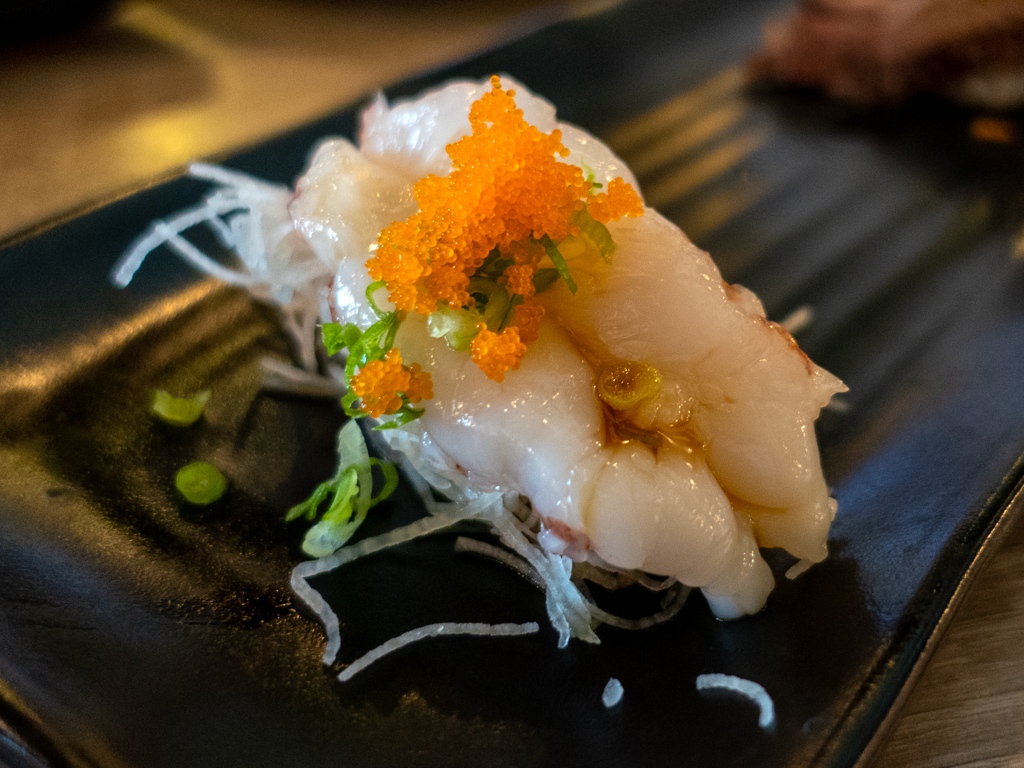
My first dish was amaebi topped with flying fish roe. It was a nice, thick, broad piece with a well-balanced amount of seasoning. It had the same juicy and satisfying texture as you’d expect from high-quality sweet shrimp.
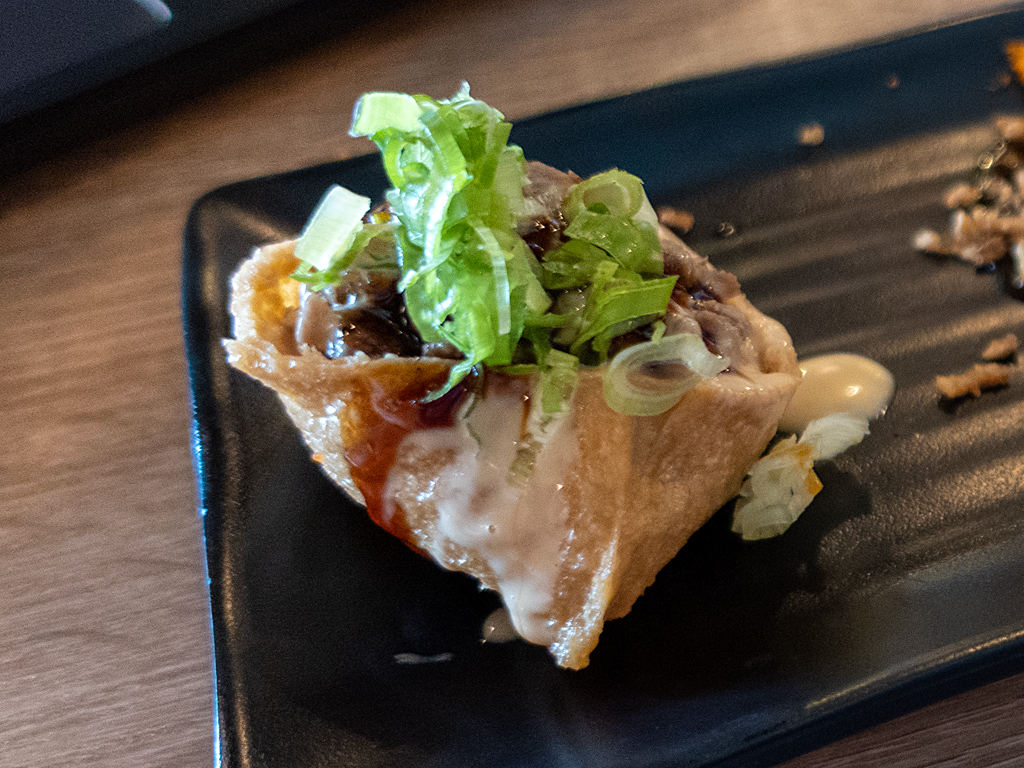
Each day of the week, they have a rotating special menu. I tried a bunch of items from their special menu, and the first item that came out was bulgogi inari. It was very average, and I liked it—it was pretty much exactly what you’d expect from bulgogi and rice with a bit of crispy onion at the top for texture.
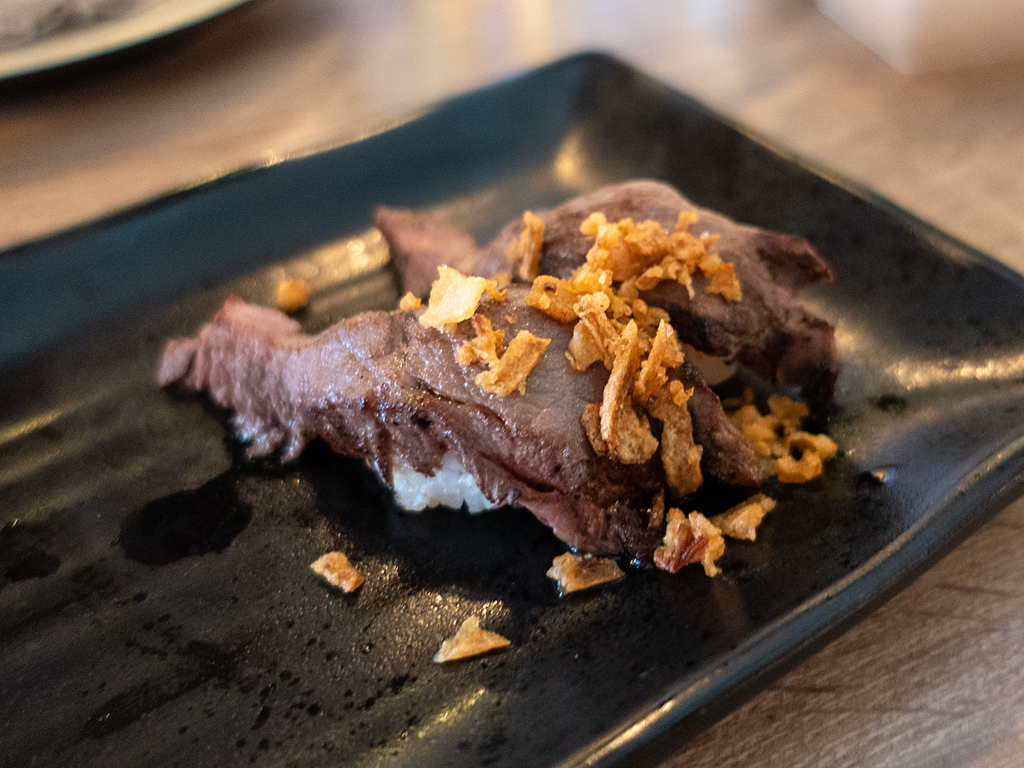
I also ordered a different beef dish, but I don’t remember what this was, as I can’t seem to find it on either the special nor the regular AYCE menu. It was almost as if it was a beef dumpling, but the fried crust was thicker and it was much creamier on the inside. This item was definitely leaning heavily towards the “steak” side of the “steak and sushi” coverage of the restaurant. I think this would’ve been a better entrée to eat as a closer to counteract a long chain of raw fish.
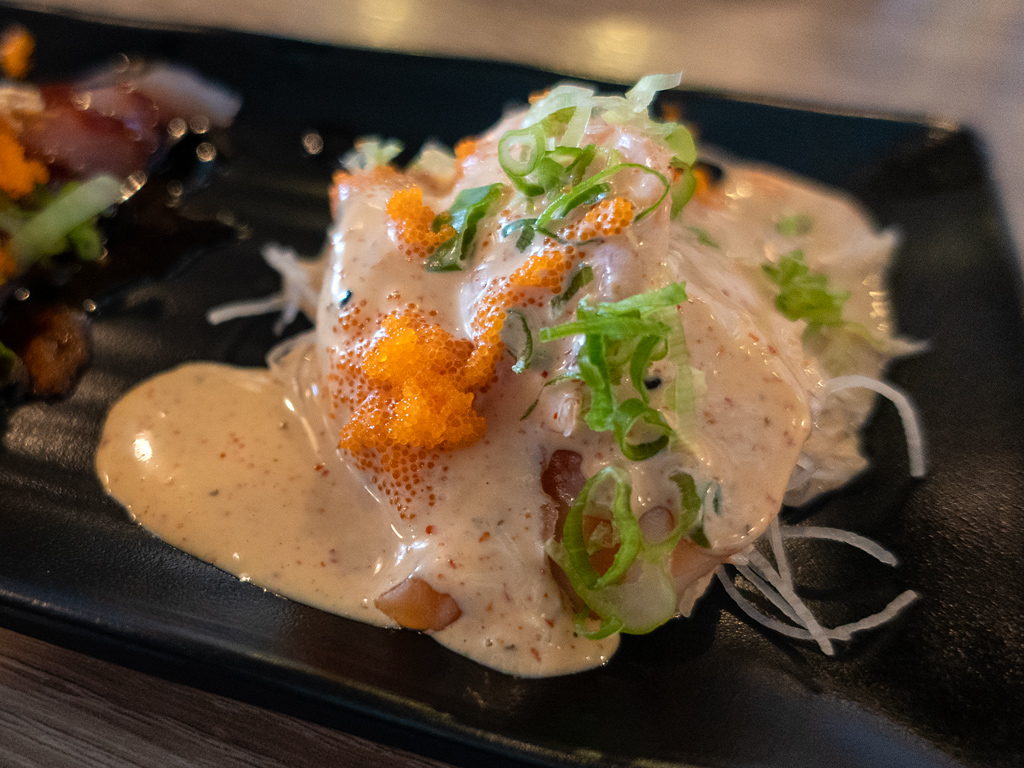
Next up was was salmon belly sashimi. As you can probably see from the photo, they put way too much screaming orgasm sauce (which is usually made with some mayonnaise, vinegar, fish sauce, and other sauces used in Japanese cuisine). I scraped a majority of it off—as much as possible without removing too much of the flying fish roe. Salmon belly is one of my favorite cuts of sushi, and I think this would’ve been much, much better if served without so much sauce.
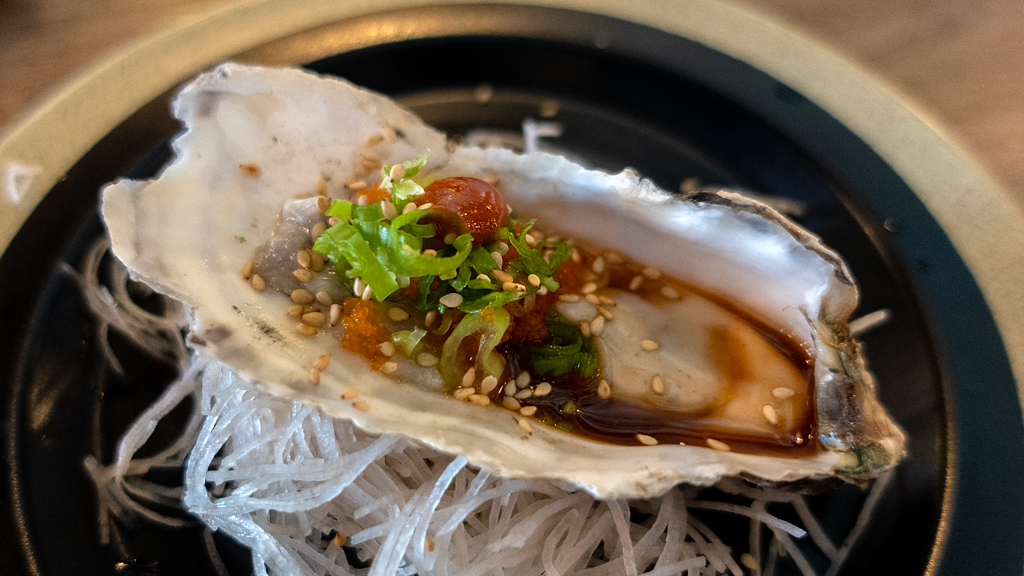
Next up was an oyster. It was mysteriously disconnected from the shell, so I’m not sure if this is one of those situations where restaurants only use the shell for show and actually just put the oyster into an empty shell manually. Regardless, the oyster was very large and very flavorful.
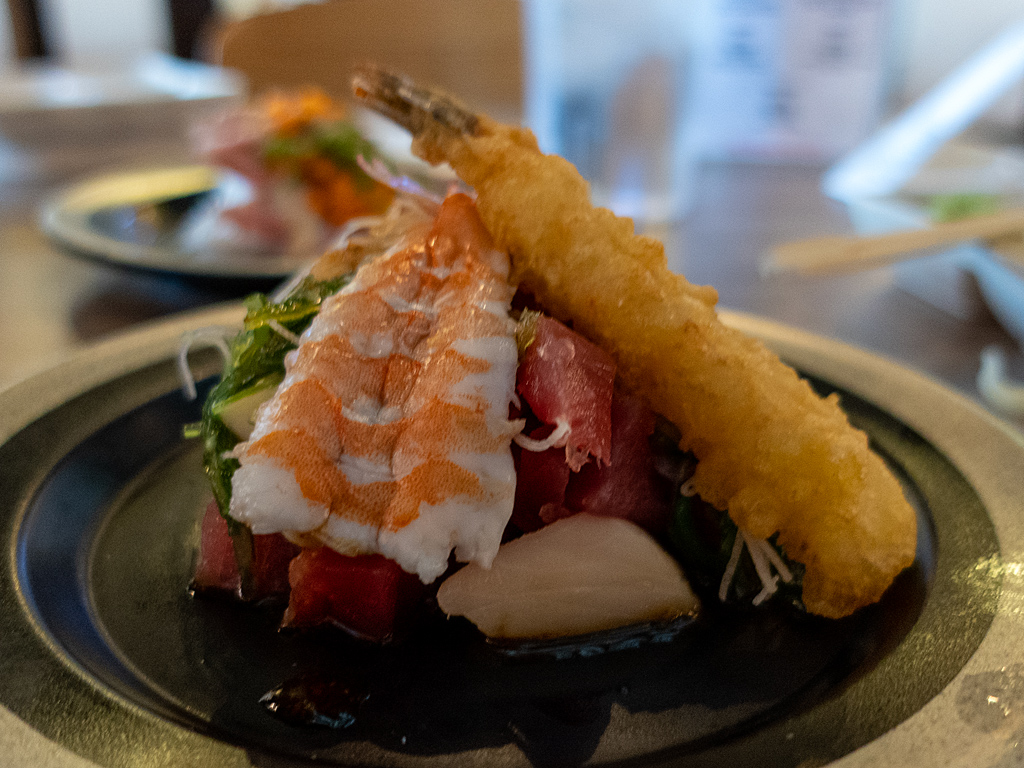
After finishing my round of daily special menu items, I ordered a sashimi salad. The photo didn’t focus properly and didn’t come out too well, but I decided to post it anyway because I enjoyed the theme that this restaurant had of broad, thick pieces of shrimp.
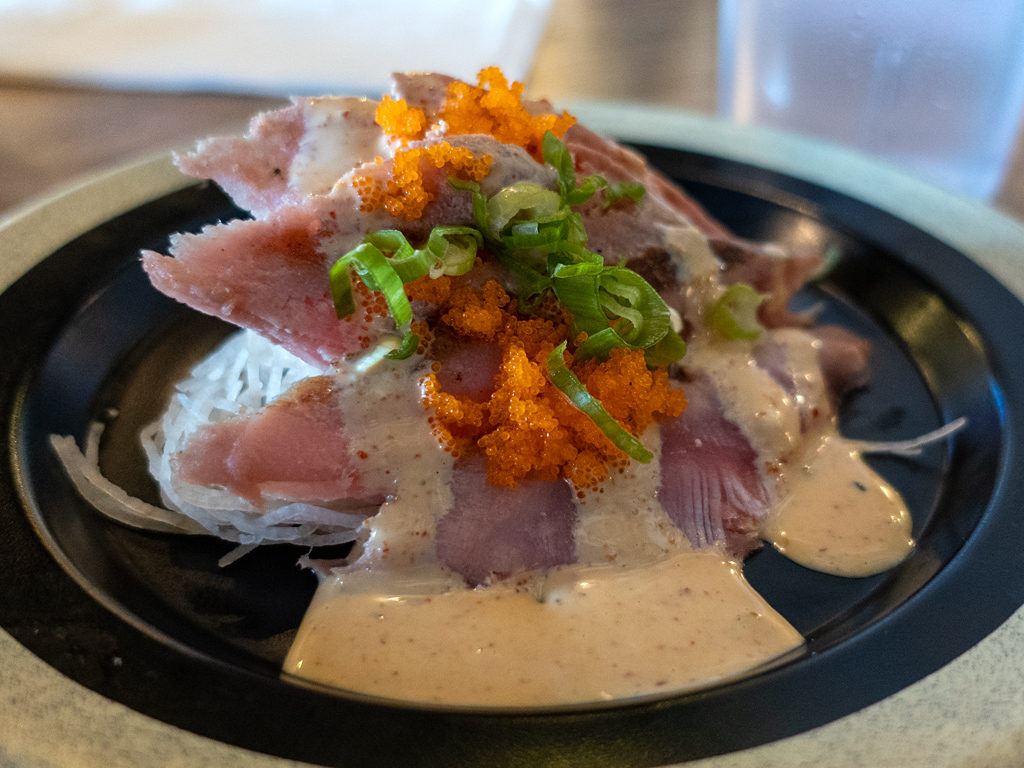
I also got a screaming orgasm—the actual entrée, not just the sauce. It was strips of tuna sashimi topped with some flying fish roe (which, I discovered, they really enjoy using on many different dishes as a topping).
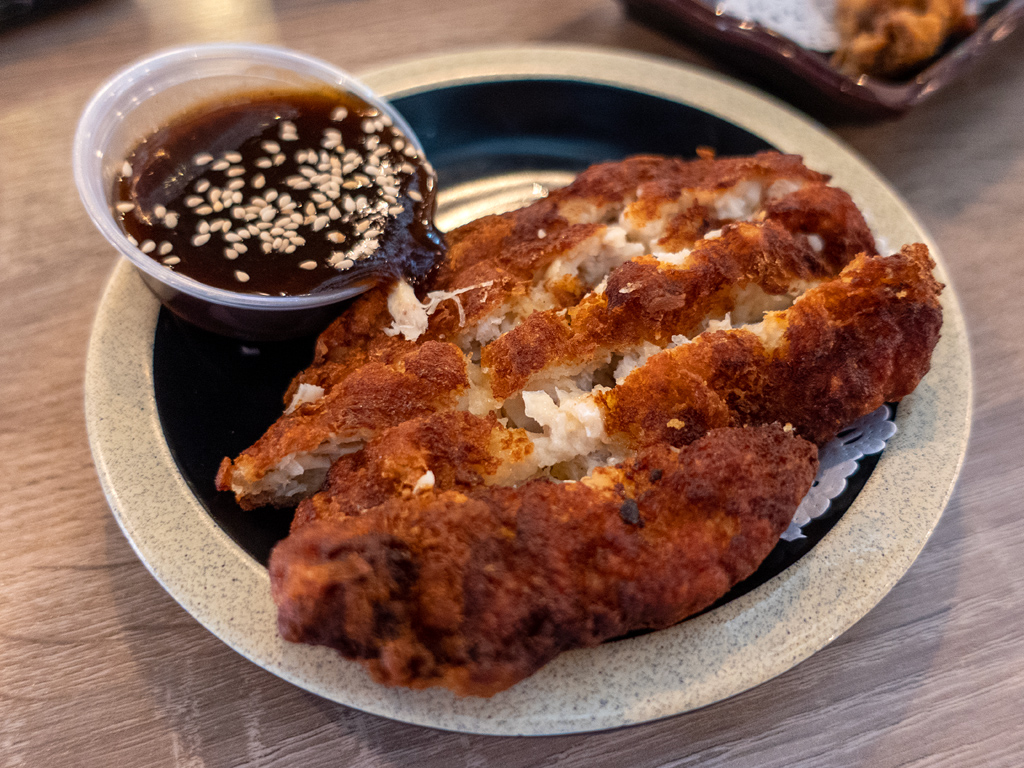
I was curious and wanted to try out a few more items from the grill side again, so I ordered a mini chicken katsu. The portion size was much, much larger than I expected, and I definitely regret ordering this because of how much sushi I could’ve had in its stead. The chicken quality was mediocre, it was slightly overcooked, and the breading was a bit excessive.
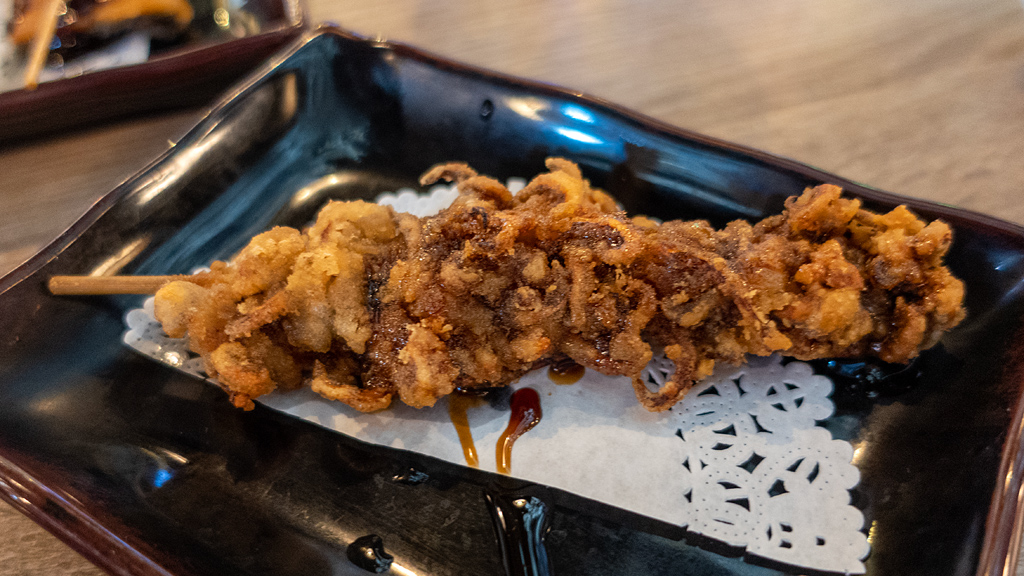
I also tried an octopus skewer. I thought it would come out raw, but it was deep fried instead. Again, it was larger than I expected, and again, it was fairly mediocre.
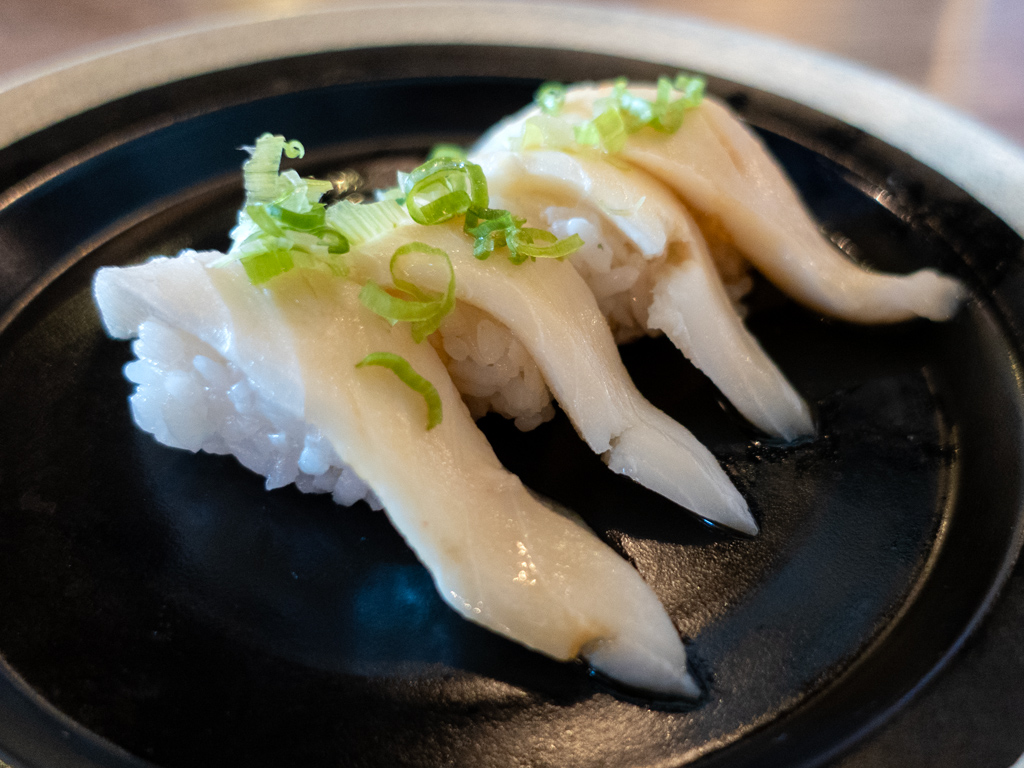
After eating all that fried food, I went back to some sushi. I had a lot more nigiri than is pictured here, but one of my favorite selections from this restaurant was the escolar, commonly known as white tuna.
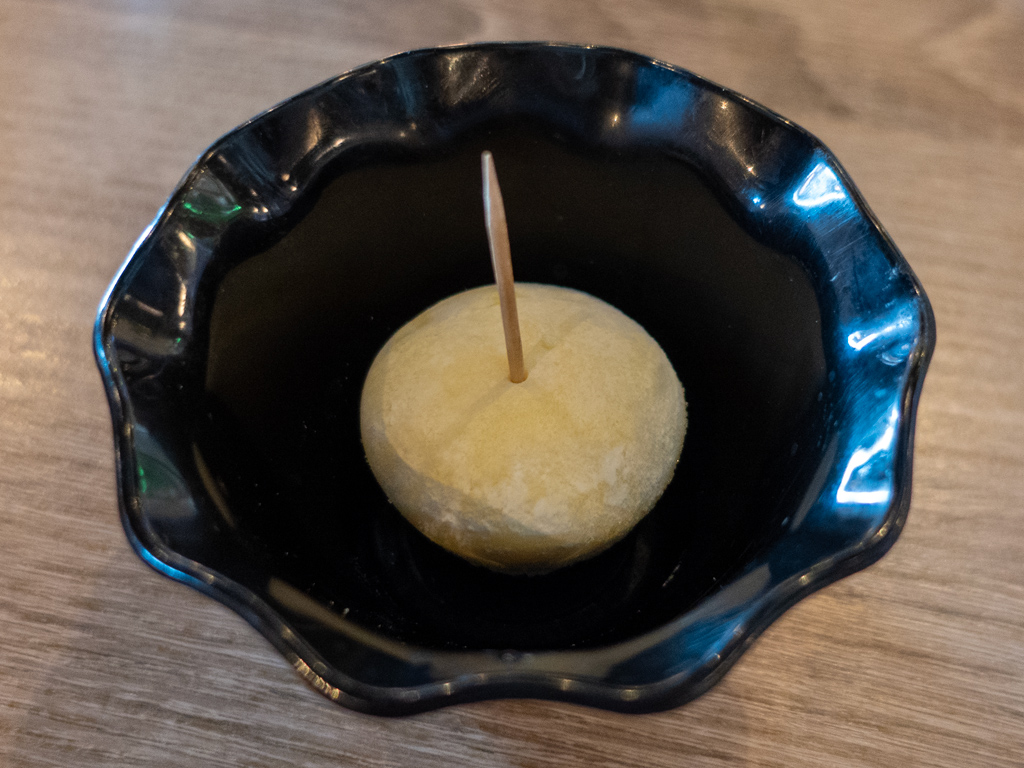
For dessert, I finished with a small piece of mango mochi.
Here is a breakdown of what I paid:
All-you-can-eat, all-day menu
$ 31.99
Tax (7.65%)
$ 2.64
Gratuity (18%)
$ 6.23
Total
$ 40.86
Overall, I’d say that I had a decently satisfying experience. If you also decide to pay a visit to Jjanga for all-you-can-eat and you like sushi, I highly recommend avoiding their grill menu and just sticking with their specials and sushi menu items to get maximum value for your money.
On Saturday, May 20, 2023, I joined my friend Doug Wreden on his Twitch channel for a live stream with his friends and staff members Berry and Parry. For the broadcast, we drove around the San Fernando Valley in Los Angeles County doing the “I’ll have what he’s having” challenge.
This was a popular trend a little while back, and I already participated in a few of these with some other friends a handful of years ago, but if you’re not familiar with the concept, the idea is that you go to various different fast food restaurants and order the same thing as what the previous vehicle in the drive-through lane ordered.
Yesterday, the recording of the live stream was cut and edited into a highlight video that was released on YouTube. The audience of Doug’s YouTube channel is far greater than the audience of his Twitch channel, so this brought the fast food challenge content in front of many more eyes and resulted in a relatively large influx of questions.
There’s been relative consistency in the questions that have been asked, and there is a bit of “lore” that I think fans would find fun and interesting, so I decided to take some time to write this as a supplement to Doug’s video content.
“How much did you actually end up eating?”
Doug’s video editor calculated the nutrition facts of everything we ate and it came to a total of 20,435 calories. However, people were curious exactly how much I personally contributed to consuming that amount. From the footage, it seemed like I ate the least… but it was not by as large of a margin as it may seem.
Food
Restaurant
Calories
Fat (g)
Carbs (g)
Na (mg)
Protein (g)
Honey walnut shrimp, ⅘ portion
Panda Express
300
18.5
22.0
381
11.5
Mushroom chicken, ⅘ portion
Panda Express
185
12.0
9.0
707
10.0
Fried rice, ⅕ portion
Panda Express
112
3.5
18.5
183
2.5
Chow mein, ⅓ portion
Panda Express
174
7.0
27.0
293
4.5
Veggie egg roll
Panda Express
180
9.0
19.0
390
7.0
Cheddar quesadilla, ⅘ portion
Del Taco
366
20.5
24.5
676
17.5
Caramel cheesecake bites, 1 stick
Del Taco
460
28.0
43.0
310
6.0
Chocolate fudge sundae
Burger King
280
7.0
47.0
220
6.0
Sourdough patty melt, ¾ portion
Jack in the Box
488
28.5
28.5
975
28.0
French fries, medium, ½ portion
Jack in the Box
215
10.0
29.0
390
2.5
Cherry Coca-Cola, 2 fl. oz.
Jack in the Box
25
0.0
6.5
5
0.0
Raspberry-filled jelly doughnut
Krispy Kreme
340
21.0
36.0
125
3.0
Chocolate iced doughnut with cream filling
Krispy Kreme
340
17.0
42.0
140
4.0
Baked potato with chives
Wendy’s
137
0.0
31.5
15
3.5
Natural-cut French fries, medium, ½ portion
Wendy’s
210
9.5
28.0
210
3.0
Pink lemonade, 28 fl. oz.
Wendy’s
308
0.0
77.0
105
0.0
Nitro cold brew coffee, ½ each of 2 drinks
Starbucks
70
1.5
13.0
45
3.0
Fried chicken thigh, small
KFC
144
8.5
4.5
150
11.0
Total
4,334
201.5
536.0
5,320
123.0
While we were working through our order at Kentucky Fried Chicken, Doug’s moderator Eddie showed up to help with a large portion of the bucket of fried chicken. Fried chicken is extremely calorically dense, and a bucket has a lot of pieces of chicken; I think it is reasonable to assume that Eddie relieved about 1,800 calories’ worth of our food burden, considering that he ate most of the bucket.
That brings the total for the four of us down to 18,635 calories. At my 4,334 calories, I ate about 23.26% of the calories, very close to the 25% needed for an even split. Of course, calories isn’t the only metric to calculate contribution, and there are many other important factors like how volumetrically filling the food is or how undesirable the meal is, but in general, I feel like I definitely carried my own weight.
“Did Doug really just find you at the hotel?”
The simplest possible answer… is actually, yes. But obviously, there is more to it than that.
Doug and I had plans during the Sunday afternoon following the day of the broadcast—plans that involved being in Los Angeles County together. Doug thought I was going to be flying in Sunday morning, but I like to have a buffer day to make for a more relaxing and less rushed travel experience, so I flew in a day early on Saturday instead.
For convenience, Doug and I booked rooms in the same hotel. However, we both like having our own separate rooms to minimize interruptions and improve sleep quality, so we had separate reservations. This meant that Doug did not know when my check-in date was, and he did not realize that I would be arriving on Saturday instead of Sunday.
The timing was uncanny. After landing from my flight, I walked to the rental car facility, picked up my vehicle, and drove to the hotel. However, the pick-up process took longer than expected because the front license plate of the vehicle was held up by a single screw and was on the verge of falling off, so they had to go find a special screwdriver to remove it so it wouldn’t fly off while the vehicle was in motion. This added about 12 minutes of delay to the pick-up process.
If everything went smoothly during vehicle pick-up, I would’ve arrived at the hotel 12 minutes sooner, walked into the hotel too early to be seen by Doug, and none of this would have happened. Instead, because of the delay, the moment I was walking into the hotel happened to perfectly coincide with Berry and Parry picking up Doug from the front of the hotel, which allowed Doug to notice me.
As a reminder, keep in mind that Doug did not know I would be there on Saturday. Thus, from his perspective, I miraculously just spawned in front of him at the hotel entryway, and the fact that our paths had crossed wasn’t far off from seeming like a force majeure event.
“How did you end up also becoming the driver?”
The original plan was for Berry to be the driver. However, with me now in the picture, we had an alternative.
When I travel and rent a vehicle, I will always opt to get a pickup truck (if one is available) for a variety of reasons. My personal daily driver at home is a pickup truck, so I am used to driving pickup trucks now. The better visibility and higher ride height makes the driving experience much more comfortable. I also easily get motion sickness, and driving a larger vehicle, especially one with a body-on-frame structure like pickup trucks, helps mitigate that.
Furthermore, for the past several years, pickup trucks have gotten much, much nicer. They used to be considered work vehicles, but the newest trucks now often have astronomically better convenience and luxury features than regular sedans. To top it all off, rental car companies usually only have one or two rental tiers for pickup trucks, while they have upwards of 12 or more classes just for sedans. This means, if you book a low-tier sedan, you for sure are going to get a pretty bad sedan, and if you want a nicer one, you have to pay for upgrades. However, if you book a pickup truck, in their system, a pickup truck is a pickup truck, so you may end up with a basic truck, but you could also end up with a really nice one, like we did for this fast food adventure.
I ended up with a Nissan Titan Platinum Reserve this time around. Being a full-size pickup truck, it is much more spacious than Berry’s car, which made it much more comfortable for four adult men to sit in for several hours. The higher ride height also meant that we would be eye-to-eye with the fast food staff, making it easier for them to hand over our food, as opposed to needing to reach down at an angle if we were in a sedan.
Because I was the only one on the rental contract, I had to be the driver. We technically could’ve just violated the rental terms of service and had someone else drive anyway, but Los Angeles isn’t exactly known for having wide roads, and the drive-through lanes are pretty tight. If you were watching the live broadcast, you might have heard a lot of beeping when we were going through the drive-throughs; the beeping was the collision sensors warning me that we were about to hit something. Considering that I have the most experience driving big, wide, long vehicles, we decided it would be safest for me to drive the entire time.
Some other frequently-asked questions…
“Did you play up your reaction to the baked potato because you knew Doug hates potatoes?” No, I did not. In fact, I did not even realize that Doug hated potatoes. I was relieved to see a baked potato because it was finally some food that wasn’t offensively greasy or salty, so it was a way that I would be able to continue helping without putting my health in increasing jeopardy.
“Did you get stream sniped at any of the restaurants?” I highly doubt it. Although it was fairly obvious to some people where we were because we drove right past Hollywood Burbank Airport at the beginning of the stream, the rest of the guys made a conscious effort to try and obscure our location by claiming we were in random states across the United States. The most likely possibility of getting sniped was the KFC bucket at the end, but the woman who ordered it was already ordering before we arrived, and she looked like she was just buying a big meal to feed her family.
“Did you feel sick during the subsequent days?” No, there was hardly any visible difference in my health. The same night, my body woke itself up four or five times in the middle of the night in extreme thirst, and I drank about one and a half 16.9 fl. oz. bottles of water overnight, but beyond that, everything was back to normal the following morning.
“Are you quitting fast food for the rest of your life?” Absolutely not. I love fast food, I’ve saved a ton of time because of the convenience, and fast food isn’t always bad—it is usually inevitably very high in sodium, but if you pick the right menu items, there are ways to piece together some pretty decent meals low in saturated fat and high in protein. I also don’t really get “sick” of foods from overeating; I think that’s more of a mindset thing, and I had no problem eating some chicken sandwiches from McDonald’s a few days after finishing this challenge.
“What happened in the bathroom of Jack in the Box?” I defecated. I did not vomit, and I did not have diarrhea. A simple bowel movement was sufficient enough that it made me feel better and allowed me to consume over 1,500 more calories afterwards.
“Do you regret agreeing to join for the challenge?”
No. Not even a little bit.
The older I get, the more I realize that relationships with other people are the most important things in life. I’ve historically optimized for other things, like maximizing personal comfort, or making as much money as possible, or finding the most luxurious things to buy and places to live… but ultimately, it’s the people in your life who matter the most.
This is probably some of the most fun I’ve had, ever. I am literally going to remember this day for the rest of my life. Sure, I had an upset stomach by the time we got to Jack in the Box, and yes, my health probably took a little bit of a hit from eating so much saturated fat and sodium, but in a big-picture sense, it was absolutely worth it.
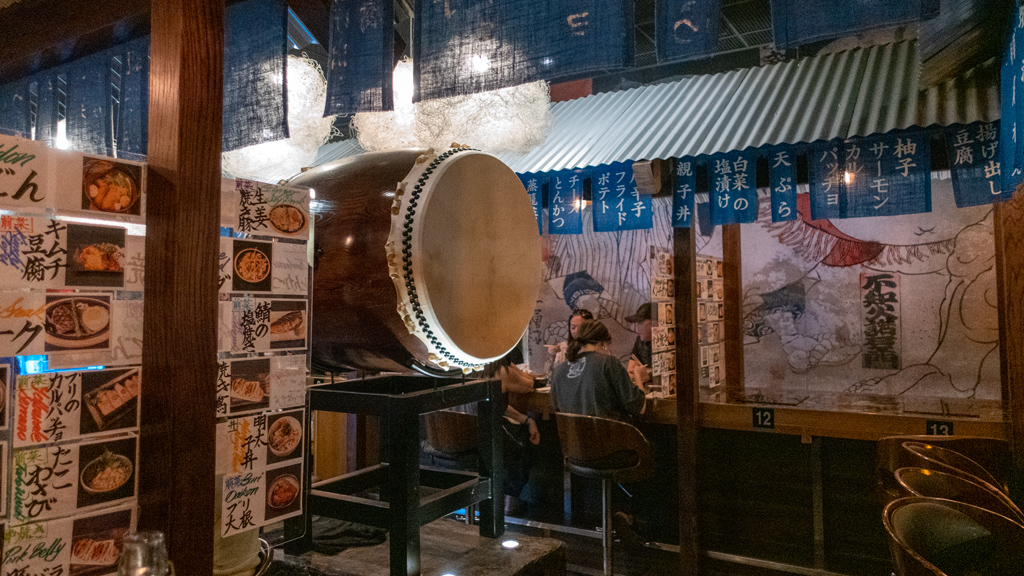
While my friend Dani was in town this past weekend, she had a list of places she wanted to visit, one of which included a nice restaurant in Chinatown. Unfortunately, it was an extremely popular spot with walk-ins only and the wait time was about two hours, so instead, we drove a mile west and went to Chanko Shabu and Izakaya.
Overall, my experience was pretty “meh,” with the good dishes being counteracted by the bad dishes.
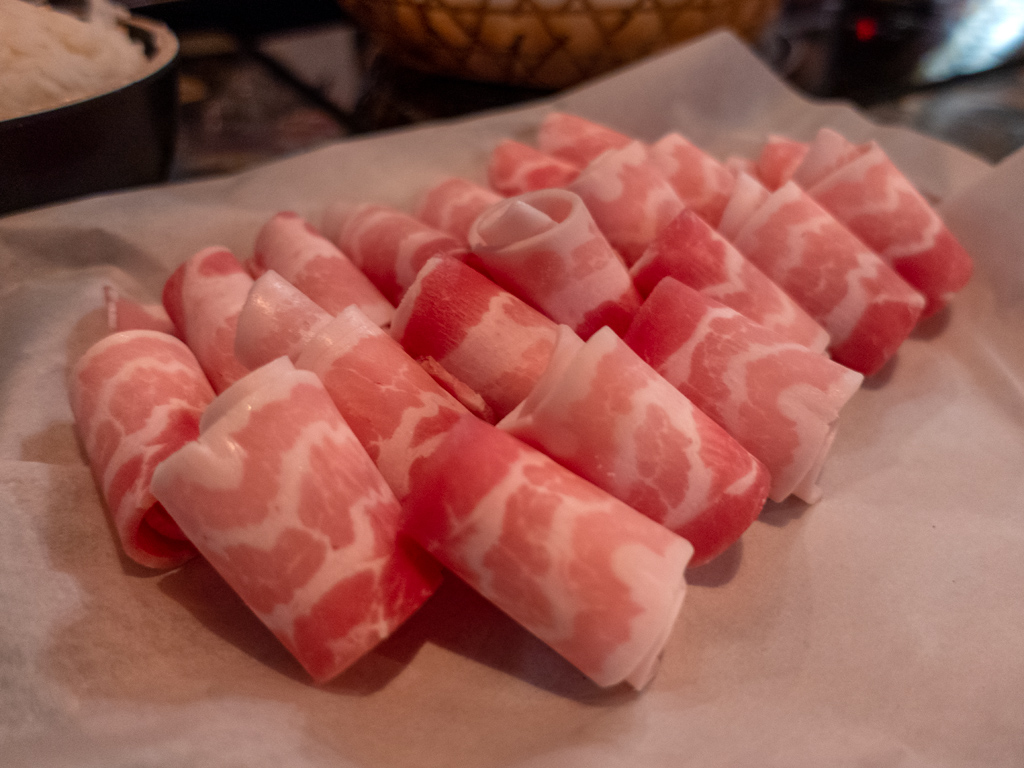
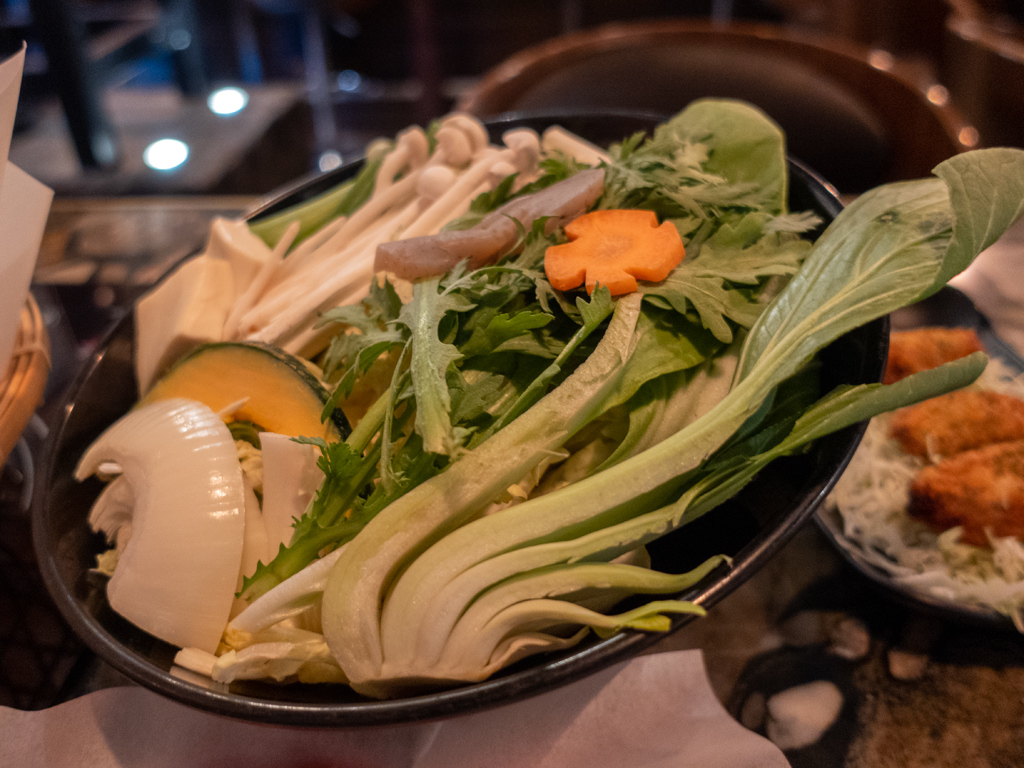
Dani ordered shabu-shabu with spicy pork broth, Mugifuji pork, assorted vegetables, garlic chili, and house special sauce. I tried some of her meat and vegetables, and it was my second favorite dish of the meal.
I usually don’t like all-you-can-eat “cook your own food” restaurants because the service is (sometimes, intentionally) slow so they limit the amount of food you end up being able to eat. However, because this was an à la carte experience unlike many other shabu-shabu restaurants, that downside wasn’t relevant. The upside, however, was relevant, because restaurant food often comes out too salty, so by being able to cook the meat ourselves, we were able to limit the saltiness and allow the rich flavor of the meat to stand out.
Something we ordered that is not pictured here was Japanese fried oysters with tartar sauce, from the agemono menu. They were fairly traditional and straightforward, and were exactly what you’d expect from fried oysters.
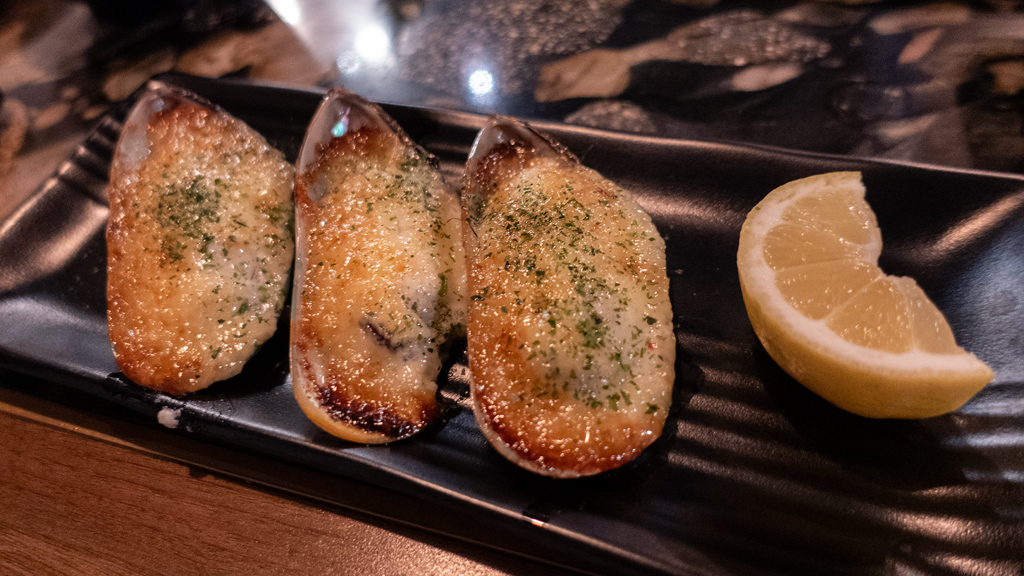
Similarly, I also ordered some baked green mussels from their hot appetizer menu, which were also exactly what you’d expect from baked green mussels.
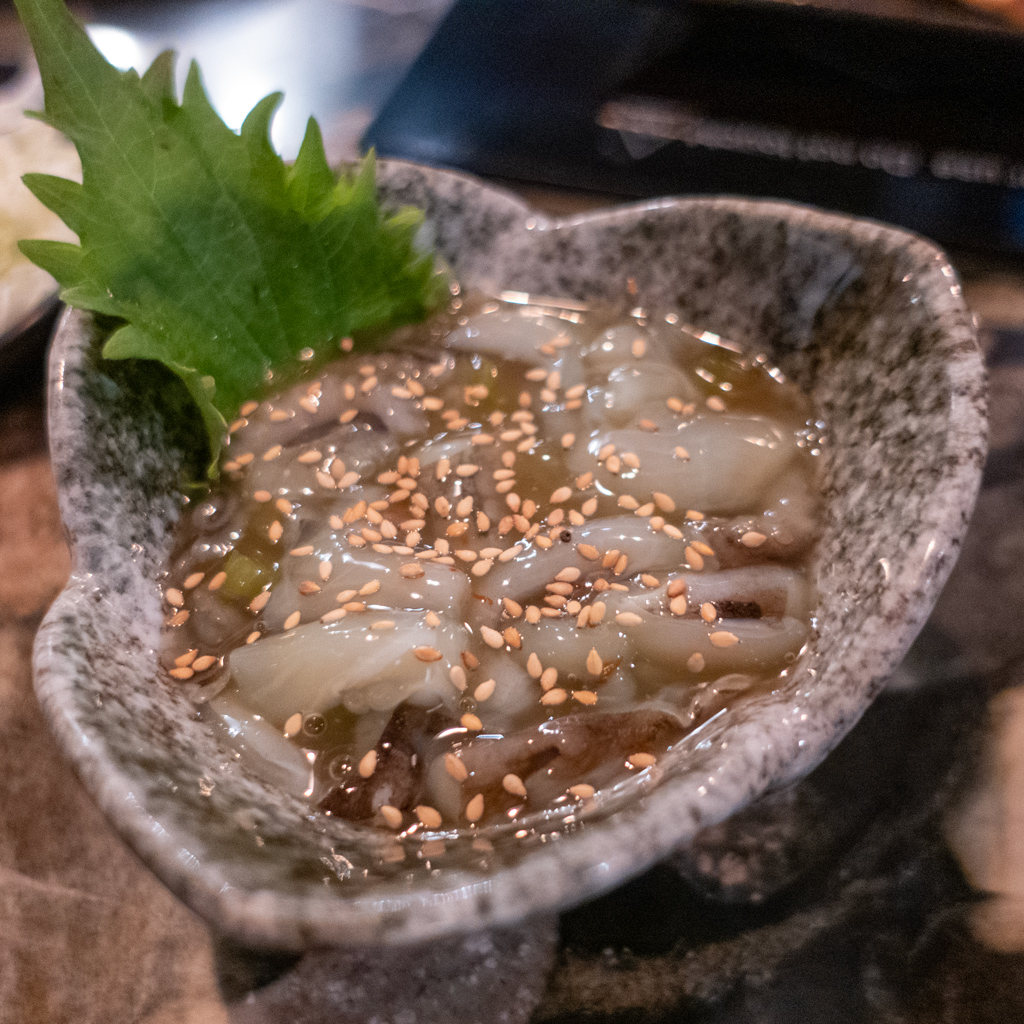
My next dish was tako wasabi, i.e., raw octopus. This tasted great and the texture of the octopus was very satisfying, but I think they overdid it a bit with the wasabi sauce, because my nose was stinging every time I took a bite. I took some of Dani’s rice to mitigate some of it, which made it taste a lot better, but the intensity was still pretty strong.
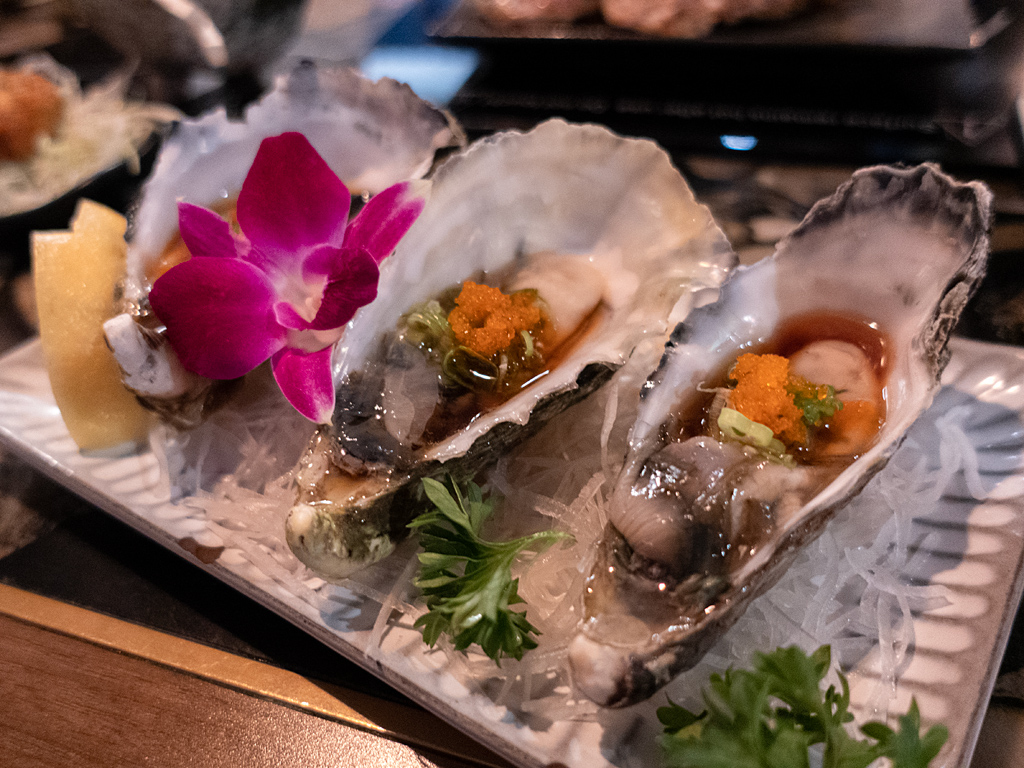
Next up was a quarter dozen of Pacific oyster with ponzu, scallion, wasabi, and ikura. It wasn’t anything particularly revolutionary or orgasmic, but the portion size of each piece was pleasantly large and they tasted straightforward and refreshing, which made it my favorite dish of the meal.
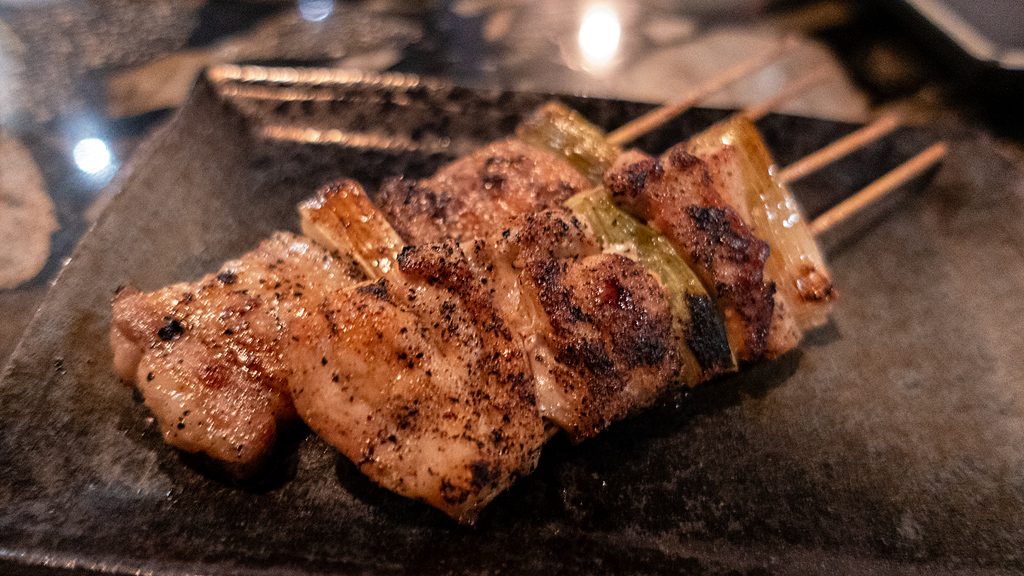
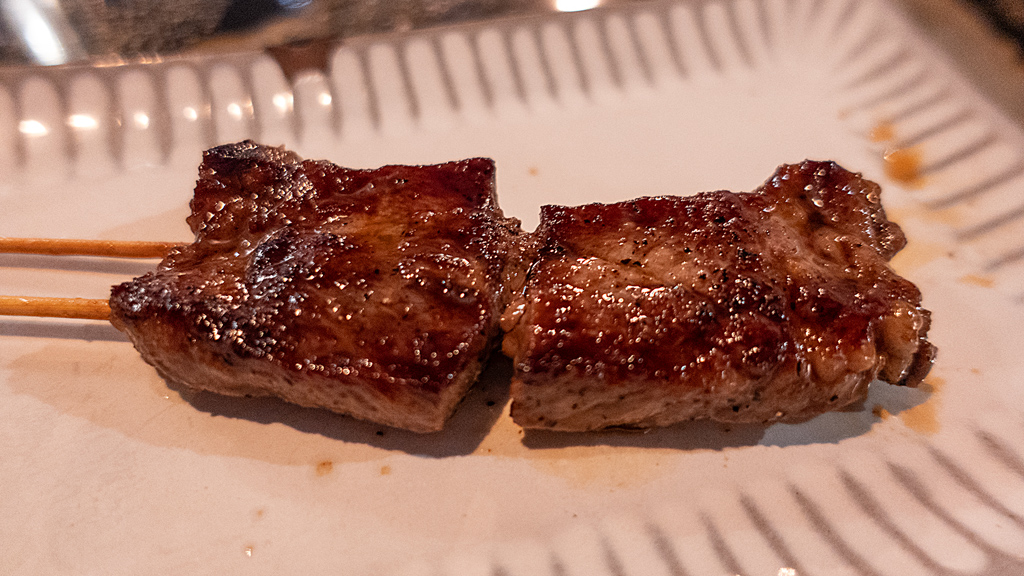
I also ordered two plates of kushiyaki. I wanted to get an A5 wagyu skewer, but they said they did not have any left, so I decided to try yakitori instead, which is a mixture of chicken and vegetables. I received two skewers, one of which was saliva-suckingly dry, and for the other, it tasted like they somehow managed to put more chicken fat than actual chicken on the skewers.
I also got an Angus beef skewer. I originally didn’t get the dish when I first ordered it, so I asked about the missing plate, and the waitress brought it out near the end of our meal. I only got one skewer instead of two like I did with the chicken, but I didn’t bother asking about it, because it was horrible.
The meat was cooked beyond well-done so it was unchewably tough, it had a very gamey smell to it, and the only way to make it remotely palatable was to dunk it into Dani’s shabu-shabu broth to attempt to tenderize it a bit.
I wouldn’t necessarily say the restaurant was high-end, but the pricing wasn’t exactly on the cheap end either. The shabu-shabu was nice, and the raw dishes weren’t bad, but because of the hard misses with the quality of the skewers, I can’t really recommend this restaurant.

 Furthermore, for the past several years, pickup trucks have gotten much, much nicer. They used to be considered work vehicles, but the newest trucks now often have astronomically better convenience and luxury features than regular sedans. To top it all off, rental car companies usually only have one or two rental tiers for pickup trucks, while they have upwards of 12 or more classes just for sedans. This means, if you book a low-tier sedan, you for sure are going to get a pretty bad sedan, and if you want a nicer one, you have to pay for upgrades. However, if you book a pickup truck, in their system, a pickup truck is a pickup truck, so you may end up with a basic truck, but you could also end up with a really nice one, like we did for this fast food adventure.