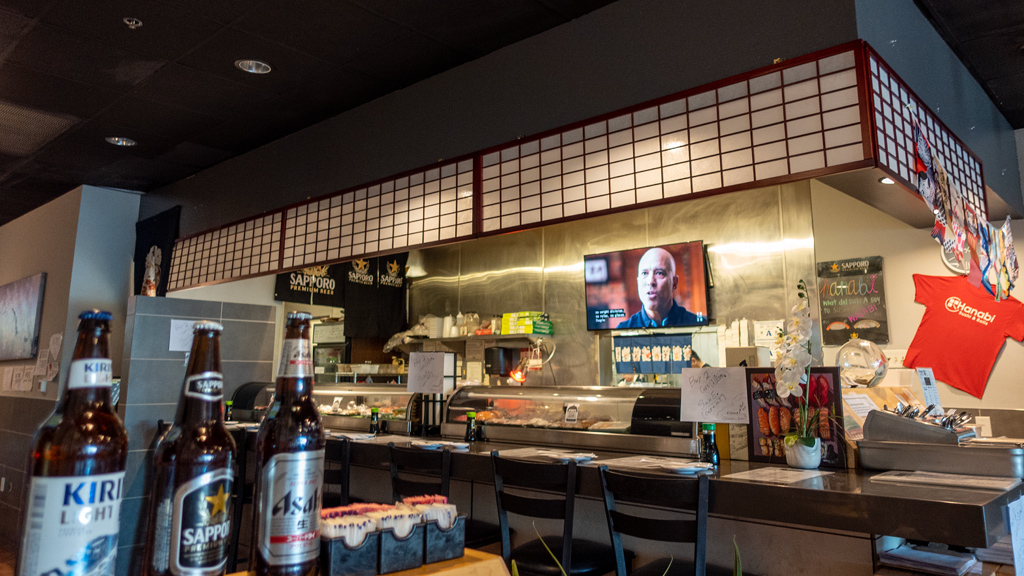
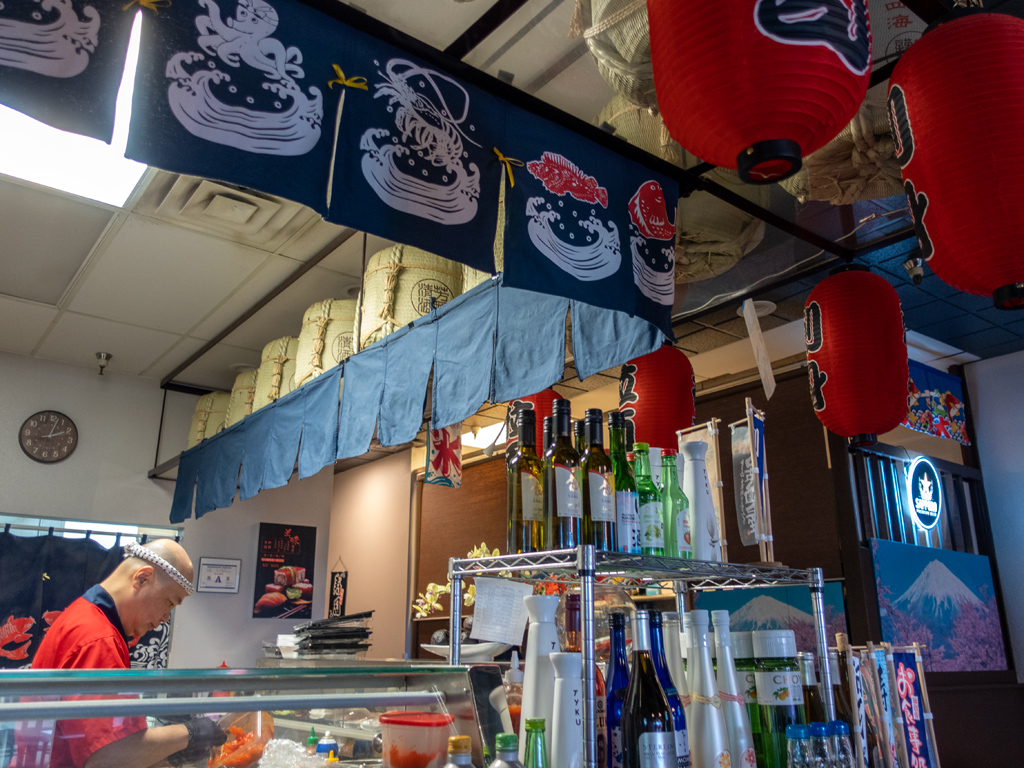
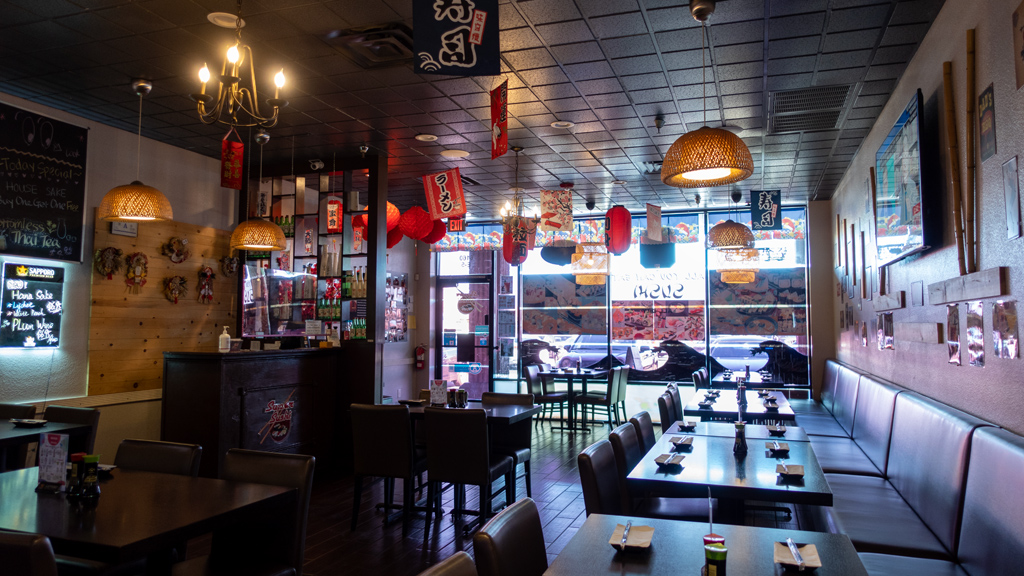
Hello, Jjanga Steak & Sushi in Las Vegas, Nevada

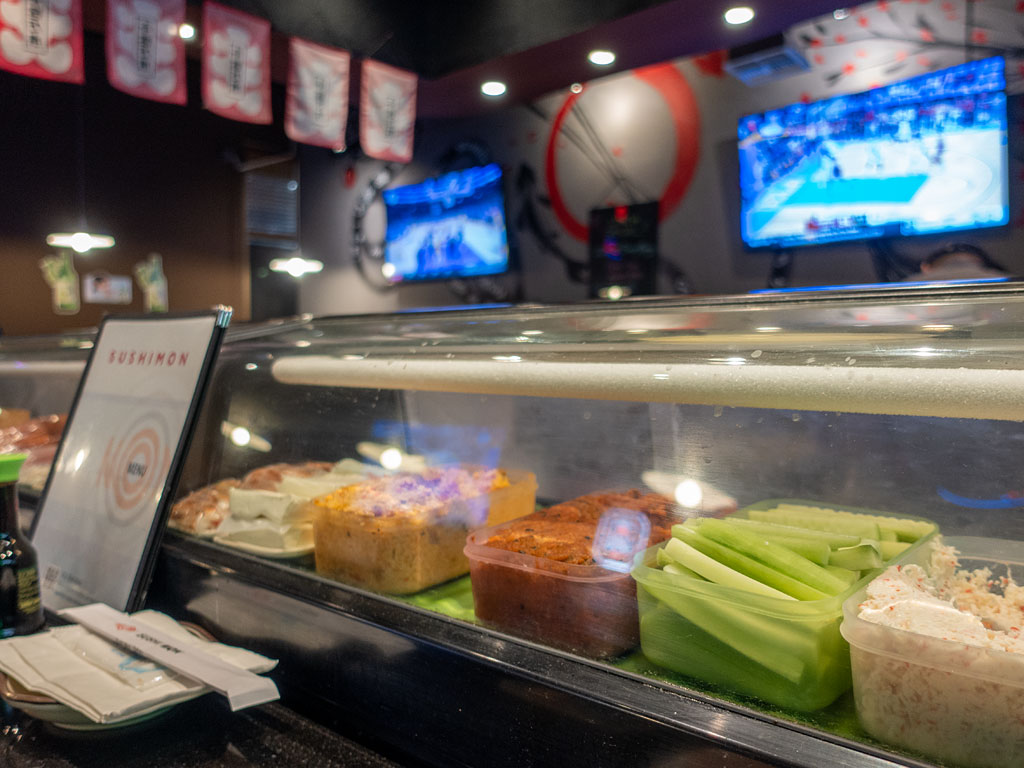
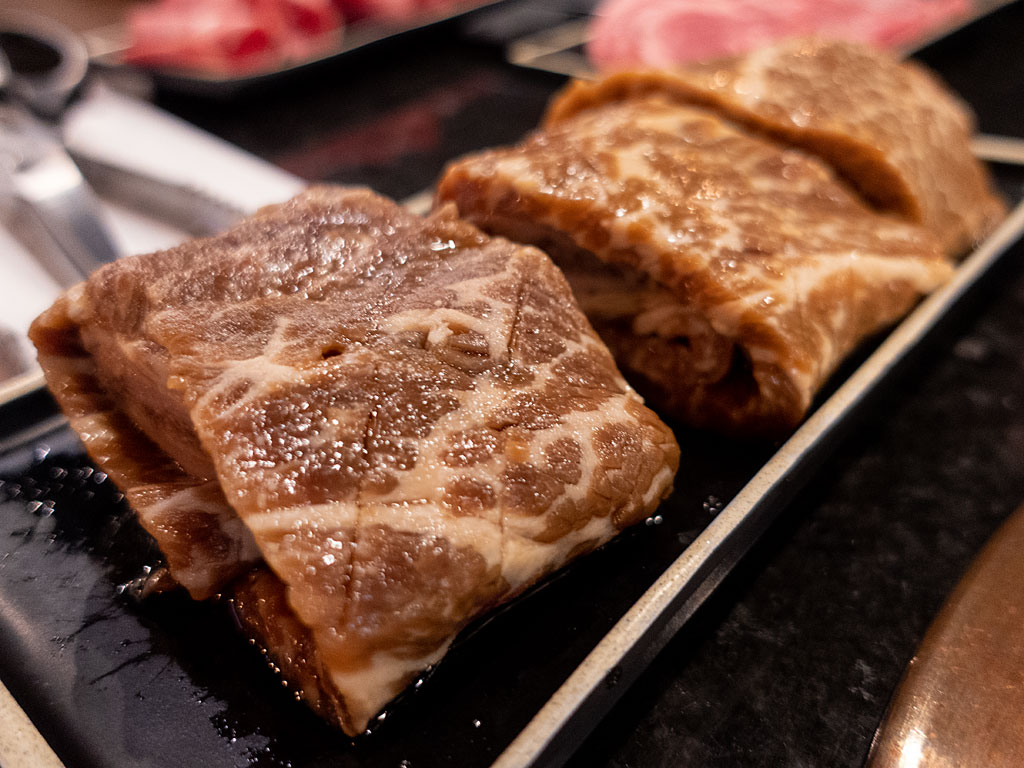
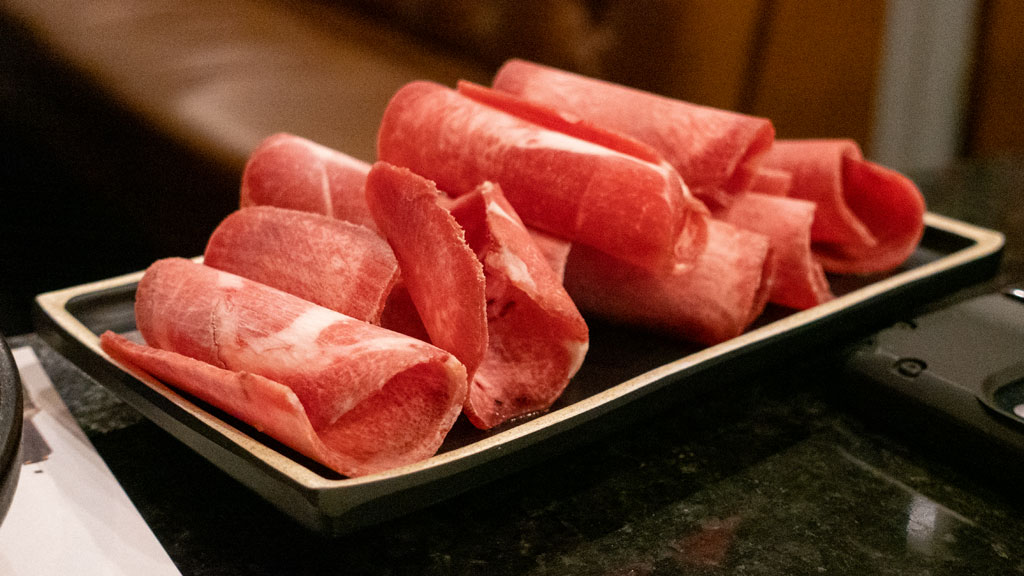
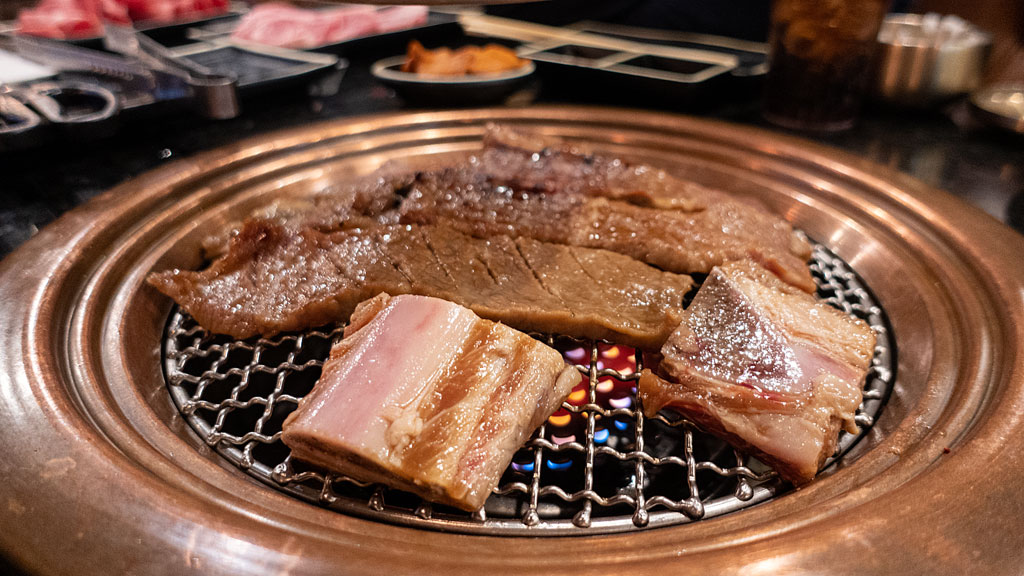
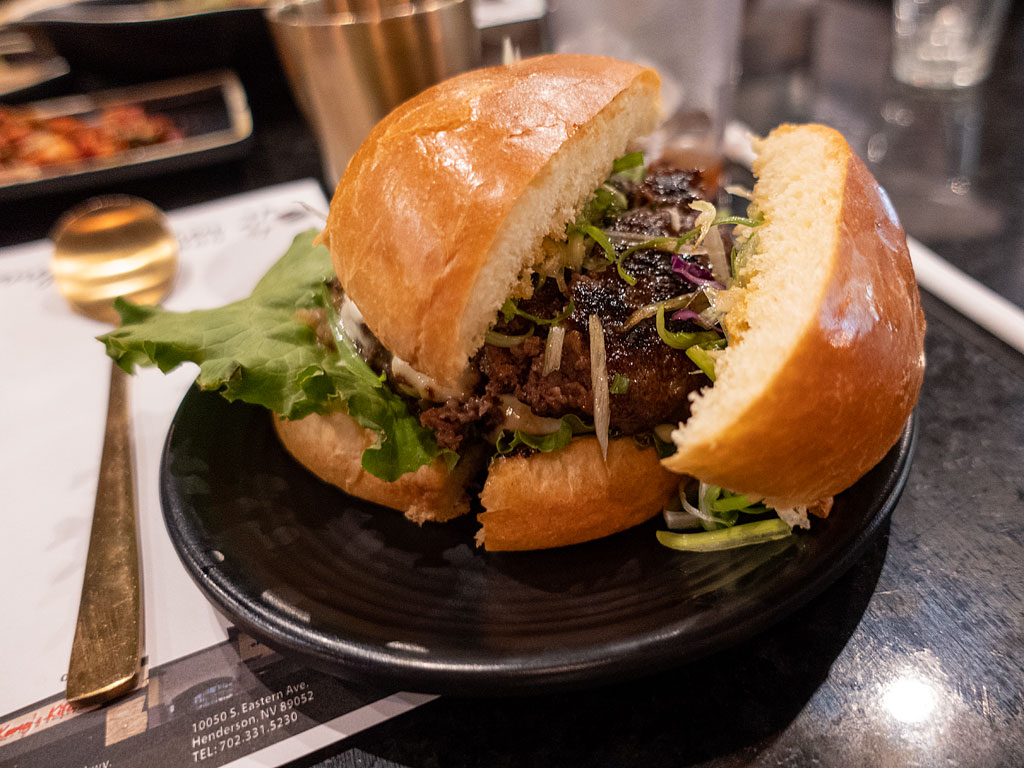
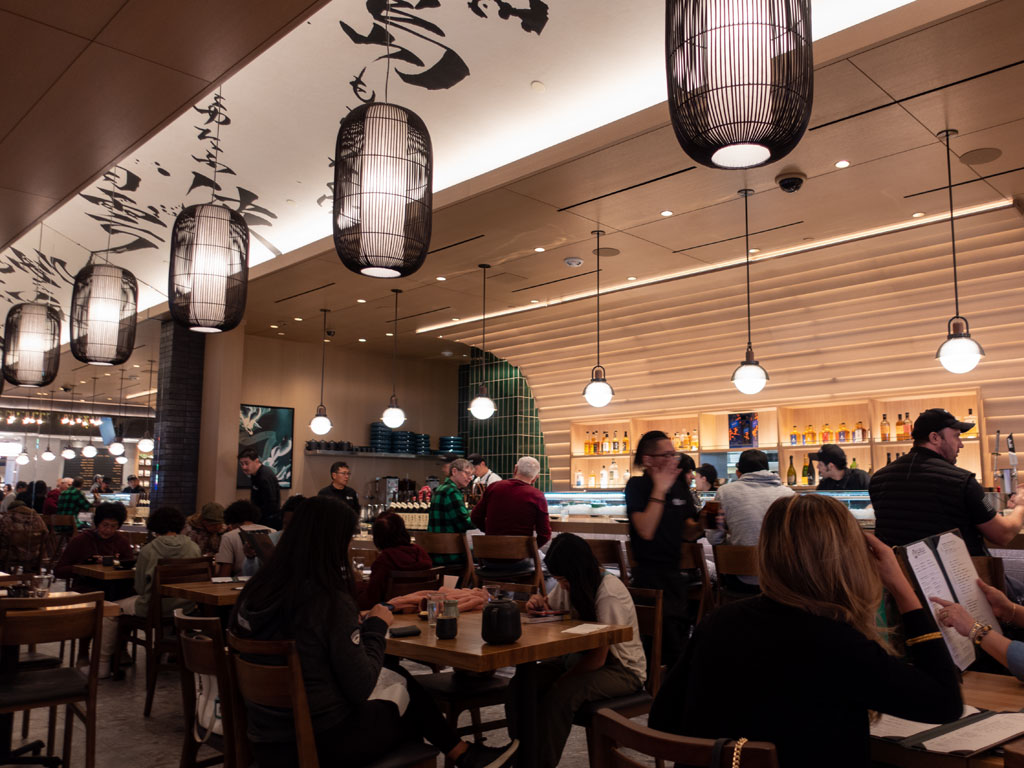
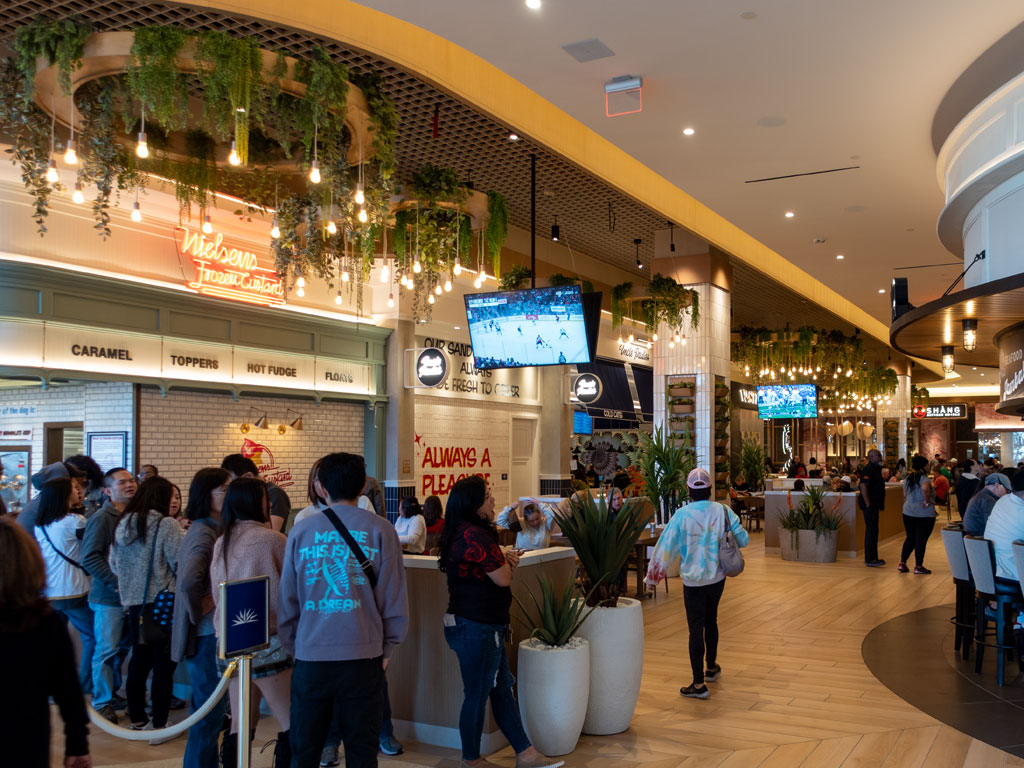
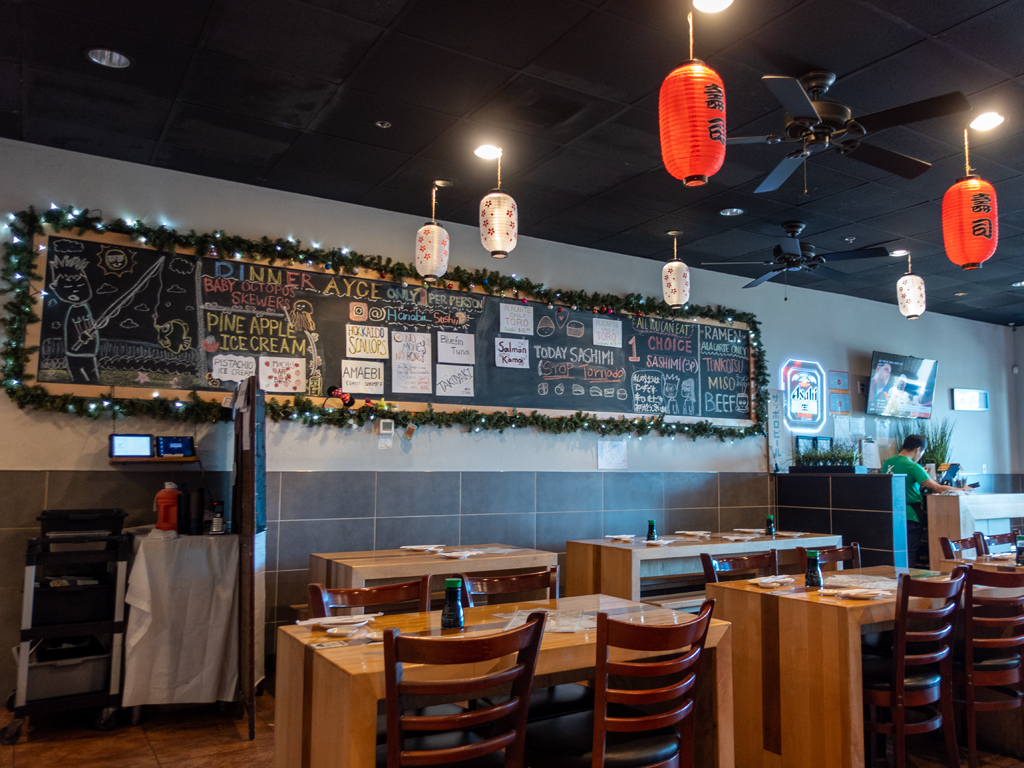
I go to a lot of high-end restaurants, and a lot of people seem to enjoy seeing what food is like at tasting menu, chef’s choice, and omakase restaurants, but I’ve also received a few requests to show some spots that are within a more reasonable price range. To fulfill that request, I made a quick lunch trip last week to Jjanga Steak & Sushi in the southwest suburbs of the Las Vegas Valley for some all-you-can-eat sushi.

They have two variants of their all-you-can-eat offering, a cheaper option for lunch and a slightly pricier option for an all day menu. The all day menu had a much broader selection that included many of my preferred sushi and seafood dishes, so I opted for the all day menu.

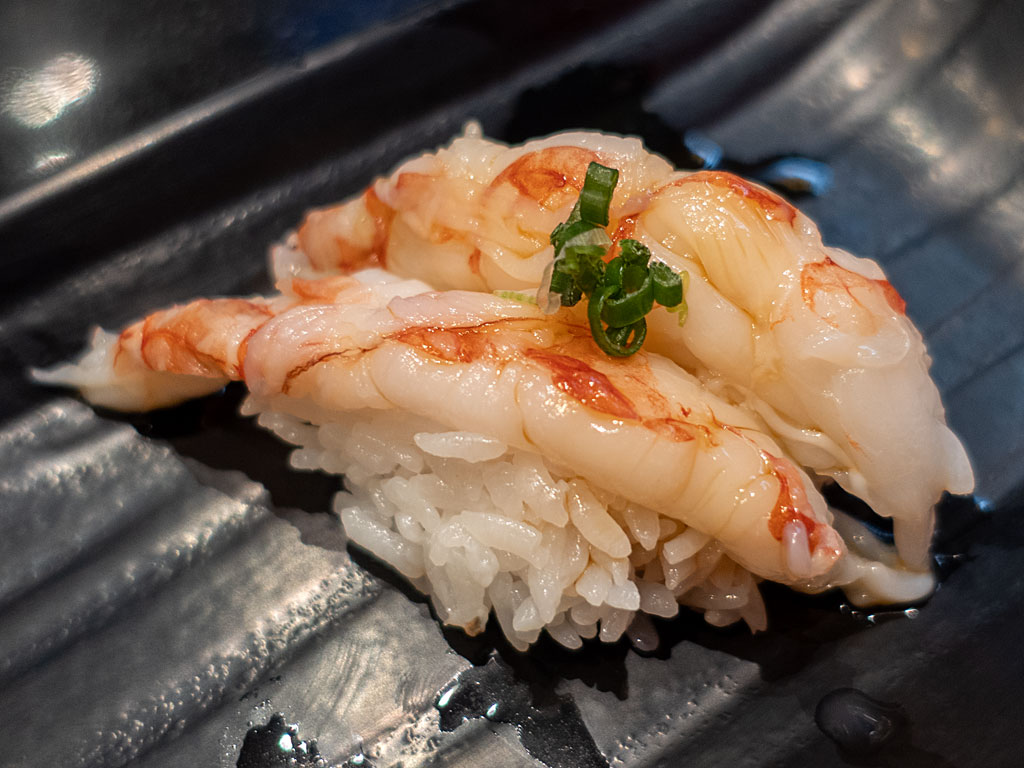
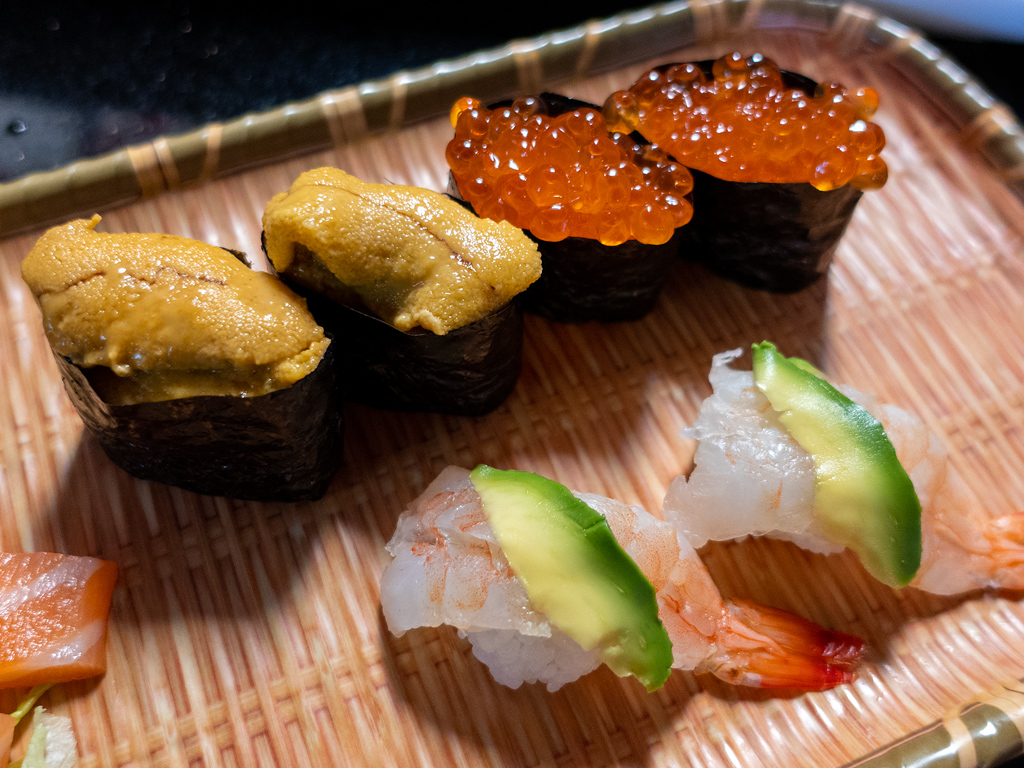
My first dish was amaebi topped with flying fish roe. It was a nice, thick, broad piece with a well-balanced amount of seasoning. It had the same juicy and satisfying tex­ture as you’d expect from high-quality sweet shrimp.

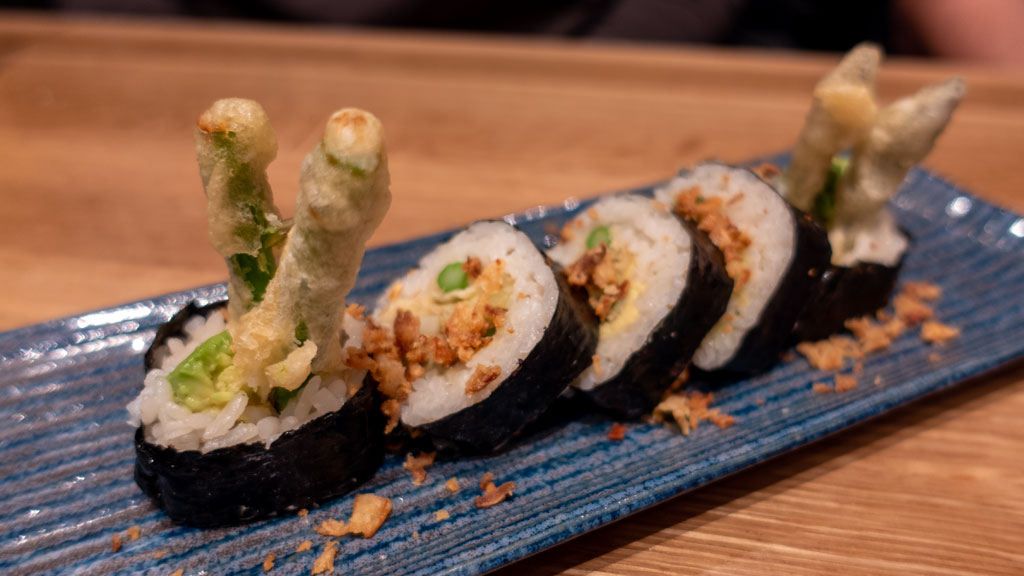
Each day of the week, they have a rotating special menu. I tried a bunch of items from their special menu, and the first item that came out was bulgogi inari. It was very average, and I liked it—it was pretty much exactly what you’d expect from bulgogi and rice with a bit of crispy onion at the top for tex­ture.

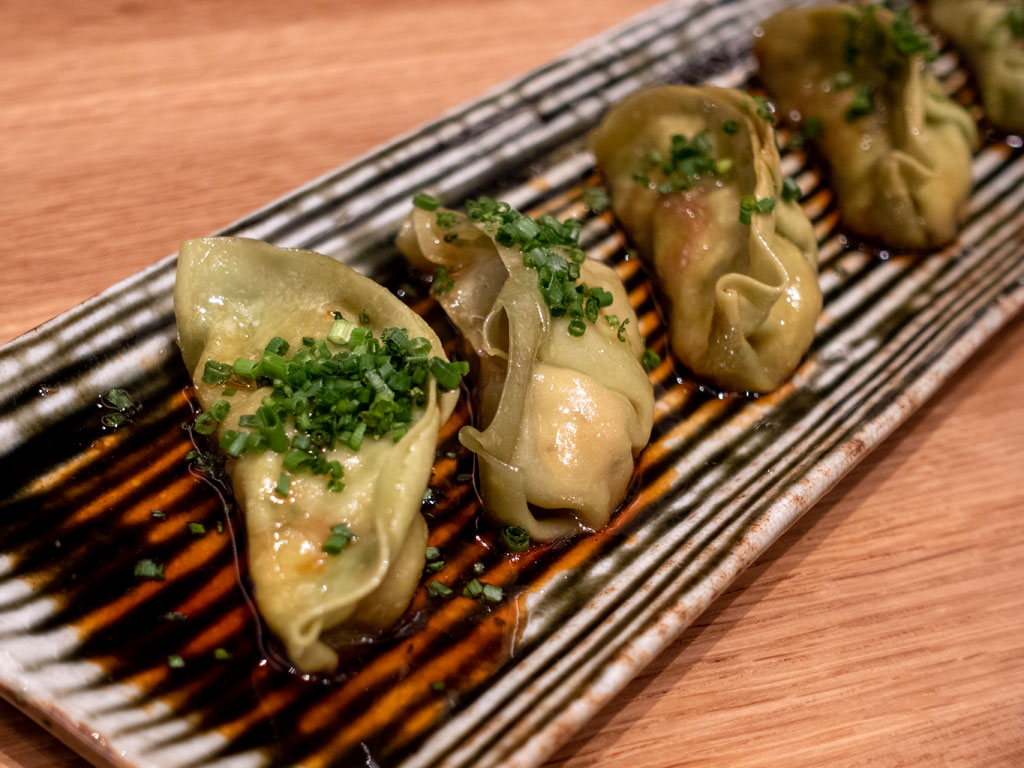
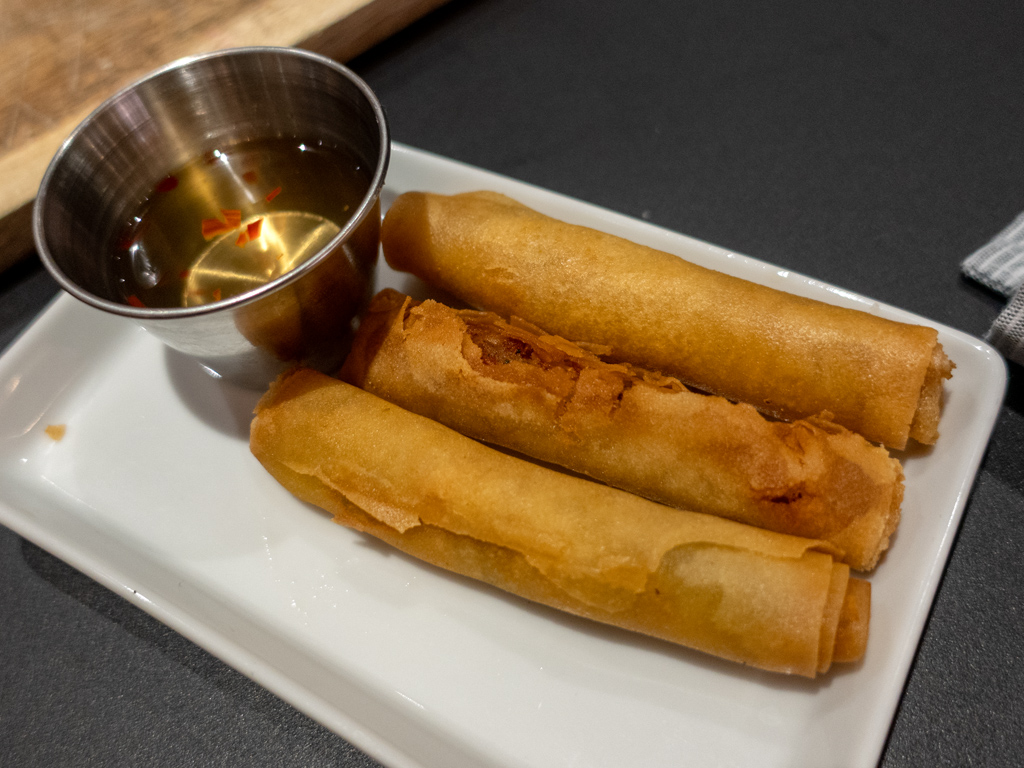
I also ordered a different beef dish, but I don’t remember what this was, as I can’t seem to find it on either the special nor the regular AYCE menu. It was almost as if it was a beef dumpling, but the fried crust was thicker and it was much creamier on the inside. This item was definitely leaning heavily towards the “steak” side of the “steak and sushi” coverage of the restaurant. I think this would’ve been a better entrée to eat as a closer to counteract a long chain of raw fish.

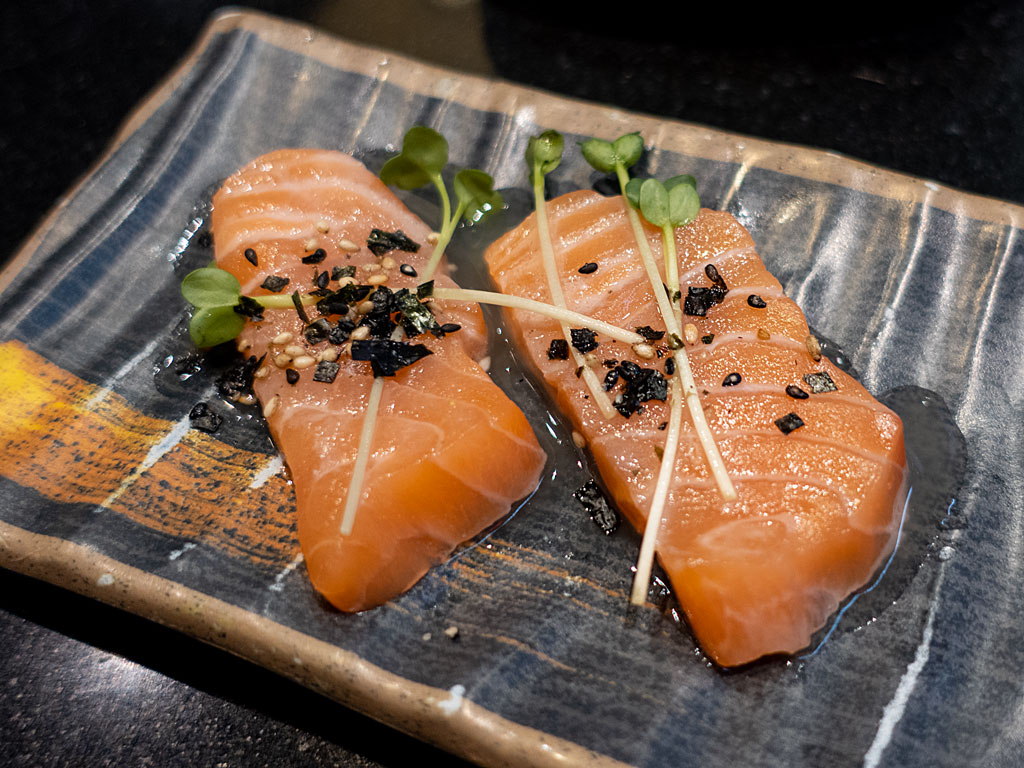
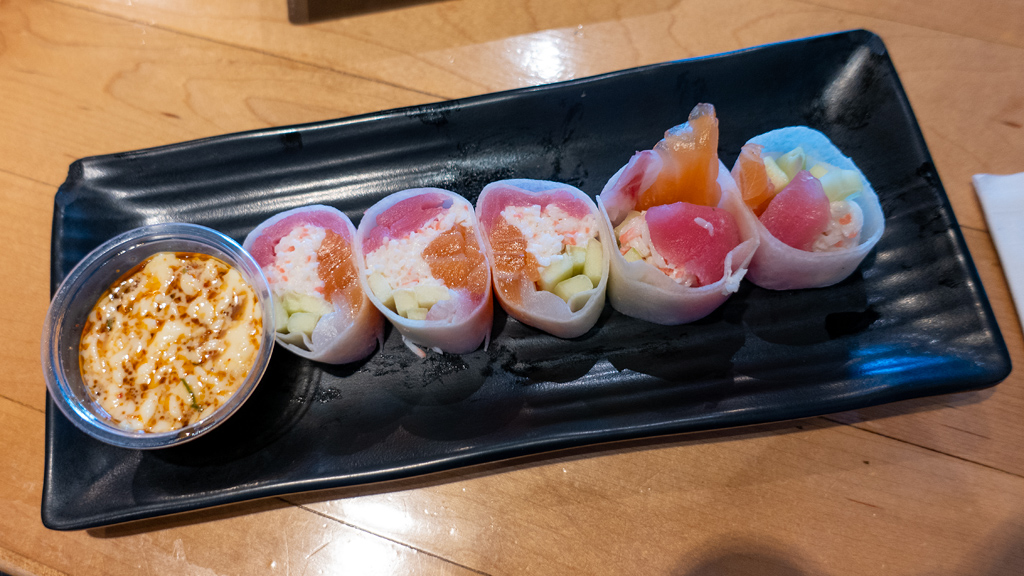
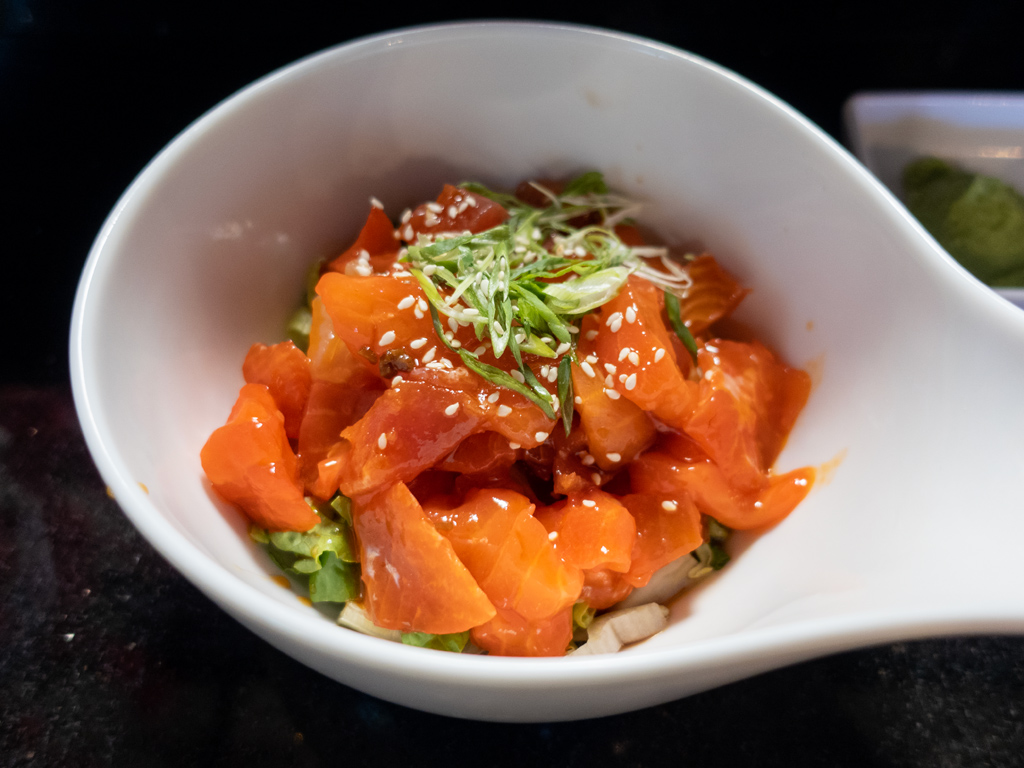
Next up was was salmon belly sashimi. As you can probably see from the photo, they put way too much screaming orgasm sauce (which is usually made with some mayonnaise, vinegar, fish sauce, and other sauces used in Japanese cuisine). I scraped a majority of it off—as much as possible without removing too much of the flying fish roe. Salmon belly is one of my favorite cuts of sushi, and I think this would’ve been much, much better if served without so much sauce.

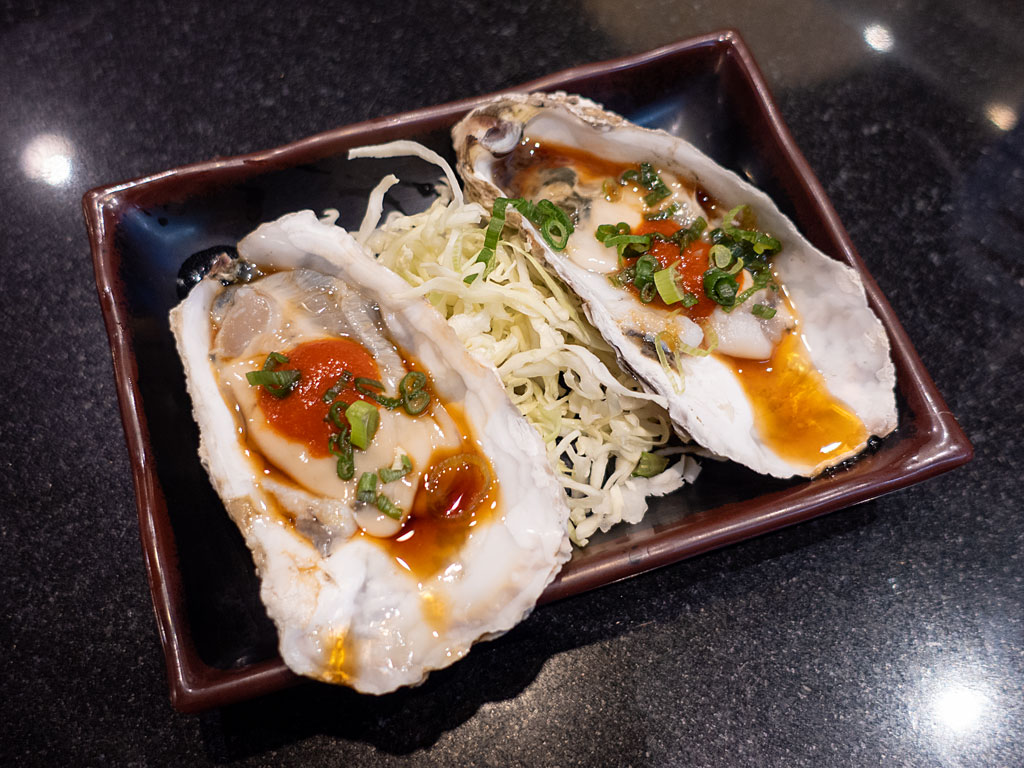
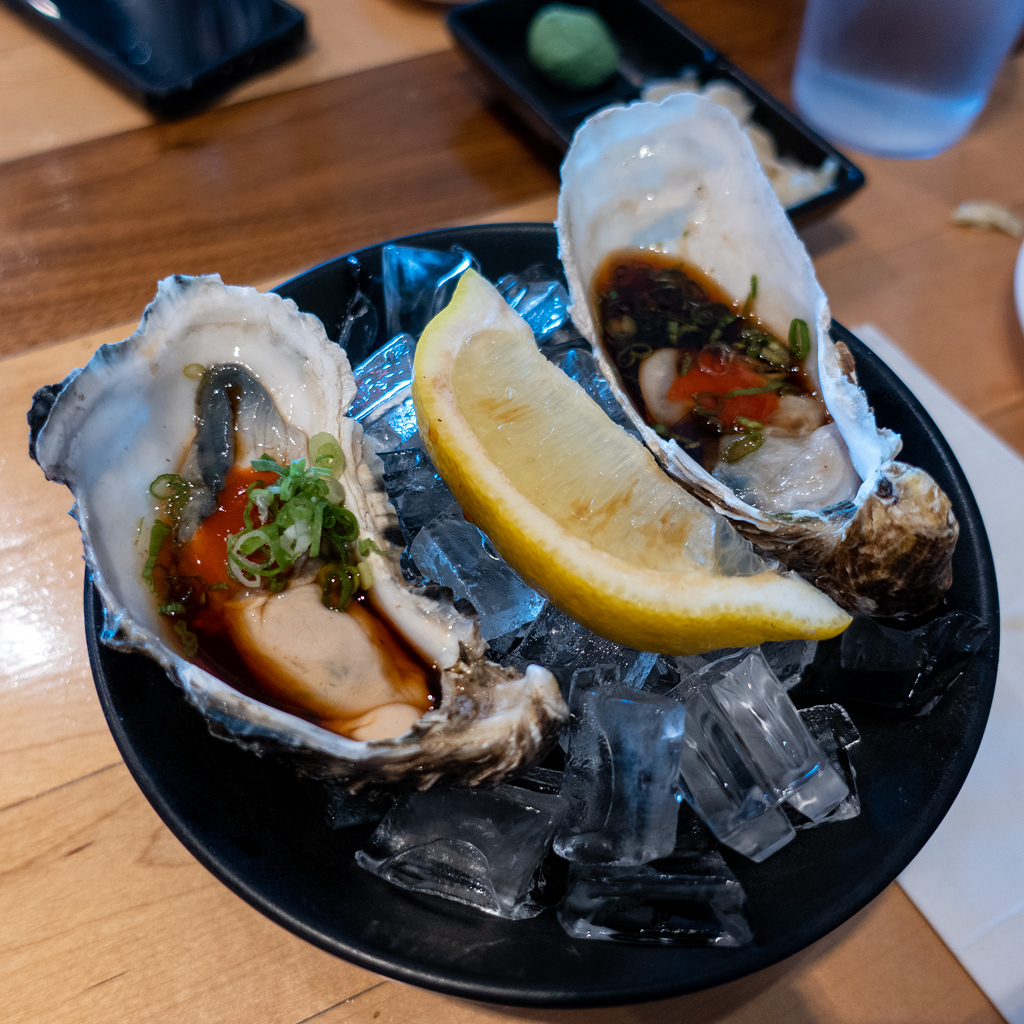
Next up was an oyster. It was mysteriously disconnected from the shell, so I’m not sure if this is one of those situations where restaurants only use the shell for show and actually just put the oyster into an empty shell manually. Regardless, the oyster was very large and very flavorful.

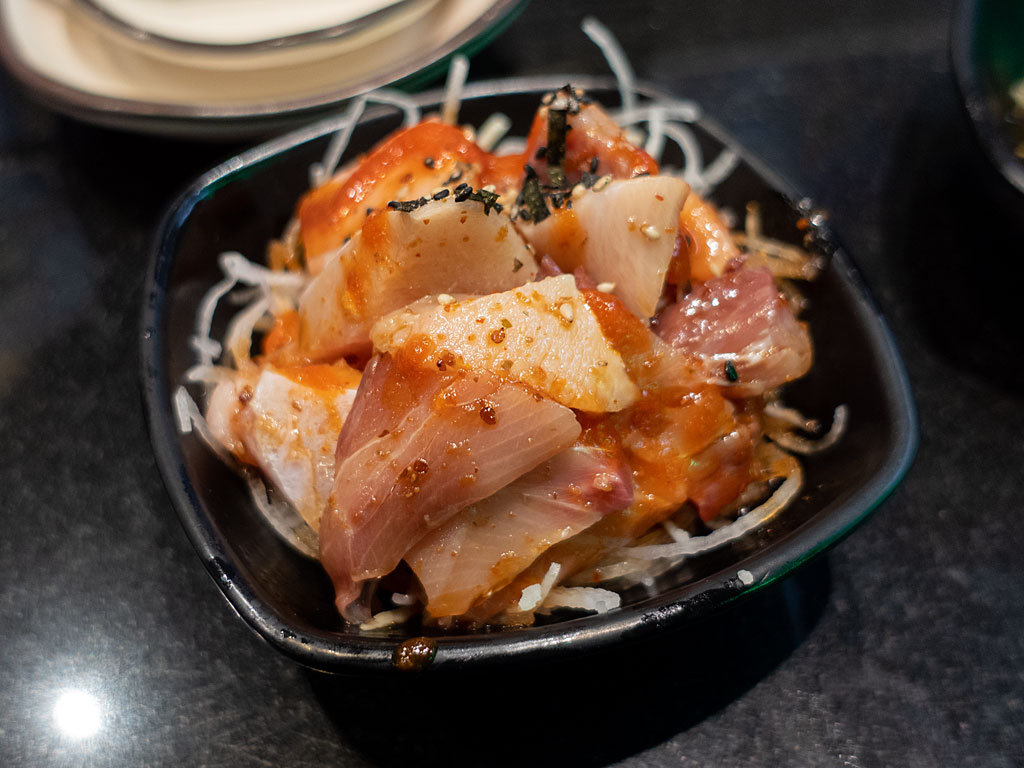
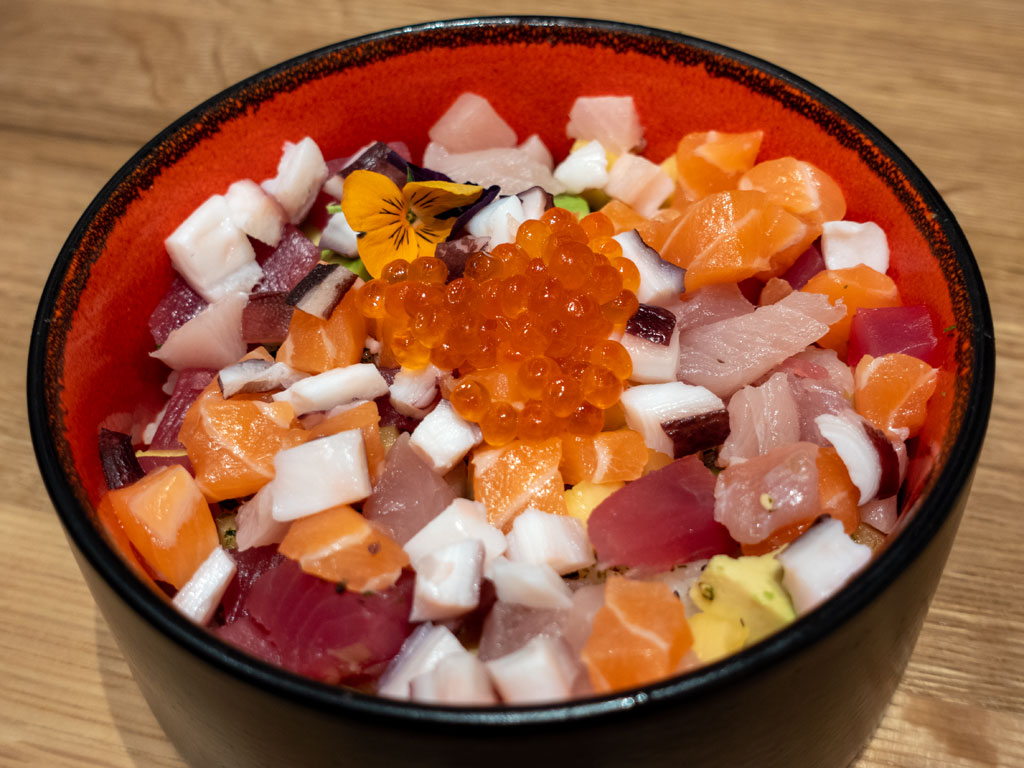
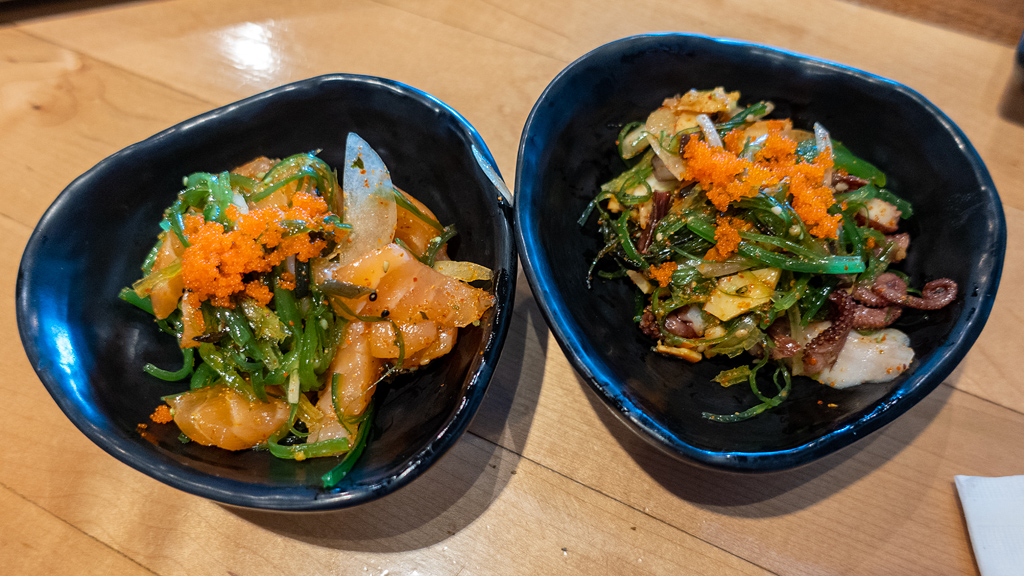
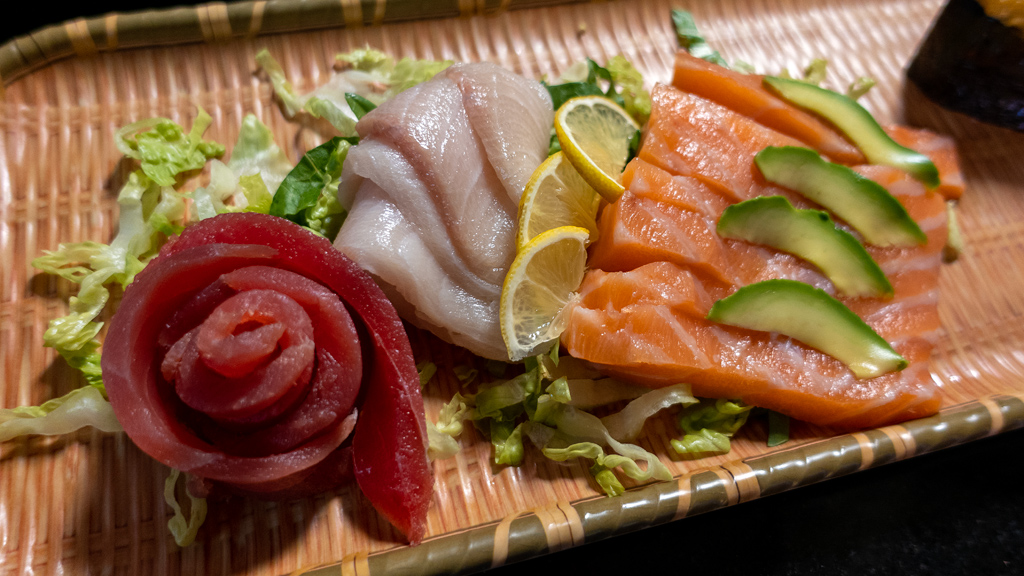
After finishing my round of daily special menu items, I ordered a sashimi salad. The photo didn’t focus properly and didn’t come out too well, but I decided to post it anyway because I enjoyed the theme that this restaurant had of broad, thick pieces of shrimp.

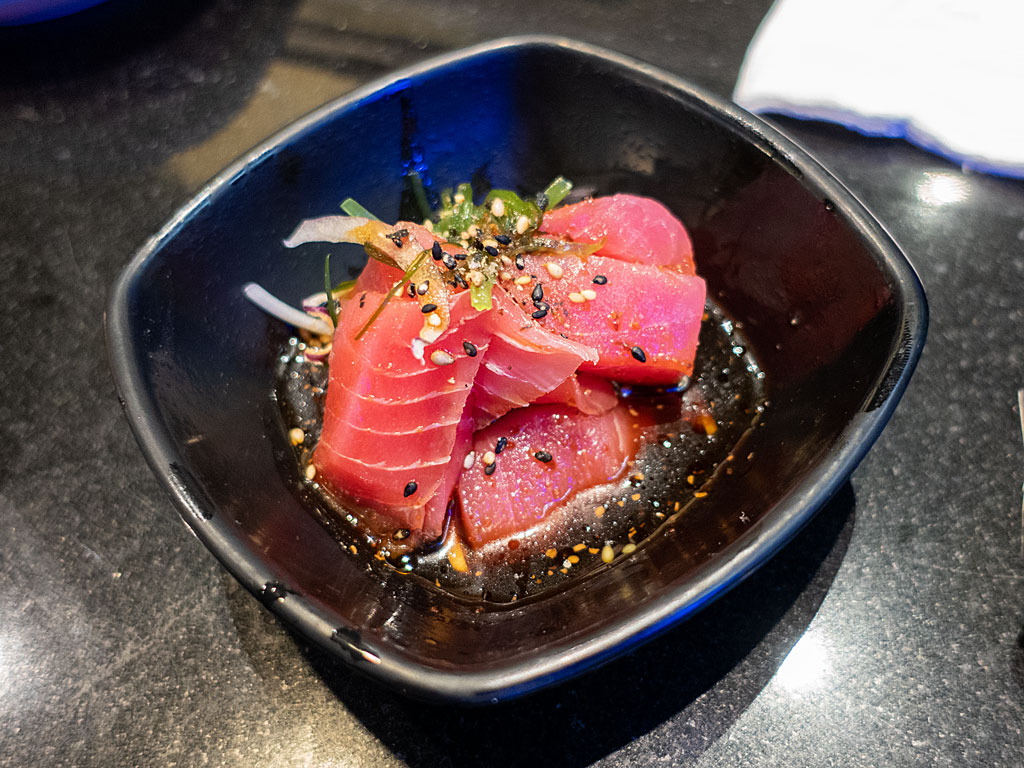
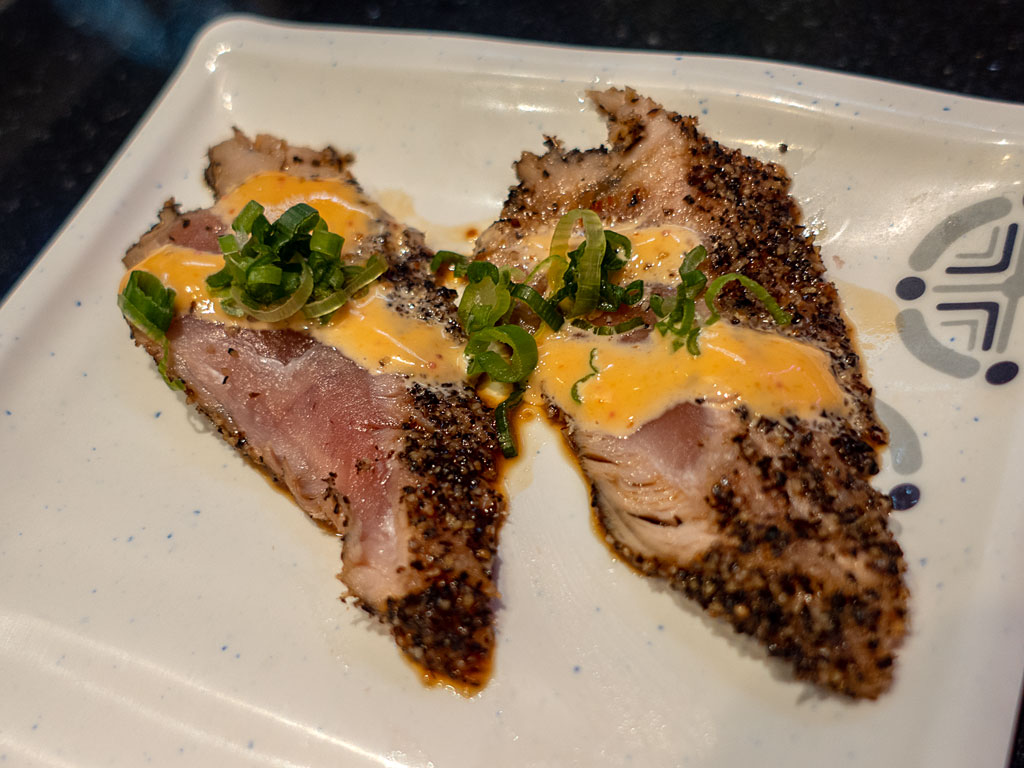
I also got a screaming orgasm—the actual entrée, not just the sauce. It was strips of tuna sashimi topped with some flying fish roe (which, I discovered, they really enjoy using on many different dishes as a topping).

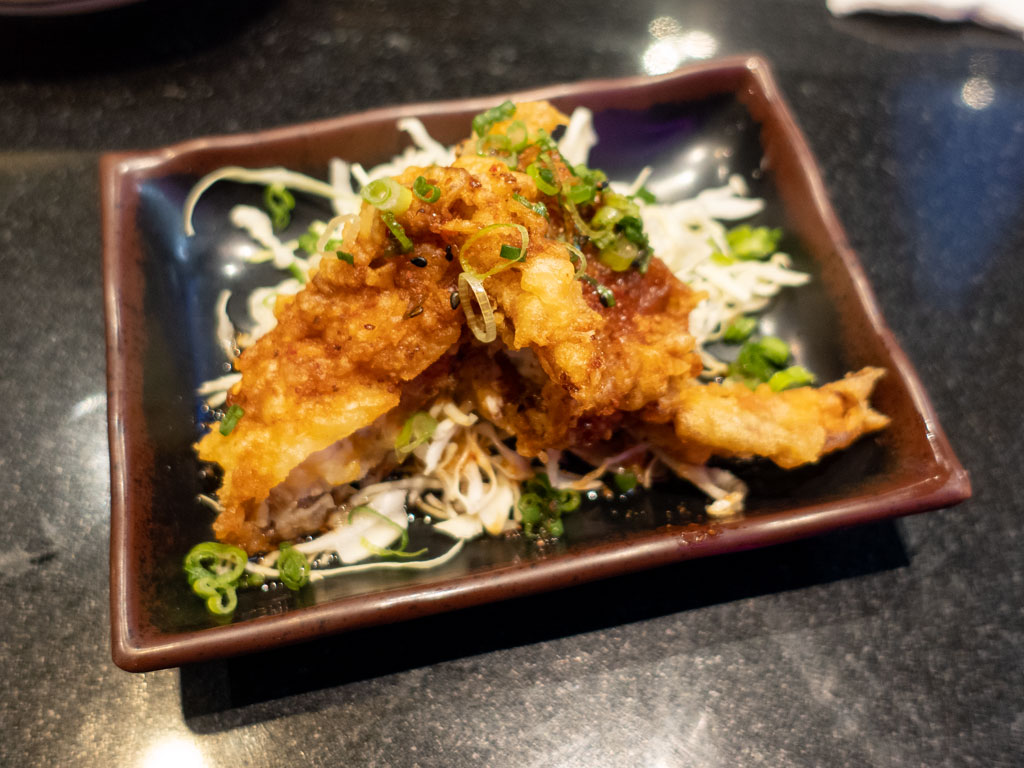
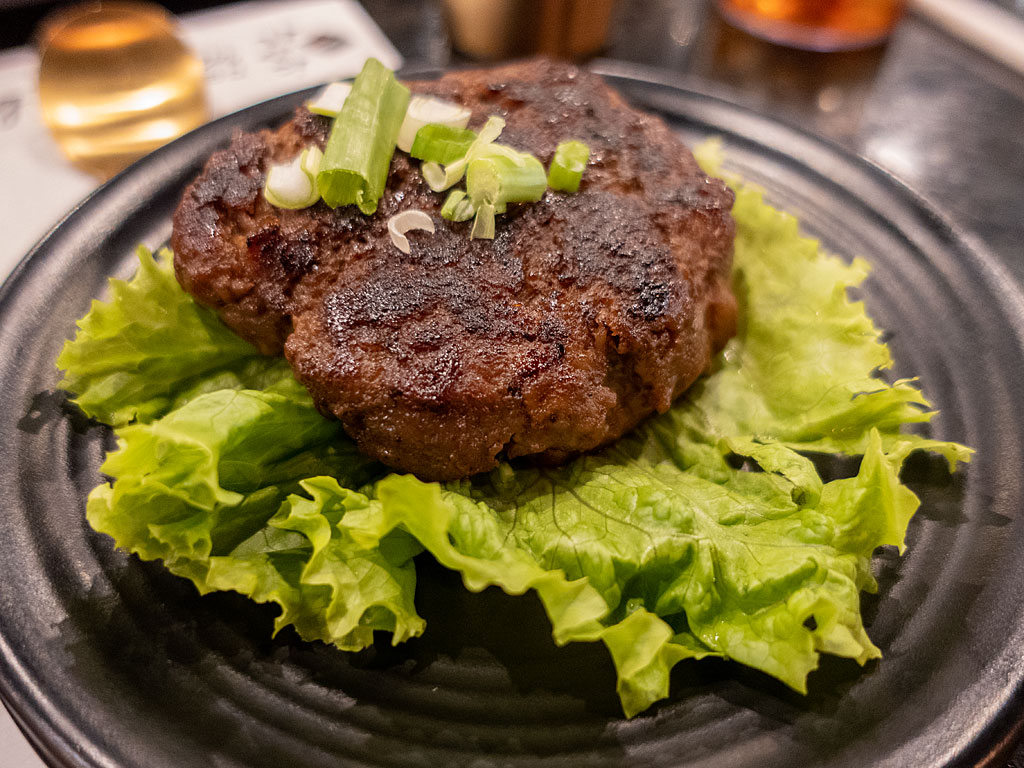
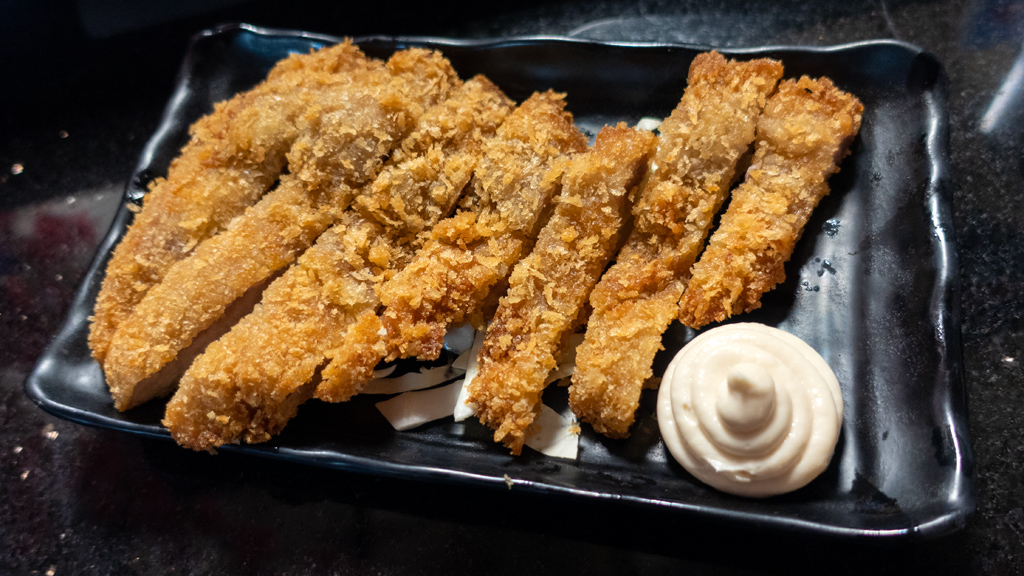
I was curious and wanted to try out a few more items from the grill side again, so I ordered a mini chicken katsu. The portion size was much, much larger than I expected, and I definitely regret ordering this because of how much sushi I could’ve had in its stead. The chicken quality was mediocre, it was slightly overcooked, and the breading was a bit excessive.

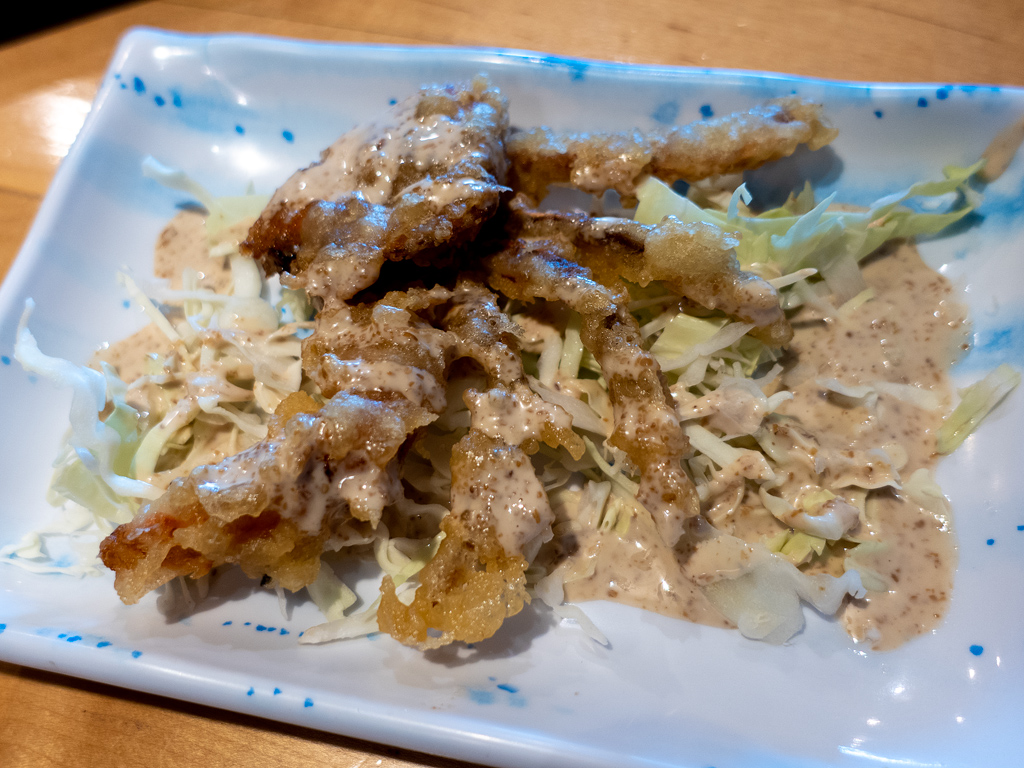
I also tried an octopus skewer. I thought it would come out raw, but it was deep fried instead. Again, it was larger than I expected, and again, it was fairly mediocre.

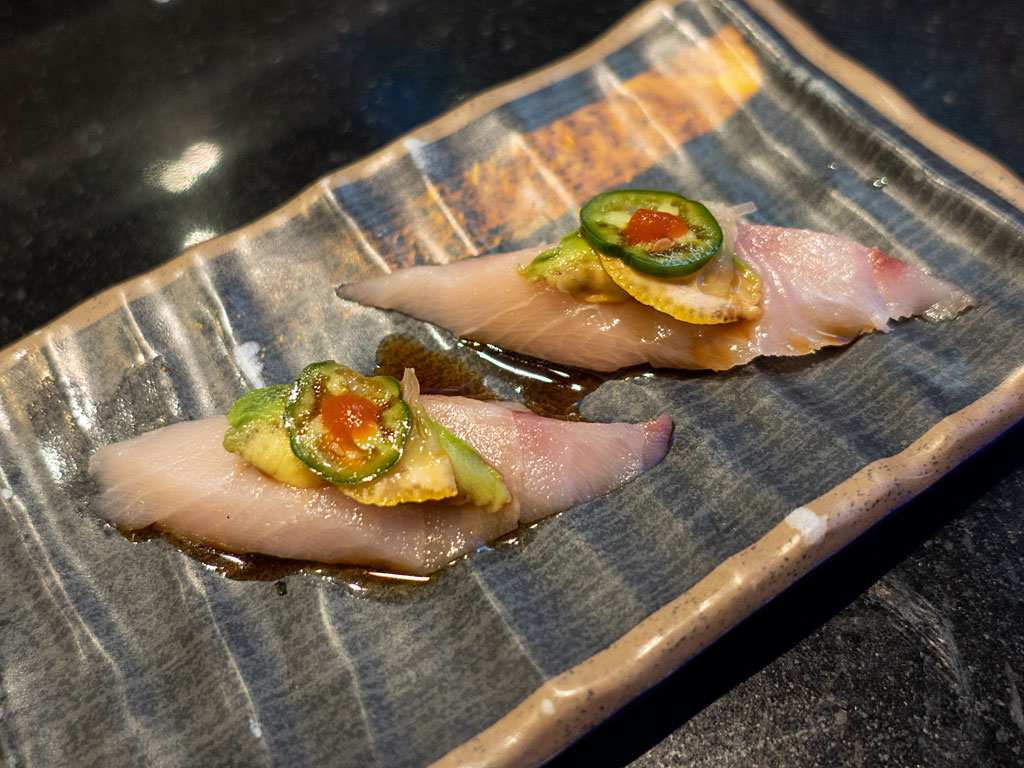
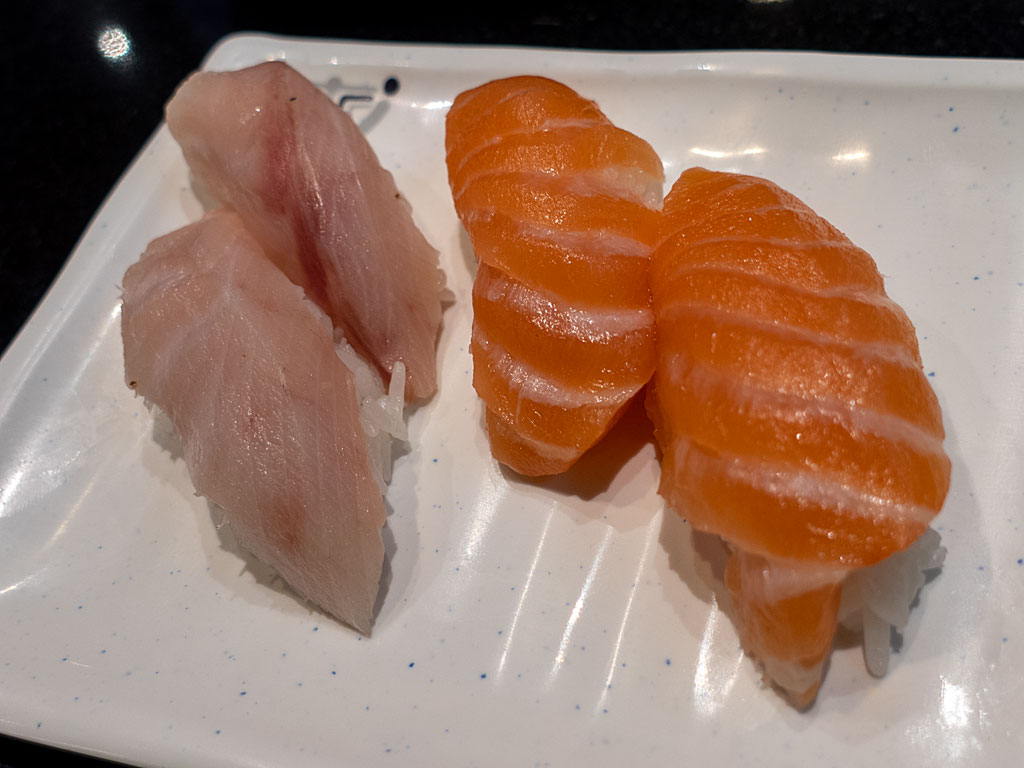
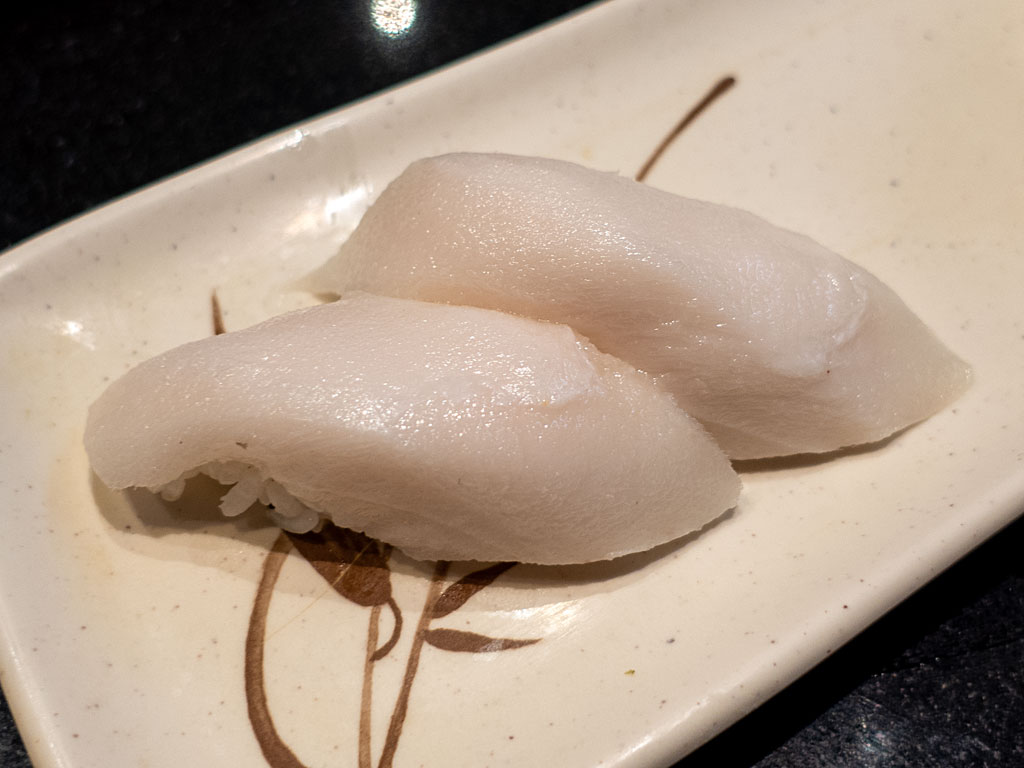
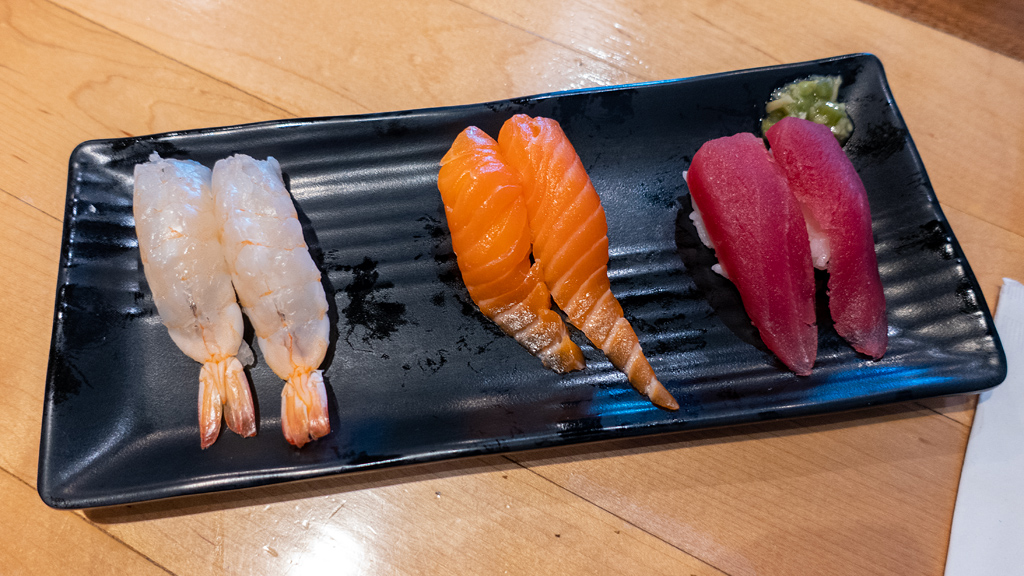
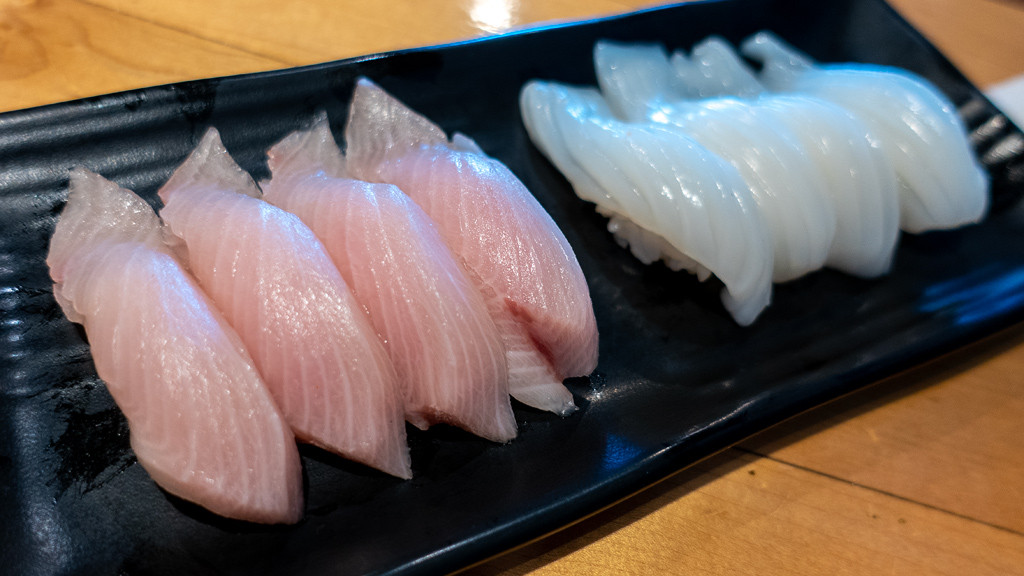
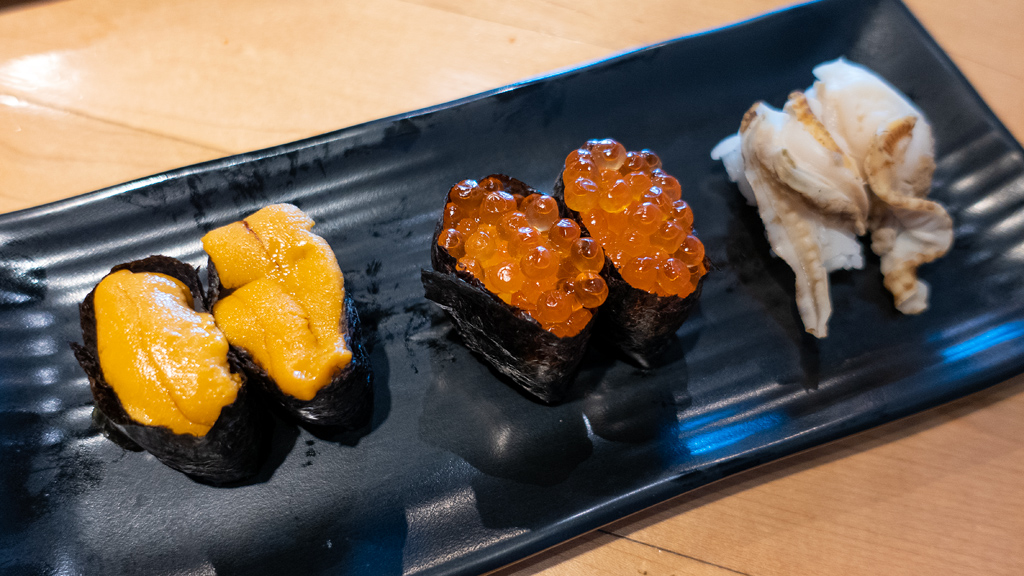
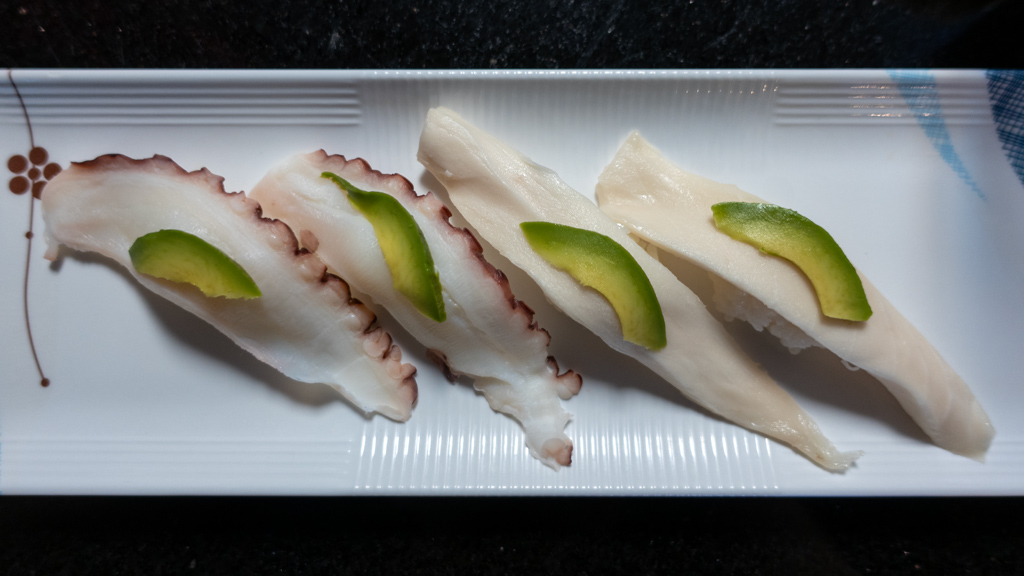
After eating all that fried food, I went back to some sushi. I had a lot more nigiri than is pictured here, but one of my favorite selections from this res­tau­rant was the escolar, commonly known as white tuna.

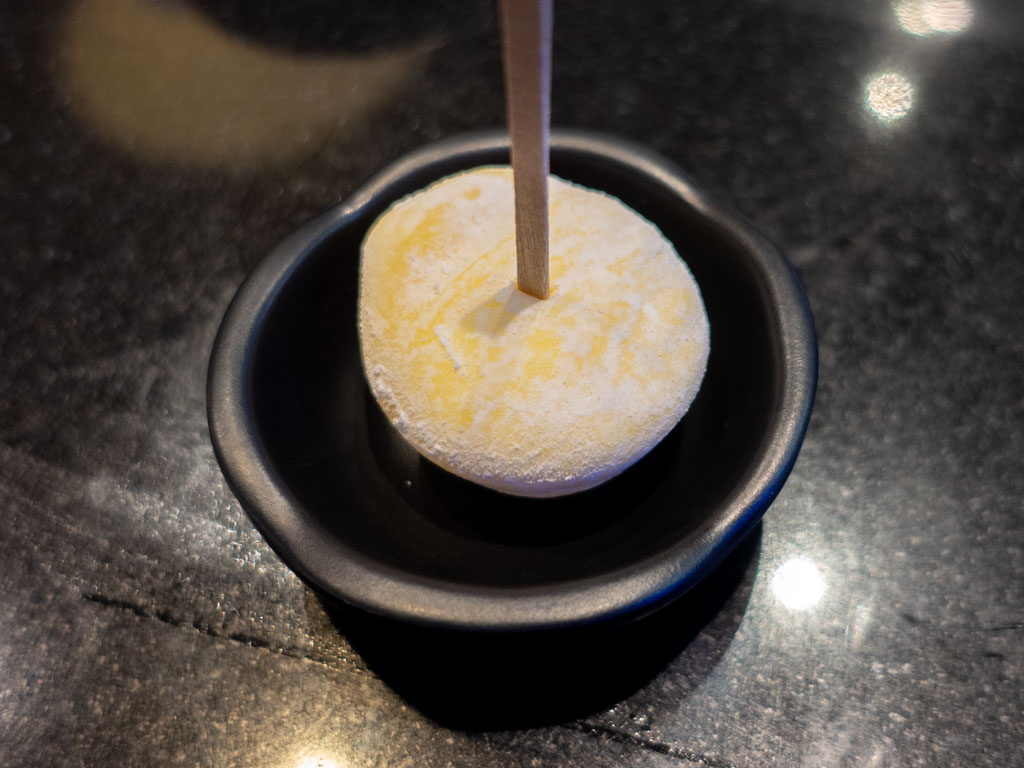
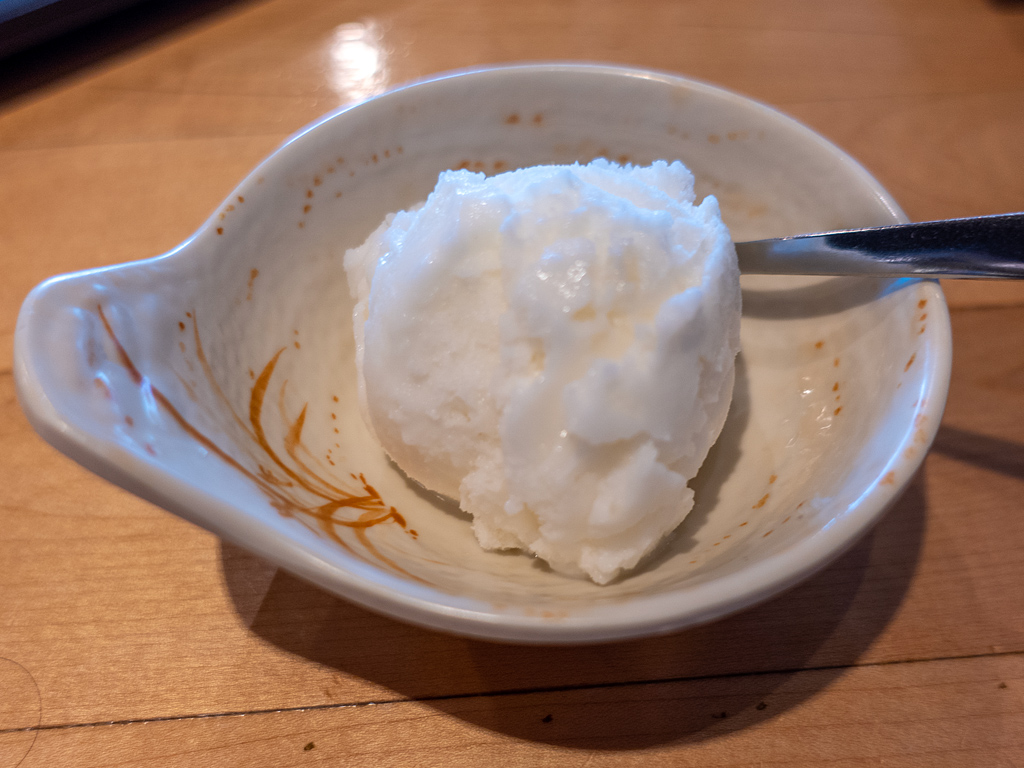
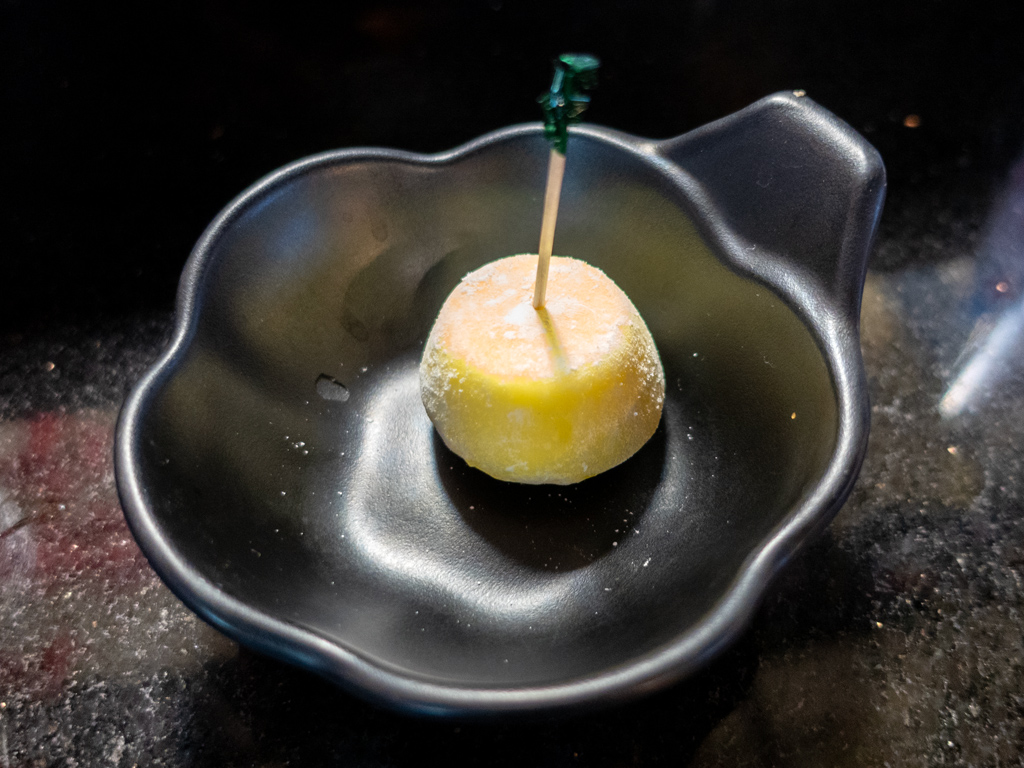
For dessert, I finished with a small piece of mango mochi.

Here is a breakdown of what I paid:

All-you-can-eat, all-day menu $ 31.99
Tax (7.65%) $  2.64
Gratuity (18%) $  6.23
Total $ 40.86

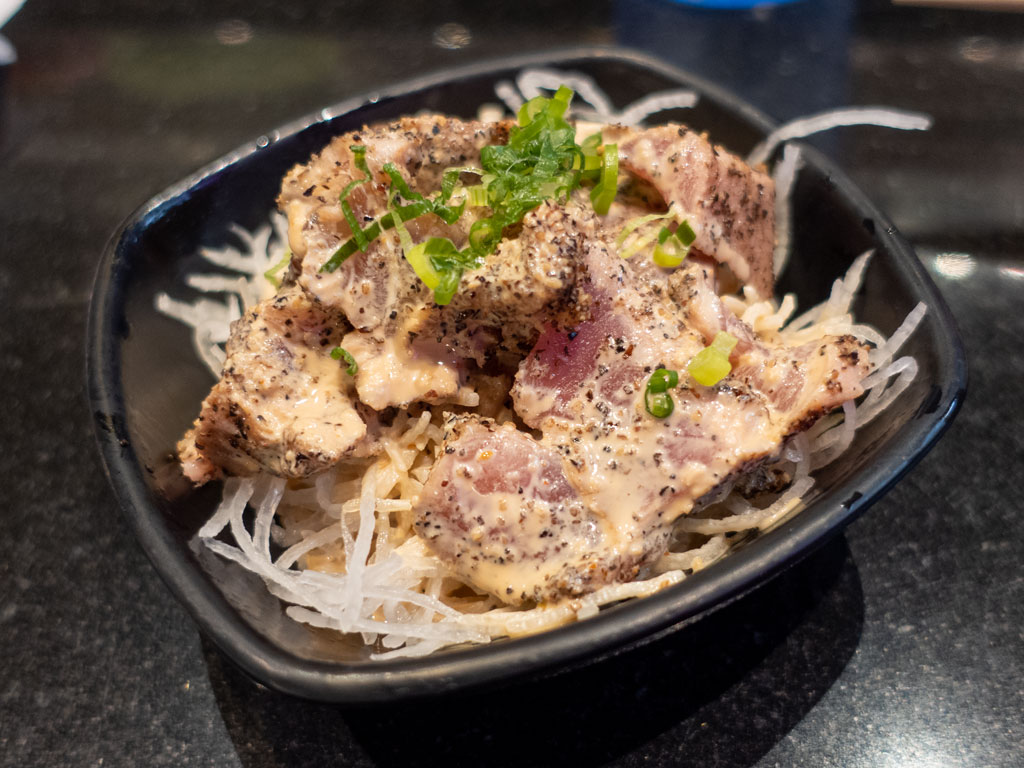
Overall, I’d say that I had a decently satisfying experience. If you also decide to pay a visit to Jjanga for all-you-can-eat and you like sushi, I highly rec­om­mend avoiding their grill menu and just sticking with their specials and sushi menu items to get maximum value for your money.


—§—


The lore behind DougDoug’s “I’ll have what he’s having” fast food challenge

On Saturday, May 20, 2023, I joined my friend Doug Wreden on his DougDoug Twitch channel for a live stream with his friends and staff mem­bers Berry and Parry. For the broadcast, we drove around the San Fernando Valley in Los Angeles County doing the “I’ll have what he’s having” challenge.

This was a popular trend a little while back, and I already participated in a few of these with some other friends a handful of years ago, but if you’re not familiar with the concept, the idea is that you go to various different fast food restaurants and order the same thing as what the previous vehicle in the drive-through lane ordered.

Yesterday, the recording of the live stream was cut and edited into a highlight video that was released on the DougDoug YouTube channel. The audience of Doug’s YouTube channel is far greater than the au­dience of Doug’s Twitch channel, so this brought the fast food challenge content in front of many more eyes and resulted in a relatively large influx of questions.

There’s been relative consistency in the questions that have been asked, and there is a bit of “lore” that I think fans would find fun and interesting, so I decided to take some time to write this as a supplement to Doug’s video content.


“How much did you actually end up eating?”

Doug’s video editor calculated the nutrition facts of everything we ate and it came to a total of 20,435 calories. However, people were curious exactly how much I personally contributed to consuming that amount. From the footage, it seemed like I ate the least… but it was not by as large of a margin as it may seem.

FoodRestaurantCaloriesFat (g)Carbs (g)Na (mg)Protein (g)
Honey walnut shrimp, ⅘ portionPanda Express 300 18.5 22.0 381 11.5
Mushroom chicken, ⅘ portionPanda Express 185 12.0  9.0 707 10.0
Fried rice, ⅕ portionPanda Express 112  3.5 18.5 183  2.5
Chow mein, ⅓ portionPanda Express 174  7.0 27.0 293  4.5
Veggie egg rollPanda Express 180  9.0 19.0 390  7.0
Cheddar quesadilla, ⅘ portionDel Taco 366 20.5 24.5 676 17.5
Caramel cheesecake bites, 1 stickDel Taco 460 28.0 43.0 310  6.0
Chocolate fudge sundaeBurger King 280  7.0 47.0 220  6.0
Sourdough patty melt, ¾ portionJack in the Box 488 28.5 28.5 975 28.0
French fries, medium, ½ portionJack in the Box 215 10.0 29.0 390  2.5
Cherry Coca-Cola, 2 fl. oz.Jack in the Box  25  0.0  6.5   5  0.0
Raspberry-filled jelly doughnutKrispy Kreme 340 21.0 36.0 125  3.0
Chocolate iced doughnut with cream fill­ingKrispy Kreme 340 17.0 42.0 140  4.0
Baked potato with chivesWendy’s 137  0.0 31.5  15  3.5
Natural-cut French fries, medium, ½ portionWendy’s 210  9.5 28.0 210  3.0
Pink lemonade, 28 fl. oz.Wendy’s 308  0.0 77.0 105  0.0
Nitro cold brew coffee, ½ each of 2 drinksStarbucks  70  1.5 13.0  45  3.0
Fried chicken thigh, smallKFC 144  8.5  4.5 150 11.0
Total 4,334201.5536.05,320123.0

While we were working through our order at Kentucky Fried Chicken, Doug’s moderator Eddie showed up to help with a large portion of the bucket of fried chicken. Fried chicken is extremely calorically dense, and a bucket has a lot of pieces of chicken; I think it is reasonable to assume that Eddie relieved about 1,800 calories’ worth of our food burden, considering that he ate most of the bucket.

That brings the total for the four of us down to 18,635 calories. At my 4,334 calories, I ate about 23.26% of the calories, very close to the 25% needed for an even split. Of course, calories isn’t the only metric to calculate contribution, and there are many other important factors like how volumetrically filling the food is or how undesirable the meal is, but in general, I feel like I definitely carried my own weight.


“Did Doug really just find you at the hotel?”

The simplest possible answer… is actually, yes. But obviously, there is more to it than that.

Doug and I had plans during the Sunday afternoon following the day of the broadcast—plans that involved being in Los Angeles County together. Doug thought I was going to be flying in Sunday morning, but I like to have a buffer day to make for a more relaxing and less rushed travel experience, so I flew in a day early on Saturday instead.

For convenience, Doug and I booked rooms in the same hotel. However, we both like having our own separate rooms to minimize interruptions and im­prove sleep quality, so we had separate reservations. This meant that Doug did not know when my check-in date was, and he did not realize that I would be arriving on Saturday instead of Sunday.

The timing was uncanny. After landing from my flight, I walked to the rental car facility, picked up my vehicle, and drove to the hotel. However, the pick-up process took longer than expected because the front license plate of the vehicle was held up by a single screw and was on the verge of falling off, so they had to go find a special screwdriver to remove it so it wouldn’t fly off while the vehicle was in motion. This added about 12 minutes of delay to the pick-up process.

If everything went smoothly during vehicle pick-up, I would’ve arrived at the hotel 12 minutes sooner, walked into the hotel too early to be seen by Doug, and none of this would have happened. Instead, because of the delay, the moment I was walking into the hotel happened to perfectly coincide with Berry and Parry picking up Doug from the front of the hotel, which allowed Doug to notice me.

As a reminder, keep in mind that Doug did not know I would be there on Saturday. Thus, from his perspective, I miraculously just spawned in front of him at the hotel entryway, and the fact that our paths had crossed wasn’t far off from seeming like a force majeure event.


“How did you end up also becoming the driver?”

The original plan was for Berry to be the driver. However, with me now in the picture, we had an alternative.

When I travel and rent a vehicle, I will always opt to get a pickup truck (if one is available) for a variety of reasons. My personal daily driver at home is a pickup truck, so I am used to driving pickup trucks now. The better visibility and higher ride height makes the driving experience much more com­fort­a­ble. I also easily get motion sickness, and driving a larger vehicle, especially one with a body-on-frame structure like pickup trucks, helps mit­i­gate that.

Furthermore, for the past several years, pickup trucks have gotten much, much nicer. They used to be considered work vehicles, but the newest trucks now often have as­tro­nom­i­cally better convenience and luxury features than regular sedans. To top it all off, ren­tal car companies usually only have one or two rental tiers for pickup trucks, while they have upwards of 12 or more classes just for sedans. This means, if you book a low-tier se­dan, you for sure are going to get a pretty bad sedan, and if you want a nicer one, you have to pay for upgrades. However, if you book a pickup truck, in their system, a pick­up truck is a pickup truck, so you may end up with a basic truck, but you could also end up with a really nice one, like we did for this fast food ad­ven­ture.

I ended up with a Nissan Titan Platinum Reserve this time around. Being a full-size pickup truck, it is much more spacious than Berry’s car, which made it much more comfortable for four adult men to sit in for several hours. The higher ride height also meant that we would be eye-to-eye with the fast food staff, making it easier for them to hand over our food, as opposed to needing to reach down at an angle if we were in a sedan.

Because I was the only one on the rental contract, I had to be the driver. We technically could’ve just violated the rental terms of service and had some­one else drive anyway, but Los Angeles isn’t exactly known for having wide roads, and the drive-through lanes are pretty tight. If you were watching the live broadcast, you might have heard a lot of beeping when we were going through the drive-throughs; the beeping was the collision sensors warning me that we were about to hit something. Considering that I have the most experience driving big, wide, long vehicles, we decided it would be safest for me to drive the entire time.


Some other frequently-asked questions…

“Did you play up your reaction to the baked potato because you knew Doug hates potatoes?” No, I did not. In fact, I did not even realize that Doug hated potatoes. I was relieved to see a baked potato because it was finally some food that wasn’t offensively greasy or salty, so it was a way that I would be able to continue helping without putting my health in increasing jeopardy.

“Did you get stream sniped at any of the restaurants?” I highly doubt it. Although it was fairly obvious to some people where we were because we drove right past Hollywood Burbank Airport at the beginning of the stream, the rest of the guys made a conscious effort to try and obscure our location by claiming we were in random states across the United States. The most likely possibility of getting sniped was the KFC bucket at the end, but the woman who ordered it was already ordering before we arrived, and she looked like she was just buying a big meal to feed her family.

“Did you feel sick during the subsequent days?” No, there was hardly any visible difference in my health. The same night, my body woke itself up four or five times in the middle of the night in extreme thirst, and I drank about one and a half 16.9 fl. oz. bottles of water overnight, but beyond that, everything was back to normal the following morning.

“Are you quitting fast food for the rest of your life?” Absolutely not. I love fast food, I’ve saved a ton of time because of the convenience, and fast food isn’t always bad—it is usually inevitably very high in sodium, but if you pick the right menu items, there are ways to piece together some pretty decent meals low in saturated fat and high in protein. I also don’t really get “sick” of foods from overeating; I think that’s more of a mindset thing, and I had no problem eating some chicken sandwiches from McDonald’s a few days after finishing this challenge.

“What happened in the bathroom of Jack in the Box?” I defecated. I did not vomit, and I did not have diarrhea. A simple bowel movement was sufficient enough that it made me feel better and allowed me to consume over 1,500 more calories afterwards.


“Do you regret agreeing to join for the challenge?”

No. Not even a little bit.

The older I get, the more I realize that relationships with other people are the most important things in life. I’ve historically optimized for other things, like maximizing personal comfort, or making as much money as possible, or finding the most luxurious things to buy and places to live… but ul­ti­mate­ly, it’s the people in your life who matter the most.

This is probably some of the most fun I’ve had, ever. I am literally going to remember this day for the rest of my life. Sure, I had an upset stomach by the time we got to Jack in the Box, and yes, my health probably took a little bit of a hit from eating so much saturated fat and sodium, but in a big-picture sense, it was absolutely worth it.

Hello, DouglasDouglas.


—§—


Hello, Chanko Shabu and Izakaya in Las Vegas, Nevada

While my friend Dani was in town this past weekend, she had a list of places she wanted to visit, one of which included a nice restaurant in Chinatown. Unfortunately, it was an extremely popular spot with walk-ins only and the wait time was about two hours, so instead, we drove a mile west and went to Chanko Shabu and Izakaya.

Overall, my experience was pretty “meh,” with the good dishes being counteracted by the bad dishes.

Dani ordered shabu-shabu with spicy pork broth, Mugifuji pork, assorted vegetables, garlic chili, and house special sauce. I tried some of her meat and vegetables, and it was my second favorite dish of the meal.

I usually don’t like all-you-can-eat “cook your own food” restaurants because the service is (sometimes, intentionally) slow so they limit the amount of food you end up being able to eat. However, because this was an à la carte experience unlike many other shabu-shabu restaurants, that downside wasn’t relevant. The upside, however, was relevant, because restaurant food often comes out too salty, so by being able to cook the meat ourselves, we were able to limit the saltiness and allow the rich flavor of the meat to stand out.

Something we ordered that is not pictured here was Japanese fried oysters with tartar sauce, from the agemono menu. They were fairly traditional and straightforward, and were exactly what you’d expect from fried oysters.

Similarly, I also ordered some baked green mussels from their hot appetizer menu, which were also exactly what you’d expect from baked green mussels.

My next dish was tako wasabi, i.e., raw octopus. This tasted great and the texture of the octopus was very satisfying, but I think they overdid it a bit with the wasabi sauce, because my nose was stinging every time I took a bite. I took some of Dani’s rice to mitigate some of it, which made it taste a lot better, but the intensity was still pretty strong.

Next up was a quarter dozen of Pacific oyster with ponzu, scallion, wasabi, and ikura. It wasn’t anything particularly revolutionary or orgasmic, but the portion size of each piece was pleasantly large and they tasted straightforward and refreshing, which made it my favorite dish of the meal.

I also ordered two plates of kushiyaki. I wanted to get an A5 wagyu skewer, but they said they did not have any left, so I decided to try yakitori instead, which is a mixture of chicken and vegetables. I received two skewers, one of which was saliva-suckingly dry, and for the other, it tasted like they some­how managed to put more chicken fat than actual chicken on the skewers.

I also got an Angus beef skewer. I originally didn’t get the dish when I first ordered it, so I asked about the missing plate, and the waitress brought it out near the end of our meal. I only got one skewer instead of two like I did with the chicken, but I didn’t bother asking about it, because it was horrible.

The meat was cooked beyond well-done so it was unchewably tough, it had a very gamey smell to it, and the only way to make it remotely palatable was to dunk it into Dani’s shabu-shabu broth to attempt to tenderize it a bit.

I wouldn’t necessarily say the restaurant was high-end, but the pricing wasn’t exactly on the cheap end either. The shabu-shabu was nice, and the raw dishes weren’t bad, but because of the hard misses with the quality of the skewers, I can’t really recommend this restaurant.


—§—


Hello, Anima by EDO at the Gramercy in Las Vegas, Nevada

I love going to tasting menu restaurants. Sometimes referred to as “chef’s choice” or “omakase” in Japan, this meal option allows me to make only one single decision at the beginning—to order the tasting menu—and then the chef handles the rest.

Although I have my fair share of experience, I still don’t consider myself to be a food expert, so any chance I have, I am happy to let the professionals make the decisions for me so I can learn more about taste complementing, dish presentation, and flavor storytelling, among other culinary concepts.

 
When I meet up with friends, I usually let them pick the restaurant. I am probably the least picky eater alive, and I am quite literally willing to try any food that would be served at a restaurant (at least in the United States), so no matter what they pick, it’s an easy “yes” from me. This lets my friends se­lect a restaurant with food they like at a price point that is comfortable for them.

This time around, I was the one tasked (or burdened, depending on how you look at it) with selecting a restaurant. To make it even more challenging, the friend with whom I was going to dinner subscribes to veganism. It is extremely rare to find a restaurant that offers a vegan tasting menu, but I came across one in the Las Vegas Valley: Anima by EDO. She ordered the vegan tasting menu, and I ordered the regular version.

 
Our amuse-bouche was a beetroot dish. This was a complimentary hors d’œuvre and was not part of our tasting menus, but I assume they gave us beet­roots because she had ordered the vegan option, and the restaurant wanted to accommodate in a “lowest common denominator” kind of fashion.

Hilariously, my friend hated it, and I ate both portions. It literally felt like I was a rabbit.

The first dish of my tasting menu was Kaluga caviar and eggs. The caviar was placed atop some bottarga espuma contained in an eggshell, and below the whip was a creamy mixture of egg yolk and trout and salmon roe. I am very disappointed that my camera decided to focus on the spoon instead of the food in both photos I took of this dish, but I still had to include a shot because of how amazing it was.

I don’t know if it was because I had just finished eating the blandest beetroot I have ever had, but the caviar and eggs was an insane explosion of flavor. The caviar had the rich flavor that you’d expect from caviar. The espuma added a nice fluffy texture, but because of the strength of the other flavors, it didn’t throw off the overall profile at all. The inside was incredibly creamy, but did not leave any kind of greasy aftertaste.

I feel like I might have eaten this too quickly, as it was just an overwhelming assault of orgasmic flavors on my taste buds the entire time. It was also un­believably salty, which I usually do not like, but the salt did not bother me. Salt is great for enhancing flavors, but if there is too much salt and not e­nough base flavor, the salt just feels like it is pickling the inside of your mouth. Because the caviar, roe, yolk, and cream was so flavorful, the salt had a lot it could work with, so the enhancement effect was on overdrive.

I think I can comfortably say that this is one of my top few favorite dishes I have ever had in my entire life.

On the vegan side, my friend’s appetizer was farro and haricot vert with green apple and almond topped with cilantro vinaigrette.

According to the menu, my next dish was supposed to be salame rosa with sunchoke gremolata and chamomile maple syrup. Unfortunately, now that I am organizing my photographs and thinking back, I never received this entrée.

Instead, I went straight to the third dish, Hawaiian tuna sashimi with roasted bell pepper escabeche and balsamic pearls.

I wasn’t a big fan of this one. The escabeche basically tasted like regular salsa you’d find at Whole Foods Market in which you’d dip your tortilla chips while watching American football with your buddies. It was far too sour, which overpowered the tuna to the extent that I couldn’t really tell that I was even eating tuna.

The second dish for the vegan menu was very interesting—it was green tartare made from zucchini, avocado, and green bell pepper topped with a drizzle of pistachio vinaigrette.

Next up for me was a caprese salad with tomato gelée, balsamic gel, textures of basil, and tomato sand. I’m usually not the biggest fan of tomatoes and will generally only enjoy them in moderation, so when I first received this dish, I was a bit concerned at the large quantity of tomatoes. However, when I started eating, all my worries were dissipated.

The tomatoes were cooked so a lot of their sourness was subdued. The large tomato in the center of the plate was hollowed out in the middle and con­tained the gelée, which had a deep, rich flavor. The tomato sand added an earthy grit to the texture of the overall dish, and the cracker had a bittery burnt taste that rounded everything out.

Eating any of these components alone would have been underwhelming, but eating all parts together, in rotation, little by little, made this one of the best salads I’ve ever had.

Back to the vegan side, dish number three was a garden vegetable salad with asparagus, eggplant, bell peppers, frisée, and romesco.

For my normal tasting menu, we were done with the introductory dishes and started getting into the main courses. As a transition dish between the ap­pe­tiz­ers and main entrées, I was served artichokes tempura with a side of Manzanilla olive hollandaise and pear mostarda.

Tempura usually leaves a greasy aftertaste and the oil stays behind on your fingers, but this chef somehow managed to batter and deep fry the artichokes in a way that didn’t have either of the previous downfalls of fried foods. It wasn’t just straight-up artichokes, though; from what I saw, it looked like the artichoke bracts were delayered, then secured in some sort of flour-based wrapping.

The sauce was unlike anything I had tasted before, and I think the sauce was secretly supposed to be the true star of the dish. The tempura was good, but not crazy in flavor, which I think was intended, because it gave a great base on which the sauce could be applied.

Next for the vegan tasting menu was oven-roasted celery root with truffle vinaigrette. You may notice that the presentation on this dish is a lot worse than the others… and that’s because this was one of those “prepare at your table” dishes.

The waiter brought out a pre-cut celery root standing upright, pressed down on it with a spoon to spread it out, cut open a pouch of truffle vinaigrette, and poured it on top. If I were to put it nicely, the waiter was still learning how to do his part, and hadn’t quite built up the skill and experience yet to stop the root from sticking together and the vinaigrette from clumping up.

Flavor-wise, it was fine. I like cooking with truffle-infused olive oil at home (during the rare times that I do cook), and this dish tasted like what I im­ag­ine it would be if I were to just drink out of the olive oil bottle.

For my main entrées, I was served two pasta dishes. The first was squid ink spaghettini with lump crab, uni, pomodoro, and calabrian chili. Eating this reminded me of the first dish, in that it was just a constant explosion of amazing flavor.

You would think that mixing this many different strong ingredients would just create a jumble of weirdness, but that surprisingly didn’t happen here—I was able to consciously extract and savor each individual flavor, depending on what I was searching for with my taste buds. To top it all off, the texture of the spaghettini was amazing, with a satisfying balance of softness and chewiness.

The second pasta was oyster mushroom raviolini with dried figs, chestnuts, and porcini mushroom espuma. I didn’t really have any lasting thoughts about this raviolini, apart from the fact that it was just a solid, well-rounded, delicious raviolini dish. There was nothing notably special about it that I could detect, which, in itself, might have been what was special about it—it was a very “comfortable” dish to eat.

It was time for the grand finale: Washugyu steak.

Washugyu is a special type of wagyu beef cross-bred with Black Angus. Wagyu beef is known for its stunning marbling, which is the even distribution of intramuscular fat across the meat. This restaurant’s Washugyu dish was served next to some burnt onion with koji marinade and alongside a round of bordelaise sauce.

In my opinion, this was actually the worst dish, and I am mostly just confused at it. The meat was cooked blue rare on the inside (which is fine for me, but unusual to serve to the general public in that state of doneness without receiving a special request for it). On the contrary, the outside was burnt (not just charred, but actually burnt).

When I cut into it, the inside had little to no marbling that you expect from wagyu. It wasn’t particularly tender, and it had none of the melt-in-your-mouth texture you expect from wagyu. I could barely taste the steak in general because my taste buds were pummeled by the scowl-inducing bitterness of the badly-burnt crust.

To wrap up the tasting menu, the final dish was the dessert of the day, crème brûlée. The caramelized sugar on top was fun to crack, the custard on bot­tom was smooth and delicious, and the ratio of the two was nicely balanced—overall, a nice, well-prepared crème brûlée with no frills.

Often, restaurants will try to stand out by crafting very creative dishes that aren’t found anywhere else. Also, often, these attempts end up being a huge hit-or-miss—the restaurant either comes up with an innovative and iconic dish, or it creates some gimmicky Frankensteinian entrée that makes you won­der how it got past quality control.

Anima by EDO is not only a great example of the “hit” in that scenario, but one where it has “hit” multiple times in a row. It serves boldly creative dishes that I have never seen before, and they are amazing. (As a side note, I find it ironic that the one dish that I think they messed up—the wagyu—is a fairly common and “boring” dish to begin with anyway.) It’s not often you come across some food where you think “wow, this is new,” and Anima by EDO managed to give me that eye-sparkling joy four times in a single dinner.

As for the vegan tasting menu, although I’m not a fan of vegan food because I think you miss out on way too much breadth of flavor by cutting out all animal products, I’m still impressed that Anima by EDO managed to come up with seven different interesting gourmet vegan dishes for a seven-course tasting menu. I, of course, would never have it for myself, but if you’re vegan and are sad about the lack of high-end restaurants that make top-tier vegan dishes, then this is a great option.

I’m split in my opinion about the cost. The price of my normal tasting menu was lower than expected, and I think it is very budget-friendly. On the other hand, I’m surprised that the vegan tasting menu’s price was close to mine, and I think the vegan one more closely resembles a high-end luxury restaurant price. This is what we paid:

Chef’s tasting menu (8 courses) $  80.00
Kaluga caviar and eggs add-on course $  18.00
Chef’s vegan tasting menu (7 courses) $  75.00
Tax (8.375%) $  14.49
Gratuity (20%) $  34.60
Total $ 222.09

If you’ve been consistently reading my blog, you know that I don’t hand out praise often and only do so when I think it is genuinely deserved. With that being said, I think I am absolutely justified in my overall very positive review. If you’re in the Las Vegas area and want to have a nice dining experience without the chaos and inflated prices of the Strip, I definitely recommend Anima by EDO.


—§—


Hello, Gladstone and Shoreline Park in Long Beach, California

Ever since arriving in SoCal after the most recent leg of my road trip, I haven’t really been getting out to do much. I’ve gone on a few out-of-town trips since then, but while in SoCal, I’ve mostly just been staying put indoors—a stark difference from going on tourist activities, hiking, and exercising at the ho­tel gym during my travels.

When I do go out, though, it’s usually because someone invites me to do something. Prompted by one of my friends and former co-workers, I de­cid­ed to head over to the downtown Long Beach area near the convention center to make a visit to the aquarium.

Unfortunately, it seemed like there was an event going on and there was an unusually high volume of tourists in the area, so the aquarium didn’t have any walk-in tickets available, and the next open time slot wasn’t for another few hours. Instead of waiting, we de­cid­ed to stop by a restaurant and walk around the bay.

 
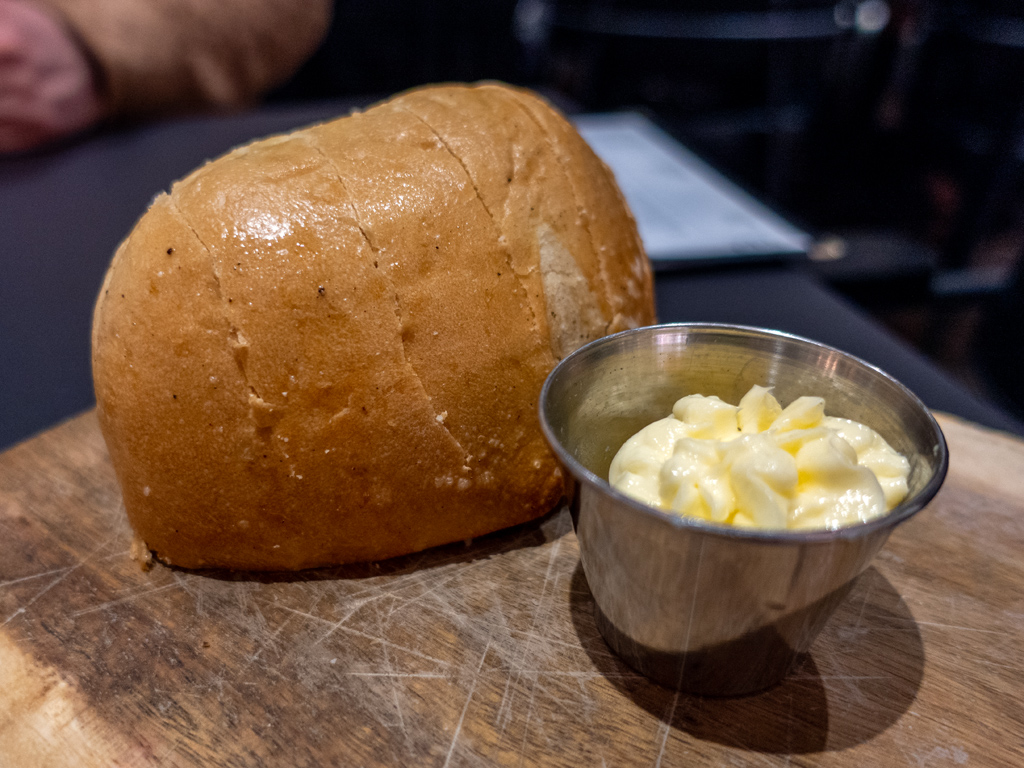
The restaurant we chose was Gladstone’s. They started us with a very large portion of free bread.

As the appetizer, I ordered a half-dozen oysters. The size of each oyster was unexpectedly small, so the portion size wasn’t very satisfying. But, at the very least, they didn’t pre-season the oysters and instead put all the sauces on the side, so I was able to eat the oysters plain and enjoy the deep, rich, un­tar­nished fla­vor of just the oysters themselves.

My friend ordered a Caesar salad with chicken breast.

For my entrée, I selected Hawaiian swordfish.

I feel like it’s difficult to prepare swordfish in a way that makes it particularly unique, but I feel like this restaurant still did a decent job at it. The sword­fish tasted like normal swordfish, and the texture was great—it was a good mixture of firm and tender that you expect from nicely-cooked swordfish. However, the uniqueness came from the rice, which had a subtle but noticeable tang to it, which was well balanced by the slight bitterness of the broccolini.

 
Here are some shots from Shoreline Park and the surrounding areas near the restaurant:


—§—


Hello, Shiro’s Sushi in Seattle, Washington

After recovering from my week of travel in the San Francisco Bay Area, I took a trip to the Seattle Metropolitan Area again to visit some friends.

While there, I met up with my friends Doug and Dani and went to a sushi restaurant for an omakase experience. There weren’t enough reservation slots a­vail­a­ble for actual omakase with the chef, so instead, we booked a seat at the regular tables for a chef’s choice four-course sushi meal with 19 pieces of as­sort­ed sushi. We also ordered a few appetizers.

Just as a disclaimer, this is my first time using my new camera for close-up macro shots since getting my old camera stolen while in Oakland, California; as a result, some of these photos are a bit blurry while I get accustomed to some of the settings, though I am already progressively getting better.
 
The first course consisted of albacore tuna from Oregon, shima aji (striped jack) from Japan, kanpachi (amberjack) from Japan, madai (sea bream) from Ja­pan, and kurodai (black snapper) from Greece.

After our first course, two of our appetizers were ready. The first was black cod kasuzuke broiled with Shiro’s original recipe.

The photo makes it look a bit small, especially because I accidentally angled the shot in a way where not much of the fish is in focus, but it was a sat­is­fy­ing­ly large filet. It tasted great—it was so tender that just poking at it with chopsticks made it fall apart, and the texture was fantastic.

The second appetizer was assorted vegetable tempura. Because it was something that was fried, it felt a little out of place eating it between fish courses due to the oils bringing out more of the “ocean-ey” taste in raw fish. It would have been nice if it came out first or last, but we still had plenty of ginger to cleanse our palates before the next course.

The second course had six pieces: katsuo (bonito) from Japan, botan ebi (sweet shrimp) from Alaska, sawara (king mackerel) from Japan, hotate (scal­lop) from Japan, Atlantic salmon from Canada, and sockeye salmon from Alaska.

The shrimp nigiri also came with a shrimp head. I wanted to seize the opportunity to get a picture of my head next to the shrimp’s head… though the pho­to didn’t really turn out as interestingly as I had hoped.

The actual botan ebi was delicious—it was thicker than most oth­er shrimp I’ve tried, the flavor was stronger and richer than usual, and the texture was very satisfying.

Adam Parkzer holding up a shrimp head next to his own head

Our third and final appetizer came out—Shiro’s chawanmushi, steamed egg custard with shrimp, chicken, whitefish, shiitake mushroom, and mitsuba leaf topped with Hokkaido sea urchin and salmon roe. It had a lot of flavors going on at once, but most of them were complementary. As you can prob­a­bly guess, the sea urchin was my favorite part of this dish.

The third course was called “Bluefin Tuna 4 Ways,” and as you’d expect from the title, it was four different variants of bluefin tuna—one akami, one chū­toro, one otoro, and one prepared in a special way with a marinade.

The otoro, or the “wagyu of the sea” as some people call it, was as melt-in-your-mouth as you’d expect from tuna belly. The specially-prepared and mar­i­nated tuna was also surprisingly tasty; tuna is generally known for having a fairly basic, simple, and straightforward taste, but the marinade added in a nice bit of supplementary flavor to the fish.

The fourth and final course was negitoro (chopped fatty tuna) from Mexico, uni (sea urchin) from Santa Barbara, unagi (freshwater eel) from Japan, and tamago (egg omelet).

Although sea urchin is one of my favorite types of sushi, my favorite out of this particular lineup was actually the freshwater eel—it was a lot more fla­vor­ful and tender than what I usually expect from eel.

The tamago was very disappointing. It wasn’t prepared traditionally; there were no layers of egg, and it resembled a dessert more than it did actual ta­ma­go that you’d expect from a sushi restaurant.

After we were done with our appetizers and tasting menu, the waiter brought out a special order menu in case we wanted a second portion of anything, or if we wanted to try anything we didn’t get to taste during the four-course meal. There was one item on that list that I had never had before and that I had also never seen on a menu before, so I figured this would be a great opportunity to try it: ankimo, or monkfish liver.

It tasted very similar to kani miso, often nicknamed “crab brains.” Kani miso is not actually entirely brains—it’s just a mixture of the crab’s organs and oth­er innards. The texture was also very interesting, and difficult to describe—it was both firm and supple at the same time; both powdery and solid at the same time; both dry and pasty at the same time.

Although I probably wouldn’t go out seeking monkfish liver at a restaurant as one of my top dishes, it was actually pretty good. The unfortunate part is that it seemed to be a bit pricey, and apparently it is also only seasonally available during the winter according to the waiter, but if this is included as part of a “pick your own” kind of sushi experience (like revolving sushi or something), I would definitely have it again.

Dani and I wanted to split a Shizuoka matcha ice green tea, but they ran out, so we just drank water. I also wanted to try the mizu shingen mochi—rain­drop jelly served with kinako (soybean powder) and brown sugar syrup—but they didn’t have any of that left either, so we passed on dessert.
Here is a breakdown of what we paid:

Chef’s choice four-course sushi meal ×3 $ 255.00
Black cod kasuzuke $  18.00
Assorted vegetable tempura $  16.00
Chawanmushi $  20.00
Ankimo ×2 $  26.00
Tax (10.25%) $  34.34
Gratuity $  75.00
Total $ 444.34

Overall, I thought this was a decent restaurant, especially considering that the price per person of US$85.00 is a bit less than what you’d probably expect from a high-end sushi restaurant.

For me personally, I think the chef could have done more with flavor storytelling. I feel like the objective here might have been to give a unique, stand­alone character or “plot” to each course, so each “category” of sushi was able to have its own plate. This is definitely a valid way to do it, but it was dif­fer­ent than what I was expecting going into this—I was hoping for a bit more flavor micro-progressions piece-by-piece, as opposed to going purely off macro-progressions.

With that being said, a side effect of this above point is that, I think this restaurant would be especially good for sushi beginners. None of the nigiri pieces from the four-course meal were particularly adventurous or pungent, and I think one of the only “hit-or-miss,” “love it or hate it” items was the sea urchin. Having each plate broadly categorized by theme is also probably less “chaotic” for someone who just wants to have a good time eating good fish.


—§—