
 When you look at the new B string head-on, it looks just the same as the other strings. But, if you tilt the guitar and shine light on it, THE STRING TURNS GOLD.Refer to the photographs above as proof that I did in fact make this discovery.
 This post is over 16 years old and may contain information that is incorrect, outdated, or no longer relevant.
My views and opinions can change, and those that are expressed in this post may not necessarily reflect the ones I hold today.
When you look at the new B string head-on, it looks just the same as the other strings. But, if you tilt the guitar and shine light on it, THE STRING TURNS GOLD.Refer to the photographs above as proof that I did in fact make this discovery. This post is over 16 years old and may contain information that is incorrect, outdated, or no longer relevant.
My views and opinions can change, and those that are expressed in this post may not necessarily reflect the ones I hold today.
 I feel horribly unprepared and unAsian, seeing as I’m not studying and not freaking out about the test.LOLWTFI JUST REMEMBEREDI STILL HAVE TO PRINT OUT MY ADMISSION TICKETBRB… Now that that’s settled, I should probably go to sleep sometime soon. Testing starts at 8 AM, which probably means I have to get up before 7:30 AM. I still get about eight hours of sleep even if I go to sleep now, so I guess I can finish watching this episode of Pokémon first.
 This post is over 17 years old and may contain information that is incorrect, outdated, or no longer relevant.
My views and opinions can change, and those that are expressed in this post may not necessarily reflect the ones I hold today.
This post is over 17 years old and may contain information that is incorrect, outdated, or no longer relevant.
My views and opinions can change, and those that are expressed in this post may not necessarily reflect the ones I hold today.
This post is over 17 years old and may contain information that is incorrect, outdated, or no longer relevant.
My views and opinions can change, and those that are expressed in this post may not necessarily reflect the ones I hold today.
Many people have come to me in the past for help writing essays for their ACT. The news spread that I received an 11/12 on my essay the first time I took the ACT, without any particular preparations (curse the grader who gave me a 5/6 subscore). Countless friends and classmates started asking me for tips on how to improve their own scores. Although I will not discuss specific strategies, I am providing samples of my writing by responding to ACT essay prompts. These essays were originally written in 30 minutes by hand (the amount of time you have to write the essay on the real test), then typed and published word-for-word into this article.
Driving and Cell Phone UsageRecently, one state has passed legislation making it illegal for anyone under the age of 18 to use a cell phone – including hands-free models – or any other electronic communications device while driving. Supporters argue that such devices distract drivers’ attention from the road, and thus this law will lower the number of accidents and save lives. Opponents argue the law is discriminatory, since adults may use hands-free cell phones while driving. In your opinion, should all states pass a law banning drivers 18 and younger from using communication devices while driving?
When teenagers turn sixteen and receive their driver’s license, they are essentially receiving a permit to operate one of the most dangerous and deadly weapons known to man. Motor vehicles can leave a path of destruction behind them, and even destroy the person behind the steering wheel if used improperly. Recently, a state passed a law banning drivers under the age of 18 from using electronic communications devices while operating a motor vehicle. This is a good first step to saving lives, but I believe it needs to be taken further; in my opinion, all states should pass a law banning all drivers, regardless of age, from using electronic communications devices while driving.
When using motor vehicles as a form of transportation, the one and only objective is to get from the starting point to the destination as safely as possible. When other tasks are introduced to the picture, the focus of the multitasker becomes divided between or among the one or more new tasks. As more tasks and more objectives arise, concentration is diverted from the original objective of operating the motor vehicle safely. This reduces the likelihood of the objective’s satisfactory completion, and increases the likelihood of something going wrong during the completion process. In some instances, like eating a banana, unsatisfactory fulfillment has little to no consequences; unsatisfactory driving, on the other hand, could have a consequence of death. By eliminating electronic communications, one of the leading causes of distracted driving, commuters can place their undivided attention on the most important and life-threatening task at hand – driving.
The opposition may argue that using electronic communications while driving should never be outlawed to account for emergency situations that may occur to family members or friends. However, a multitude of alternative solutions exist for tending to emergencies. Sometimes, passengers in the passenger or back seat may be receiving a ride. Because passengers are not driving, their attention is not necessarily vital for a life-or-death situation, and could tend do the emergency on behalf of the driver. In the case that there are no other riders in the vehicle, a driver can easily pull over to the side of the road to take a phone call, putting his or her and others’ lives away from risk.
In summary, when it comes down to driving a car, safety is always number one. Although some people can control themselves, others require laws to set guidelines for them. By making it illegal for one to use electronic communications devices inside a vehicle he or she is driving, all the drivers affected by the law are one step closer to living a longer life.
Extending High SchoolEducators debate extending high school to five years because of increasing demands on students from employers and colleges to participate in extracurricular activities and community service in addition to having high grades. Some educators support extending high school to five years because they think students need more time to achieve all that is expected of them. Other educators do not support extending high school to five years because they think students would lose interest in school and attendance would drop in the fifth year. In your opinion, should high school be extended to five years?
Limiting Extracurricular Activity ParticipationIn some high schools, administrators have limited students to participating in a maximum of two school-sponsored extracurricular activities each semester. Advocates believe that over-extended students lack sufficient time after school to devote to homework. Other educators disagree, arguing that extracurricular activities offer students vital experience and opportunities to explore additional interests. In your opinion, should schools limit the number of school-sponsored extracurricular activities?
As we progress through high school, a variety of opportunities await us, including some after our academics that act as extensions of our learning experiences. By taking advantage of these opportunities, we can further expand on the core subjects we already learn and develop a new insight on the information we already know. I believe that placing a restriction on the number of opportunities such as school-sponsored sports and extracurricular activities that we may participate in only stunts the growth of our minds. High schoolers are generally sufficiently responsible to manage their time wisely, and can determine for themselves the best balance of academics and extracurricular, taking into account current academic standing, intensity of workload, and importance of extracurricular to their future.
First, school administrators looking to limit the participation of extracurricular activities by students making the statement only based off a general overview of an average student. Obviously, all students are different in the way they learn and how much they choose to learn. Some high schoolers take only the required classes at the most basic level, leaving more time to take more than the two recommended extracurricular. Others load their schedules with honors and Advanced Placement courses, leaving very little spare time to do extracurricular, and may participate in less than two. By setting the bar at the average, under- and overachievers’ special needs are ignored and cannot bloom into their fullest potential.
In addition, not only do school administrators look at the mere average of students, they also look at the mere average of clubs. The generalization of a maximum of two clubs does not take into consideration the workload of and position in the club. For example, some clubs meet only one or twice every week,and the time and effort put into them are minimal. On the other hand, some clubs meet almost everyday, and require a much larger amount of time and effort. Furthermore, even within the same club, position and ranking can determine workload as well. Using the newspaper or magazine club, for example: a reporter only has to find an idea to write an article about. They only have to proofread and finalize their one article. The editor in chief, on the other hand, must review and proofread tens to hundreds of articles and submissions, depending on the size of the newspaper. They must also approve the final draft of the final product after planning with all the articles Obviously, an editor-in-chief’s duties far surpass those of a reporter; thus, an editor in chief may have time only for one club, while a reporter could participate in more.
In summary, administrators should not limit students to participating in a maximum of two extracurricular activities because the administrators made the choice oblivious to the students’ individual needs. By restraining the mental development of the students, administrators are causing only harm to the student body, which was already capable of responsibly managing their own time and needs. Adults should not make ignorant, rough estimates of students’ intellect, and a two-maximum participation policy should not be applied to extracurriculars.
Restaurants and Nutrition FactsIn some cities, restaurants must provide detailed nutritional information, including calorie, saturated and trans fat, carbohydrate, and sodium on fast-food menu boards and printed menus. Supporters believe that consumers will make better food choices if educated about the nutritional content. Restaurant owners complain that a public display is unnecessary because the information is readily available if diners ask. In your opinion, should restaurants post nutritional information publicly?
Food is an important part of our lives. For some, it is merely a form of survival, while for others, it is a form of happiness and entertainment. In both instances, the food we eat must be safe and harmless to our bodies. Some restaurants add unreasonable amounts of fat and sodium just to attract customers and improve sales. I believe restaurants should be required by law to post nutritional information on menus, boards, or other publicly viewable areas. Everyone deserves to know exactly what they are eating, and displaying detailed nutritional information is a start to helping diners make proper choices without falling victim to business scams.
To begin, posting nutrition facts provides ways for customers with special needs to effectively make proper choices to fit their diet. For example, someone planning to lose weight may look into purchasing a comestible low in fats, all at the convenience of their menu. Others with health problems like high blood pressure may look into purchasing a delectable low in sodium. By accounting for a wider variety of people, customers can pick the best foods to maintain optimal health. Although customers can ask cashiers or waiters for a list of foods low in a particular item, some clients may feel uncomfortable sharing their health deficiencies with complete strangers. If the nutrition facts were posted on the menu, eaters can browse for compatible foods from the privacy of their table.
Some restaurants combat this argument by stating that nutritional information is always available as long as diners ask for it. This causes several immediate problems. First, a majority of customers are unaware that they can request nutritional information from cashiers or waiters. It is possible to post notifications of nutrition fact availability, but why post those when the space can be used to post the actual nutrition facts? Second, restaurants may receive foreign tourist customers incapable of fluently or confidently speaking English. The fact that out-of-country diners cannot receive the same opportunities because they cannot speak a secondary language is unfair and unjustifiable.
In conclusion, to promote the well-being, privacy, comfort, and security of various people eating out, nutritional information should be posted in all restaurants, bost fast food and dine-in. This will not only discourage restaurants from cooking foods with extreme amounts of unhealthy ingredients, but also promote production of healthy foods to attract customers planning to live healthy lives.
Schools and Vending MachinesMany schools have removed soda and unhealthy snack machines from school property. Some think this is a good way to combat the rising rates of childhood obesity because these machines feature high-calorie snacks with low nutritional value. Others argue that the machines are necessary sources of food and drink outside the hours the cafeteria is open. In your opinion, should schools ban soda and vending machines on school property?
You see them everywhere: giant devices with bright-colored lights and a stash of food behind a clear-plastic panel. Little children surround the high-tech food pantries in throngs, begging their guardians for a few coins so they can get something to munch on. Vending machines have become modern-day concession stands without the person behind the counter. Vending machines can be used where ever they’re accessible, supplying a convenient energy boost whenever needed. The benefits of vending machines far outweigh their potential cons like childhood obesity, which is not caused by the vending machine, but by the irresponsibility of the user. Therefore, schools that have removed vending machines from school grounds should reconsider their choices, and schools still possessing vending machines should keep them.
First, vending machines are beneficial for students as they supply a source of energy to last the day. A variety of foods with a variety of nutritional values fit inside vending machines, including fruit snacks with high levels of Vitamin C, milk chocolate bars with high levels of Calcium, and granola bars with high levels or protein. Additionally, students without definite break or lunch periods can use vending machines before the beginning of classes or between class periods to get the food and drinks they need to perform well throughout the day. While the cafeteria is only open during serving hours, vending machines are always operating as long as a supply of electricity is present, thus accommodating for a wider range of students and having a positive influence on the student body.
Furthermore, vending machines are also beneficial for the educational institutions and affiliations, and ultimately the community, that they are located in. Most vending machines are owned, operated, supplied, and maintained by third parties. Thus, the school with the vending machines on its grounds does not need to tend for them at all. More importantly, third parties don’t just steal the school’s space – for allowing them to use their facilities, third parties will give the school an average of 30% of the profits made in that building! This effortless stream of income helps the school raise more money to purchase better equipment, improve facilities, and better the learning environment for students overall. As a result, the value of the community increases, as it then becomes home to a more powerful education system and more respectable students and adults.
In conclusion, something so little as vending machines can have immense positive impacts on the development of students and communities. Because vending machines fuel students with the energy they need during the day, they deserve to stay on school grounds and continue to serve the students.
Smoking and MPAA RatingsA number of health organizations are lobbying the Motion Picture Association of America (MPAA) to incorporate cigarette smoking into the criteria for a restricted, or R, rating for films. Since the R rating requires anyone under the age of 17 to be accompanied by a parent or guardian, supporters of this policy believe it would reduce the exposure youths may have to smoking as a glamorous habit and make these teens less likely to smoke as a result. Opponents of the policy believe it would curtail the creative freedom of the filmmakers. In your opinion, should movies be rated R if they contain cigarette smoking?
Smoking, drinking, and other health-deteriorating behaviors hold an unnegligible position in society today. Teenagers observe these actions frequently, may it be from friends, parents, celebrities, or complete strangers. To guard the well-being of our future leaders, health organizations are attempting to persuade the Motion Picture Association of America into classifying cigarette smoking as criteria for a restricted rating. I believe these health organizations are trying to opportunize on a subtle aspect of the big picture, and that the presence of smoking should not immediately flag a movie as restricted.
Primarily, the reduced exposure of smoking provided by upping a rating of a film from PG-13 to R does not have a sufficiently significant value. Teenagers perceive smoking from the people around them, and stars in popular movies only compose a fraction of the people teens see everyday. The impact made by limiting the observation of a minuscule percentage of smokers in teens’ lives is not worth the effort of rallying to modify the MPAA’s current rating conventions. Overall, these health organizations should conserve the time and funds, and instead contribute them to issues with a greater importance to the greater good.
Continuing, the presence of a parent or guardian does not necessarily affect the way a teenager takes in a movie. Just because a teen’s mother is sitting beside him or her does not make smoking safer or the scene less influential. The excessive loopholes present, such as purchasing the movie on home DVD or illegally downloading it off the internet, make the health organizations’ struggle pointless. In a worst-case scenario, a companion may prove to have a negative effect on the visit to the theater: a teen’s just-turned 18-year-old older sibling, now an adult by law and an approved guardian, could potentially act as a commentator throughout the movie, explaining how "cool and awesome" the smoking is.
Finally, the education teenagers receive nowadays gives them sufficient information regarding the detrimental effects of smoking. Adolescents are aware of the consequences of cigarette smoking. Although peer pressure may be an issue, smoking ultimately comes down to personal decisions. Merely changing a movie’s rating and hiding the aspects of the real world do not focus on the central cause of the issue – the power of choice. In their teenage years, as their minds develop, people are stubborn in the choices they make, and stand unmovingly behind their words to prove their accuracy. This, in turn, causes the health organizations’ efforts to become futile, as the power of determined choice is far greater than the power of attempted distraction from the fundamentals of living life.
Conclusively, I believe that the rubric used to determine a movie’s rating should remain untouched by the hands of health organizations. The excessive energy expended to make this change will not yield satisfactory or desired results. The numerous different facets of a human’s life prove that controlling and changing the progression of such a volatile group as 21st-century teenagers cannot be done by simply placing a poorly-constructed obstacle in the center of their path.
Social Networking Sites and College AdmissionsSome colleges and universities, as part of the application process, have reviewed applicants’ pages on social networking sites such as MySpace and Facebook. Many support this idea, arguing that schools can distinguish between true and false claims of extracurriculars listed on applications. Others disagree, arguing that such use of social networking sites is unfair. In your opinion, should admissions’ offices use the content of applicants’ MySpace and Facebook pages in weighting their applications?
As times change, people change as well. Through technological advancements, we have entered the Internet Age, a time where everyday tasks are centralized on computers and electronics. Schoolwork is done on computers: we use online search engines for research and word processors for writing reports. Communication is done on computers: we instant message for immediate contact, or email for a more nostalgic, pen-pal felling. With this spike in computer and internet usage came social networking, a way that friends could make online communities and hang out while staying seated at their desks. Using social networking, individuals opened up to the world, revealing semi-private information and constantly updating current whereabouts. I believe that information acquired by college admissions officers from social networking sites should be taken into consideration at some point during the application review process. Colleges should know as much information as possible about their applicants, and social networking profiles are a doorway to a sector of an applicant’s life.
To begin, a social networking profile could be used as a truth checker to identify possible attempts at deceit on an application. This will allow admissions staff to better classify the applicants by levels of dishonesty and unethicalness. Teenagers tend to be more open and honest to their peers, and using information revealed during this state will give relatively precise information as opposed to masked or partial information a student may include in his or her application. Furthermore, friends interacting with the individual in question could also provide an accurate insight to the social status of the applicant. By observing comments or public messages, an admissions officer could determine levels of social amiability and respectability. This stream of unfiltered data can be invaluable when judging if the applicant is capable of successfully leading a positive life with peers in residential facilities, and could be significantly more accurate than potentially false claims made by the applicant him or herself.
Moving on, traitistic information provided on social networking sites not supplied on applications could help college admissions staff decide if their college is really the right place for the applicant. All social networking profiles have a space for interests, hobbies, or favorite activities. In these areas, users describe their true interests, not what they want their interests to be. In turn, by reading these blurbs, college administrators find out what applicants do in their free time, or natural lifestyle, instead of just their successful, academic background. By knowing the true nature of the students, compatibility checks would be optimized, and admissions staff can better determine using past experiences if their institution is the best choice for the student. This ultimately results in an overall better experience for the future of college-bound students.
In summary, by allowing colleges to access social networking profiles, not only do colleges benefit by getting a clearer view of an applicant’s true inner self, but the applicants themselves also benefit by indirectly allowing professionals to lead them towards a brighter future. By using the technologies of today, we can create a better tomorrow.
This post is over 17 years old and may contain information that is incorrect, outdated, or no longer relevant.
My views and opinions can change, and those that are expressed in this post may not necessarily reflect the ones I hold today.
| loveispoison:helloplease review my website thanksThewebsite is for all those people that find it more convenient to bother you with their question rather than google it for themselves.http://let-me-google-it-for-you.co.cc/ |
| adamparkzer:So just curious, what’s the point of having a clone of that site when we can just use http://letmegooglethatforyou.com/? |
| loveispoison:what the point of google video or daily motion or other website that are the same? |
| adamparkzer:You’re not getting my point.There’s Youtube, Daily Motion, Hulu, and multiple other video sites because video websites are used with high frequency, and these websites are competitors. They program their own material from scratch, and they have their own specialties and features.Your clone, on the other hand, is just stealing the work of someone else. I’m on the verge of wondering if this is even legal, as you’re plagiarizing someone else’s code and script.If you want to use the "google video or daily motion" analogy, then think of it this way: It’s fine to have a Google Video and Daily Motion, but do we really need two Daily Motions? |
| Ryan of LMGTFY, LLC:Adam,Thanks for the notice. Yes, that site is in direct copyright violation of our company, LMGTFY, LLC.It never ceases to amaze us how blatantly stupid and immoral some people are. This isn’t the first time we’ve been outright plagiarized. The only good thing for us is that we have millions of visitors per month, where these rip-offs rarely top a few dozen.I’d post a reply on the forum, but I’m restricted because my forum account isn’t activated yet.-Ryan and Jimhttp://twitter.com/rmm5t http://twitter.com/coderifousP.S. Check out our live search stream: http://live.lmgtfy.com |
| rmm5t:loveispoison, Hi. This is one of the owners of LMGTFY, LLC. You are in direct violation of our copyright. In addition, outright copying code and rebranding it as your own just isn’t cool. Be original. Be yourself. Stealing other people’s ideas (and implementations) just makes you look like a fool. |
loveispoison:copy and paste the code into your browser and see what happensCode removedtested And Working 100 % Guaranteed…………!!  |
| adamparkzer:So essentially, it’s a script for prompting input, plugging it into a giant string to search for on Google, then hoping you can find a website that illegally offers the song for free?Man, you’re on a roll with this copyright infringement stuff. First you steal LMGTFY’s scripts, and now you’re helping people find illegal ways to download songs by misusing a search engine? |
David:Referencing to above post by adamparkzerWow, someone who actually has a clue, you get a cookie! |
| loveispoison:hi alljust finished this new site been working on the design for some time know its done but still needs some work done please review and if you can let me know if something is wrong or or ad something new thanks for reading know time to visit the websitehttp://get-vid.co.cc/index.php |
| sourfacedcyclop:Err… whats the point. Looking at the source code, it just looks like you copied and pasted from http://www.downloadyoutubevideos.com/ |
| adamparkzer:LISTEN. I AM BEING SERIOUS.This is the THIRD incident in the past few days I can name off the top of my head of you infringing copyright.(1) You stole LetMeGoogleThatForYou’s copyrighted code. (2) You created a script to help people misuse search engines and acquire illegal music. (3) You stole DownloadYoutubeVideo’s copyrighted code.I already notified Let Me Google That For You’s owner, Ryan McGeary, and he was nice enough to just tell you that you’re directly violating their copyright and he didn’t take action.I will be immediately notifying the owners of DownloadYoutubeVideos.com for copyright infringement. What they choose to do is up to them. If this continues, I will have personal discussion(s) with admin(s) so they will take disciplinary action against your account. |
loveispoison:Referencing to above post by sourfacedcyclop copied my ass copied my ass  Referencing to above post by adamparkzerhahaha what da hell is wrong wit ya kido let me worry about that not you dumbhead tell me something what if i copy your site what your gona do huh nothing hehe so buzz of and leave me alone Referencing to above post by adamparkzerhahaha what da hell is wrong wit ya kido let me worry about that not you dumbhead tell me something what if i copy your site what your gona do huh nothing hehe so buzz of and leave me alone  but i dont copy others website and claim it as my own and yes i do copy some sites but for learning purposses only but i dont copy others website and claim it as my own and yes i do copy some sites but for learning purposses only |
| Christopher:Closing this before it goes too far |
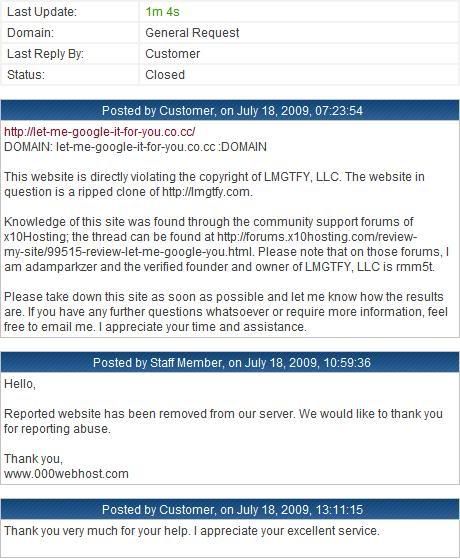 |
| Ryan of LMGTFY, LLC:Adam,Thanks for the follow-through. We really appreciate it.http://twitter.com/lmgtfy/status/2713134670You rock, -Ryan and Jim |
| loveispoison:well if you think ur who does not let go then you dont know me im worst then you i will copy your site and reup my website and make your life a hell that i swear on the devil and pormise you this corss my heart make your life a hell dont think this is a joke i will buy a hosting some were were yo u cant **** with any 1 even tell the host to shut me down but they wont shut me down and i know were |
loveispoison:let me begin i have to websites and yhe links are on my sig but there is 2 members who are tottaly racist so i made a post to review my website review my new website pleaseas you can see they are saying that i was copying other website so i wasnt u copying others and the website let me google it for you is a free script and they made a fake  user as the real owner and said im the owner huh and my other website get-vid.co.cc it was suspended in there bcoz i was violating youtube.com temrs cmon there are 1000s of youtbe downloaders online and who is saing its ilegal so if you guys dont want me here then fine thanks and these are the user here who i dont like and are racist %100check herehttp://forums.x10hosting.com/members…itor_messagingthese guys below user as the real owner and said im the owner huh and my other website get-vid.co.cc it was suspended in there bcoz i was violating youtube.com temrs cmon there are 1000s of youtbe downloaders online and who is saing its ilegal so if you guys dont want me here then fine thanks and these are the user here who i dont like and are racist %100check herehttp://forums.x10hosting.com/members…itor_messagingthese guys belowsourfacedcyclop adamparkzerso if you still dont want me here then fine i leave but one thing i promise i will make those guys life a hell |