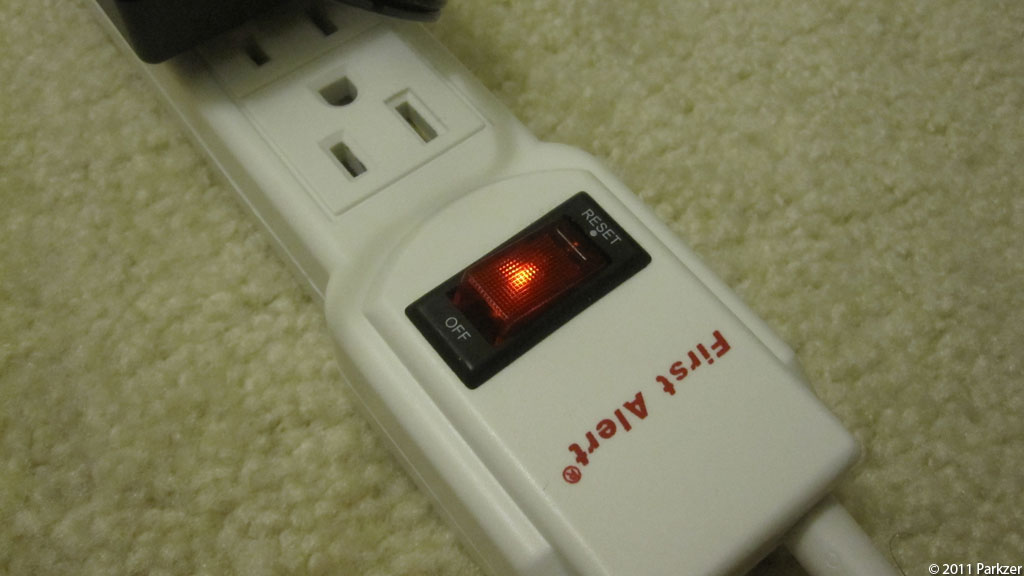
 I’ve had the surge protector pictured above for almost a year now. I bought it in Madison primarily to get more outlets than to actually use it as a surge protector.I’ve noticed lately that the light on the switch is flickering and looks really weak. I searched on Google for possible explanations and apparently a flickering, blinking, or weak light on your surge protector means that it already protected your electronics from a surge and is no longer at full power.This question might be silly to someone who actually knows how surge protectors work, but can I still use it to get more outlets without any problems and without worrying about protecting from surges? I never even needed protection against surges anyway because I unplug electronics when I’m not using them and turn off the switch on my surge protector when I’m away from my office or room.So I guess the main question is, is my surge protector damaged electricity-conducting-wise and I should replace it, or can I still keep using it if I’m not worried about surges and just want the extra outlets? Response: Justin White’s “Facebook Dislike Button” (July 14, 2011)Yesterday, a buddy of mine named Justin White wrote a blog post about the Facebook dislike button (more specifically, the lack of a dislike button). You should probably go read that now so my response is in context and you know what I’m talking about.http://jtwhite.net/2011/07/14/facebook-dislike-button/To begin my response, I want to state that looking at the main idea of the post, the post itself is misnamed. The main focus of the blog post is not about the dislike button, but about things that Facebook users request in general. In the conclusion, Justin explains how Facebook’s users could go about bringing about change on Facebook.com. He uses the dislike button as merely an example, not as the main focus of the article.Ignoring the title, Justin’s proposed solution to getting a dislike button is for many people to start using advertisement blockers: “They would need to have a good percentage of Facebookâs users to protest by installing … advertisement blocking software and refusing to disable it on Facebook … until a dislike button is created. By doing this, you are … boycotting Facebook and therefore hindering the income of the company.”We first have to take a look at the types of people who use advertisement blockers in the first place. The reason they want to get rid of advertisements is because they’re bothersome and they don’t want to deal with them. These are generally the types of people who would never click on an advertisement in the first place, or if the advertisement is interesting enough, might click on one or two once in a while, but at significantly lower rates than other people. These are also the people that advertising companies don’t even target because it’s a waste of their resources. Facebook would probably save more money by saving bandwidth not showing advertisements to these people than they would earn from the miniscule number of potential clicks they could get.Next, how many people actually use an advertisement blocker? The most famous one is Adblock Plus, an add-on for Firefox. According to Add-ons Product Manager Justin Scott from Mozilla, on May 17, 2010, there were 131.9 million active Firefox users and 10.7 million people with Adblock Plus installed. That calculates to about 8% of Firefox users using Adblock Plus. As of today, according to Net Applications, 21.67% of Internet users use Firefox. Eight percent of 21.67% equals about 1.73% of all Internet users using Adblock Plus. Not a lot, if you ask me. At this rate, I’m pretty sure getting enough advertisement blocker users to leave a dent in Facebook and make the concerned is going to take a long time.But what if we were to suddenly somehow get over half the population to use advertisement blockers? Justin points out that Facebook might implement a script that detects advertisement blockers and prevents you from using their website if you don’t whitelist it. But that’s way too much work. There’s an easier solution.Advertisement blocking software works on the concept of keywords. It identifies domains and URL paths that are common to advertisements, and prevents them from showing up. For example, if the ad blocker were to block Google Adsense advertisements, they might block all URLs that follow the format of http(s)://adsense.google.com/*. But what if the advertisements didn’t fit a specific pattern?For example, what if Facebook started randomizing the URLs of their advertisements? What if an image displayed as an advertisement had the URL of:https://facebook.com/.jpg(If that URL isn’t random enough for you, refresh the page to get a new randomized URL.)Sure, the ad blocker could block everything that matches http(s)://facebook.com/*.jpg, but then it would be blocking all the images on the entire website. By doing that, Facebook can essentially force you to disable your ad blocker to use their website without actually forcing you to do anything at all.So what’s my point? The best (and I think the only effective) way to really boycott Facebook is to literally boycott it and not visit the website. Unfortunately, seeing how addicted people are to Facebook, I don’t think that’s going to happen anytime soon. Installing an advertisement blocker, creating groups and events, and doing other protest-like things will most likely get you nowhere to your quest to get a dislike button. And even the concept of a dislike button is dumb. Disliking a status (or anything, for that matter) is spreading negativity and will only cause arguments. Facebook wants their users to enjoy their time on Facebook.com, not spend hours arguing with other users.
 Is My Surge Protector Gonna Explode?
This post is over 15 years old and may contain information that is incorrect, outdated, or no longer relevant.
My views and opinions can change, and those that are expressed in this post may not necessarily reflect the ones I hold today.
Hi humans and surge protector experts.I address surge protector experts specifically because I need your help.I’ve had the surge protector pictured above for almost a year now. I bought it in Madison primarily to get more outlets than to actually use it as a surge protector.I’ve noticed lately that the light on the switch is flickering and looks really weak. I searched on Google for possible explanations and apparently a flickering, blinking, or weak light on your surge protector means that it already protected your electronics from a surge and is no longer at full power.This question might be silly to someone who actually knows how surge protectors work, but can I still use it to get more outlets without any problems and without worrying about protecting from surges? I never even needed protection against surges anyway because I unplug electronics when I’m not using them and turn off the switch on my surge protector when I’m away from my office or room.So I guess the main question is, is my surge protector damaged electricity-conducting-wise and I should replace it, or can I still keep using it if I’m not worried about surges and just want the extra outlets? Response: Justin White’s “Facebook Dislike Button” (July 14, 2011)Yesterday, a buddy of mine named Justin White wrote a blog post about the Facebook dislike button (more specifically, the lack of a dislike button). You should probably go read that now so my response is in context and you know what I’m talking about.http://jtwhite.net/2011/07/14/facebook-dislike-button/To begin my response, I want to state that looking at the main idea of the post, the post itself is misnamed. The main focus of the blog post is not about the dislike button, but about things that Facebook users request in general. In the conclusion, Justin explains how Facebook’s users could go about bringing about change on Facebook.com. He uses the dislike button as merely an example, not as the main focus of the article.Ignoring the title, Justin’s proposed solution to getting a dislike button is for many people to start using advertisement blockers: “They would need to have a good percentage of Facebookâs users to protest by installing … advertisement blocking software and refusing to disable it on Facebook … until a dislike button is created. By doing this, you are … boycotting Facebook and therefore hindering the income of the company.”We first have to take a look at the types of people who use advertisement blockers in the first place. The reason they want to get rid of advertisements is because they’re bothersome and they don’t want to deal with them. These are generally the types of people who would never click on an advertisement in the first place, or if the advertisement is interesting enough, might click on one or two once in a while, but at significantly lower rates than other people. These are also the people that advertising companies don’t even target because it’s a waste of their resources. Facebook would probably save more money by saving bandwidth not showing advertisements to these people than they would earn from the miniscule number of potential clicks they could get.Next, how many people actually use an advertisement blocker? The most famous one is Adblock Plus, an add-on for Firefox. According to Add-ons Product Manager Justin Scott from Mozilla, on May 17, 2010, there were 131.9 million active Firefox users and 10.7 million people with Adblock Plus installed. That calculates to about 8% of Firefox users using Adblock Plus. As of today, according to Net Applications, 21.67% of Internet users use Firefox. Eight percent of 21.67% equals about 1.73% of all Internet users using Adblock Plus. Not a lot, if you ask me. At this rate, I’m pretty sure getting enough advertisement blocker users to leave a dent in Facebook and make the concerned is going to take a long time.But what if we were to suddenly somehow get over half the population to use advertisement blockers? Justin points out that Facebook might implement a script that detects advertisement blockers and prevents you from using their website if you don’t whitelist it. But that’s way too much work. There’s an easier solution.Advertisement blocking software works on the concept of keywords. It identifies domains and URL paths that are common to advertisements, and prevents them from showing up. For example, if the ad blocker were to block Google Adsense advertisements, they might block all URLs that follow the format of http(s)://adsense.google.com/*. But what if the advertisements didn’t fit a specific pattern?For example, what if Facebook started randomizing the URLs of their advertisements? What if an image displayed as an advertisement had the URL of:https://facebook.com/.jpg(If that URL isn’t random enough for you, refresh the page to get a new randomized URL.)Sure, the ad blocker could block everything that matches http(s)://facebook.com/*.jpg, but then it would be blocking all the images on the entire website. By doing that, Facebook can essentially force you to disable your ad blocker to use their website without actually forcing you to do anything at all.So what’s my point? The best (and I think the only effective) way to really boycott Facebook is to literally boycott it and not visit the website. Unfortunately, seeing how addicted people are to Facebook, I don’t think that’s going to happen anytime soon. Installing an advertisement blocker, creating groups and events, and doing other protest-like things will most likely get you nowhere to your quest to get a dislike button. And even the concept of a dislike button is dumb. Disliking a status (or anything, for that matter) is spreading negativity and will only cause arguments. Facebook wants their users to enjoy their time on Facebook.com, not spend hours arguing with other users.
I’ve had the surge protector pictured above for almost a year now. I bought it in Madison primarily to get more outlets than to actually use it as a surge protector.I’ve noticed lately that the light on the switch is flickering and looks really weak. I searched on Google for possible explanations and apparently a flickering, blinking, or weak light on your surge protector means that it already protected your electronics from a surge and is no longer at full power.This question might be silly to someone who actually knows how surge protectors work, but can I still use it to get more outlets without any problems and without worrying about protecting from surges? I never even needed protection against surges anyway because I unplug electronics when I’m not using them and turn off the switch on my surge protector when I’m away from my office or room.So I guess the main question is, is my surge protector damaged electricity-conducting-wise and I should replace it, or can I still keep using it if I’m not worried about surges and just want the extra outlets? Response: Justin White’s “Facebook Dislike Button” (July 14, 2011)Yesterday, a buddy of mine named Justin White wrote a blog post about the Facebook dislike button (more specifically, the lack of a dislike button). You should probably go read that now so my response is in context and you know what I’m talking about.http://jtwhite.net/2011/07/14/facebook-dislike-button/To begin my response, I want to state that looking at the main idea of the post, the post itself is misnamed. The main focus of the blog post is not about the dislike button, but about things that Facebook users request in general. In the conclusion, Justin explains how Facebook’s users could go about bringing about change on Facebook.com. He uses the dislike button as merely an example, not as the main focus of the article.Ignoring the title, Justin’s proposed solution to getting a dislike button is for many people to start using advertisement blockers: “They would need to have a good percentage of Facebookâs users to protest by installing … advertisement blocking software and refusing to disable it on Facebook … until a dislike button is created. By doing this, you are … boycotting Facebook and therefore hindering the income of the company.”We first have to take a look at the types of people who use advertisement blockers in the first place. The reason they want to get rid of advertisements is because they’re bothersome and they don’t want to deal with them. These are generally the types of people who would never click on an advertisement in the first place, or if the advertisement is interesting enough, might click on one or two once in a while, but at significantly lower rates than other people. These are also the people that advertising companies don’t even target because it’s a waste of their resources. Facebook would probably save more money by saving bandwidth not showing advertisements to these people than they would earn from the miniscule number of potential clicks they could get.Next, how many people actually use an advertisement blocker? The most famous one is Adblock Plus, an add-on for Firefox. According to Add-ons Product Manager Justin Scott from Mozilla, on May 17, 2010, there were 131.9 million active Firefox users and 10.7 million people with Adblock Plus installed. That calculates to about 8% of Firefox users using Adblock Plus. As of today, according to Net Applications, 21.67% of Internet users use Firefox. Eight percent of 21.67% equals about 1.73% of all Internet users using Adblock Plus. Not a lot, if you ask me. At this rate, I’m pretty sure getting enough advertisement blocker users to leave a dent in Facebook and make the concerned is going to take a long time.But what if we were to suddenly somehow get over half the population to use advertisement blockers? Justin points out that Facebook might implement a script that detects advertisement blockers and prevents you from using their website if you don’t whitelist it. But that’s way too much work. There’s an easier solution.Advertisement blocking software works on the concept of keywords. It identifies domains and URL paths that are common to advertisements, and prevents them from showing up. For example, if the ad blocker were to block Google Adsense advertisements, they might block all URLs that follow the format of http(s)://adsense.google.com/*. But what if the advertisements didn’t fit a specific pattern?For example, what if Facebook started randomizing the URLs of their advertisements? What if an image displayed as an advertisement had the URL of:https://facebook.com/.jpg(If that URL isn’t random enough for you, refresh the page to get a new randomized URL.)Sure, the ad blocker could block everything that matches http(s)://facebook.com/*.jpg, but then it would be blocking all the images on the entire website. By doing that, Facebook can essentially force you to disable your ad blocker to use their website without actually forcing you to do anything at all.So what’s my point? The best (and I think the only effective) way to really boycott Facebook is to literally boycott it and not visit the website. Unfortunately, seeing how addicted people are to Facebook, I don’t think that’s going to happen anytime soon. Installing an advertisement blocker, creating groups and events, and doing other protest-like things will most likely get you nowhere to your quest to get a dislike button. And even the concept of a dislike button is dumb. Disliking a status (or anything, for that matter) is spreading negativity and will only cause arguments. Facebook wants their users to enjoy their time on Facebook.com, not spend hours arguing with other users.  (The image is horrible quality because I forgot that the camera on my iPod Touch has digital zoom and not optical zoom.)If you can’t read the vanity license plate, it says I LVE GOD.I decided that the missing vowel in LVE was A, so she was actually trying to say that she was laving god. (For those of you who don’t know, laving is the equivalent of washing.) It must be really difficult washing an abstract concept that you can’t even touch.After we got back on campus after lunch, the electricity went out again. Ed got really excited because there was an exam scheduled for his next class and he might not have to take it.The the power came back on.On our way back home, we saw this massive truck parked in a lot.
 Ed insisted that I take a picture of it and upload it to my blog, so there it is.
  As you can see, it might be a failure in that the advertisement doesn’t say anything about the company, but it might also be a win because you (or at least I) want to click on the advertisement just to see what company would use an unfilled template advertisement, thus bringing more traffic to their website.In other news, I’ve been doing way too much Shakespeare homework and reading lately.