How not to address a letter

This post is over 8 years old and may contain information that is incorrect, outdated, or no longer relevant.
My views and opinions can change, and those that are expressed in this post may not necessarily reflect the ones I hold today.
 

I’ve been doing some shopping for collectables on eBay lately. I’ve never really been much of a materialistic person (and I’m still not), but I recently started collecting Absol Pokémon cards for two main reasons – the first reason being that Pokémon has had quite a significant impact on my childhood and it seemed like, if I were to collect anything, cards of my favorite Pokémon would be reasonable.

The second reason is a bit more complex. I often criticize people for being too materialistic and focusing too much on possessions, especially if these are material possessions that aren’t even used that much and serve no real function or purpose. I personally believe in spending a lot of money on items that you use often, then offsetting that extra spending by just straight-up not purchasing items that you don’t really need – this is a pretty straightforward way to enhance your quality of life.

However, I’m also under the belief that it’s very difficult to understand other people’s “strange” behaviors unless you are there in their shoes. As a result, in order to ensure that I’m not “missing out” on something simply because I’m not a collector of an item, and to make sure that I’m not making this criticism out of ignorance, I decided to partake in the activity for first-hand experience.

That explanation got quite a bit more involved than I anticipated, especially for a blog post titled “how not to address a letter.” As I mentioned moments ago, I’ve been buying very cheap Absol Pokémon cards off eBay to try and round out my collection, some of which are only available from international sellers. I found one particular foreign card offered by a German seller, so I purchased the item.

Of course, being from Germany, the seller most likely wasn’t too familiar with United States addresses. However, instead of just copying the address exactly like how I submitted it to him, he decided to apply his own unique twist:

How not to address a letter

I’ve historically complained a substantial amount about the United States Postal Service for leaving my packages in front of random, incorrect doors, or putting my mail in the wrong mailbox, but in this case, I’m genuinely impressed that an envelope addressed to “8SΛCA Las Vegan” somehow still ended up in my mailbox.


—§—


How not to ship a battery

This post is over 8 years old and may contain information that is incorrect, outdated, or no longer relevant.
My views and opinions can change, and those that are expressed in this post may not necessarily reflect the ones I hold today.
 

I ordered a single spare camera battery from Amazon. This is how it arrived.

How not to ship a battery

???


—§—


My first experience with JetBlue, and why I’ll just stick with oneworld Alliance

This post is over 8 years old and may contain information that is incorrect, outdated, or no longer relevant.
My views and opinions can change, and those that are expressed in this post may not necessarily reflect the ones I hold today.
 

So I’m back from my eventful trip to the NVIDIA headquarters San José, CA, and I’ve had a few days to settle back in at home. After hearing a lot of positive things about JetBlue (especially from Casey Neistat after he switched his primary domestic airline from American Airlines to JetBlue after American Airlines didn’t reinvite him to Concierge Key), I finally tried them out for the first time. I decided I would share my thoughts and experiences regarding my first flight ever with JetBlue versus my regular airline of American Airlines, part of oneworld Alliance.

 
I have notoriously bad flight experiences. A few years ago, I traveled a decent amount for my job in esports, with my primary trip being from Chicago’s O’Hare International Airport to Los Angeles International Airport. There have been nearly non-existent instances where I managed to fly without problems. Very often, my gate was moved around, sometimes multiple times per flight, before they finally decided on one through which we would board. I’ve had some absurd instances where my flights were delayed because of things like a broken toilet, and once even because they somehow ran out of planes and had to send one from Mexico to come pick us up in Los Angeles.

On flights where everything else seemed to work out, there have still been little nuisances, such as online check-in not working, having to check in at the kiosk, and ending up in the final boarding group so I was forced to check my carry-on luggage; all the way to having pre-purchased a wifi pass and having the wifi break on my flight. Even on a flight where I flew first class, everything seemed to be going perfectly until I got to my final destination… first class is supposed to have priority baggage where your luggage is supposed to be the first to come out at baggage claim, but my luggage somehow ended up being the last.

The one time I clearly recall that I flew with zero problems is a minuscule less-than-one-hour first class flight from Las Vegas to Los Angeles, which I imagine was problem-free only because I literally got off the plane and out of the airport before anything could even happen. But interestingly enough, we nearly had a car collision on my way from the airport back home because my driver wasn’t paying attention to the road and nearly rear-ended someone.

However, through all of that, there had not been a single time that my flight was canceled. The longest my flight has ever been delayed was just a few hours, and eventually, American Airlines always found a way to get me to my final destination before the day was over.

And then JetBlue proceeded to cancel my second ever flight with them (first, if you calculate it by round-trip bookings).

 
Although I might have a slight bias because JetBlue introduced me to my very first canceled flight experience, I still think I’m taking a relatively neutral approach to analyzing my JetBlue vs. American Airlines breakdown – at least when it comes to my individual perspective in my personal situation.

  • JetBlue’s unlimited snacks is no different than what is already served with economy fares anyway.

    When JetBlue really marketed their unlimited snacks, I thought it would be similar to my first class experience with American Airlines from LAS to LAX. Because the flight was so short, there was no meal served, but the flight attendant literally came around 4 times with a tray of snacks with such great variety that every single bag of chips, crackers, and cookies was different. I literally ate four different items that day.

    JetBlue goes around with complimentary non-alcoholic drinks and a limited choice between cookies and Cheez-Its (the rest of the supposed available snacks were not available). Nowadays, free non-alcoholic beverages and a choice from two basic snacks is standard (as long as you’re not flying with an ultra budget airline like Spirit), so I’m not exactly sure why JetBlue is borderline bragging about their snacks.

  • The leg room is nice, but irrelevant for me.

    On my JetBlue flight from LGB to SJC, I upgraded to an Even More Space seat, while on the way back from SJC to LGB, I sat in a normal seat. Although the extra leg room on the outbound flight was nice, to me personally, it was next to pointless.

    Even though I’m somewhat tall at 5’10” (178 cm), I’m extremely lean at approximately 142 lbs (65 kg). I’m also pretty flexible, so I end up getting settled in pretty comfortably in small spaces. A lot of people use the space in front of them to stretch out their legs, but I generally am able to nimbly use vertical space to swing my legs around into different positions (and even sometimes cross my legs into the other) to keep the blood flowing. I’m also pretty intense and am able to sit still in the same position for hours at a time without fatiguing.

    The only reason I would imagine the extra space would be helpful is if I needed to pull out my laptop and work on the plane, but I generally cannot do that due to my air sickness. Although I would love to take advantage of that extra time, all I’m able to do without getting sick is occasionally look at my phone and just sleep. Although, sometimes working on my laptop isn’t even entirely possible because of the wifi, which brings us to the next point:

  • The wifi is nowhere near as advertised, and didn’t even work on my return flight.

    On my outbound flight, the free wifi on JetBlue, which is supposedly supposed to be somewhere around 12 Mbps, is nowhere near as advertised. It’s pretty much as slow as any other plane’s wifi, and it took a good few minutes to post photos on Twitter. On my inbound flight, the wifi just didn’t work at all.

    This personally isn’t really much of an issue for me because I’m a T-Mobile One Plus customer, and they provide unlimited free Gogo Inflight wifi to all their clients, so I can stay connected on American Airlines flights for free anyway. Although this is obviously not applicable to everyone, it ends up being a non-factor for me personally (mainly because my only potential benefit over Gogo – the supposed 12 Mbps of JetBlue wifi – seems to not be true).

  • Mosiac, JetBlue’s elite status program, is underwhelming.

    Again, this assessment heavily relies on my own personal situation, and may not apply to others, but I personally don’t care at all about rewards travel. The only reason I work towards an airline loyalty program, such as oneworld Alliance, is for the chance to get free cabin upgrades.

    I hate travel and try to avoid leisurely flights at all costs; the only time I fly is if my employer or a different company pays for the flight, which in that case, my points for award flights don’t matter. Either way, the value of literally one bump in cabin on a decently long domestic flight is generally far higher than any award flight that you struggle to book with your miles in basic economy.

    Mosiac does not offer cabin upgrades at all (I don’t really consider complimentary Even More Space seats to count because just having more leg room in the same exact seat doesn’t matter to me), and if I’m not mistaken, you cannot even redeem your airline points for cabin upgrades. Thus, I feel like I’m collecting all these points with JetBlue to possibly redeem them for a single free flight maybe once a year that has a microscopic retail price of like $60.

  • The aircraft feels a bit on the dated side.

    I’m not sure if I just got unlucky, but the plane I rode looked nothing like the JetBlue photos. The cabin looked old, the seats were a faded gray color and felt a bit tattered, and even the screens are just small TVs that don’t provide interactive show or movie selection. There’s a map “channel” that shows your GPS location, but that also isn’t interactive and cycles through so many advertisements that you only get to see the actual map for about 10 seconds out of every minute.

 
So, what’s my verdict after all of this?

I plan on sticking with American Airlines unless its prices are 20%+ more expensive than JetBlue, or in cases where American Airlines does not offer any non-stop flights but JetBlue does. At this point, I would literally prefer to pay up to 20% more because of AAdvantage and oneworld Alliance’s loyalty program for elite and Million Miler status.

In the case that JetBlue does provide significantly cheaper and more convenient options for a particular flight, I’m not entirely against using them. I think I probably just got unlucky with the canceled flight, and they are still a decent secondary alternative.


—§—


I just moved for the fourth time in 14 months

This post is over 8 years old and may contain information that is incorrect, outdated, or no longer relevant.
My views and opinions can change, and those that are expressed in this post may not necessarily reflect the ones I hold today.
 

I’m not a very materialistic person. In fact, I’m actually quite the opposite – I like to cut down on my possessions to only the essentials. I’m pretty lucky I’m like that, because I’ve moved four times in the past 14 months.

Back in November 2016, I got an opportunity to do what most other people only dream of – I got to start doing my hobby as a full-time job. With our involvement with League of Legends and Overwatch, Tempo Storm was getting two team houses, and I was offered a spot in one of the houses. I obviously seized the opportunity, which started my chain of moves, relocating from my hometown of the Chicagoland suburbs to one of the team houses.

After I finished setting up the first team house and players moved in, it ended up getting full of League of Legends players, so I moved again to our other team house in December 2016. I repeated the process, setting up the other team house for our Overwatch players.

During this entire process, I realized something – I am very incompatible with living with a bunch of other guys in their upper teens and low 20s. I didn’t realize how messy, dirty, and inconsiderate people could be, especially considering that I am an only child and I lived alone (without roommates) throughout all my years of university. Although I was being given free housing in the team house, I noticed it probably wasn’t worth taking it, because it was having an effect on my mental well-being, so I decided to move to my own apartment.

I executed my decision the following month, moving from the second team house to my own apartment in January 2017. I was feeling better already, as having quiet, alone time is pretty important to me, and I’m on the extreme end of cleanliness and organization. I signed a one-year lease and happily lived in my apartment until today, in January 2018.

Since November 2016, Tempo Storm hired a lot more people who are local to the Southern California area, and my duties shifted significantly from being an all-around administration and operations guy to focusing in specifically on editorial and digital media projects within the production division. This specific task didn’t require me to be present in person, and as a result, I was given the freedom to work from wherever I wanted. Because of the extremely high cost of living in Southern California, I decided to move away to somewhere nearby without such high prices for … pretty much everything.

Thus, I decided not to renew my lease, which ends tomorrow, and to instead move to Las Vegas. I was able to pick out a new apartment complex still under construction with an ultimate-tier luxurious lifestyle, most utilities included, free breakfast, a gym/pool, and a ton of other amenities for far lower than the cost of what I was paying for a 26-year-old building in Southern California. I’m pretty picky about stuff like this, so I ended up selecting the perfect place for me … which unfortunately doesn’t get released from construction until late February or early March.

I still needed to get out of my current apartment, though, because of an ending lease. Fortunately, the timing worked out so one of the team houses had a vacancy for me, so today, I moved over my stuff into a free bedroom in our team house, for the fourth move in 14 months.

So yes, logically, this means that I will be moving for a fifth time in under 1.5 years once my new apartment in Las Vegas is ready. But as a result of my tedious, detail-oriented focus on picking out my next place to live, I think I’ll be staying in this particular apartment building in Las Vegas long-term (or at least until I purchase my own property).

It’s been an interesting year and a half with a whole lot of moves, but I’m glad I did it – it’s not something I would otherwise do, and forcing myself into these new and different situations is always a great learning experience.


—§—


The YouTube Partner Program needs to be more exclusive again

This post is over 8 years old and may contain information that is incorrect, outdated, or no longer relevant.
My views and opinions can change, and those that are expressed in this post may not necessarily reflect the ones I hold today.
 

Back when YouTube was still young, being a YouTube Partner actually meant something. Not only did it allow you to add custom thumbnails and a header to your YouTube channel (back when it was more customizable), it also allowed you to make money off your videos. The only way you would be allowed to make money off your videos if it they were even worth monetizing – so being a YouTube Partner acted as validation for a lot of people.

Then, for some reason, YouTube opened up its “Partner” program to … pretty much everyone. Anybody was basically able to create a YouTube channel, verify that they’re a real person, then start “making money” off the videos right off the bat. There was no build-up process to ensure that YouTube partnership was actually a prestigious title given to only reputable creators.

Two days ago, YouTube posted an update on their Creator Blog titled “Additional changes to the YouTube Partner Program (YPP) to better protect creators.” In this blog post, they said that they will be limiting access to the Partner Program only to channels with over 1,000 subscribers and over 4,000 hours of watchtime in the past year.

When I read this, I was pretty excited. It seemed like YouTube was going back to ensuring that their Partner Program is actually a real special program, and not just something build straight into the “base version” of YouTube. However, after reading the comments on the post and look at people’s responses on social media, I was a bit confused at how much outrage there was about this change.

I personally stopped uploading to YouTube a while back because I didn’t agree with YouTube’s visions on their website. I hated how little it seemed like they cared about their creators, with strange policies like opening up partnership and monetization to the general public being one of many contributing factors. Because of that, I haven’t really been keeping up with the newest updates to YouTube, but based off what I know, there are a few reasons why most of the people complaining about this change are wrong.

  • This protects creators from losing out on money because of people reuploading their videos. Back when I was more deeply involved in YouTube, a big problem that came up with popular creators is that people would just rip videos off the creator’s channel and steal it for their own, brand new channel. This was a no-risk maneuver because they could just create a new channel and instantly be able to monetize content if a different channel got banned.
  • People who have fewer than 1,000 subscribers and less than 4,000 hours of watchtime per YEAR should not even be trying to make money from YouTube. This requirement isn’t actually that high, and I sort of wish YouTube had set the bar a little bit higher. A majority of people who are enrolled in monetization are most likely making less than single-digit dollars per year, and I personally think it’s not even worth it for Google AdSense to be even keeping track of these people’s money. It’s easy for people to pretend like they’re “YouTubers,” but it’s time to snap out of it and realize that vlogging as a hobby to just friends doesn’t make them a YouTuber.
  • Real creators are probably going to start making more money. YouTube has been rampant with completely random and unjustified demonetization on perfectly acceptable videos, so they need all the money they can get. By guaranteeing to advertisers that their ads will be displayed on videos from reputable channels, rather than completely random videos from insignificant, single-digit-subscriber channels, advertisers are more likely to want to invest more money, because they know their ads will have a greater impact than before.

This isn’t enough to bring me back to regularly uploading to my own YouTube channel (although I obviously will be uploading on my employer’s channels as part of my job). However, if YouTube continues to take these kinds of steps to actually make sure real creators are being protected and filtering out those who just abuse the system, I may reconsider in the future.


—§—


Why does Google Flights think Basic Economy is the same as Economy?

This post is over 8 years old and may contain information that is incorrect, outdated, or no longer relevant.
My views and opinions can change, and those that are expressed in this post may not necessarily reflect the ones I hold today.
 

Budget airlines like Spirit and Frontier have been a lot more successful than anyone would have imagined – apparently people are ok with giving up every possible aspect of comfort in exchange for the lowest ticket price possible. As a result of this, leading airline brands in the United States, like Amer­i­can Airlines and United Airlines, have also implemented a budget system by creating a new class of service called Basic Economy.

In a flying sense, it’s the same as regular Economy; the difference isn’t like how first class is separated from the rest of the plane in domestic flights. But, the process leading up to the actual flight is drastically different – you can’t bring carry-on luggage, you have to pay extra fees for everything, you board the plane last, and you get assigned your seat (instead of picking it ahead of time at booking/check-in).

 
I’m going to be going on a trip soon, so I’ve been looking at airline prices. Even though I’m pretty loyal to oneworld and only fly American Airlines, I still want to do some price comparisons to see if it’s worth flying with another airline for one trip and foregoing adding to my frequent flyer balance. I think Google Flights is a great tool to use to do that, so I browse it pretty frequently.

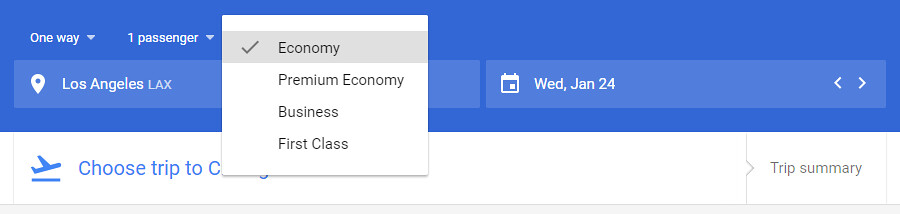
One thing that’s been irritating me about Google Flights lately is how they’ve integrated Basic Economy into their search results, but haven’t actually separated it from the rest of the classes of travel. They have Economy, Premium Economy, Business, and First Class, but no Basic Economy (under which I would assume Spirit Airlines and other no-amenity airlines would fall).

Google Flights

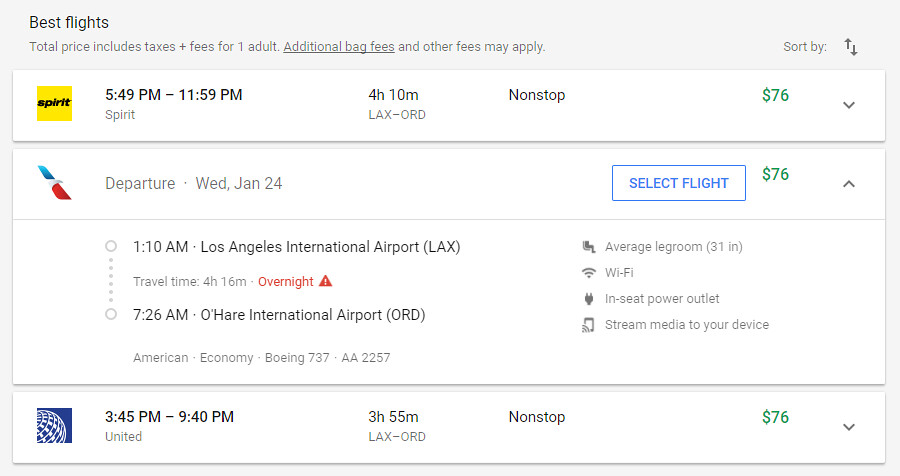
Because of that, I often run into situations where I search for a flight and get really excited when I see that American Airlines and United Airlines are offering Economy flights that are somehow the same price as Spirit Airlines. I eagerly click on my preferred oneworld airline to book…

Google Flights

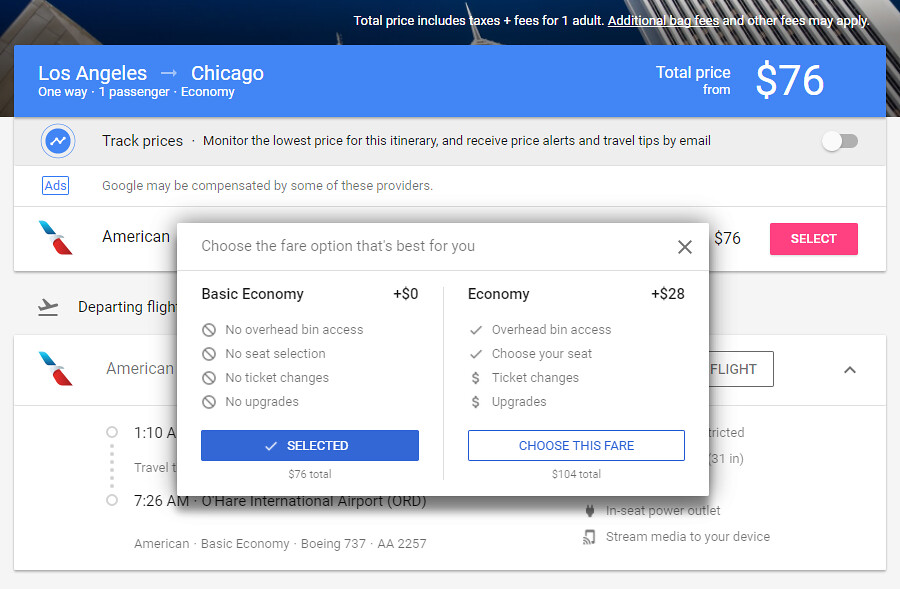
… only to find that, even though Google Flights hasn’t im­ple­mented Basic Economy vs. Economy filtering in the search field, they have, in fact, im­ple­mented it in the actual ticket purchase page. So, when I go to actually buy the ticket, there is a new drop-down menu that magically appears that now does actually have that distinction in place … and wants to charge me an extra US$28 to upgrade to Economy – the class of service I was looking for in the first place.

Google Flights

I’d imagine that this is likely an issue with budget airlines like Spirit and Frontier getting permanently relegated to Basic Economy status on all their flights, and they wouldn’t be too happy about that, but I feel like this is a pretty important quality-of-life feature that Google Flights should look into implementing in the search function from the beginning.

In the meantime, this price is still pretty good, and it looks like I’ll be headed to Chicago in a few weeks for just around US$100.


—§—